
Dental social media works when patients feel they know your team before they ever call. It needs a clear goal, one or two well-chosen platforms, a steady rhythm of content that shows real people and real expertise, and a firm grip on HIPAA. Get those four things right and your feed becomes a quiet, steady source of trust and new-patient inquiries. We build and manage campaigns like this for healthcare and dental brands, so this guide covers what we would put in place first.
TL;DR
- Set a business goal first (more booked visits, fewer no-shows, more referrals), then pick one or two platforms, not all of them.
- Show the dentist and the team regularly. Patients choose people, not faceless businesses.
- Mix education, team stories and service spotlights, and plan a month ahead so posting never stalls.
- Treat patient photos, names and review replies as protected health information (PHI) until you have the right written authorization.
- Review results every month and every quarter against the goals you set, not against likes alone.
Table of Contents
- Why social media earns its place in a dental marketing mix
- Start with goals, not platforms
- Which platforms fit a dental practice
- Dental social media content ideas that work
- Protect patient privacy: HIPAA rules for dental social media
- Build a posting rhythm you can keep
- Paid social: when organic is not enough
- Measure what matters
- How we help dental practices with social media
- Our perspective on dental social media
- FAQ
- Sources
Why social media earns its place in a dental marketing mix
The American Dental Association describes social media as a virtual face-to-face conversation that lets a practice talk directly with current and prospective patients. It can supplement print, broadcast and direct mail, and in many cases costs less than traditional advertising. It also notes that positive posts from happy patients boost referrals through digital word of mouth.
The effect on trust is easy to see in practice. In an ADA podcast episode, a pediatric dentist in Dallas, Texas, says patients tell her they feel they know her from her social media and trust her because of it. When she posts about a procedure, patients reach out asking to have it done with her.
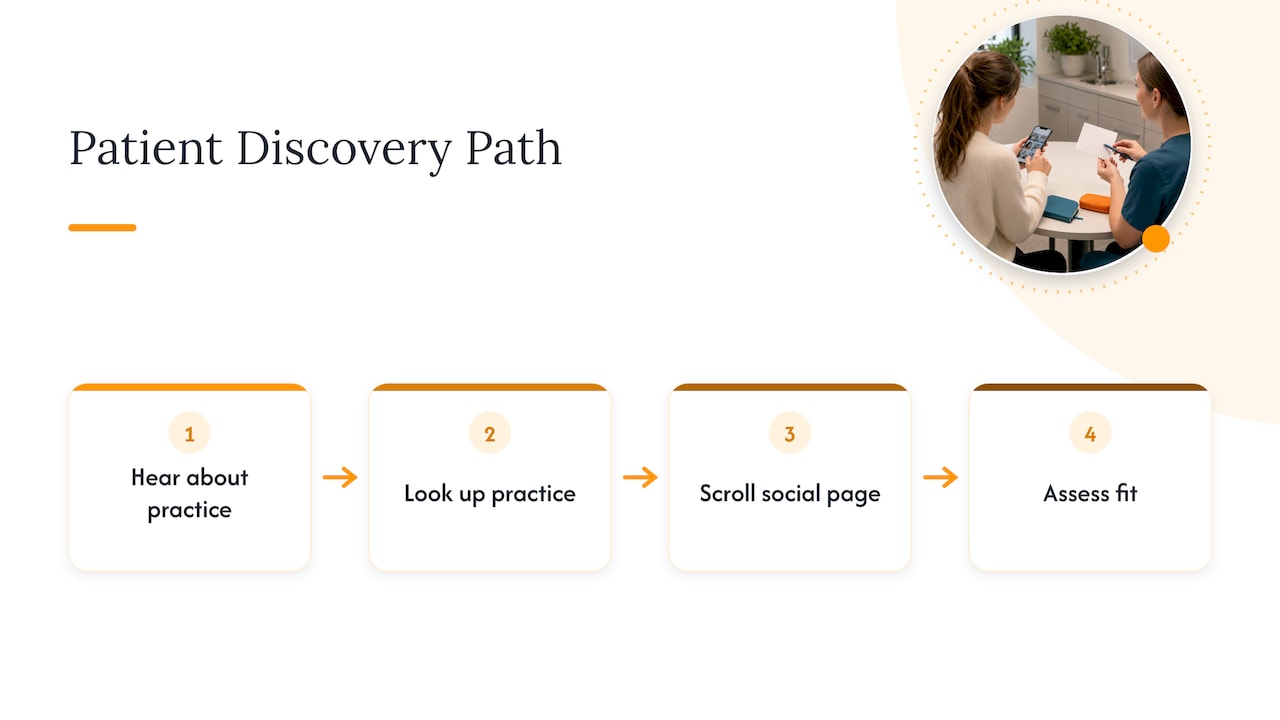
The American Academy of Pediatric Dentistry lists four business benefits of a practice presence: building awareness, gaining new patients, strengthening customer service and increasing engagement. Social media sits upstream of your website, your search results and your phone. Someone hears about you, looks you up, scrolls your page and decides whether you feel like a good fit.
Start with goals, not platforms
The ADA’s checklist for engaging in social media advises setting business-related goals rather than platform-specific ones. “Get 1,000 followers” is a platform goal. These are business goals:
- Fill more new-patient appointments for a service you want to grow, such as clear aligners or implants.
- Reduce no-shows by keeping patients familiar with your team.
- Increase referrals from existing patients.
- Build recognition in a new neighborhood or after opening a second location.
Every post should connect to one of these. If it does not, it is probably content that feels good to publish but does nothing for the practice.
Which platforms fit a dental practice
The same ADA checklist suggests starting with one or two platforms and judging each by five things: whether your tone fits the platform, whether your target patients use it, whether people will view content mostly on mobile, how often you can post, and who will monitor, respond to and approve messages.
A peer-reviewed article on choosing media platforms for dental practices gives a useful starting point:
| Platform | Who it reaches | Best formats for a practice |
|---|---|---|
| Family health-care decision makers. The article reports 74% of Americans aged 35 to 54 and 52% of those 55 and older use it. | Community news, team announcements, patient education, events, local ads | |
| Young families, and anyone drawn to visual results | Before-and-after photos (with written authorization), Reels, Stories, team portraits | |
| YouTube | Appeals to 70% of Internet users aged 36 and older, according to the same article | Short explainers on procedures, office tours, answers to common questions |
| TikTok | Mainly college-town or early-adopter practices | Personality-led short video, myth-busting, day-in-the-life clips |
A family practice in a suburb will usually get the most from Facebook and Instagram together. A cosmetic or orthodontic specialist may lean harder on Instagram and short video. A practice near a university may add TikTok. Pick the one or two you can sustain, and add another only when the first is running smoothly.
Dental social media content ideas that work
In a 2025 AGD webinar, Dr. Ashley Brede-Chapchick argued that patients choose dentists, not faceless businesses. Content should be intentional, audience-focused and authentic, and the dentist should appear regularly. Her summary notes that video-based content dominated in 2025. Posts should deliberately communicate competence, quality care, patience, respect and clear communication, which are the qualities patients weigh most when they choose a dentist.
Here are content ideas organized around those qualities.
Education that shows competence
- A 30-second answer to a question patients ask every week: “Does whitening hurt?” or “How long does a crown last?”
- A short explainer on what happens during a first visit, a cleaning or a root canal.
- Myth versus fact posts on brushing, flossing and sugar.
- Seasonal reminders: back-to-school checkups, using up insurance benefits before year end, mouthguards for sports season.
Team content that builds familiarity
- Introduce each team member with one personal detail and one professional strength.
- A “meet the hygienist” video that shows how you put nervous patients at ease.
- Staff milestones, continuing education and community volunteering.
- A walk-through of the office so first-time patients know what to expect.
Service spotlights
Pick a treatment people rarely connect with your practice, such as sleep apnea appliances, Invisalign or same-day crowns, and explain who it helps and what the process looks like. Finish with one clear action: a link to book, a phone number or an invitation to message the office.
Calming content for anxious patients
Social posts can also ease dental fear. Short videos that walk through numbing, sedation options or what a cleaning feels like give nervous patients a reason to schedule.
Patient stories and referral thank-yous
A patient story is powerful, and it is also the content most likely to cause a privacy problem. Use it only with written authorization (see the compliance section below). A simple thank-you post for referrals, with no patient names unless the patient has agreed in writing, keeps the warmth without the risk.
What to leave out
The AGD webinar summary warns against content that shows poor infection control, unprofessional humor or anything that could damage trust or violate regulations. The AAPD toolkit adds that your voice should be authentic, human and professional, with two-way dialogue. It advises against profanity and political or personal updates, and reminds practices that nothing is truly off the record.
Protect patient privacy: HIPAA rules for dental social media
This is the part of dental social media that costs practices money when mishandled, so it earns its own section.
The ADA’s marketing and advertising guidance states that protected health information goes beyond patient records. A photo or video of a patient, even one sitting in the waiting area, may count as PHI. Merely revealing that someone is a patient can violate privacy laws. The ADA also says dental advertising must be truthful and non-deceptive, and fake positive reviews may violate FTC rules.
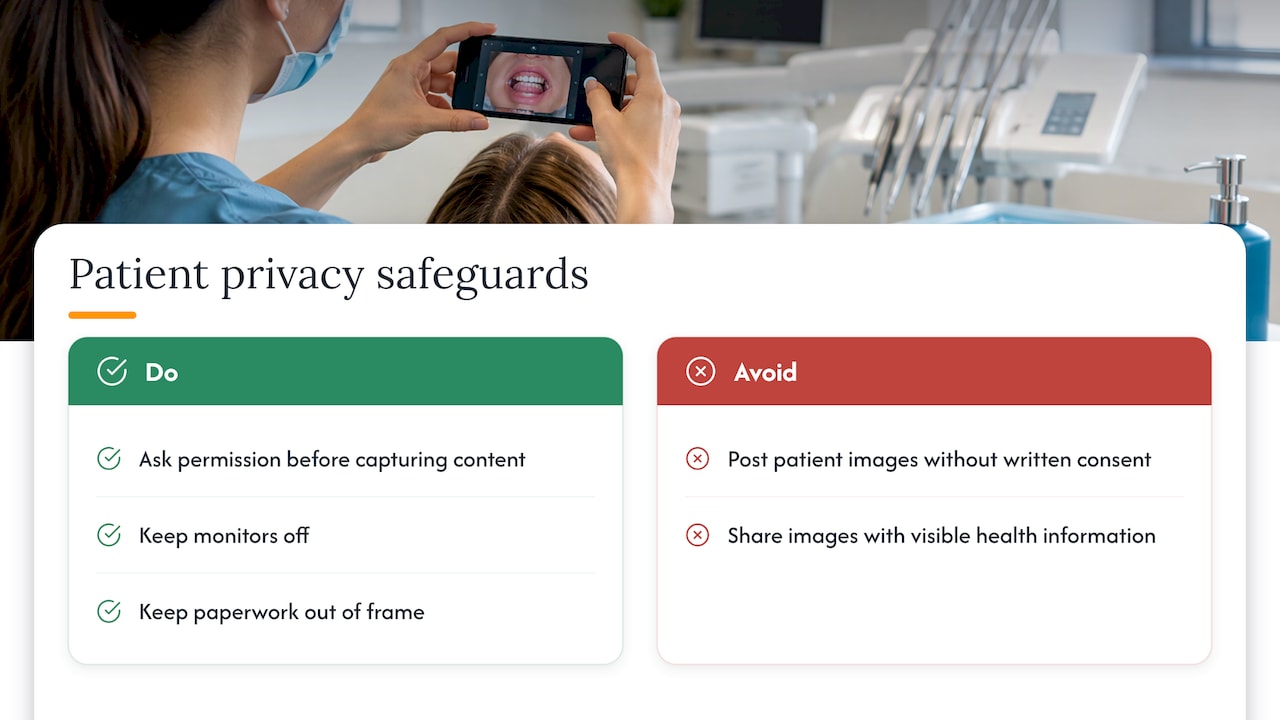
Two common Instagram problems for dental offices, according to an ADA journal article on Instagram, are posting patient images, videos or identifying information without written consent, and sharing images where personal health information is visible. The recommended habit is to ask permission before capturing content and to keep monitors off and paperwork out of frame.
Review replies are the biggest trap
The ADA warns that responding to a negative review can itself be a HIPAA violation, because you must keep protecting information a patient has already made public. A peer-reviewed article in PMC documents the real cost of getting this wrong:
- A Texas dental practice was fined $10,000 by HHS’s Office for Civil Rights for disclosing a patient’s last name and health-condition details in a Yelp response.
- In June 2023 the same office fined a New Jersey provider $30,000 for revealing a mental-health diagnosis in a reply to a negative review.
- A Rhode Island physician was fined $500 and required to take a confidentiality course for identifying patients on Facebook.
The same article notes that many providers underestimate how broadly PHI is defined. Names, photos and even details like tattoos count. HIPAA does not restrict de-identified information that neither identifies a person nor gives a reasonable basis to identify one. A safe public reply to a review is generic, for example thanking the reviewer and inviting them to call the office, without confirming that they were ever a patient.
Get authorization right, and track its expiration
A valid authorization must meaningfully describe the information to be used and why. State law can add requirements. The California Dental Association explains that under California’s Confidentiality of Medical Information Act, patient authorization covering testimonials and photographs in marketing is valid for one year from the signing date unless the patient asks for a longer date or it relates to an approved research study. HIPAA has similar requirements. Keep a log of who signed, what it covers and when it expires, and remove content when authorization lapses.
For a deeper walk-through of compliant campaigns, see our HIPAA compliant marketing guide and our HIPAA-first guide to healthcare reputation management. Your own compliance officer or a health-care attorney should confirm the policy that fits your state and practice.
Build a posting rhythm you can keep
Most practices do not fail at social media for lack of ideas. They fail because posting depends on whoever has a free minute. A rhythm fixes that.
- Choose a cadence you can sustain. Two or three quality posts a week on one or two platforms beats daily posting that stops after a month.
- Plan a month at a time. List the dates that matter: awareness months, seasonal reminders, promotions, team events. Our content calendar strategy playbook shows how marketing teams structure this.
- Batch the filming. Shoot several short videos in one session, with the dentist in front of the camera at least some of the time.
- Repurpose each idea. One patient question can become a Reel, a Facebook post, a short YouTube clip and a blog paragraph. We cover the method in our content repurposing strategy.
- Assign approvals. Decide who reviews every post for PHI and tone before it goes live, and who replies to comments and messages. The ADA checklist lists this as a platform decision for a reason.
- Answer people. Reply to comments and direct messages promptly, with general information only. The ADA also cautions that practices should avoid inadvertently establishing a doctor-patient relationship through social media, so move clinical questions to a phone call or an appointment.
Paid social: when organic is not enough
Organic posts build familiarity with people who already know you. Paid campaigns reach new households in your service area. Health-related advertising has strict platform rules, and account flags can pause a campaign for weeks. Our guide to compliant Facebook ads for clinics covers the steps that keep an account in good standing. Paid social works best alongside search, so a practice that also runs Google Ads for dentists can meet patients both when they look for care and when they scroll.
Measure what matters
Likes feel good but do not fill a schedule. The ADA’s GPS marketing checklist recommends setting measurable benchmarks: more calls, more scheduled visits, fewer no-shows, greater social media engagement and more referrals. It also advises tracking how first-time callers heard about the practice every month, measuring performance against goals every three months and assessing the whole campaign at 12 months.
In practice that means:
- Monthly: ask every new patient how they found you and record it. Note which posts drew comments, messages or profile visits.
- Quarterly: compare calls, booked visits and referrals against the goals you set, and shift your content toward what produced them.
- Yearly: decide which platforms and content types stay, which change and what budget supports them.
Social traffic only pays off if your website turns a visit into a booking. Our guide to dental website conversion covers that handoff, and our dental practice branding article explains how a consistent look and voice make every post recognizable.
How we help dental practices with social media
Social media is one channel in a larger plan. The Artist Evolution is a full-service marketing agency with more than 18 years in business, and our clients include healthcare and dental organizations. We handle strategy and campaign management, brand development, content creation, creative asset production, SEO, pay-per-click management and ongoing reporting and optimization, with a multidisciplinary in-house team. That lets your social content, website and search presence work as one system instead of three separate efforts.
If you want a clear view of where your practice stands today, start with our marketing assessment, or see how we approached increasing website traffic for a dental office. When you are ready to put a plan in place, talk to our team.
Our perspective on dental social media
Practices come to us with the same worry: “We post, but nothing happens.” In our experience building campaigns for healthcare brands, the cause is almost never effort. It is a missing link between the feed and the front desk.
Social media should be treated as the first conversation, the one where a future patient decides whether your team feels trustworthy. That is why we start with brand and goals before a single post is scheduled. A consistent voice, a recognizable look and a clear next step turn scattered content into a campaign.
We also believe compliance is part of the creative brief, not an afterthought. Build authorization, approvals and review-reply rules into the workflow from day one, and your team can post with confidence.
Finally, measure what the practice cares about: calls, booked visits and referrals. When social, search, paid media and your website are planned together, each one makes the others work harder. That is how we approach every engagement, and it is what we would build for your practice.
Derek
FAQ
How often should a dental practice post on social media?
Choose a frequency your team can keep up. Two or three quality posts a week on one or two platforms is a realistic starting point for most practices. Consistency and a clear connection to your goals matter more than volume.
Can I post patient photos or testimonials?
Only with the right written authorization. The ADA says a photo or video of a patient, even in the waiting area, may be PHI, and even revealing that someone is a patient can violate privacy laws. Authorization must describe what will be used and why, and some states set expiration periods, such as one year in California. Confirm your policy with your compliance officer or a health-care attorney.
Should I reply to negative reviews?
Yes, but carefully. HIPAA still protects information a patient has already made public, so never confirm they were a patient or mention any treatment. Offer a generic thank-you and invite them to call the office to talk. Several fines have followed detailed replies, including a $10,000 penalty for a Texas dental practice.
Which platform is best for dentists?
Facebook reaches many family health-care decision makers, and Instagram suits visual content and young families. YouTube helps with explainer videos and TikTok can suit practices in college towns. Start with one or two that match your patients, then add more only when the first ones run well.
How do I know if social media is working?
Track outcomes tied to your goals: calls, scheduled visits, no-shows, referrals and engagement. Ask each new patient how they found you every month, and review results against your goals every three months, as the ADA’s marketing checklist recommends.
Sources
- Social Media: Introduction, American Dental Association
- Build Your Dental Brand: Social Media Strategies, ADA Dental Sound Bites
- Toolkit for AAPD Members
- ADA Checklist for Engaging in Social Media
- Choosing the Best Media Platforms, PMC
- Social Media Strategies that Attract High-Value Patients, AGD
- Marketing and Advertising, American Dental Association
- What About Instagram? ADA journal article
- Lessons Learned: Avoiding Risks When Using Social Media, PMC
- Obtaining patient authorization for use or disclosure of health information, California Dental Association
- GPS Marketing: Checklist for Launching Marketing Strategy, ADA