
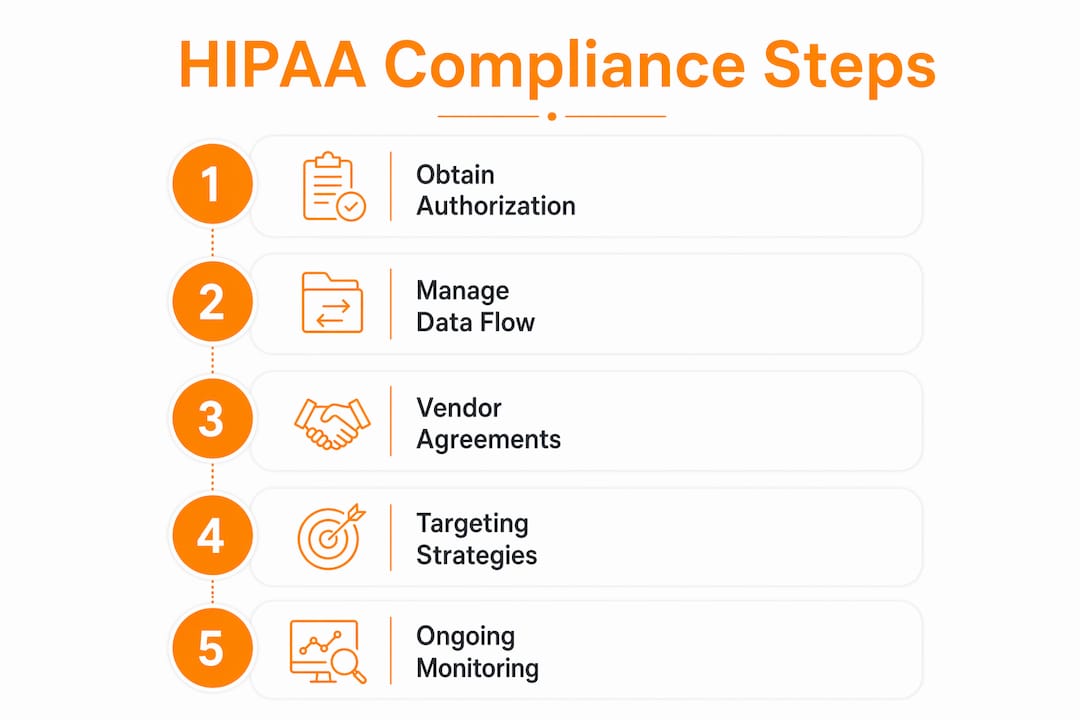
HIPAA compliant marketing is the practice of promoting healthcare products and services while strictly protecting patient privacy under law-defined rules on Protected Health Information (PHI) use and disclosure. The Health Insurance Portability and Accountability Act’s Privacy Rule, enforced by the HHS Office for Civil Rights (OCR), defines marketing as any communication that encourages a patient to purchase or use a product or service using their PHI. Most healthcare organizations require written patient authorization before using PHI for marketing purposes. Understanding where that line sits, and how to build campaigns that respect it, is the core challenge for every healthcare marketer in the United States.
What are the specific HIPAA marketing rules?
HIPAA defines marketing as any communication that uses PHI to encourage the purchase or use of a product or service, and authorization is required for those communications. That definition is broader than most marketers expect. A newsletter promoting a new service line to existing patients can qualify as marketing if it uses their health data to personalize the message.
Three exceptions exist where PHI use does not trigger the marketing definition:
- Treatment communications. A physician can contact a patient about a follow-up appointment or a care reminder without authorization, because the communication serves the patient’s direct care.
- Health plan operations. Communications about benefits, coverage changes, or care coordination fall under operations and are generally exempt.
- Nominal value gifts. Promotional gifts of nominal value, such as branded pens or calendars, do not require authorization as long as no PHI is used to select recipients based on health status.
The authorization requirement becomes absolute when financial remuneration is involved. Arrangements involving PHI disclosure for remuneration always require patient authorization with no exceptions. That means if a pharmaceutical company pays your health system to send patients a drug promotion, you need a signed authorization before sending it.
A valid HIPAA marketing authorization must specify the purpose of the communication, describe the content, state an expiration date, explain revocation rights, and disclose any financial remuneration involved. Authorizations must be written in plain language, and patients must receive a copy. Respecting revocation requests is not optional. Patient data retention records must be maintained for at least six years under the Privacy Rule.
Pro Tip: Keep a separate authorization log for every marketing campaign that uses PHI. Auditors from HHS OCR will ask for it, and a well-organized log demonstrates good-faith compliance.
How to handle PHI and data flows in compliant campaigns
PHI leaks in marketing campaigns most often happen at the data collection layer, not in the campaign itself. Standard client-side pixels can cause unauthorized PHI disclosure by sending URL parameters, form field data, or referral strings directly to ad platforms. A patient who searches for “depression treatment” and lands on your intake form can have that search term transmitted to a third-party analytics tool without anyone realizing it.
A four-step framework addresses this risk:
- Audit data flows. Map every point where patient data enters your marketing stack, including web forms, appointment schedulers, chatbots, and email platforms.
- Close leaks. Strip PHI from URL parameters and form submissions before any data leaves your servers. This includes removing diagnosis codes, medication names, and appointment types from tracking strings.
- Route through compliance layers. Use server-side tracking or a privacy-first Customer Data Platform (CDP) to process data before it reaches ad platforms. This keeps identifiers off third-party servers.
- Measure ROI without PHI. Aggregate campaign-level data rather than individual-level conversion tracking to assess performance.
The following table shows the risk level of common marketing data practices:
| Practice | PHI Risk Level | Compliant Alternative |
|---|---|---|
| Client-side pixel on intake form | High | Server-side event API with PHI stripping |
| URL parameters with diagnosis codes | High | Generic campaign IDs only |
| Email with patient name and condition | High | Segmented send with authorization on file |
| Geo-targeted display ads | Low | Acceptable as-is |
| Aggregated conversion reporting | Low | Acceptable as-is |
Business Associate Agreements (BAAs) are required with every vendor that touches PHI in your marketing workflow. Google and Meta do not sign BAAs, which means you cannot send PHI directly to those platforms. Privacy-first CDPs and server-side tagging tools that do sign BAAs act as the compliance layer between your patient data and the ad ecosystem.

Pro Tip: Before onboarding any new marketing technology vendor, send a BAA request as the first step. A vendor that refuses or delays signing is a vendor you cannot use with PHI.
What are compliant targeting and measurement strategies?
Low-risk targeting methods for healthcare marketing include geographic, demographic, and contextual approaches. Retargeting using PHI poses high risk for violations and should be avoided unless you have explicit authorization and a signed BAA with the retargeting platform. Contextual targeting, where ads appear on relevant health content pages without using patient data, carries no HIPAA risk at all.
Measurement is where many healthcare marketers compromise compliance without realizing it. Sending individual-level conversion data back to ad platforms creates a PHI disclosure event if that data includes health-related identifiers. The compliant path uses aggregated methods:
- Media Mix Modeling (MMM) analyzes the relationship between ad spend and outcomes at the channel level, with no patient-level data involved.
- Geo-holdout testing compares outcomes in markets where ads ran versus markets where they did not, measuring lift without individual tracking.
- Server-side Conversion APIs can pass aggregated or de-identified signals to ad platforms, satisfying attribution needs without exposing PHI.
Analytics-driven measurement consistently produces better campaign outcomes than single-touch attribution models. Healthcare marketers who adopt MMM and geo-holdout testing often find they can defend budget decisions more confidently than those relying on pixel-based last-click data.
The practical tradeoff is real: privacy-first measurement is less granular than individual tracking. Accept that tradeoff. The legal exposure from PHI-based measurement far outweighs the marginal gain in attribution precision.
How to manage vendors and technology for HIPAA compliance
Every vendor in your marketing technology stack that processes, stores, or transmits PHI must sign a BAA before you go live. This includes email service providers, CRM platforms, analytics tools, and any CDP you use for audience management. Healthcare email marketing requires secure transport encryption, PHI-free subject lines, and complete separation of clinical and marketing systems.
When evaluating platforms, check for these capabilities:
- End-to-end encryption for data in transit and at rest
- Role-based access controls that limit who can view patient data
- Audit logging that records every data access event
- Consent management tools that propagate patient preferences across your stack
- Documented data retention and deletion policies
Governing your marketing approval workflow is as important as the technology itself. Every campaign that touches patient data should pass through a compliance review before launch. Assign a designated Privacy Officer or compliance lead to approve campaigns, and document that approval in writing. Annual team training on HIPAA marketing rules keeps your staff current as regulations evolve.
Healthcare marketers must also comply with FTC truth-in-advertising rules and state medical board regulations alongside HIPAA. Substantiation files for every health claim in your advertising protect against FTC enforcement actions. A blended compliance framework that covers HIPAA, FTC standards, and state rules is the only complete approach to legal healthcare marketing.
Pro Tip: Build a vendor compliance register that tracks BAA status, renewal dates, and data processing scope for every tool in your stack. Review it quarterly, not just at contract renewal.
Key Takeaways
HIPAA compliant marketing requires written patient authorization for PHI use in commercial communications, server-side data handling to prevent leaks, BAAs with every PHI-touching vendor, and aggregated measurement methods to protect privacy while tracking performance.
| Point | Details |
|---|---|
| Authorization triggers | PHI used for commercial marketing always requires written patient authorization, especially when remuneration is involved. |
| Safe targeting methods | Geo, demographic, and contextual targeting carry low HIPAA risk; PHI-based retargeting does not. |
| Server-side tracking | Strip PHI before data reaches ad platforms using server-side APIs or a privacy-first CDP with a signed BAA. |
| Vendor BAA requirement | Every marketing vendor that touches PHI must sign a BAA; Google and Meta do not sign them. |
| Blended compliance | HIPAA alone is not enough. FTC truth-in-advertising rules and state medical board regulations apply simultaneously. |
Why compliance-first marketing is actually a growth strategy
I have worked with healthcare clients long enough to see the same mistake repeat itself. Marketing teams treat HIPAA compliance as a legal checkbox, something to hand off to the Privacy Officer and forget about. That approach produces campaigns that are either legally risky or so restricted they barely perform.
The smarter frame is this: privacy-first marketing infrastructure is a competitive advantage. When you build server-side tracking, consent management, and PHI-free data flows into your campaigns from the start, you create a marketing operation that can scale without legal exposure. Your competitors who skip those steps will eventually face an HHS OCR investigation or an FTC enforcement action. You will not.
The healthcare organizations I have seen succeed at this are the ones that integrate compliance into campaign planning, not as a final review step, but as a design constraint from day one. They use contextual targeting and MMM measurement not because they have to, but because those methods produce defensible, repeatable results. They also recognize that HIPAA and healthcare marketing compliance builds patient trust, and patient trust drives long-term engagement better than any retargeting pixel ever will.
The future of healthcare marketing belongs to organizations that treat privacy as a feature, not a burden. Build your stack that way now, and you will be ahead of every regulatory change that comes next.
— Derek
Theartistevolution’s approach to healthcare marketing compliance
Healthcare marketing done right requires more than legal awareness. It requires a full-service team that understands both the regulatory environment and the creative work needed to engage patients effectively.

Theartistevolution has spent over 18 years building and managing campaigns for healthcare clients who need results without compliance risk. From brand development built around HIPAA-safe messaging to campaign management that integrates consent workflows and vendor governance, the team brings the full picture. Healthcare marketers who want a partner that handles both the creative and the compliance architecture will find that Theartistevolution delivers exactly that. Reach out to start a conversation about your next campaign.
FAQ
What is HIPAA compliant marketing?
HIPAA compliant marketing is the practice of promoting healthcare products or services without improperly using or disclosing Protected Health Information. It requires written patient authorization for commercial uses of PHI, with limited exceptions for treatment and care coordination communications.
When does healthcare marketing require patient authorization?
Patient authorization is required whenever PHI is used in a communication that encourages the purchase or use of a product or service, particularly when financial remuneration is involved. Treatment reminders and care coordination messages are exempt from this requirement.
Can healthcare organizations use Google or Meta ads?
Healthcare organizations can run ads on Google and Meta, but they cannot send PHI directly to those platforms because neither company signs Business Associate Agreements. Compliant campaigns use server-side tracking and PHI stripping before any data reaches those ad platforms.
What is the safest targeting method for healthcare advertising?
Geo-targeting, demographic targeting, and contextual targeting carry the lowest HIPAA risk because they do not rely on patient health data. PHI-based retargeting poses a high risk of violation and requires explicit authorization and a signed BAA with the retargeting platform.
What happens if a healthcare marketer violates HIPAA?
HHS OCR enforces HIPAA violations and can impose civil monetary penalties based on the level of negligence involved. Healthcare marketers who also make unsubstantiated health claims face additional exposure under FTC truth-in-advertising rules and state medical board regulations.