
A dental marketing plan is a one-year document that answers four questions: who you want as patients, which channels will reach them, what you will spend, and how you will know it worked. The American Dental Association describes the goal as a customized list of solutions and an action plan for your business. The plans that pay off are specific, tracked every month and reviewed every quarter.
Below is the framework we use with dental and healthcare clients, with the ideas for strategy, advertising and content that fit inside it. If you would rather have a team build and run it, our marketing plan service does exactly that.
TL;DR
- Start with the questions, not the tactics: who your best patients are, what result you want, who competes with you locally and what sets you apart.
- Write the plan for 12 months, with a budget, measurable goals, call tracking and a quarterly check-in.
- Build a base of website, Google Business Profile, reviews and local search before adding paid ads and social content.
- Check HIPAA and FTC review rules before you publish patient content or install tracking tools.
- Ask every new caller how they found you and review the answers monthly, so budget moves to what works.
Table of Contents
- What a dental marketing plan has to contain
- Step 1: Answer the launch questions first
- Step 2: Set goals you can measure
- Step 3: Choose channels in the right order
- Dental advertising ideas that fit the plan
- Dental content ideas that build trust
- Step 4: Budget for twelve months
- Step 5: Check the rules before you publish
- Step 6: Track, review and adjust
- Our perspective
- Put the plan to work
- FAQ
- Sources
What a dental marketing plan has to contain
The ADA says a tailored plan should draw on patient-survey results and community demographics. It should also contain short- and long-term goals, possible tactics, an evaluation plan and a timeline, often one year with quarterly assessments.
That gives you a simple skeleton:
- Situation: who your patients are today, what services you offer, what the local market looks like.
- Goals: numbers you can check, tied to the business.
- Audience: the patients you most want to add.
- Channels and tactics: where and how you will reach them.
- Budget and owners: what each piece costs and who is responsible.
- Measurement: what you track, how often, and what triggers a change.
The ADA also notes that practices can build a campaign themselves, outsource it, or combine internal work with outside consultants, and that no single approach suits every practice. The deciding factor is usually time. A plan only works if someone executes it every week, and most practice owners and office managers are already full.
Step 1: Answer the launch questions first
Before choosing a single tactic, the ADA’s marketing launch checklist asks you to settle five things: your audience, your desired result, your preferred tactics, your local competition and your practice’s advantages.
Write one honest paragraph for each. A few prompts help:
- Audience: Is it families within a short drive, professionals who want evening appointments, or patients seeking implants, aligners or other specialty care?
- Result: More new-patient exams, higher case acceptance, a fuller hygiene schedule, or fewer no-shows?
- Competition: Search the way a new patient would, then note who appears for your top services and what their listings promise.
- Advantages: Hours, technology, a specialty, a warm team, the way your office feels. These become the core of your messaging.
This last point is a brand question as much as a marketing one. Patients choose a dentist on trust and first impressions, so your positioning should be settled before ads are written. Our guide to dental practice branding walks through how a clear identity supports new-patient growth, and our brand development work is built for this step.
Step 2: Set goals you can measure
A goal such as “get more patients” cannot be reviewed. Tie goals to business outcomes. The ADA’s checklist names increased calls, scheduled visits, fewer no-shows, social engagement and referrals as possible benchmarks. A Michigan Dental Association article published in the ADA’s repository likewise suggests starting with goals linked to business outcomes, such as patient referrals and engagement, then using platform engagement measures to learn which content your followers value.
A worked example for a single-location general practice:
| Goal | Baseline (month 0) | Quarter 2 target | Where you read it |
|---|---|---|---|
| Calls from new patients | Your current monthly count | A set increase you choose | Call tracking |
| New-patient exams scheduled | Your current count | A set increase you choose | Practice software |
| No-shows | Current percentage | A lower percentage | Scheduling report |
| Five-star reviews added | Current monthly count | A steady monthly pace | Google Business Profile |
The numbers belong to your practice, so fill in your own baseline first. Without a baseline, you cannot tell whether a quarter went well.
Step 3: Choose channels in the right order
Most practices get better returns when they build the base before buying attention. This is the sequence we recommend.
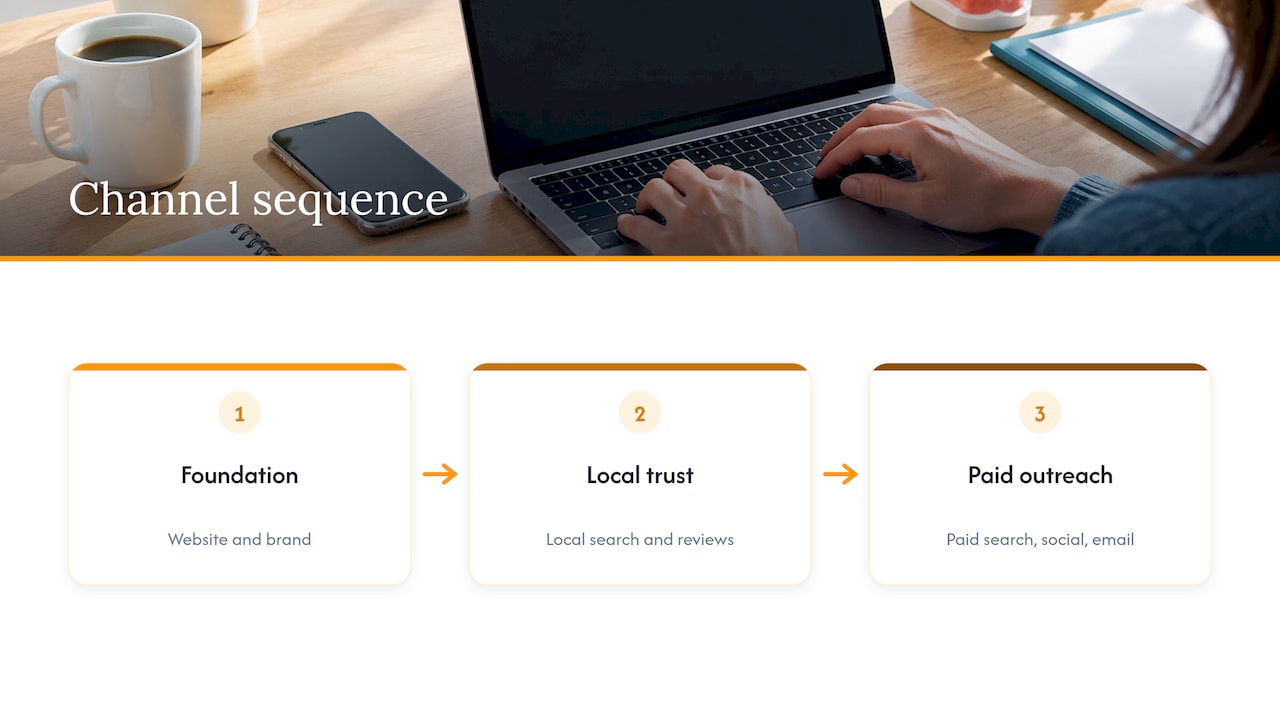
Your website and brand
Every channel sends people to the same place. If the site loads slowly, hides the phone number or makes booking hard, extra traffic is wasted. Our article on dental website conversion covers how to turn visitors into booked patients. For practices that need a new site, we offer website design. In one dental office case study we show how we approached growing website traffic.
Local search and Google Business Profile
People searching for a dentist near them see the map listing before they see your website. Keep your categories, hours, services and photos accurate, and respond to reviews. Our SEO team handles the ongoing work of keeping a practice visible for the services and neighborhoods that matter.
Reviews and reputation
Reviews are part of the plan from month one. See the compliance section below for the rules, and our HIPAA-first reputation management guide for how to respond without exposing patient information.
Paid search
Pay-per-click ads capture patients who are already searching for an emergency visit, implants or Invisalign-type treatment. They reward careful keyword and location targeting. We cover this in Google Ads for dentists, and our pay-per-click management service runs the campaigns and reports on them.
Social media and email
Social works best as a human layer on top of the base. See our practical guide to dental social media for platform-by-platform detail.
Dental advertising ideas that fit the plan
Good advertising ideas answer a goal from Step 2. These are the ones that tend to fit a local practice:
- Radius-targeted social ads. The ADA’s social media article notes that social advertising can target relevant audiences, and gives parents within a 10-mile radius as an example. Pair that with a family-exam offer.
- Service-specific search ads. One ad group per service (implants, emergency care, cosmetic work) with a landing page that matches it.
- New-neighbor and community outreach. Sponsor a school event or local team, then follow up with a simple landing page and a tracked phone number.
- Reactivation email or text. Reach patients who have not visited in a year or more with a clear reminder to book a hygiene visit.
- Referral prompts. Make it easy for happy patients to share your practice, within the compensation rules below.
If you run geotargeted ads, confirm they actually show where you intended. A guide on checking ad placements by city explains how to view your ads as a local searcher would.
Dental content ideas that build trust
The ADA’s custom-publishing material says practical, relevant educational content builds awareness and engagement, and lists website, newsletter, print and digital distribution as formats. For a practice, that means answering the questions patients already ask in your chair.
- Procedure explainers: what a crown, root canal or implant visit involves, how long it takes and how to prepare.
- Cost and insurance guides: how your office handles benefits, payment plans and estimates.
- Seasonal reminders: back-to-school checkups, using up year-end benefits, post-holiday cleanings.
- Meet-the-team posts and short videos. The ADA article describes visual, authentic content such as short videos and practice-life photos as useful for creating human connection.
- Before-and-after stories, only with proper written patient authorization.
One piece can serve several channels: a procedure explainer becomes a web page, a newsletter item, a short video and three social posts.
Step 4: Budget for twelve months
The ADA checklist calls for a 12-month budget and goals, so set the full year at the start rather than spending month to month. A practical approach:
- Fix the base costs: website hosting and updates, listing management, call tracking, and any software.
- Add a recurring core: local search work and content production.
- Set ad spend separately, so you can raise or cut it without touching the core.
- Hold a reserve of a portion of the year for what the first two quarters teach you.
How much to spend depends on whether you are launching, growing or maintaining, and on your local competition. Rather than copying a percentage from a generic benchmark, use your Step 2 goals: estimate how many new patients you need, what each is worth over time, and work backward. Our marketing assessment can help size this for your practice.
Step 5: Check the rules before you publish
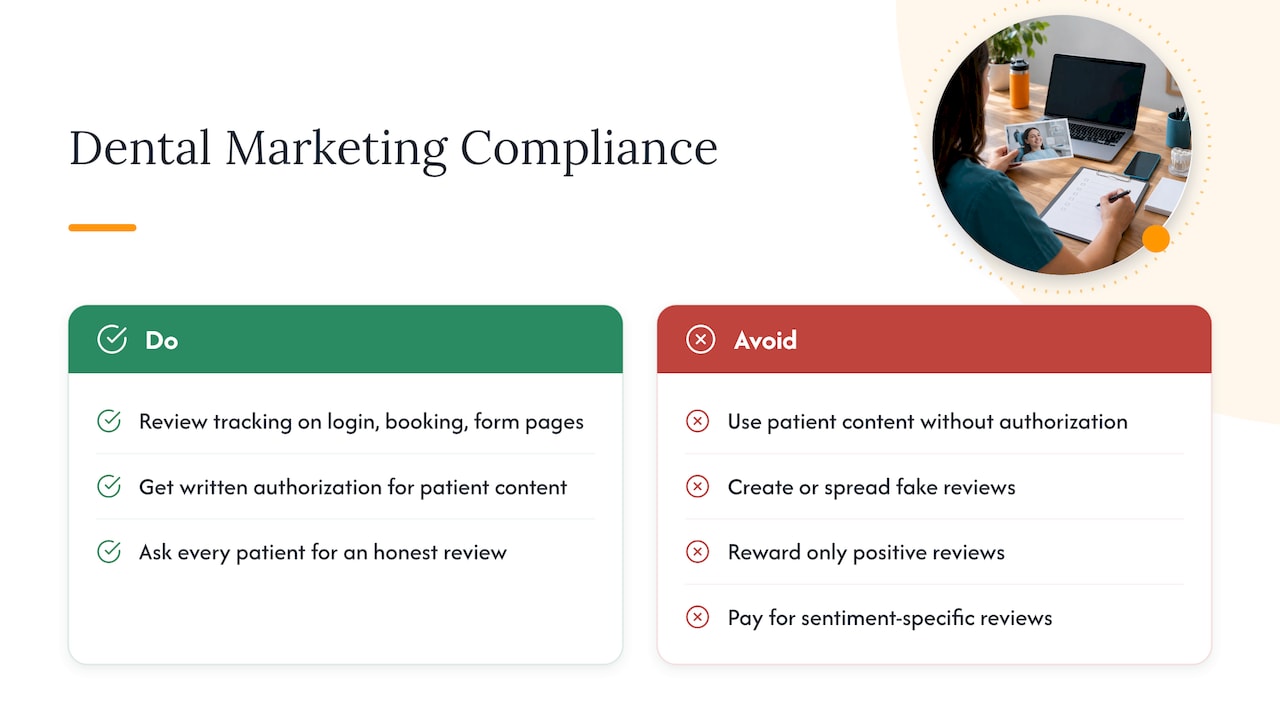
Dental marketing sits inside healthcare privacy and advertising law. Three checks belong in every plan.
Tracking tools on your website. HHS guidance says HIPAA applies when the tracking information collected by a regulated entity includes protected health information, and that impermissible disclosures of this information to tracking vendors are prohibited. HHS adds that disclosures to tracking vendors for marketing generally require a HIPAA-compliant individual authorization unless a Privacy Rule permission or exception applies. Review pixels and analytics on any page where patients log in, book or fill in forms. Our HIPAA compliant marketing guide explains how to run campaigns within these limits.
Patient photos and stories. The ADA’s social media article reminds practices to ensure HIPAA compliance for patient content. Get written authorization before using a patient’s image, name or story.
Reviews. The FTC says its Consumer Review Rule became fully effective on October 21, 2024. It prohibits creating fake or false reviews, and buying or spreading them when a business knew or should have known they were fake. The same FTC document says businesses may not tie compensation or incentives to a review expressing a particular positive or negative sentiment. So ask every patient for an honest review, and never reward only the good ones.
Step 6: Track, review and adjust
The ADA checklist recommends asking every first-time caller how they heard about the practice, recording the answers and reviewing them monthly to assess conversion and channel return. It also calls for call tracking, quarterly progress comparisons and a review at 12 months.
A simple routine:
- Weekly: front desk logs source for each new-patient call and booking.
- Monthly: compare sources against bookings and cost. Pause what produces calls that never book.
- Quarterly: compare results with Step 2 targets and move budget.
- Annually: review the whole plan and write the next one.
Self-reported sources and call-tracking data will not always agree, and that is fine. Use both to see the pattern. A one-page summary keeps the team focused, and this guide to a one-page campaign performance report shows a clean way to present results to partners or stakeholders.
Our perspective
Most dental marketing fails for a plain reason: it is a pile of tactics instead of a plan. A practice buys ads in March, posts on social in May, redesigns the site in August, and never connects any of it to a number.
We have been in business for more than 18 years, and our team of strategists, designers and digital specialists works in-house. That matters here because a good dental plan needs several disciplines at once: a brand patients trust, a website that converts, search visibility and ads that point at the right pages. We built our approach around a proven playbook so the plan, creative and reporting stay connected.
We serve healthcare, dental, legal, retail and consulting clients, and we work as an extension of your team. You keep running your practice. We handle the strategy, campaigns and reporting that turn the plan into booked appointments.
Derek
Put the plan to work
If you want the plan built and managed by one team, we cover brand development, website design, SEO, pay-per-click and marketing tools under one roof. Start with our marketing plan service or contact us through our site to talk about your practice.

If you are comparing providers first, our roundup of dental marketing agencies explains what to look for.
FAQ
How long should a dental marketing plan cover?
Twelve months is the standard. The ADA describes a timeline that is often one year, with quarterly assessments. Write the full year’s budget and goals up front, then review each quarter and adjust.
What should I do first if I have a small budget?
Fix the base: an accurate Google Business Profile, a website that makes booking easy, and an honest, steady flow of patient reviews. Add call tracking so you can see what produces calls. Once that works, add paid search for your highest-value services.
How do I know if my dental marketing is working?
Track calls, scheduled visits, no-shows, referrals and reviews against the baseline you set. Ask each new caller how they heard about you, log the answer, and review it monthly. Compare progress against your goals every quarter.
Can I use patient reviews and photos in my marketing?
Yes, with care. Ask for honest reviews and never offer rewards tied to positive sentiment, which FTC rules prohibit. For photos and stories, get written HIPAA-compliant authorization first.
Sources
- Create Your Marketing Plan: The Basics, American Dental Association
- Marketing Checklist for Launching Marketing Strategy, ADA
- Your Journey through Dental Social Media: Master the Metrics, Journal of the Michigan Dental Association
- Custom Content = Customers, ADA 2021 custom publishing
- Use of Online Tracking Technologies by HIPAA Covered Entities, HHS
- Fake Review Warning Template, Federal Trade Commission