
Focus on positioning first. Identify the single client problem you solve better than anyone else, then build every visual and verbal element around that claim. Branding is strategic, not merely visual: positioning and messaging must come before logo work, or you risk spending real money on window dressing that does not move the needle.
Start here, right now:
- Define your target client in one sentence. Not “businesses and individuals” — something like “early-stage tech founders facing IP disputes in California.”
- Run a 30-day brand audit. Score your homepage headline, attorney bios, and referral language against the checklist in Section 9.
- Change your homepage headline. If it leads with your firm name or founding year, rewrite it around the client’s problem and your specific outcome.
- Refresh one attorney headshot. A professional headshot is the fastest credibility signal you can update in a week.
Watch these metrics in the first 90 days: inbound call volume from your target practice area, the percentage of proposals that convert, and whether referral partners can describe what you do in one sentence without prompting.
Key Takeaways
Strong law firm branding starts with positioning clarity and a client-focused value proposition, then builds messaging, visual identity, and client experience in that order.
| Point | Details |
|---|---|
| Positioning comes first | Define your target client and specific outcome before touching logo or website design. |
| Full rebrand processes typically take several months | Budget for discovery, messaging, visual identity, website, and rollout as distinct phases. |
| Quick wins are real | Updates to homepage headline, attorney bios, and a headshot refresh can deliver measurable impact before a full rebrand. |
| Measure from day one | Track qualified leads, proposal conversion rate, and referral source quality against a pre-rebrand baseline. |
| Theartistevolution accelerates the process | The agency’s brand development and marketing assessment services give law firms a structured, proven path from positioning to client acquisition. |
Table of Contents
- What does law firm branding actually cover?
- Why branding matters for solo and small firms
- How do you build a law firm brand step by step?
- What can U.S. law firms learn from real branding moves?
- Common branding mistakes law firms keep making
- What does law firm branding cost, and how long does it take?
- How do you measure brand success and keep it consistent?
- Brand audit checklist: score your firm in 30 minutes
- Why positioning fails and how to fix it with proven frameworks
- How Theartistevolution helps law firms build brands that win clients
- Sources
What does law firm branding actually cover?
Most firm leaders think branding means a logo and a color palette. It covers far more than that. Your brand is the total market perception of your firm, shaped by four interconnected layers: positioning, messaging, visual identity, and client experience.
Positioning is the strategic core. It answers: who do you serve, what problem do you solve, and why are you the right choice? Messaging translates that positioning into language — your homepage headline, your attorney bios, your intake scripts. Visual identity (logo, color, typography, photography) gives that language a consistent look. Client experience is how every touchpoint from first call to final invoice either confirms or contradicts the promise your brand makes.
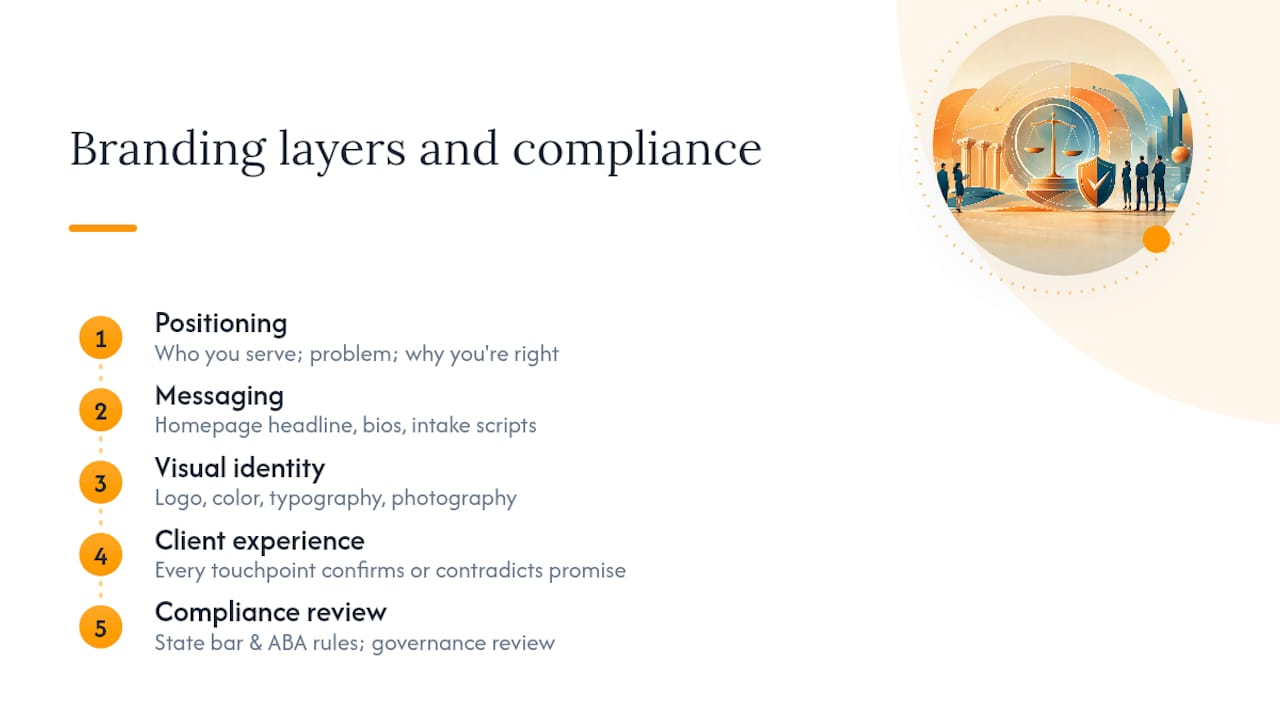
These layers are not parallel — they are sequential. Positioning drives messaging. Messaging guides visual choices. Visual identity and client experience then deliver the promise at every contact point. Skip the first step and the rest becomes decoration.
One note specific to U.S. attorneys: all branding and marketing materials must comply with your state bar’s advertising rules and the ABA Model Rules of Professional Conduct, particularly Rules 7.1 through 7.5 on communications about legal services. Superlatives, testimonials, and “specialist” claims each carry specific restrictions that vary by state. Build compliance review into your brand governance process from day one.
Why branding matters for solo and small firms
Strong branding helps solo and small firms build trust, stand out online, and attract the right clients — frequently shaping a prospect’s perception before any conversation takes place. That is the core business case, and it has direct revenue implications.
Here is what a well-positioned brand actually does for a smaller firm:
- Attracts higher-quality leads. When your positioning is specific, the wrong clients self-select out and the right ones feel immediately understood.
- Supports stronger pricing. Commodity positioning invites price comparison. A firm known for a specific outcome in a specific context can charge for that expertise.
- Generates more targeted referrals. Referral sources can only send you the right work if they can describe what you do precisely. Vague positioning produces vague referrals.
- Simplifies lateral and hiring conversations. Candidates want to join firms with a clear identity. A defined brand makes recruiting easier and faster.
- Reduces wasted business development effort. When your brand does the positioning work, you spend less time explaining and more time closing.
The risk of ignoring brand work is not just missed opportunity — it is active damage. Without a clear position, competitors and the market fill the perception gap and make your firm look interchangeable. You end up competing on price, taking mismatched cases, and burning BD budget on outreach that never converts.
Personal attorney brands deserve a specific note here. For solo practitioners and small firms, the founding attorney’s personal brand and the firm brand are often inseparable. That is fine — and even an asset — as long as the personal brand amplifies the firm’s positioning rather than contradicting it. An attorney who publishes thought leadership on employment law while the firm’s website claims to handle “all business matters” creates confusion. Align the two, and the personal brand becomes the firm’s most credible marketing channel.

How do you build a law firm brand step by step?
Effective rebrands follow clear objectives, adequate budgets, internal and external insight, and coordinated timing. Full projects commonly span several months, with website work often taking a few months. Here is the full playbook, broken into five phases.
Phase 1: Discovery
Before you write a word of copy or sketch a logo, gather real intelligence.
- Conduct stakeholder interviews. Ask each partner: “What three types of clients do you most want more of?” and “What do you do that no other firm in this market does?” Expect disagreement — that is useful data.
- Survey referral sources. Ask them: “How do you describe our firm when you refer us?” Their language is your current brand, whether you designed it or not.
- Map the client journey. Trace every touchpoint from first Google search to signed engagement letter. Note where the experience is inconsistent or below the brand promise you want to make.
- Run a competitive scan. Pull the homepage headlines and taglines of your five closest competitors. If yours sounds like theirs, you have a positioning problem.
Phase 2: Positioning workshop
Bring the discovery findings into a working session with your key decision-makers. The goal is one sentence: your value proposition.
Use this format: “We help [specific client type] who face [specific problem] achieve [specific outcome] — unlike [alternative], we [specific differentiator].”
From that sentence, develop two or three positioning anchors — the short phrases that will appear consistently across your website, proposals, and intake calls. Specificity is everything here. “Experienced” is not a positioning anchor. “The only firm in Austin focused exclusively on construction defect litigation” is.
Phase 3: Messaging framework
With positioning locked, build the messaging layer:
- Homepage headline: one sentence, client-problem-first, no firm name in the first line.
- Value proposition paragraph: three to four sentences expanding on the headline.
- Three proof points: specific outcomes, case types, or client results that validate the claim.
- Voice guide: two or three paragraphs that show what your firm sounds like — formal vs. plain-spoken, technical vs. accessible. Include one “we sound like this / we don’t sound like this” example.
- Bio templates: a standard structure for attorney pages that leads with client value, not law school graduation year.
A solid brand messaging framework is the document your whole team writes from. Without it, every attorney writes their own bio in their own voice, and the firm’s website reads like five different firms sharing a domain.
Phase 4: Visual identity
Visual identity work should follow messaging, not precede it. Once you know what you are saying and to whom, visual decisions become much easier to make and defend.
- Logo: decide scope first. A full redesign takes longer and costs more. A refinement of an existing mark is often sufficient for small firms.
- Color and typography: choose a palette and type system that reflects the positioning. A boutique estate planning firm and a high-volume personal injury firm should not look identical.
- Photography: professional headshots are non-negotiable. Beyond headshots, consider practice-in-action photography (client meetings, courtroom settings) that shows the work rather than just the people.
Pro Tip: Before commissioning a full visual identity, test your new messaging on your existing website for 60 days. If the new copy moves your metrics, you have proof of concept before spending on design.
Phase 5: Website, content, and digital presence
Your website is the brand’s primary proof point. Prioritize in this order:
- Homepage headline and hero section (highest-traffic, highest-impact)
- Practice area pages (buyer-intent search traffic lands here)
- Attorney bio pages (second-most-visited pages on most firm sites)
- A single, focused blog post targeting one high-intent search term in your practice area
For SEO, focus on buyer-intent terms (“Chicago employment attorney for executives”) rather than informational terms (“what is wrongful termination”) in your first 90 days. The former converts; the latter educates.
Phase 6: Client experience alignment
Smaller firms can differentiate using fixed-fee packaging, response-time promises, client portals, and unbundled services. These operational moves often deliver faster brand separation than a new logo. Build them into your onboarding templates, your engagement letter language, and your intake call scripts.
Phase 7: Rollout and internal adoption
A brand that lives only on the website is not a brand — it is a brochure. Roll it out internally before you go external:
- Brief all attorneys and staff on the new positioning and messaging.
- Update email signatures, voicemail greetings, and LinkedIn profiles simultaneously.
- Replace all proposal and pitch deck templates.
- Set a go-live date and communicate it to referral sources.
30-90-180 day plan with deliverables
What can U.S. law firms learn from real branding moves?
Three short examples show what practical brand decisions look like in action — and what smaller firms can replicate without a large budget.
A solo immigration attorney narrows the focus
A solo immigration practitioner in Houston was marketing to “all immigration needs” and competing on price against high-volume shops. She repositioned around a single niche: employment-based green cards for healthcare professionals. She rewrote her homepage headline, updated her LinkedIn summary, and published two blog posts targeting the specific search terms her ideal clients used. Within six months, her inbound inquiries from hospitals and healthcare staffing firms increased, and she raised her flat-fee rate without losing conversion.

The lesson: narrowing your stated focus does not shrink your market — it makes you the obvious choice for the clients who matter most.
A three-attorney estate planning firm repackages its services
A small estate planning firm in Ohio was losing consultations to larger firms that offered bundled packages with clear pricing. The firm introduced three fixed-fee tiers (basic will package, comprehensive estate plan, business succession plan) and listed them on a dedicated pricing page. Prospects who previously ghosted after the initial consultation began converting at a higher rate because the pricing transparency removed the uncertainty that was stalling decisions.
The lesson: client experience changes — especially pricing transparency — often outperform visual redesigns in terms of measurable conversion impact.
A boutique employment firm rebuilds its attorney pages
A four-attorney employment defense firm in Atlanta had attorney bio pages that read like résumés: law school, bar admissions, publications. They rewrote each bio to lead with the type of client the attorney serves and the specific outcomes they deliver. They also added professional headshots taken in a consistent style. Referral partners began citing specific attorneys by name when sending work, rather than sending general inquiries to the firm’s main inbox.
The lesson: personal branding through consistent bios and headshots makes attorneys more discoverable and reinforces firm credibility — and it costs far less than a full rebrand.
Common branding mistakes law firms keep making
Common positioning mistakes include sounding similar to competitors, confusing credentials with positioning, inconsistent messaging, and focusing the brand on the lawyer rather than the client. Here is how each one shows up — and how to fix it.
-
Mistake: Generic differentiators. “Experienced,” “aggressive,” “client-focused,” and “results-driven” appear on nearly every law firm website. They say nothing specific. Fix: Replace with a concrete claim — a specific client type, a specific outcome, or a specific process that is genuinely yours.
-
Mistake: Credentials as positioning. “Harvard Law, 20 years of experience” is a credential, not a position. Clients care about what those credentials mean for their problem. Fix: Translate credentials into client outcomes: “20 years of experience representing mid-market manufacturers in product liability cases.”
-
Mistake: Inconsistent voice across platforms. Your website sounds formal, your LinkedIn posts are casual, and your intake calls follow no script. Consistent messaging across platforms is one of the most common implementation failures in legal marketing. Fix: Build a one-page voice guide and require all external communications to follow it.
-
Mistake: Brand centered on the lawyer, not the client. A homepage that leads with the firm’s founding story or the managing partner’s biography puts the wrong person at the center. Fix: Rewrite the homepage hero around the client’s problem and desired outcome. The firm’s story belongs further down the page.
-
Mistake: Overusing “aggressive.” This word has become so common in personal injury and criminal defense marketing that it functions as noise. Fix: Show aggression through proof — verdicts, settlements, case outcomes — rather than claiming it as a trait.
Red-flag checklist — act immediately if you check any of these:
- Your homepage headline could appear on a competitor’s site without changing a word.
- Your three most recent referrals were outside your target practice area.
- Different attorneys describe the firm differently when asked “what do you do?”
- Your Google Business profile has not been updated in over 12 months.
- Your attorney bios lead with law school graduation year.
What does law firm branding cost, and how long does it take?
Under-investing in a rebrand can create higher long-term costs as rollout tasks like signage, onboarding packs, and staff adoption may be overlooked without sufficient budget planning. Plan for the full scope from the start.
Pricing and timelines for U.S.-based firms vary widely depending on firm size and project phase.
Priority matrix — where to invest first:
- Positioning and messaging (highest ROI, lowest cost, fastest impact on lead quality)
- Homepage headline and attorney bios (high-traffic, high-conversion pages that cost little to update)
- Client experience fixes (pricing transparency, response-time promises, onboarding templates)
- Visual identity (important, but only after the strategic layer is locked)
Vendor selection guidance: For solos and two-attorney firms, a freelance brand strategist paired with a freelance designer often delivers better value than a full-service agency. For firms of five or more attorneys, an agency with legal marketing experience handles stakeholder management and rollout coordination more efficiently. DIY is viable for messaging and bio updates; it rarely produces professional results for logo and website work.
How do you measure brand success and keep it consistent?
Brand measurement is where most firms fall short. They invest in a rebrand, launch it, and then never check whether it moved the metrics that matter. Set these KPIs before launch so you have a baseline to measure against.
Suggested KPIs:
- Qualified leads from your target practice area (track monthly)
- Proposal-to-engagement conversion rate (track per quarter)
- Average case or matter value (track per quarter)
- Referral volume and source quality (are referrals coming from the right sources?)
- Brand-search lift (track “your firm name” queries in Google Search Console)
- Net Promoter Score or client satisfaction score (survey at matter close)
Governance checklist:
- Assign one brand owner (managing partner or marketing director) with final approval authority on all external communications.
- Create a content approval rule: any new web page, press release, or social post must be reviewed against the messaging framework before publishing.
- Maintain a profile template for attorney pages and update it whenever the messaging framework changes.
- Schedule a brand training session for new hires and laterals within their first 30 days.
- Run a quarterly brand review: pull KPIs, review three to five recent client touchpoints, and flag any drift from the messaging framework.
Monthly/quarterly review cadence:
- Monthly: check qualified lead volume, Google Search Console brand queries, and any new client feedback.
- Quarterly: review proposal conversion rate, referral source quality, and average matter value. Compare against the pre-rebrand baseline.
- Annually: run the full brand audit (Section 9) and assess whether the positioning still reflects the firm’s actual work and target clients.
Personal branding for attorneys — consistent bios, headshots, and thought leadership — makes individual attorneys more discoverable and reinforces firm credibility when done consistently. Include attorney-level metrics (LinkedIn profile views, speaking invitations, direct inbound from attorney name searches) in your governance dashboard.
Brand audit checklist: score your firm in 30 minutes
Run this audit today. Score each item: 2 = strong, 1 = needs work, 0 = missing or broken.
Score interpretation:
- 11–14: Your brand is well-positioned. Focus on governance and measurement to maintain it.
- 7–10: Solid foundation with clear gaps. Prioritize homepage headline, bios, and referral language first.
- 4–6: Significant brand drift. Start with a positioning workshop before touching visuals.
- 0–3: Your brand is working against you. A full discovery and repositioning project is the right next step.
Why positioning fails and how to fix it with proven frameworks
Research on legal marketing consistently points to the same root cause of brand failure: vagueness. Firms describe themselves in terms that are true of every firm in their market, which means they are describing nothing distinctive at all.
Positioning should surface what is true and valuable about the firm. When it does not, the market fills the perception gap with its own assumptions — and those assumptions usually default to “one of many options, probably similar in price.”
The most common failure modes are:
- Specificity vs. vagueness: “We handle complex litigation” versus “We represent mid-market manufacturers in product liability cases in the Southeast.” The second sentence tells a prospect whether they belong.
- Credentials as positioning: A firm’s Chambers ranking or Martindale-Hubbell rating is a validation signal, not a differentiator. Every firm in the top tier has one.
- Inconsistent messaging: The website says one thing, the pitch deck says another, and the managing partner’s LinkedIn bio says a third. Prospects notice the inconsistency and interpret it as disorganization.
Six diagnostic interview questions
Ask these questions to three to five current clients and two to three active referral sources:
- “How would you describe our firm to a colleague who needed legal help in our area?”
- “What made you choose us over other options?”
- “What do we do that you have not found elsewhere?”
- “What would you tell a friend to expect from working with us?”
- “Is there anything about our work that surprised you — positively or negatively?”
- “If we were not available, who would you call instead, and why?”
The answers to questions 1 and 6 are your current brand. The gap between those answers and the position you want to hold is your brand project.
Three positioning templates
Adapt one of these to your firm:
- Niche specialist: “We are the [city/region] firm for [specific client type] facing [specific legal challenge].”
- Outcome-led: “We help [client type] [achieve specific outcome] without [common pain point].”
- Process differentiator: “Unlike most [practice area] firms, we [specific process or commitment] so that [client benefit].”
Validation steps
Test your new positioning before committing to a full visual rebrand. Share the new homepage headline with five referral sources and ask: “Does this describe what you would send us?” Run a small paid search campaign targeting your highest-intent keyword with the new messaging. Use LinkedIn outreach to test the value proposition with prospects in your target segment. If the messaging resonates, you will see it in click-through rates and inquiry quality within 30 days.
Pro Tip: Partner alignment is the most common execution failure in repositioning projects. Before finalizing any positioning statement, get written sign-off from every equity partner. One dissenting partner who continues using old messaging in client conversations will undermine the entire effort.
What the research and 18 years of brand work actually tell us
Most law firm branding projects fail not because the strategy was wrong but because the firm skipped the positioning work and went straight to the logo. The result is a beautiful website that still sounds like every other firm in the market.
The playbook in this guide is built around a simple truth: clients hire firms they understand quickly. If a prospect lands on your homepage and cannot tell in five seconds whether you are the right fit for their problem, they leave. That is not a design problem. It is a positioning problem.
What actually moves the needle for solo and small firms is not a six-figure rebrand. It is a sharp value proposition, a homepage headline that speaks directly to the right client, attorney bios that lead with outcomes, and a client experience that delivers on the brand promise at every touchpoint. Firms that do those four things well consistently outperform larger competitors with bigger marketing budgets and generic positioning.
The two outcomes you can realistically expect from following this playbook: a cleaner inbound pipeline where the wrong clients self-select out before they call, and higher-value engagements because your positioning signals expertise rather than availability. Neither requires a full visual overhaul to start seeing results.
How Theartistevolution helps law firms build brands that win clients
Law firm brand work is not a one-time project — it is an ongoing system of positioning, messaging, and client experience that requires consistent management to stay effective. Theartistevolution brings 18 years of brand development experience to firms that want results, not just a refreshed logo.

The agency’s brand development services cover the full scope: positioning strategy, messaging frameworks, visual identity, website messaging, and attorney-level thought leadership. For firms that need a focused starting point, the brand story development engagement delivers a complete positioning and messaging foundation in a defined scope. For firms ready to scale, campaign management keeps the brand working across every channel with ongoing reporting and optimization.
The right first step is a marketing assessment — a structured review of your current brand, positioning gaps, and highest-priority opportunities. Request one today and walk away with a clear picture of where your brand stands and exactly what to fix first.
Sources
- Brand Positioning Mistakes Law Firms Keep Repeating | Legal Marketing Blog
- Beyond the Logo: 7 Branding Moves Law Firms Can’t Afford to Miss
- Law Firm Branding Guide for Solo and Small Firms | Clio
- Personal Branding for Attorneys: Why It Matters and How To Do It – New York State Bar Association
- Law Firm Branding: Beyond the Logo | Legal Practice Marketing