
A brand messaging framework is the single source of truth that connects your strategy to every piece of copy, campaign, and customer conversation your team produces. Without one, marketing writes one thing, sales says another, and your audience never quite gets a clear picture of who you are.
Here is what you can do in the next 48–72 hours to start building yours:
- Schedule a 90-minute workshop with your marketing, sales, and leadership stakeholders to align on positioning and audience.
- Draft your positioning statement and three core value propositions using the fill-in-the-blank templates in this guide.
- Pilot test one message in a live ad or landing page headline and set a baseline click-through rate to measure against.
Follow this sequence and you will cut revision cycles, speed up content production, and give every channel a consistent voice. The industry-standard Three C’s of effective messaging, Clarity, Consistency, and Constancy, are the organizing principle behind every step.
Table of Contents
- What does a brand messaging framework actually include?
- Why a shared messaging framework drives real business outcomes
- What are the essential components of a brand messaging framework?
- How do you build a brand messaging framework step by step?
- How do you know if your messages are actually working?
- How do you roll out and govern messaging across teams?
- Copyable framework examples and a 60-minute worksheet
- How Theartistevolution applied this framework for a healthcare client
- How long should your messaging framework be, and when should you update it?
- Key Takeaways
- Why messaging should always come before creative
- Theartistevolution builds messaging frameworks that teams actually use
- Useful sources and where to find templates
What does a brand messaging framework actually include?
A brand messaging framework is a structured document that organizes everything your brand says, from your mission down to individual ad headlines, into a traceable hierarchy. Think of it as the architecture beneath your copy: mission → positioning → value propositions → proof points → channel copy. Each layer informs the next, so a paid social caption can always be traced back to a core strategic claim.
The framework governs two distinct streams. Internal messaging shapes how your team talks about the brand in sales calls, onboarding materials, and all-hands presentations. External messaging is what customers see on your website, in ads, and across social channels. Both streams must stay aligned, because internal brand messaging creates a positive feedback loop that reinforces your external identity.
Where teams often get confused is in distinguishing the framework from two related but separate assets:
| Asset | What it governs | Primary users |
|---|---|---|
| Brand messaging framework | Message hierarchy, value props, proof points, channel copy | Marketing, sales, content, leadership |
| Brand voice guide | Tone, vocabulary, grammar rules, personality | Copywriters, designers, social media managers |
| Visual identity system | Logo, color palette, typography, imagery | Designers, brand managers, agencies |
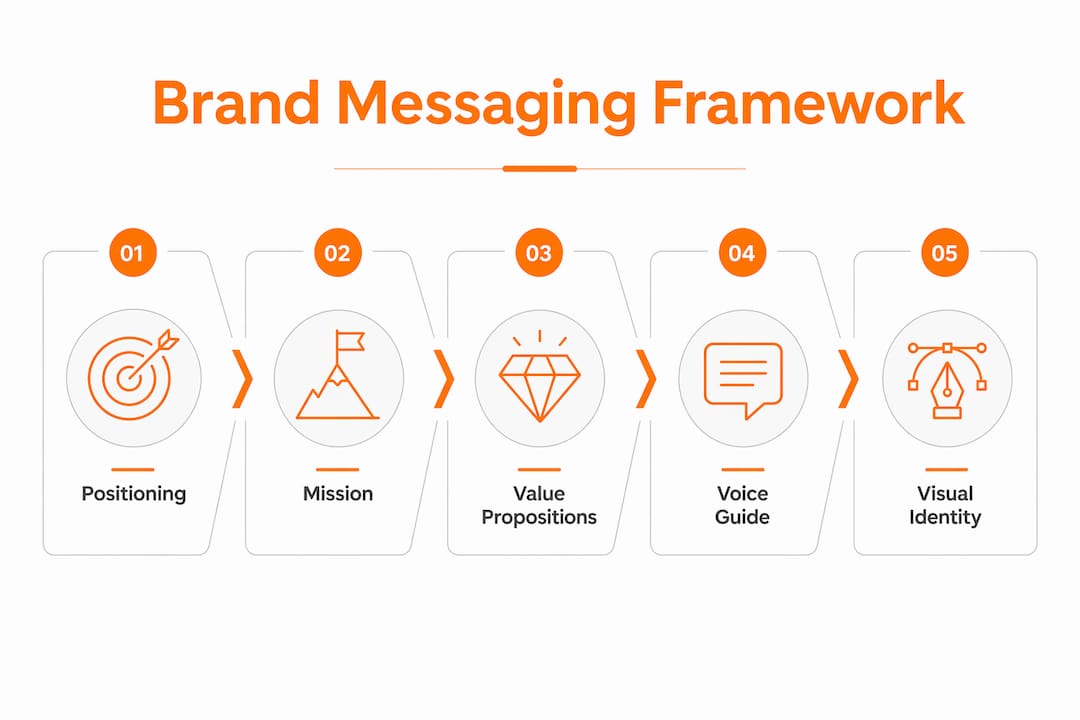
The messaging framework tells you what to say and why it matters. The voice guide tells you how to say it. The visual identity tells you how it looks. All three work together, but the framework comes first. As Atlassian’s brand team puts it, positioning is an internal compass and messaging is the translation of that positioning into audience-facing language. You cannot write the translation until the compass is set.
Why a shared messaging framework drives real business outcomes
The business case for investing in a brand communication framework comes down to three principles: Clarity, Consistency, and Constancy. Clarity means your messages are concise enough for a prospect to understand in seconds. Consistency means every channel, from a LinkedIn post to a sales deck, reinforces the same core claims. Constancy means your brand shows up with the same voice over time, building recognition and trust.
When these three principles are missing, fragmentation sets in. Marketing runs one campaign angle, sales pitches a different benefit, and product describes features the marketing team never mentioned. The result is a confused buyer who cannot articulate why they should choose you.
A well-built framework produces measurable gains across the business:
- Faster content production: Writers work from templates instead of starting from scratch every time.
- Fewer revision cycles: Stakeholders approve copy faster when it maps to an agreed-upon framework.
- Higher ad performance: Teams that tie ad creative to validated value propositions often report higher ad engagement.
- Stronger sales conversations: Reps who use consistent proof points close more consistently because the story is already familiar to the prospect.
Statistic: Structured messaging frameworks typically produce measurable ad performance improvements, with teams reporting 15–25% higher ad engagement when ads tie back to validated value propositions and proof points.
Brand consistency compounds over time. The longer your audience sees the same core claims reinforced across channels, the more credible and memorable your brand becomes.
What are the essential components of a brand messaging framework?
Every effective brand messaging framework contains the same core building blocks. The table below lists each component, its purpose, and a fill-in-the-blank prompt to get you started.

| Component | Purpose | Fill-in-the-blank prompt |
|---|---|---|
| Mission statement | Anchors all messaging to organizational purpose | “We exist to help [audience] achieve [outcome] by [method].” |
| Positioning statement | Defines your unique place in the market | “For [audience] who [need], [brand] is the [category] that [key benefit] because [reason to believe].” |
| Value propositions (3–5) | Distinct, provable reasons to choose you | “We help [audience] [achieve X] without [pain point], proven by [proof point].” |
| Brand pillars | 3–4 thematic commitments that guide all messaging | One-word or short-phrase values with a two-sentence explanation each |
| Proof points | Evidence that validates each value proposition | Specific data, case results, certifications, or client outcomes |
| Audience personas | Profiles of your key buyer segments | Name, role, top challenge, decision criteria, preferred channels |
| Voice and tone guide | Rules for how the brand sounds | Adjective pairs (e.g., “confident but approachable”), words to use, words to avoid |
| Taglines and elevator pitch | Short, memorable expressions of positioning | A 10-second spoken version and a 25-word written version |
| Channel copy templates | Ready-to-use copy blocks per channel | Website headline, email subject line, paid social caption, sales opening line |
Why limit value propositions to 3–5? Memory and execution. A sales rep cannot credibly deliver eight distinct value claims in a single call, and a prospect cannot retain that many. Limiting the count forces prioritization and ensures each proposition is genuinely distinct. Each value prop should also carry at least two proof points to make it credible rather than aspirational.
Pro Tip: Write your positioning statement before you write any value propositions. The positioning statement is the constraint that keeps all five value props pointing in the same direction. If a value prop does not connect back to the positioning, cut it.
A messaging playbook should also include key phrases to use and avoid, because language discipline is what separates a framework that lives in a document from one that actually shapes copy. Storytelling is a powerful amplifier here; brand storytelling woven into your value propositions makes them more memorable and emotionally resonant than feature lists alone.
How do you build a brand messaging framework step by step?
Building a framework is a six-phase process. Each phase has a clear owner, a set of inputs, and a deliverable that feeds the next phase.
- Research (Week 1–2): Conduct 5–8 customer interviews, run a voice-of-customer survey, and complete a competitive messaging scan. Document the exact language customers use to describe their problems and your solutions. This is your raw material.
- Synthesis (Week 2): Cluster research findings into messaging hypotheses. Identify the top three customer pain points, the three most differentiated things you do, and the proof points that support each claim.
- Workshop (Week 3): Bring together 6–10 stakeholders from marketing, sales, product, and leadership for a structured session. The goal is alignment on positioning and value propositions before any copy is written.
- Drafting (Week 3–4): A lead copywriter or brand strategist translates workshop outputs into the full framework document, including all components from the table above.
- Pilot testing (Week 4–5): Run the new messages in one live channel, typically a paid ad or landing page, and measure performance against your baseline.
- Rollout (Week 5–6): Distribute the approved framework, train teams, and establish governance.
Sample workshop agenda (90 minutes)
| Time | Activity | Facilitator prompt |
|---|---|---|
| 0:00–0:10 | Framing and ground rules | “We are here to align on positioning, not to write copy.” |
| 0:10–0:25 | Customer insight share-out | “What did customers say they actually value? Read it back in their words.” |
| 0:25–0:45 | Competitive gap exercise | “Where does every competitor say the same thing? Where is the white space?” |
| 0:45–1:00 | Positioning draft | “Complete this sentence together: ‘For [audience] who [need], we are the [category] that [benefit] because [proof].’” |
| 1:05–1:15 | Value prop prioritization | “Vote on the top three to five claims. Each must be provable and distinct.” |
| 1:15–1:30 | Next steps and owners | Assign drafting owner, review date, and pilot channel. |
Customer research is the non-negotiable input for this process. Messaging hypotheses built from internal assumptions alone rarely survive contact with real buyers.
How do you know if your messages are actually working?
Testing converts your framework from a strategic document into a performance engine. The measurement plan should cover three layers: channel KPIs, message-level experiments, and qualitative validation.
KPIs by channel:
- Paid search and social: click-through rate, cost per lead, conversion rate
- Website: time on page, scroll depth, form completion rate
- Email: open rate, click-to-open rate, reply rate
- Sales: deal velocity, objection frequency, win rate by message variant
- Brand health: branded search volume, NPS, unaided brand recall
A/B testing checklist:
- Isolate one variable per test: headline, value prop emphasis, or proof point inclusion.
- Set a minimum sample size before reading results (statistical significance matters).
- Run tests for at least two weeks to account for day-of-week variation.
- Document every test, its hypothesis, result, and the decision it informed.
- Feed winners back into the framework as updated channel copy templates.
For qualitative validation, use a short post-interaction survey with three questions: “What does [brand] do?” “Why would you choose [brand] over alternatives?” and “What one word describes [brand]?” If the answers mirror your positioning statement, your messages are landing. If they do not, the gap tells you exactly where to revise.
Pro Tip: Do not wait for a full campaign to test messages. Run a 5-day paid social test with a $500 budget across two headline variants. The data you get in five days will save you months of misaligned creative.
How do you roll out and govern messaging across teams?
A framework that lives in a shared drive folder and never gets opened is not a framework. It is a document. The difference between the two is operationalization.
Rollout checklist:
- Publish the framework as a living handbook in a tool your team already uses (Notion, Confluence, or Google Docs work well).
- Assign a messaging steward, typically the VP of Marketing or a senior brand manager, who owns updates and approvals.
- Create channel-specific playbooks that extract the relevant templates for each team (sales, content, paid media, PR).
- Run a 60-minute onboarding session for every team that touches copy.
- Build the framework into your creative brief template so it is consulted at the start of every project.
Governance model:
The messaging steward reviews proposed changes, routes them through a lightweight change-request process (a shared form works fine), and approves updates on a defined cadence. Quarterly reviews for proof points and channel copy, annual reviews for value propositions, and a full positioning review every one to two years keep the framework current without creating constant churn.

Sample value proposition mapped to three channels:
Core value prop: “We help mid-market B2B companies close deals faster by giving sales teams consistent, research-backed messaging.”
- Website headline: “Sales teams close faster when every rep tells the same story.”
- Sales opening line: “Most of our clients come to us because their reps are all pitching differently. We fix that in six weeks.”
- Paid social caption: “Inconsistent messaging costs deals. Here is how to fix it.”
Launching messaging across multiple channels requires more than distributing a document. It requires training, templates, and a clear owner who can answer questions when teams hit edge cases.
Copyable framework examples and a 60-minute worksheet
Anonymized B2B example
Company: Mid-market SaaS, operations software for logistics companies.
Positioning statement: “For logistics operations managers who lose hours to manual reporting, [Brand] is the operations platform that automates compliance tracking and delivery reporting, because it connects directly to your existing TMS without a six-month implementation.”
Value propositions:
- Cuts reporting time by automating compliance documentation. Proof points: average 12 hours saved per week per team; SOC 2 certified.
- Reduces implementation risk with a no-code TMS integration. Proof points: live in under 30 days; dedicated onboarding specialist included.
- Gives leadership real-time visibility without manual data pulls. Proof points: live dashboard with 14 pre-built reports; mobile access included.
Elevator pitch (spoken): “We help logistics ops teams stop spending half their week on manual reporting. Our platform connects to your TMS on day one and automates the compliance and delivery reports your team builds by hand.”
Sample channel lines:
- Website H1: “Stop building reports. Start running operations.”
- Email subject: “Your ops team is spending 12 hours a week on this.”
- Paid social: “Manual compliance reporting is costing you more than time.”
Anonymized B2C example
Company: Direct-to-consumer skincare brand targeting women 30–50.
Positioning statement: “For women in their 30s and 40s who want effective skincare without a 12-step routine, [Brand] is the simplified skincare line that delivers clinical-grade results with three products, because every formula is developed by dermatologists and tested on real skin.”
Value propositions:
- Clinical results without the complexity. Proof points: dermatologist-developed; 94% of users saw visible improvement in 30 days.
- Transparent ingredients with no fillers. Proof points: every ingredient listed with its function; no fragrance, no parabens.
- A routine you will actually stick to. Proof points: three-product system; average routine takes under three minutes.
Elevator pitch: “We make dermatologist-grade skincare simple. Three products, real ingredients, and results you can see in 30 days.”
60-minute worksheet for a small team
Work through these steps with 3–5 people. One person facilitates, one captures notes.
- (0:00–0:10) Customer language audit. Each person writes down three phrases they have heard customers use to describe the problem your product solves. Read them aloud and circle the ones that appear more than once.
- (0:10–0:25) Competitive white space. List the top three messages your closest competitors lead with. Identify one claim none of them make that you can credibly own.
- (0:25–0:45) Positioning draft. Complete this sentence as a group: “For [audience] who [need], [brand] is the [category] that [benefit] because [proof].” Write three versions and vote on the strongest.
- (0:45–1:00) First value proposition. Using the template “We help [audience] [achieve X] without [pain point], proven by [proof point],” draft your single strongest value proposition and identify two proof points that back it up.
How Theartistevolution applied this framework for a healthcare client
Project context: A regional healthcare services provider needed to reposition after expanding from a single specialty into a multi-service network. Their existing messaging described individual service lines but said nothing about the unified patient experience that made them different.
Approach: Theartistevolution ran a two-week research phase that included patient interviews, staff focus groups, and a competitive scan of regional providers. The findings revealed a consistent gap: competitors led with clinical credentials, but patients cared most about care coordination and communication. That gap became the positioning anchor.
A half-day workshop with the client’s leadership team aligned stakeholders on a single positioning statement and three value propositions before any copy was written. The draft framework went through two rounds of review, with the second round focused entirely on proof point validation.
Before messaging: “We offer comprehensive care across multiple specialties with experienced physicians and state-of-the-art facilities.”
After messaging: “For patients managing complex health needs, [Client] is the multi-specialty network that keeps your care connected, because every provider shares your records and communicates directly with your care team.”
The shift from listing services to articulating a coordinated care experience gave the client’s marketing team a clear brief for every asset they produced. Content that previously took three rounds of revisions was approved in one. The sales and outreach team reported that referral partners responded more positively to the new positioning because it described a patient outcome, not a service catalog.
Three lessons from this engagement:
- Positioning must be settled before value propositions are drafted. Teams that skip this step write value props that contradict each other.
- Proof points need to be gathered during research, not invented during drafting. If you cannot find evidence for a claim, the claim is not ready.
- Internal alignment sessions are as important as the framework document itself. The workshop is where the real work happens.
Theartistevolution’s brand story development work follows this same research-first, workshop-driven approach across sectors including retail, legal, and CPG.
How long should your messaging framework be, and when should you update it?
A practical framework lives in two formats: a one-page cheat sheet for daily use and a detailed living handbook for governance and onboarding. The cheat sheet contains the positioning statement, three to five value propositions, the elevator pitch, and the top three voice and tone rules. The handbook contains everything else, including personas, proof points, channel templates, and the change-request process.
Target length: The cheat sheet should fit on a single page (roughly 300–500 words). The full handbook typically runs 2,000–4,000 words depending on the number of audience segments and channels you serve.
Review cadence by layer (based on recommended update frequency):
- Mission: every 3–5 years
- Positioning: every 1–2 years
- Value propositions: every 6–12 months
- Proof points: quarterly
- Channel copy: continuously, based on test results
Triggers for a full messaging review:
- A new product or service that changes what you offer
- Entry into a new market or audience segment
- A merger, acquisition, or significant leadership change
- A measurable shift in customer language or buying behavior (surfaced through VOC or NPS data)
- A competitor repositioning that closes the gap on your differentiated claims
The goal is a framework that stays current without constant disruption. Updating channel copy continuously while leaving positioning stable for 12–18 months gives teams the stability they need to execute while keeping the framework grounded in current market reality.
Key Takeaways
A brand messaging framework works when it connects every channel to a single, research-backed positioning statement and is maintained through clear ownership, a defined review cadence, and ongoing message testing.
| Point | Details |
|---|---|
| Start with positioning | Finalize your positioning statement before writing value propositions; it is the constraint that keeps all messages aligned. |
| Limit value propositions | Build 3–5 value props, each with at least two proof points, to keep messaging memorable and provable. |
| Test before you scale | Run a short paid test to validate messages before rolling out across all channels; teams often report higher ad engagement with validated messaging. |
| Govern with a living handbook | Assign a messaging steward, use a change-request process, and review each framework layer on its own cadence. |
| Theartistevolution’s approach | Theartistevolution uses a research-first, workshop-driven process to build and operationalize messaging frameworks for clients across healthcare, retail, legal, and CPG. |
Why messaging should always come before creative
The most common mistake marketing teams make is treating messaging as something that happens alongside creative development rather than before it. When a designer starts building a campaign before the positioning is locked, the creative becomes the brief. That is backwards, and it is expensive.
Every time a team skips the messaging phase, they pay for it in revision cycles. The creative looks good but does not say the right thing, so it goes back. The copy is on-brand but does not match the visual direction, so it goes back again. Two weeks of revisions that a 90-minute workshop would have prevented.
The other moment teams underestimate is the transition point: when a company hires new leadership, enters a new market, or launches a product that changes the competitive context. Those are the moments when the existing framework stops being a North Star and starts being a constraint. The right response is not to abandon the framework but to run a focused repositioning exercise, update the positioning layer, and cascade the changes down through value propositions and channel copy. A framework built with a clear hierarchy makes that process fast. One built as a flat list of brand adjectives makes it nearly impossible.
Messaging-first is not a philosophical preference. It is the operational choice that produces faster creative, fewer revisions, and campaigns that actually reflect what the brand stands for.
Theartistevolution builds messaging frameworks that teams actually use
Most messaging documents end up in a shared drive, opened once and never referenced again. Theartistevolution builds frameworks that become part of how your team works, from the initial research and stakeholder workshop through to channel playbooks, governance handoffs, and ongoing campaign execution.
With over 18 years in brand development across healthcare, retail, legal, and CPG, Theartistevolution brings a proven, research-first process to every engagement. Whether you need a full messaging overhaul, a focused repositioning workshop, or a marketing assessment to identify where your current messaging is breaking down, the team delivers structured frameworks with the templates and training your team needs to execute consistently.
Ready to build messaging your whole organization can use? Contact Theartistevolution to schedule a discovery conversation and get a clear picture of where your messaging stands today.
Useful sources and where to find templates
The following references informed this guide and are worth bookmarking for ongoing messaging work:
- Asana: Brand Messaging Framework Components + 6-Step Guide — A clear breakdown of the Three C’s and a practical framework overview. Good starting point for teams new to structured messaging.
- Benly.ai: Brand Messaging Framework from Value Prop to Ad Copy — Covers the full messaging hierarchy, update cadence by layer, and the 15–25% ad engagement uplift data cited in this guide.
- Shopify: How to Craft Brand Messaging That’s Effective and Memorable — Practical walkthrough of messaging components with examples; strong on the internal/external messaging distinction.
- Atlassian: Nail Your Brand Positioning and Messaging — Useful for understanding the positioning-first principle and how positioning differs from messaging.
- CXL: How to Build a Winning Messaging Strategy — Research-heavy guide with emphasis on VOC, competitive analysis, and testing methodology. Recommended for teams ready to move from framework to measurement.
- Templates and worksheet: The fill-in-the-blank positioning template, value proposition template, and 60-minute workshop worksheet are all in the “Copyable framework examples” section of this article. Copy them directly into a Google Doc or Notion page to start your first draft.
For next reading, the testing frameworks section of this article pairs well with a deeper study of conversion rate optimization principles. If you are building out a full brand system, the voice guide and visual identity work should follow the messaging framework, not precede it.