
Law firm PPC is the practice of running pay-per-click advertising tailored specifically to legal services, placing your firm in front of high-intent prospects at the exact moment they search for help. Unlike SEO, which builds visibility over months, paid search for lawyers delivers results within days of launch. The real measure of success is not clicks or even leads. It is signed retainers. This guide covers budgeting, keyword strategy, Google Local Services Ads, conversion tracking, and the compliance factors every law firm marketing manager must understand running campaigns that actually grow revenue.
What is law firm PPC and why does it matter for client acquisition?
Law firm PPC is a form of legal paid search advertising where you pay only when a prospect clicks your ad. Google Ads is the dominant platform, and it operates on a real-time auction where your bid, ad quality, and landing page relevance determine placement. The legal industry runs some of the most expensive keyword categories in digital advertising. Legal keywords cost between $50 and over $300 per click depending on practice area. Personal injury can reach $100–$400 per click, while family law typically runs $8–$30 and criminal defense $10–$60.
Those numbers sound alarming until you factor in case value. A single signed personal injury case can generate tens of thousands in contingency fees. That math makes even a $300 click worth pursuing if your intake process converts at a reasonable rate. The firms that win at lawyer digital advertising are the ones who tie every dollar spent back to a signed case, not just a form fill.
How much should law firms budget for PPC campaigns?
Budget is the first decision, and it is also the most consequential. Most law firms need a minimum monthly Google Ads budget of $3,000–$7,000 in competitive practice areas just to generate enough data for the algorithm to work. Mid-sized firms running campaigns across multiple practice areas typically invest $10,000–$30,000 per month. Highly competitive firms in major metro markets can spend over $100,000 monthly.
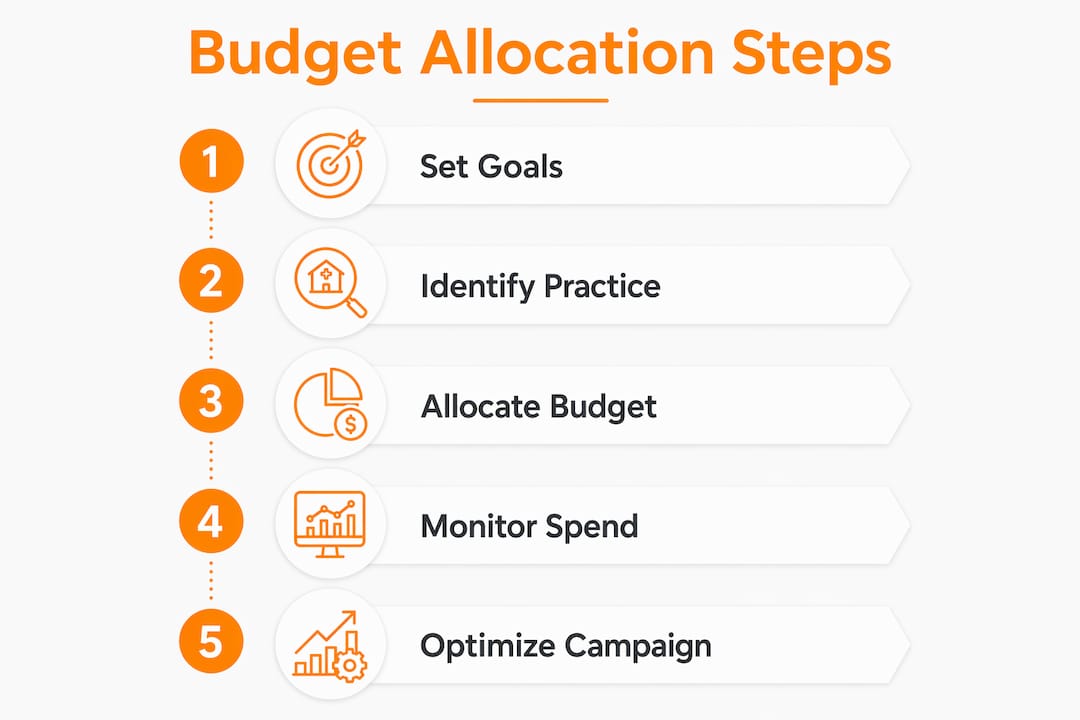
Budget decisions should start with case value, not gut feel. Here is the framework:
- Identify your average case value by practice area. A bankruptcy case may average $2,500 while a personal injury case averages $40,000.
- Set a target cost per signed case. If you are willing to spend 10% of case value on acquisition, your target for personal injury is $4,000 per signed case.
- Work backward from conversion rates. If your intake converts 10% of consultations to signed cases, and consultations convert 20% of leads, you need 50 leads to sign one case.
- Calculate required budget. At $150 cost per lead, 50 leads costs $7,500 per signed case. Adjust bids, landing pages, or intake to hit your target.
- Scale only after you have data. Underfunding a campaign starves the bidding algorithm. Spend enough to generate at least 30–50 conversions per month before drawing conclusions.
Pro Tip: Allocate at least 60–70% of your initial budget to your highest-value practice area. Spreading budget too thin across multiple areas prevents any single campaign from generating enough data for Google’s Smart Bidding to perform.
How do you build a high-intent keyword strategy for legal PPC?
Keyword strategy separates profitable campaigns from money pits. High-intent keywords signal that a prospect is ready to hire, not just researching. “Car accident lawyer Chicago” is high intent. “What does a personal injury lawyer do” is not. Your budget belongs on the former.
Structure your keyword approach in four steps:
- Build tightly themed ad groups. Group keywords by practice area and intent level. Personal injury, criminal defense, and family law each get their own campaigns with dedicated ad groups for specific case types.
- Use phrase match and exact match. Broad match keywords trigger ads for searches like “law school” or “attorney salary,” which will never produce a client. Phrase and exact match give you control.
- Build a negative keyword list from day one. Add terms like “free,” “pro bono,” “law school,” “salary,” “jobs,” and “how to become” before you spend a single dollar. Review your search term report weekly and expand the list continuously.
- Match ad copy to keyword intent. An ad triggered by “DUI lawyer near me” should speak directly to DUI defense, not general criminal law. Generic ads produce low Quality Scores and high costs.
Effective campaign structures use tightly themed keyword sets linked to dedicated landing pages, not your homepage. Sending paid traffic to a generic homepage produces high bounce rates and wasted spend.
Pro Tip: Add your city, county, or metro area to keywords wherever possible. “Divorce attorney Dallas” outperforms “divorce attorney” in both relevance and Quality Score, which directly lowers your cost per click.
High Quality Scores are not just a vanity metric. Quality Scores reduce CPC and improve ad positioning, which is critical in expensive legal keyword categories. Landing pages must be relevant, fast-loading, and mobile-optimized to earn those scores.

How do Google Local Services Ads integrate with traditional Google Ads?
Google Local Services Ads (LSAs) appear above standard search ads and carry the “Google Screened” badge, which signals verified credentials to prospects. The payment model differs fundamentally from traditional Google Ads. You pay per lead, not per click. That shift changes the economics significantly.
In a $3.3M spend analysis of law firm campaigns, Google Ads produced 76% of total leads while LSAs produced 24%. LSAs generated fewer leads overall but delivered a more efficient cost per signed case. The leads that come through LSAs tend to be further along in the decision process.
| Feature | Google Ads | Google Local Services Ads |
|---|---|---|
| Payment model | Pay per click | Pay per lead |
| Ad position | Below LSAs | Top of search results |
| Trust signal | Ad label | Google Screened badge |
| Qualification required | None | Background check + license verification |
| Lead quality | Variable | Generally higher intent |
Qualifying for LSAs requires passing background checks and license verification for every attorney listed. That process takes time, but the Google Screened badge increases trust and improves conversion rates once live. Start the qualification process early so LSAs can run in parallel with your Google Ads campaigns from the beginning.
Pro Tip: Monitor your budget split between LSAs and traditional Google Ads monthly. If LSAs are producing a lower cost per signed case, shift budget toward them. The data will tell you the right ratio for your market and practice area.
How do you track PPC performance from clicks to signed cases?
Most law firms track clicks and leads. The firms that scale profitably track signed retainers. Cost per lead is a misleading metric in legal PPC. Criminal defense campaigns can produce cheap leads at around $60 each with a conversion rate below 2%. Bankruptcy campaigns may cost $201 per lead but convert at 10%, producing a cost per signed case of $192. The cheap leads cost more in the end.
Build your tracking stack around these components:
- Call tracking with dedicated numbers. Phone calls are the primary conversion action for law firms. Use dedicated tracking numbers for each campaign to attribute calls accurately.
- Google Ads conversion tracking. Set up conversion actions for calls over 60 seconds, form submissions, and chat initiations. Import these into your bidding strategy.
- CRM integration. Link Google Ads data with your intake and case management system to track from click to signed retainer. This is the only way to calculate true return on ad spend.
- Consultation and retainer tracking. Log every consultation outcome in your CRM with the originating campaign tagged. This data drives every future budget decision.
Most law firms attribute fewer than 75% of signed cases to specific marketing channels. That gap means budget decisions are based on incomplete data, which leads to scaling campaigns that do not actually produce clients and cutting campaigns that do.
State bar advertising rules vary by jurisdiction and must be reviewed before any campaign launches. Non-compliance risks disciplinary action. Assign one person inside the firm to own compliance review and attribution reconciliation. That accountability prevents both legal risk and wasted spend.
What are the most common law firm PPC mistakes to avoid?
The most expensive mistake in legal PPC is optimizing for the wrong metric. Chasing low cost per lead produces high volume of unqualified prospects who consume intake resources without signing. The fix is to set bidding targets based on cost per signed case, not cost per lead.
The second most common mistake is poor landing page design. Mobile optimization is not optional. Google favors mobile-friendly experiences in ad ranking and Quality Score, and most legal searches now happen on mobile devices. A landing page that loads slowly or displays poorly on a phone loses the prospect before they ever read your offer.
Additional mistakes that drain budget:
- Sending all traffic to the homepage. Every practice area needs its own landing page with copy that mirrors the ad that drove the click.
- Ignoring search term reports. Broad match settings trigger irrelevant queries. Review the search term report weekly and add negatives aggressively.
- Setting campaigns and walking away. Legal PPC requires weekly performance reviews. Bids, budgets, and ad copy need regular adjustment based on actual conversion data.
- Skipping ad extensions. Call extensions, location extensions, and sitelinks improve click-through rates and provide more real estate on the search results page.
Pro Tip: Run a monthly audit comparing cost per signed case by campaign, ad group, and keyword. Cut or reduce bids on anything exceeding your target acquisition cost. Reinvest that budget into what is working.
Key Takeaways
Law firm PPC produces the best results when every budget decision, keyword choice, and tracking setup connects directly to the cost per signed case.
| Point | Details |
|---|---|
| Budget to the algorithm | Spend at least $3,000–$7,000 per month per practice area to generate enough data for effective bidding. |
| Track signed cases, not leads | Cost per lead misleads; cost per signed case is the only metric that reflects true campaign ROI. |
| Use LSAs alongside Google Ads | LSAs produce fewer but higher-intent leads and often deliver a lower cost per signed case. |
| Build tightly themed campaigns | Each practice area needs its own campaign, ad groups, and dedicated landing pages to maximize Quality Score. |
| Own your attribution | Link Google Ads to your CRM and call tracking to attribute every signed case to a specific campaign. |
Why I think most law firms are solving the wrong PPC problem
After working with law firms across practice areas, the pattern I see most often is this: firms obsess over cost per lead and miss the metric that actually matters. A $60 lead that converts at 1% costs $6,000 per signed case. A $200 lead that converts at 10% costs $2,000 per signed case. The math is not subtle, yet most firms still optimize for the cheaper lead.
The second thing I see consistently is underinvestment in LSAs. Firms launch Google Ads immediately but delay LSA qualification because the background check process feels like friction. That friction is exactly what makes LSAs valuable. Fewer competitors qualify, which means lower competition and better placement for those who do the work.
Attribution is where I see the most money wasted. Firms that lack attribution end up scaling campaigns that look good on a dashboard but produce no signed cases. The fix is not a bigger budget. It is connecting your ad platform to your intake system so you know exactly which campaigns produce revenue.
Legal compliance is the one area where I always recommend erring on the side of caution. State bar rules on advertising vary significantly, and a campaign that violates them creates liability that no amount of leads can offset. Build compliance review into your launch checklist, not as an afterthought.
The firms that win at pay-per-click management treat it as a data discipline, not an advertising expense. They measure what matters, cut what does not, and scale what works. That mindset is the real competitive advantage.
— Derek
How Theartistevolution helps law firms build PPC campaigns that sign cases
Law firm marketing managers need more than a Google Ads account. They need a system that connects ad spend to signed retainers, stays compliant with state bar rules, and adjusts based on real performance data.

Theartistevolution builds and manages comprehensive PPC campaigns for law firms, integrating Google Ads and Local Services Ads into a single performance-driven program. With over 18 years managing campaigns across legal, healthcare, retail, and entertainment, the team knows how to structure campaigns that produce measurable results. If you want to know where your current PPC spend is going and what it is actually returning, a marketing assessment is the right starting point. The data will tell you exactly where to focus next.
FAQ
What is law firm PPC?
Law firm PPC is pay-per-click advertising tailored to legal services, where firms pay each time a prospect clicks an ad on platforms like Google Ads. The goal is to connect with high-intent prospects at the moment they search for legal help.
How much do law firms typically spend on PPC?
Most law firms budget $3,000–$7,000 per month at minimum in competitive practice areas, with mid-sized multi-practice firms often spending $10,000–$30,000 monthly. Budget should be set based on case value and target cost per signed case, not arbitrary figures.
What is the difference between Google Ads and Google Local Services Ads for lawyers?
Google Ads charges per click and appears below LSAs in search results, while LSAs charge per lead and display at the very top with a Google Screened badge. LSAs require background checks and license verification but typically produce higher-intent leads.
Why is cost per lead a bad metric for law firm PPC?
Cost per lead ignores conversion rates, which vary dramatically by practice area. A low CPL can mask poor intake conversion, resulting in a high cost per signed case. Cost per signed case is the accurate measure of campaign profitability.
How do law firms stay compliant with PPC advertising rules?
Law firms must review campaigns against both Google’s advertising policies and their state bar’s advertising regulations before launch. Non-compliance with bar rules can result in disciplinary action, so assign a designated reviewer to audit every campaign before it goes live.
Recommended
- LinkedIn Lead Generation for Expanding Agency – The Artist Evolution
- CPG and Retail Industry LinkedIn Lead Generation – The Artist Evolution
- Pay-Per-Click Management Agency – The Artist Evolution
- Unveiling Local SEO Secrets: A Blueprint for Boosting Visibility for Brick-and-Mortar Businesses – The Artist Evolution