
A healthcare content strategy is the plan that decides what your practice or health system publishes, for which patients, in what format, who reviews it and how you will know it worked. The blog posts are the visible part. The strategy is the audience research, the review process and the measurement behind them. At The Artist Evolution, a full-service marketing agency with over 18 years in business, we build that plan and manage the campaigns that carry it, so your content serves patients and your organization’s goals together.
TL;DR
- Strategy sets the “why” and “how”; content marketing is the tactical publishing inside it. Start with the strategy.
- Begin with your patients’ real questions, then audit what you already have before you write anything new.
- Write patient education at or below a sixth-grade reading level, with clinical review before publishing.
- Keep marketing content inside HIPAA and FTC rules, especially testimonials and tracking.
- Measure patient conversions, not pageviews alone, and revisit the plan every quarter.
Table of Contents
- Strategy versus content marketing
- Step 1: Start with the audience
- Step 2: Audit what you already have
- Step 3: Choose topics patients actually search for
- Step 4: Write patient education that people can use
- Step 5: Stay inside the rules
- Step 6: Review, publish and promote on a rhythm
- Step 7: Measure what matters
- What good looks like: the Cleveland Clinic example
- Put the strategy to work with us
- FAQ
- Sources
Strategy versus content marketing
The two terms get mixed up. A content strategy sets the overall direction for content and ties it to business goals and user needs: purpose, audience and distribution channels. Content marketing is the tactical work inside it: creating, publishing and distributing content to attract and keep an audience.
The gap matters in healthcare because most teams skip the first part. A 2020 study cited by a healthcare content marketing review found only 28% of healthcare marketers had a clearly defined strategy. The same page notes a 2019 survey in which 52% of the U.S. population worried that online healthcare content is not credible. Credibility is the asset you are building, and a strategy is how you protect it.
A useful way to keep the layers straight:
- Strategy: what content is for, and what it will not do.
- Content plan: the topics and types needed to deliver the strategy.
- Content calendar: when each piece is published and promoted. Our content calendar playbook covers that last layer.
Step 1: Start with the audience
The CDC’s Health Communication Playbook treats audience understanding as the starting point: concise, consistent key messages determine both the content and its format. It recommends limiting key messages to three, with no more than five supporting talking points each.
For a practice, that means naming the groups you serve and what each needs:
- New patients comparing providers: who you treat, what to expect, how to book.
- Existing patients managing a condition: aftercare, prevention, what to do between visits.
- Families and caregivers: questions about children, older relatives, costs and logistics.
- Referring clinicians and job candidates, if recruitment is a goal.
Gather the questions from front-desk staff, nurses, call logs and search data. The Hartford HealthCare presentation from the Society for Healthcare Strategy & Market Development describes choosing consumer-friendly topics from patient questions, keyword research, search habits and marketing goals, then closing with a clear call to action.
Step 2: Audit what you already have
Before planning new assets, inventory what exists. Heinz Marketing suggests logging each piece by audience, funnel stage, format, title and topic, then looking for gaps. Most practices find outdated service pages, thin blog posts and no content for patients who are ready to book.
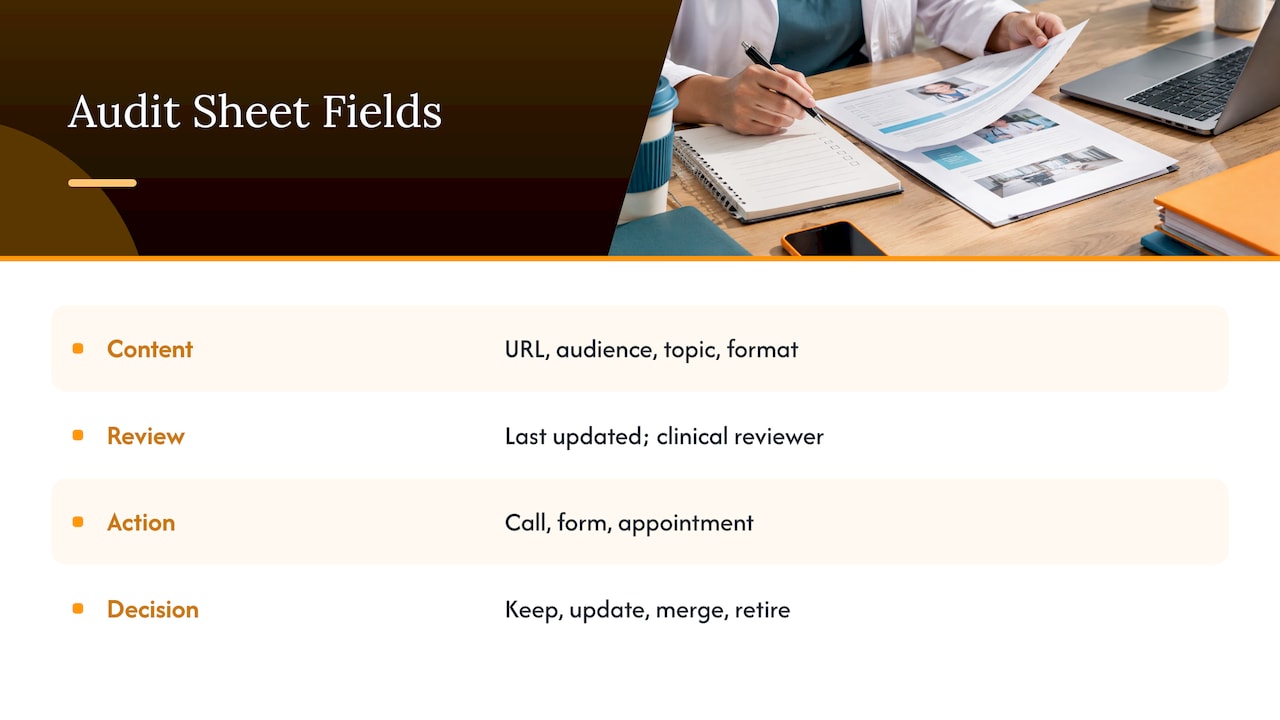
A simple audit sheet has these columns: URL, audience, topic, format, last updated, clinical reviewer, and whether it leads to an action (call, form, appointment). Mark each piece keep, update, merge or retire. Updating a strong page is usually faster than starting from nothing.
Step 3: Choose topics patients actually search for
The American Medical Association’s guide to building trust in your practice advises choosing blog topics from your expertise, local community needs and the questions patients commonly ask. Its examples include vaccines and fall prevention for older patients, and children’s mental health and nutrition for families.
Build topics along the care journey:
| Stage | Patient question | Format that fits |
|---|---|---|
| Awareness | “Is this symptom normal?” | Short blog post, infographic |
| Consideration | “What are my treatment options?” | Service page, FAQ, short video |
| Decision | “What does the first visit involve?” | Landing page, provider bio |
| Care | “What do I do after the procedure?” | Email, printable guide |
| Loyalty | “How do I stay healthy?” | Newsletter, social posts |
Boston Scientific’s patient education guidance suggests two to three focus topics drawn from frequent patient questions and one to two updates a week at a consistent time. Service pages, blogs, short videos, infographics, newsletters and social posts all work as formats.
For specialties, the same logic holds. A dental practice can build around whitening, implants and children’s first visits, and our dental social media guide shows how those topics travel. For search visibility, see our healthcare SEO 90-day plan.
Step 4: Write patient education that people can use
Health literacy decides whether content works. The American College of Physicians recommends evidence-based research, physician and multidisciplinary review, materials at or below a sixth-grade reading level, and input from patients and caregivers when developing or assessing materials.
The American Academy of Family Physicians’ health literacy review adds practical rules:
- Use plain language and short, concrete steps.
- Limit each piece to three key points.
- Use pictures and graphs, short sections and bulleted lists.
- Check understanding with teach-back, where the patient explains the instructions in their own words.
The AMA adds that a practice blog should be informational, educational, relevant, actionable, confirmed and evidence-based, not merely promotional. End every piece with one clear next step: call, book, or download.
A worked example
Take a post for a knee-replacement practice. Weak version: “Total arthroplasty indications and postoperative rehabilitation protocols.” Stronger version: “Knee replacement recovery: what the first six weeks look like.” It has three headings (pain control, movement, when to call us), short sentences, a surgeon’s review line and a button to schedule a consultation.
Step 5: Stay inside the rules
Healthcare content carries legal weight. These are the points marketers meet most often.
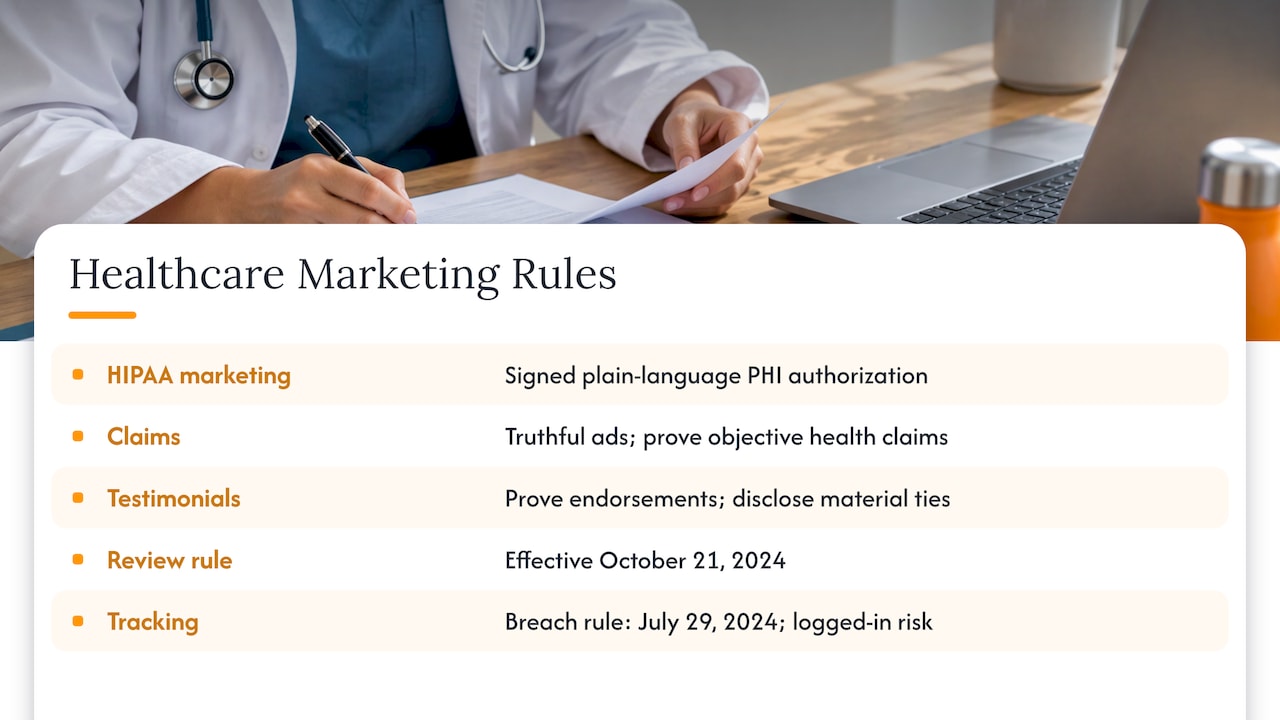
HIPAA and marketing. HHS states that covered entities and business associates need a valid, signed, plain-language authorization to use or disclose protected health information (PHI) for marketing. That includes patient stories and photos tied to identifiable care. Our HIPAA-compliant marketing guide walks through the practical checks.
Claims. The FTC’s Health Products Compliance Guidance says health advertising must be truthful and not misleading, and that objective health or safety claims need adequate substantiation before an ad runs.
Testimonials. FTC endorsement guidance requires substantiation and clear disclosure of material connections, and its Consumer Reviews and Testimonials Rule took effect on October 21, 2024. A patient story is not scientific proof, so keep outcome claims tied to evidence. See our reputation management guide for handling reviews.
Tracking. The FTC amended its Health Breach Notification Rule in 2024, effective July 29, 2024, with changes that clarify unauthorized disclosures can count as breaches. The same analysis notes that a federal court in June 2024 vacated part of HHS’s online-tracking guidance, while risks on logged-in pages remain. Have your compliance officer or healthcare attorney review analytics and ad pixels on any page where patients sign in or book.
Step 6: Review, publish and promote on a rhythm
The AMA recommends that posts be reviewed and approved before publication and that the physician owner keeps control of the website, blog and social accounts. It also favors predictable, consistent posting: strategic, quality information weekly beats hastily produced daily posts.
A workable weekly flow:
- Topic assigned from the quarterly plan.
- Draft in plain language, with sources.
- Clinical review and sign-off by a named clinician.
- Compliance check for PHI, claims and testimonials.
- Publish, then promote through email, social, office materials and follow-up messages.
Heinz Marketing’s quarterly rhythm fits this well: align themes with organizational goals, plan by quarter, prioritize gaps by goals and effort, repurpose suitable assets and revisit the plan each quarter.
Step 7: Measure what matters
The Hartford HealthCare presentation recommends tracking patient conversions and conversion rates alongside traffic and email metrics, and calls pageviews and total subscribers vanity metrics when used alone. It also advises comparing metrics across time periods and using them to adjust upcoming campaigns.
A practical scorecard:
- Organic visits to service-line pages
- Appointment requests and calls from content pages
- Conversion rate from content visit to booking
- Email engagement among current patients
- Pages updated or retired this quarter
Our guide to healthcare landing pages shows what to build so that content visitors have somewhere to convert.
What good looks like: the Cleveland Clinic example
The Content Marketing Institute’s case study of Cleveland Clinic describes a shift from filling internal content requests to prescribing content around audience needs. Its blog traffic reportedly grew from 200,000 to 1 million monthly visits in half a year after moving to three to five audience-focused articles daily. Those are a large system’s historical figures, not a benchmark for a single practice. The transferable lesson is the method: audience first, performance data to win internal support.
Our perspective
Most healthcare content fails before the first word is written. It starts from what the organization wants to say, not from what a patient is asking at 10 p.m. with a symptom and a search box.
We have spent over 18 years building brands and running campaigns, and our approach is to join strategy to execution. A content plan that never reaches your website, search presence, ads and reporting stays a document. When the same team handles messaging, SEO, paid media and measurement, content stops being a blog habit and becomes a patient-engagement system you can actually track.
For providers, that means clinically reviewed, plain-language content tied to services you want to grow, and a clear next step on every page.
Derek
Put the strategy to work with us
We work with healthcare providers, dental specialists and other organizations that need a complete marketing partner. Our Marketing Plan service turns audience insight into a roadmap, and our Search Engine Optimization team makes sure the content you publish gets found. Brand voice and messaging come first, and our messaging framework guide shows how we approach it.

If you want a content strategy built around your patients and measured against your goals, talk to The Artist Evolution.
FAQ
What should a healthcare content strategy include?
It should state your goals, your audiences and their key questions, the topics and formats you will publish, the review and compliance process, the publishing rhythm and the metrics you will track. Keep key messages to three per audience, as the CDC advises.
What reading level should patient education content use?
Aim for a sixth-grade level or below. The ACP recommends that level for patient materials, and the AAFP recommends a fifth- to sixth-grade level for printed material, with short sentences, bullets and visuals.
How often should a practice publish?
Consistency beats volume. The AMA says strategic, quality information posted weekly is preferable to rushed daily posts. Boston Scientific’s guidance suggests one to two updates a week at a consistent time.
Can we use patient testimonials in our content?
Yes, with care. HIPAA requires a signed authorization before PHI is used for marketing, and the FTC requires clear disclosure of material connections. Ask your compliance officer or healthcare attorney to approve your consent form and review process.
Sources
- Content Strategy in UX/UI Design
- Healthcare & Medical Content Marketing: 10 Key Tactics
- Health Communication Playbook (CDC)
- Content Marketing Done Right (SHSMD)
- Developing a Content Strategy for the Healthcare Industry
- A Guide to Building Trust in Your Practice (AMA)
- Content marketing (Boston Scientific)
- Patient and Interprofessional Approach to Content Development (ACP)
- Health Literacy in Primary Care Practice (AAFP)
- Collecting, Using, or Sharing Consumer Health Information (HHS)
- Health Products Compliance Guidance (FTC)
- Healthcare Marketing and Testimonial Compliance Review
- Telehealth Advertising Rules After the FTC Cases
- Cleveland Clinic content strategy case study (Content Marketing Institute)