
An SEO content brief is a one- to two-page document that tells a writer who the piece is for, what the reader is trying to do, what the business needs from the page, and what the draft must cover to earn a ranking. A good one saves a round of revisions. A weak one produces a keyword-stuffed draft that nobody wants to edit.
This guide shows what to put in a brief, in what order, and what to leave out. It also covers the extra care needed for healthcare, dental and legal topics, where accuracy matters more than anything else on the page.
TL;DR
- A brief is a communication tool first and an SEO checklist second. State the business reason for the page, not only the keyword.
- Build every brief on search intent: what the searcher wants to accomplish, and what the top results already give them.
- Do not assign a word count as the goal. Google says it has no preferred length; ask for a complete, satisfying answer instead.
- For health and legal topics, require primary sources and expert review in the brief itself.
- Keep the template short enough that writers read it, and refine it after every published piece.
Table of Contents
- What an SEO content brief is, and what it is not
- The parts of a brief that do the work
- Start with intent and the business reason
- Why a word count is the wrong target
- A sample brief, filled in
- Healthcare, dental and legal briefs need a stricter standard
- Where the brief sits in the larger workflow
- Our perspective: briefs fail when strategy is missing
- Getting help with briefs, SEO and the content behind them
- Mistakes that make briefs fail
- A short template you can copy
- FAQ
- Sources
What an SEO content brief is, and what it is not
Think of the brief as the handoff between strategy and writing. Strategy decides which topics matter. The brief translates one topic into instructions a writer can act on without a meeting.
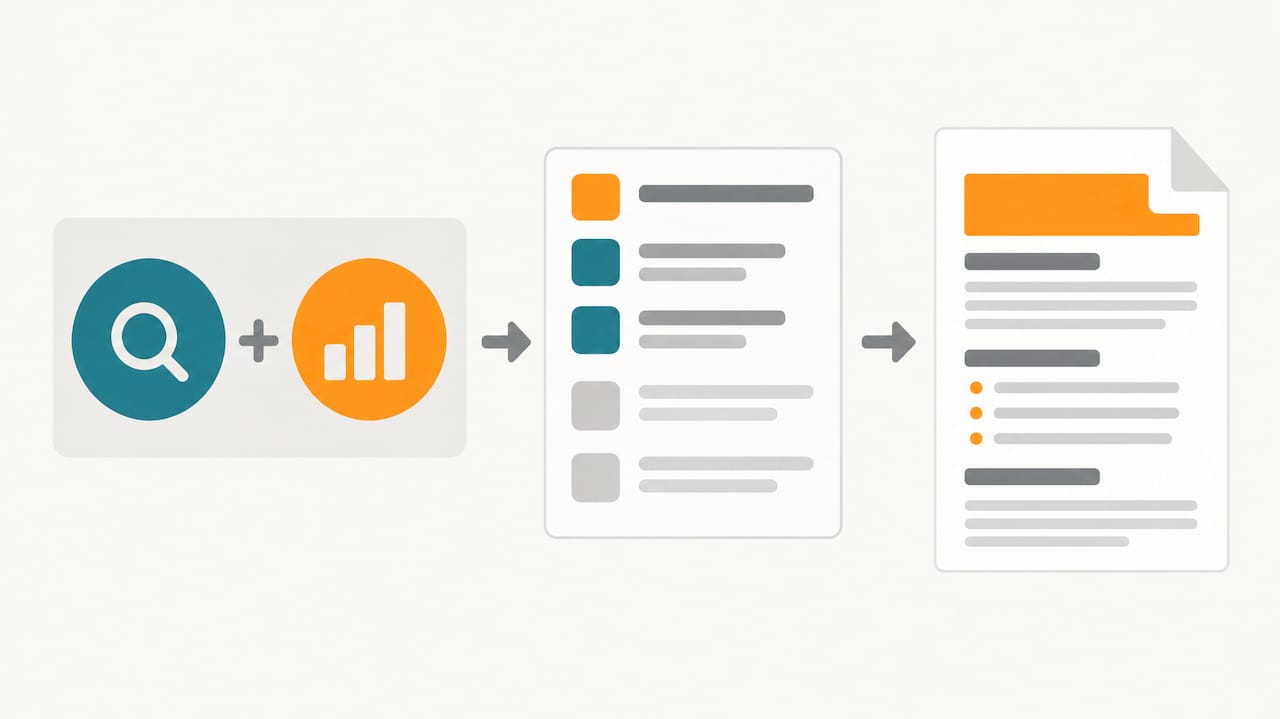
The most common misconception is that a brief is a task list of keywords to insert. Content Marketing Institute makes the point that a brief should explain the business “why” behind a piece. A page meant to position a CEO as an expert needs a different voice and depth than a page meant to collect newsletter signups. If the brief does not say which one you want, the writer will guess.
A brief is also not a creative brief. A creative brief sets the idea, tone and audience for a campaign or asset. An SEO brief is narrower and more tactical: it ties one page to one search need. The two work together, and if you need the campaign-level version, our guide to the one-page creative brief covers the five fields that matter.
The parts of a brief that do the work
Templates online run from five fields to twenty. In our experience the shorter ones get used. Here are the nine fields we would keep, in the order a writer needs them.
- Working title and primary keyword. Give the query the page targets, plus two to five related questions the page should answer. Treat these as topics to cover, not phrases to paste.
- Business goal. One sentence: book a consultation, earn trust before a sales call, support a product category, capture an email. This sets the call to action and the depth.
- Audience and stage. Who is reading, what they already know, and where they are in the decision. A practice manager comparing vendors reads differently from a student defining a term.
- Search intent. Is the searcher trying to learn, compare, or buy? Name it and describe the ideal outcome in plain words.
- What the current results do. Summarize the format of the top-ranking pages: guides, templates, tools, lists. Note the angles they share and the gaps they leave.
- Outline. Proposed H2s and H3s, with a note on what each section must deliver. Let the writer reorder if the research suggests it.
- Sources and experts. Primary sources to use, people to interview, and anything the writer must verify before publishing.
- Brand and style rules. Voice, terms to use or avoid, formatting preferences, and examples of past pieces that got it right.
- On-page and linking requirements. Title and meta description guidance, internal links to include, calls to action, and image needs.
CMI’s own publishing checklist is a useful model for the last mile. It includes a post-editing review and a check of every name of the people, companies and tools mentioned. A short closing checklist at the bottom of the brief keeps proofreading, internal linking and image handling from being forgotten.
Start with intent and the business reason
Keyword research tells you what people type. Intent tells you what they want when they type it. For “seo content briefs,” the people searching are mostly content managers, marketers and agency strategists who want either a template or a method. The results confirm that: guides with templates, how-to steps and tool pages dominate.
A brief should translate that into a decision. Will the page be a method with a downloadable template? A walkthrough with an example? A comparison of approaches? Pick one primary job for the page and say so at the top.
Then add the business reason. A few examples of how the same keyword changes with the goal:
- Goal: generate consultation requests. The page needs a clear next step, proof of results and a section that helps the reader judge whether to hire help.
- Goal: build authority in a niche. The page needs original analysis, named experts and deeper sourcing, and fewer sales prompts.
- Goal: support an existing service page. The page should answer the questions that come before the buying decision and link to the service page naturally.
Writers who know the goal make better decisions on tone, examples and length without asking.
Why a word count is the wrong target
Many briefs open with a number: 1,800 words, 2,500 words. It feels precise, and it is almost always arbitrary.
Google’s guidance on helpful content asks creators whether they are writing to a particular word count because they heard Google prefers one, and answers that it does not. Its framing is people-first: content should leave the reader feeling they got what they came for. You can read that in Google’s documentation on creating helpful, reliable content. The related helpful content update announcement says the system rewards pages where visitors have a satisfying experience.
So write the completeness standard into the brief instead. For example:
- The reader should be able to complete the task without opening another tab.
- The draft must answer each related question in two to four direct sentences before elaborating.
- Every claim that can be checked carries a source.
A length range can still help as a planning estimate for editors and budgets. Label it as an estimate, not a requirement.
A sample brief, filled in
Here is an illustration, not a real client document. Imagine a dental specialist that wants more implant consultations.
| Field | Example entry |
|---|---|
| Primary keyword | dental implant consultation: what to expect |
| Related questions | How long does a consultation take? What imaging is used? What should I ask? |
| Business goal | Reduce hesitation and prompt a consultation request |
| Audience | Adults considering implants, anxious about cost and procedure, early in research |
| Intent | Learn what happens before committing |
| Competitor gap | Top pages are generic and never walk through the appointment step by step |
| Outline | What happens at the visit; questions to bring; how to prepare; what the next step looks like |
| Sources | Professional dental association patient guidance; review by the practice’s licensed dentist |
| Voice | Calm, plain language, no fear-based claims, no guaranteed outcomes |
| Links and CTA | Link to the practice’s implant page; end with a request-a-consult prompt |
Notice how little of this is about keywords. The keyword sits in one row. Everything else tells the writer how to be useful.
Healthcare, dental and legal briefs need a stricter standard
If your page touches health, money or legal outcomes, the brief carries more weight. Google treats these as topics where low-quality information can harm people, and its guidance stresses expertise and trust. Its documentation on helpful content describes E-E-A-T (experience, expertise, authoritativeness and trust) and notes that trust is the most important part. Google’s guidance on AI-generated content repeats the same four qualities.
In practice, add these lines to the brief for those industries:
- Named reviewer. Specify who reviews the draft: a licensed dentist, physician, attorney or other qualified professional. Include the credential to display in the byline or review note.
- Primary sources only for facts. Require links to regulators, professional associations, clinical guidance or statutes. Secondary blog posts do not count.
- Date sensitivity. Flag anything that can change, such as laws, fees or guidelines, and require the date of the source in the text.
- No outcome promises. The brief should forbid language that guarantees results or implies a diagnosis.
- Local specifics. For legal pages, name the state or jurisdiction the content applies to. Law differs by place, and a page that ignores this can mislead.
An analysis of improving E-A-T on YMYL pages from Search Engine Land describes sites improving by adding more authoritative references and removing lower-quality content. Both moves start in the brief, not in the edit.
Where the brief sits in the larger workflow
A brief is the middle step, not the first one. CMI’s data-driven strategy template lays out a seven-stage process: interview stakeholders, review metrics, audit the site, summarize findings, brainstorm ideas, fill in the planning document, and secure buy-in. The brief comes out of that work, which is why it can be short. The thinking has already been done.
A practical sequence for most teams looks like this:
- Decide the topic cluster and the role of each page. Our post on content pillar strategy explains how three to five pillars keep a library coherent.
- Check whether the topic needs a new page or a refresh of an existing one. A content refresh strategy is often the faster win.
- Write the brief, using the nine fields above.
- Have a subject matter expert approve the outline before drafting begins. This is cheaper than fixing a finished draft.
- Draft, edit, fact-check and publish with a short checklist.
- Review performance after a few weeks and update the brief template with what you learned.
CMI also notes that documenting your process matters even for solo operators, since standard steps let someone else step in during an absence. A simple checklist often beats an elaborate system.
Our perspective: briefs fail when strategy is missing
We have spent more than 18 years running campaigns for businesses from startups to household brands, across retail, healthcare, legal and entertainment. The pattern we see most often is not a bad writer. It is a brief that skips the strategic question.
When a page is commissioned as “a 1,500-word post on keyword X,” the writer has nothing to optimize for except the keyword. When the brief says who the reader is, what decision they face and what we want them to do next, the same writer produces something specific. That is the gap between content that fills a calendar and content that supports a campaign.
Three habits make the difference for us:
- We write the brief from the campaign, not the keyword list. Each page has a job inside a larger plan. Our marketing campaign management framework shows how we connect goals to channels and reporting.
- We bring messaging into the brief. A brand messaging framework gives writers approved language, so voice stays consistent across many authors.
- We treat regulated industries differently. For healthcare and legal clients, expert review is a step in the process, not an afterthought.
Our view is simple: the brief is where strategy becomes execution. If it is vague, everything after it is slower and more expensive.
— Derek
Getting help with briefs, SEO and the content behind them
If your team lacks the time to build briefs, or you want briefs tied to a full search plan, our Search Engine Optimization Agency service connects keyword research, content and measurement under one roof. If you are not sure where to start, a marketing assessment shows where content fits in your wider plan. You can also see what search growth looked like for one client in our SEO improvement case study.
Mistakes that make briefs fail
- Too long. A ten-page brief goes unread. Keep it to two pages and link out to the style guide.
- Keywords without context. A list of terms with no explanation of why they matter invites stuffing.
- Copying the top results. If your outline mirrors the first three pages, you add nothing. Name the gap you will fill.
- No source standard. Writers fall back on whatever ranks. Specify what counts as an acceptable source.
- No feedback loop. If you never compare published results against the brief, it never improves. Note what worked, then change the template.
- Outdated guidance. SEO advice ages quickly. If you rely on older advice, check it against current documentation. Our earlier post on Google’s algorithms and best practices is a snapshot of that moment and should be read as such.
A short template you can copy
Paste this into a document and fill it in for each piece:
- Page job (one sentence):
- Primary keyword and related questions:
- Reader and stage:
- Search intent and ideal outcome:
- What top results do, and the gap:
- Outline with section goals:
- Required sources and experts:
- Voice and terms:
- Links, call to action, images:
- Reviewer and sign-off:
- Closing checklist: proofread, verify names and figures, internal links, image alt text, publish date
Start with one page, publish it, and measure it. Then adjust.
FAQ
How long should an SEO content brief be?
One to two pages is enough for most posts. Include only what the writer needs to act: goal, audience, intent, outline, sources and rules. Put the long style guide in a separate document and link to it.
Who should write the content brief?
Usually a content strategist, editor or SEO lead who understands both the business goal and the search landscape. In regulated fields, a subject matter expert should review the outline before drafting starts. Solo operators can write their own briefs, and doing so still improves focus.
Can AI tools write the brief for me?
They can speed up research, such as summarizing the format of top results or suggesting related questions. They cannot know your business goal, brand voice or which claims need expert review. Google says its systems reward quality and helpfulness whatever how content is produced, so use tools for drafting support and keep a person responsible for the final brief.
Should a brief include a target word count?
Only as a rough planning estimate. Google has said it has no preferred word count, so the brief should define completeness instead: the questions to answer and the task the reader should be able to finish.
What is the difference between a content brief and a creative brief?
A creative brief sets the idea, tone and audience for a campaign or asset. A content brief is a page-level instruction tied to a search need and a business goal. Many teams use both, with the creative brief guiding the content briefs that follow.
Sources
- Creating Helpful, Reliable, People-First Content, Google Search Central
- What creators should know about Google’s August 2022 helpful content update
- Google Search’s guidance about AI-generated content
- Better Content Writing: Follow This System, Content Marketing Institute
- Data-Driven Content Strategy Meets Content Marketing, Content Marketing Institute
- How To Set Up a Content Publishing Process Worthy of Repetition, Content Marketing Institute
- How to improve E-A-T for YMYL pages, Search Engine Land