
An outsourced marketing department is a team of outside specialists who plan, run and report on your marketing as if they sat down the hall. You get strategy, creative, digital advertising, SEO and analytics from one partner instead of hiring each role yourself. For healthcare practices, law firms, consultancies, retailers, CPG brands and new businesses, the real question is whether one accountable team can carry more of your growth than a patchwork of freelancers and a single in-house hire. At The Artist Evolution, a full service marketing agency with more than 18 years in business, that is the model we build and manage every day.
TL;DR
- An outsourced marketing department replaces a hiring plan with a ready team: strategy, brand, creative, paid media, SEO and reporting under one roof.
- Most companies do not go all in on one side. Bain & Company found that 82% of marketers pair an in-house agency with external agencies, so the strongest setups keep direction close and hand execution to specialists.
- It works best when the partner behaves like an extension of your team, with a written scope, shared KPIs and a clear first win.
- Judge a partner on scope, relevant industry experience, communication rhythm and how it reports results, not on the size of its pitch deck.
Table of Contents
- What an outsourced marketing department actually is
- What the team can cover
- When outsourcing makes sense
- In-house, hybrid or outsourced
- What it costs and what moves the price
- How a good engagement runs, step by step
- How to choose a partner
- Where The Artist Evolution fits
- Our perspective
- FAQ
- Sources
What an outsourced marketing department actually is
Think of it as a marketing department you rent by the month rather than build by the hire. The same function exists (planning, brand, content, advertising, website, measurement), but the people sit at a partner firm and serve several clients.
The idea has a name in the trade. MarketingProfs describes Marketing as a Service as managed-services thinking applied to marketing: execution and operational work moves outside so internal staff can focus on strategic, high-value work. Offerings span digital marketing, account-based marketing, analytics and creative services.
Three terms searchers use all point to the same thing:
- Outsourced marketing department: the whole function, usually under a retainer.
- Outsourced marketing team: the same people, described by who does the work.
- Outsourced marketing services: the individual deliverables, such as a pay-per-click (PPC) campaign, an SEO program or a brand refresh.
How it differs from freelancers and a one-off project
A freelancer gives you one skill. A project agency gives you one deliverable and moves on. A department gives you a standing team where strategy, creative and media buying are planned together, so the ad, the landing page and the search presence tell the same story. That coordination is the part most small teams cannot staff alone.
What the team can cover
The Conference Board’s February 2026 research brief finds that companies outsource mainly for expertise they lack internally, such as content creation, video production, creative strategy, media planning and buying, and marketing strategy. Here is how that maps to the work our readers usually need.
| Need | What the outsourced team handles |
|---|---|
| Brand identity for a new business | Positioning, brand story, visual identity, messaging |
| Patient or client acquisition | Website, local SEO, paid search, content |
| Online visibility for a law firm | SEO, PPC, website structure, reporting |
| Consulting firm growth | Integrated strategy, thought leadership, lead generation |
| Retail and CPG | Campaign management, digital advertising, creative assets |
| Ongoing performance | Reporting, optimization, marketing technology |
Our own services follow that list: brand development, website design, SEO, pay-per-click management and marketing tools, all tied together by strategy and management.
When outsourcing makes sense
You do not need a crisis to outsource. These situations are the common triggers:
- You are launching or renaming a business. Brand identity, website and first campaigns need several skills at once. Hiring four people before you have revenue is rarely practical.
- You have a marketing hire, but one person cannot cover everything. One marketer is rarely a strategist, designer, SEO specialist and media buyer. A partner fills the gaps and your hire gains a team.
- Your visibility is behind your quality. A law firm with strong results but weak search presence, or a dental specialist whose practice is better than its website, has an execution problem a specialist team can fix.
- Demand is uneven. Seasonal retail and CPG launches need a burst of capacity, then a steady maintenance rhythm. A retainer scales up and down more easily than payroll.
- You are filling a gap. The Conference Board notes that external vendors can temporarily expand teams and fill interim gaps while reorganizations are put in place.
If you already have a large internal team with spare capacity and a clear plan, a lighter engagement for a single discipline may be all you need. The model suits owners and leaders who want results more than they want to manage a marketing org chart.
In-house, hybrid or outsourced
The choice is rarely binary. Bain’s 2024 research reports that 82% of marketers had an in-house agency as well as external agencies, up from 78% in 2018. Its guidance is to keep media strategy, insights, data, analytics and performance metrics close, while outsourcing creative development, flexible execution and other capacity.
For a growing practice or business, that translates into a simple split:
- You own: the goals, the budget, the patient, client or customer knowledge, and the final call.
- Your partner owns: the plan, the creative, the campaigns, the technical work and the reporting against your goals.
The same Bain research flags the real risk: companies that juggle many external agencies can see rising costs, inefficiency and less innovation, and marketers can burn time coordinating instead of running the business. Its remedy is a consolidated agency ecosystem with clear decision rights, service-level agreements and escalation guidelines. That is the strongest argument for one full service partner over five separate vendors: one point of accountability, one plan, one report.
What it costs and what moves the price
Pricing depends on the scope you sign, so no honest figure fits every business. These are the factors that move it:
- Number of disciplines. Brand, web, SEO and paid media together cost more than a single channel.
- Ad spend. Your media budget is separate from the fee for managing it.
- Production load. Video, photography and custom creative take more hours than template work.
- Industry complexity. Regulated fields such as healthcare and legal need more care in messaging and approvals.
- Pace. A fast launch needs more people at once than a steady campaign.
Most of our work runs on fee-for-service contracts and retainer agreements, with project-based pricing for brand development. A marketing assessment is a practical place to turn your goals into a defined scope before any commitment.
How a good engagement runs, step by step
The Conference Board quotes a roundtable participant who describes success as onboarding agencies that become an extension of the team, learn from you and push your ideas. The research also finds that treating external partners as integrated team members makes collaborations work, especially in creative. Here is the routine that produces that.
1. Define the scope in writing
List deliverables, channels, owners and what is out of scope. Vague scope is the usual source of friction. Our guides to a marketing scope of work and a marketing SLA with KPIs give you language you can copy.
2. Protect what you pay for
The contract should say who owns the creative, the accounts and the data. See the five clauses in our guide to a marketing agency contract.
3. Onboard toward a quick win
The first weeks should end in something visible, not a stack of slides. Our agency onboarding framework lays out five stages aimed at a first result within two weeks.
4. Build one integrated plan
Brand, website, search and paid media should pull the same way. Our guide to an integrated marketing strategy shows how to connect them, and brand versus performance helps you split budget between long-term awareness and short-term leads.
5. Run campaigns on a cadence
Weekly check-ins for active work, a monthly review of results and a quarterly look at strategy keep everyone aligned. A step-by-step campaign management framework covers the stages.
6. Report on a few KPIs
Five to eight numbers tied to business goals beat a forty-slide dashboard. See our notes on marketing reporting for how to choose them. Our description of the service includes ongoing reporting and optimization, so the numbers lead to changes rather than archives.
How to choose a partner
Use these criteria and ask every candidate the same questions.
| Criterion | What to look for |
|---|---|
| Scope | One team covering strategy, brand, web, SEO, paid media and reporting |
| Industry fit | Work in your sector: healthcare, legal, consulting, retail or CPG |
| Communication | A named lead, a set meeting rhythm and a clear escalation path |
| Measurement | KPIs agreed up front and reported on a schedule |
| Track record | Case studies with real outcomes |
| Ownership | Clear terms for creative, accounts and data |
If you are comparing several firms, a structured request for proposal keeps the comparison fair. Our marketing RFP template includes a scoring rubric. To see what finished work looks like, browse our case studies, such as SEO improvement after a national relaunch and the engineering firm project.
Where The Artist Evolution fits
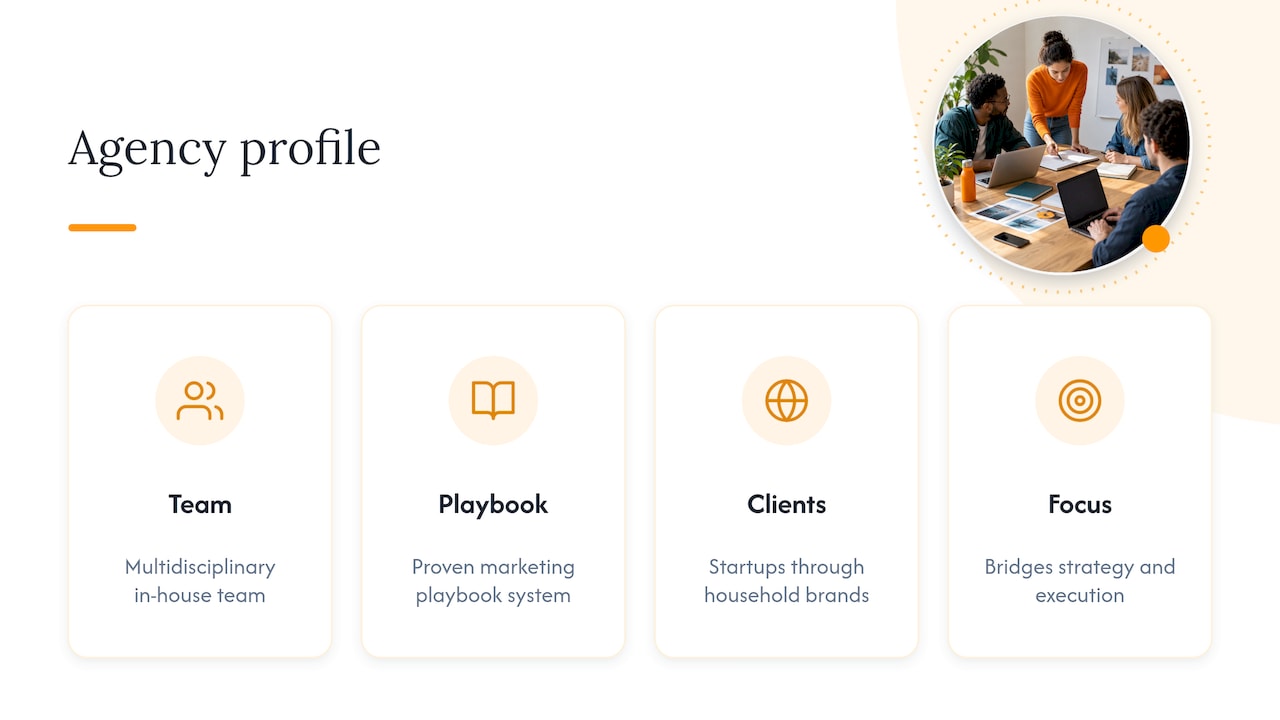
We are a full service agency that builds and manages campaigns for startups through household brands, with a multidisciplinary in-house team and a proven marketing playbook system. Clients in healthcare, legal, retail and entertainment come to us for visibility and measurable results. We aim to function as an extension of your team, bridging strategy and execution.
If you want to see how that would apply to your practice, firm or brand, start with our Strategy & Management service or ask for a marketing plan.

Our perspective
Most owners come to us after trying the pieces one at a time: a freelancer for the logo, another for the website, an ad account nobody has time to watch. Each piece may be fine. Nothing connects them.
The advantage of a department is the connection. Our team works across brand, web, SEO, paid media and reporting, so the message a patient or client sees in search is the same one they find on the site and in the ad. Over 18 years, that is what has separated campaigns that talk about goals from campaigns that reach them.
Our advice is to start with a defined scope and one visible win, then expand as results come in. Treat us as part of your team, share your goals openly and expect us to bring ideas that push yours.
Derek
FAQ
What is the difference between an outsourced marketing team and an agency?
An agency is a firm that sells marketing work. An outsourced marketing department is a way of using one: a standing team that covers strategy and execution across disciplines on an ongoing basis. The emphasis is on continuity and integration rather than a single campaign.
Which services can I outsource?
Nearly all of them. Common ones are brand development, website design, SEO, PPC, content and creative production, campaign management and reporting. The Conference Board’s brief points to content, video, creative strategy, media buying and marketing strategy as areas companies most often lean on outside experts for.
Do I lose control of my brand if I outsource?
No, provided the contract and process keep you in charge of goals, budget and approvals. Put ownership of creative and accounts in writing and agree a regular review rhythm. The partner then works to your direction and brings expertise to carry it out.
How long before I see results?
It depends on the channel. A well-planned onboarding should produce a first visible deliverable within weeks, while SEO and brand work build over a longer period. Agree the KPIs and reporting schedule at the start so progress is measured the same way each month.
Sources
- Marketing as a Service: Outsourcing Marketing, MarketingProfs
- In-House vs. Outsourcing: AI-Driven Shifts in Marketing and Communications, The Conference Board
- Marketers’ Agency Partnerships Are Strained. Now Comes AI, Bain & Company