
An integrated approach, often called “brandformance,” is the recommended baseline for most organizations. The debate between brand and performance marketing is largely a false choice. The two disciplines work as a system: brand builds the demand that performance converts. The practical question is not which one to run, but how to weight them given your stage, margins, and goals.
Starter allocation rule-of-thumb by business stage:
- Pre-product-market fit: Weight heavily toward performance (roughly 70–80% of paid budget) to generate fast feedback loops, test messaging, and validate demand. Keep brand investment minimal but consistent.
- Growth stage: Shift toward a more balanced split as you scale paid channels and begin building category recognition. Brand investment starts earning compounding returns here.
- Mature brand: Prioritize brand investment to defend pricing power and sustain baseline demand, while performance channels harvest the demand brand creates.
These are starting points, not rules. The signals that should move your allocation are covered in the decision framework below.
Table of Contents
- What is brand vs performance marketing, and where does each live in the funnel?
- Which channels and tactics belong to brand, performance, or both?
- What are the real strengths and weaknesses of each approach?
- How do you measure brand and performance? KPIs, attribution, and experiments
- How do you build an integrated brand and performance program?
- How do you choose the right brand vs performance mix for your business?
- Step-by-step checklist for launching an integrated program
- What does the research say about combining brand and performance?
- What are the most common pitfalls when balancing brand and performance?
- Key Takeaways
- The case for treating brand investment as infrastructure
- How Theartistevolution helps you run brand and performance together
- Useful sources for further reading
What is brand vs performance marketing, and where does each live in the funnel?
Brand marketing and performance marketing are not competing philosophies. They operate on different timelines, with different objectives, and at different points in the customer journey.
Brand marketing focuses on awareness, emotional differentiation, and preference. Its goal is to make your company the first name a buyer thinks of when a need arises, and to make that association positive enough to justify a price premium. Results compound over months and years. You are building mental availability, a concept popularized by Byron Sharp’s work at the Ehrenberg-Bass Institute, which describes how readily a brand comes to mind in buying situations.
Performance marketing focuses on measurable actions: a lead form submitted, a product purchased, a call booked. It operates on a timeline of days to weeks, and every dollar is expected to produce a trackable output. Google Ads, Meta conversion campaigns, and affiliate programs are the canonical examples. Cost per acquisition (CPA), return on ad spend (ROAS), and conversion rate are the metrics that matter.
Which channels and tactics belong to brand, performance, or both?
The channel-to-objective mapping is less fixed than most planning frameworks suggest. The same platform can serve radically different objectives depending on how you configure it. Shopify’s practitioner guidance makes this explicit: Meta and YouTube, for example, are equally capable of running brand awareness campaigns and direct-response conversion campaigns. The objective setting, creative format, and audience targeting are what determine which discipline you are practicing.
Paid channels
- Brand objectives: Broad-reach video on YouTube or connected TV, display campaigns optimized for reach and frequency, sponsored podcast content, programmatic awareness buys.
- Performance objectives: Google Search and Shopping, Meta conversion campaigns, retargeting, affiliate networks, pay-per-click management across intent-driven placements.
- Both: YouTube can run a 30-second brand film for awareness and a 15-second direct-response pre-roll for conversions in the same campaign structure. Meta’s Advantage+ campaigns blend reach and conversion objectives within a single budget.
Owned channels
- Brand: Your website’s editorial content, a brand-consistent email newsletter, a LinkedIn thought leadership program, and a brand messaging framework that keeps creative coherent across every touchpoint.
- Performance: Landing pages optimized for conversion, triggered email sequences tied to behavioral signals, on-site personalization based on traffic source.
Earned channels
- Brand: Press coverage, organic social sharing, influencer partnerships focused on reach and sentiment, community-building.
- Performance: Referral programs with tracked attribution, review generation tied to purchase events, affiliate partnerships with CPA structures.
Pro Tip: When testing a new channel, define the objective before you define the creative. A YouTube campaign built for awareness and one built for conversions require different creative lengths, calls to action, and success metrics. Mixing objectives in a single campaign produces mediocre results on both dimensions.
The brand recognition fundamentals that make performance campaigns more efficient are built in owned and earned channels long before a paid conversion campaign launches. Teams that treat owned content as a brand asset rather than a traffic tactic tend to see lower CPAs over time.
What are the real strengths and weaknesses of each approach?
Decision-makers need to weigh trade-offs that affect budget risk, measurement clarity, and long-term competitive position. The table below captures the practical consequences.
| Dimension | Brand Marketing | Performance Marketing |
|---|---|---|
| Speed to results | Slow (months to years) | Fast (days to weeks) |
| Measurement clarity | Indirect; requires brand tracking, surveys, or incrementality tests | Direct; click-through, conversion, and CPA are immediately visible |
| CAC impact | Lowers CAC over time by increasing organic and direct traffic | Produces immediate conversions but CAC tends to rise as audiences saturate |
| Pricing power | Builds it; strong brands command premium prices | No direct effect; performance channels compete on price and offer |
| Scalability | Scales with reach; diminishing returns are gradual | Scales quickly but hits diminishing marginal ROAS as budgets grow |
| Platform dependency | Lower; brand equity lives in memory, not an algorithm | Higher; CPMs and CPCs fluctuate with platform policy and auction dynamics |
| Long-run baseline volume | Sustains and grows it | Does not build baseline; volume drops when spend stops |
| Attribution | Difficult to attribute directly to revenue | Easily attributed in last-click models; incrementality is harder to prove |
The practical consequences are worth spelling out. A mature ecommerce brand that cuts brand investment to hit a short-term ROAS target often sees branded search volume decline within two to three quarters. When that happens, the performance campaigns that relied on warm audiences become more expensive, and blended ROAS falls anyway. The short-term gain reverses. An early-stage startup that invests heavily in brand before validating product-market fit faces the opposite problem: beautiful creative, no conversion data, and a shrinking runway.
Hyper Island’s analysis frames this well: neither approach wins in isolation. The question is which constraint matters most right now, speed to revenue or durability of demand.
How do you measure brand and performance? KPIs, attribution, and experiments
Measurement is where most integrated programs break down. Brand metrics feel soft to finance teams, and performance metrics feel incomplete to brand strategists. A practical measurement playbook covers both.
KPI reference table
| Metric | What it measures | When it’s most useful |
|---|---|---|
| Unaided brand awareness | % of target audience who name your brand unprompted | Quarterly brand tracking; baseline before major campaigns |
| Aided brand awareness | % who recognize your brand when prompted | Useful for new markets or product launches |
| Net Promoter Score (NPS) | Customer loyalty and likelihood to recommend | Ongoing; compare pre/post brand campaigns |
| Branded search volume | Search demand for your brand name (Google Search Console) | Monthly; leading indicator of brand health |
| Share of voice | Your brand’s presence vs. category in paid/organic/social | Quarterly competitive review |
| ROAS | Revenue generated per dollar of ad spend | Weekly/monthly for paid performance channels |
| CPA / CAC | Cost to acquire a paying customer | Campaign-level and blended across channels |
| Conversion rate | % of visitors or leads who complete a target action | Landing page and funnel optimization |
| Blended ROAS | Total revenue divided by total marketing spend | Monthly; accounts for brand’s contribution to performance |
| Incrementality lift | Revenue or conversions attributable to a specific investment | Post-test; validates whether spend is actually driving outcomes |
For measuring marketing ROI across brand and performance, blended ROAS is more honest than channel-level ROAS because it captures the halo effect brand investment has on paid conversion efficiency. A brand campaign that lifts branded search CTR by 15% will improve the ROAS of your search campaigns without appearing in search campaign attribution.
Attribution limits and how to work around them
Last-click attribution systematically undervalues brand touchpoints because brand impressions happen early in the journey and rarely receive credit for the conversion that follows weeks later. Data-driven attribution models (available in Google Ads and GA4) distribute credit more fairly, but they still struggle with cross-channel and offline brand exposure.
The most reliable method for validating brand investment is incrementality testing: running controlled experiments where a holdout group sees no brand advertising while a treatment group does, then measuring the difference in conversion rates, branded search volume, and direct traffic. Geo-based holdout tests are practical for most mid-market budgets and produce defensible evidence for finance teams.
Experiment checklist:
- A/B creative tests: Run within a single channel to isolate creative variables. Use for performance optimization, not brand measurement.
- Holdout tests: Suppress ads to a matched audience segment for 4–6 weeks. Measure lift in conversion rate and branded search.
- Geo tests: Activate brand campaigns in select markets, hold others dark. Compare sales velocity or branded search index across markets.
- Incrementality tests: The gold standard for validating any channel’s true contribution. Use before scaling a channel significantly.
For tracking setup: implement UTM taxonomy consistently across all campaigns, standardize event naming in GA4 or your analytics platform, and audit tracking before every major campaign launch. AI-powered brand awareness measurement tools are increasingly useful for capturing brand signal data that traditional analytics miss.
How do you build an integrated brand and performance program?
The term “brandformance” describes campaigns designed to serve both objectives simultaneously. HBR’s research makes the case that modeling and measurement can capture the return on brand investment when the right metrics are applied, and that the two disciplines reinforce each other when run together.
A practical integration framework has three components:
1. Narrative-first creative strategy
Start with a brand story that works at every funnel stage. The same core narrative should appear in a 60-second awareness video, a 15-second retargeting cut, and a static conversion ad. When creative is built from a single narrative, brand signals accumulate even in performance placements. When performance creative is built in isolation, it often contradicts the brand, creating cognitive dissonance that reduces conversion rates.

2. Audience layering
Use brand campaign audiences as seeds for performance targeting. Viewers of your YouTube brand content, visitors to editorial pages, and email subscribers who engaged with thought leadership are warmer audiences for conversion campaigns. Layering these audiences into paid search and social retargeting typically produces lower CPAs than cold prospecting.
3. Shared KPIs and a unified dashboard
Brand and performance teams operating on separate dashboards will optimize against each other. A shared dashboard that tracks branded search volume, blended ROAS, direct traffic share, and CAC trend gives both teams a common language. Weekly reviews should cover both sets of metrics.
Operational guidance:
- Hold a monthly cross-team creative review where brand and performance teams align on upcoming campaigns and share audience insights.
- Build a creative template library that includes brand-compliant assets at every format and length, so performance teams can iterate without going off-brand.
- Set a minimum brand investment floor (a percentage of total paid budget) that does not get cut during short-term ROAS pressure.
Two short examples:
DTC product launch: A consumer brand launching a new product runs a six-week YouTube and podcast awareness campaign to build category association, then activates Meta conversion campaigns targeting audiences who engaged with the awareness content. The conversion campaign benefits from pre-warmed audiences and sees lower CPAs than cold prospecting would have produced.
B2B lead generation + thought leadership: A professional services firm publishes a LinkedIn thought leadership program (brand) while running LinkedIn Lead Gen Forms targeting the same job titles (performance). The thought leadership content increases the open rate on the lead nurture sequence, shortening the sales cycle.
How do you choose the right brand vs performance mix for your business?
The right allocation depends on four variables: product-market fit status, cash runway, margin structure, and current brand signals. Work through this checklist before setting budgets.
Decision checklist:
- Do you have product-market fit? If not, performance-heavy allocation gives you faster signal. Brand investment before PMF is largely wasted.
- What is your cash runway? Short runway demands performance-heavy allocation. Brand investment has a long payback period.
- What are your gross margins? High-margin products (software, professional services, luxury goods) can sustain brand investment because the lifetime value justifies slower payback. Low-margin products need faster conversion cycles.
- How competitive is your category? High-competition categories with established players require brand investment to differentiate. Pure performance competition in a crowded category drives up CPCs for everyone.
- What do your brand signals look like? Flat or declining branded search volume, falling direct traffic share, and rising CAC are signals that brand investment is underweighted.
Sample allocation matrix
| Business type | Suggested starter split (brand / performance) | Primary rationale |
|---|---|---|
| Pre-PMF startup | 70% / 30% | Speed of feedback and cash efficiency |
| Growth-stage DTC | — | Building category presence while scaling conversion |
| Growth-stage B2B SaaS | 40% / 60% | Thought leadership shortens sales cycles |
| Mature ecommerce brand | — | Defending pricing power and sustaining demand |
| Established enterprise brand | 60% / 40% | Brand equity is the primary competitive moat |
These splits are directional starting points informed by the Binet & Field research tradition, not prescriptive rules. Adjust based on your specific signals.
Signals that should trigger a rebalance toward brand:
- Branded search volume is flat or declining despite growing ad spend.
- Marginal ROAS on performance channels is declining quarter over quarter.
- Direct and organic traffic share is shrinking as a percentage of total.
- CAC is rising without a corresponding increase in customer lifetime value.
Step-by-step checklist for launching an integrated program
A structured launch process prevents the most common failure mode: running brand and performance as separate programs that never reinforce each other.
- Define objectives and success metrics for both brand and performance before any creative or channel work begins. Agree on which KPIs belong to each objective and who owns them.
- Audit current brand signals: Pull branded search volume trends (Google Search Console), direct traffic share (GA4), NPS or CSAT scores, and any existing brand awareness data. This is your baseline.
- Set your allocation using the decision checklist above. Document the rationale so it can be revisited at the 90-day mark.
- Build your creative brief from a single brand narrative. Specify required formats for each channel (video lengths, static dimensions, copy character limits) and flag which assets serve brand objectives vs. conversion objectives.
- Map channels to objectives and confirm that each channel has a defined primary objective, a budget, and a measurement method before launch.
- Implement tracking: Establish UTM taxonomy (source / medium / campaign / content / term), standardize GA4 event names, verify conversion tracking in Google Ads and Meta, and confirm that brand campaign impressions are being logged for audience building. For brand asset governance, follow a consistent naming and usage standard across all creative, similar to how organizations like Harvard’s trademark office govern brand asset usage.
- Pre-launch QA: Confirm all UTMs fire correctly, conversion events trigger on the right actions, and audience lists are populating before spend goes live.
- Set reporting cadence: Weekly performance review (ROAS, CPA, conversion rate), monthly brand review (branded search, direct traffic, awareness tracking), and quarterly allocation review.
- Define creative refresh rhythm: Performance creative typically needs refreshing every 4–6 weeks as creative fatigue sets in. Brand creative can run longer but should be reviewed quarterly for relevance.
- Establish budget reallocation rules: Define in advance what signal triggers a budget shift (e.g., if blended ROAS drops below a threshold for two consecutive months, shift 10% of performance budget to brand).
What does the research say about combining brand and performance?
The evidence for an integrated approach is consistent across multiple research traditions. HBR’s analysis argues that brand building and performance marketing are complementary, and that applying modeling to brand investment can improve total marketing ROI. The article’s central claim is that performance marketing has dominated recent decades at the expense of brand, and that organizations willing to measure brand rigorously can recover significant value.
The Binet & Field body of work, drawn from decades of IPA Effectiveness Award data, established the directional principle that brand investment tends to drive long-run sales impact more efficiently than activation spending alone. Their research shaped the 60/40 discussion that many planning teams reference, though the appropriate ratio varies significantly by business stage and category. Rule1’s synthesis of this research, alongside Analytic Partners’ ROI Genome data, reinforces the point: brand investment often outperforms performance in long-run total sales impact, even when it looks inefficient on a short-term ROAS basis.
Research insight: Brand investment acts as a multiplier on performance outcomes. When brand campaigns increase awareness and preference, paid search CTRs rise, conversion rates improve, and CPCs tend to fall because more users are searching for your brand by name rather than generic category terms. The performance channel benefits from brand equity it did not create.
The practical implication for measurement: you cannot evaluate brand investment using performance metrics on a short timeline. The right test is an incrementality or geo holdout study that measures brand’s contribution to downstream conversion rates and branded search volume over a 60–90 day window. Harvard Business School Publishing provides executive education frameworks for structuring these measurement conversations at the leadership level, particularly useful when presenting brand investment cases to finance teams.
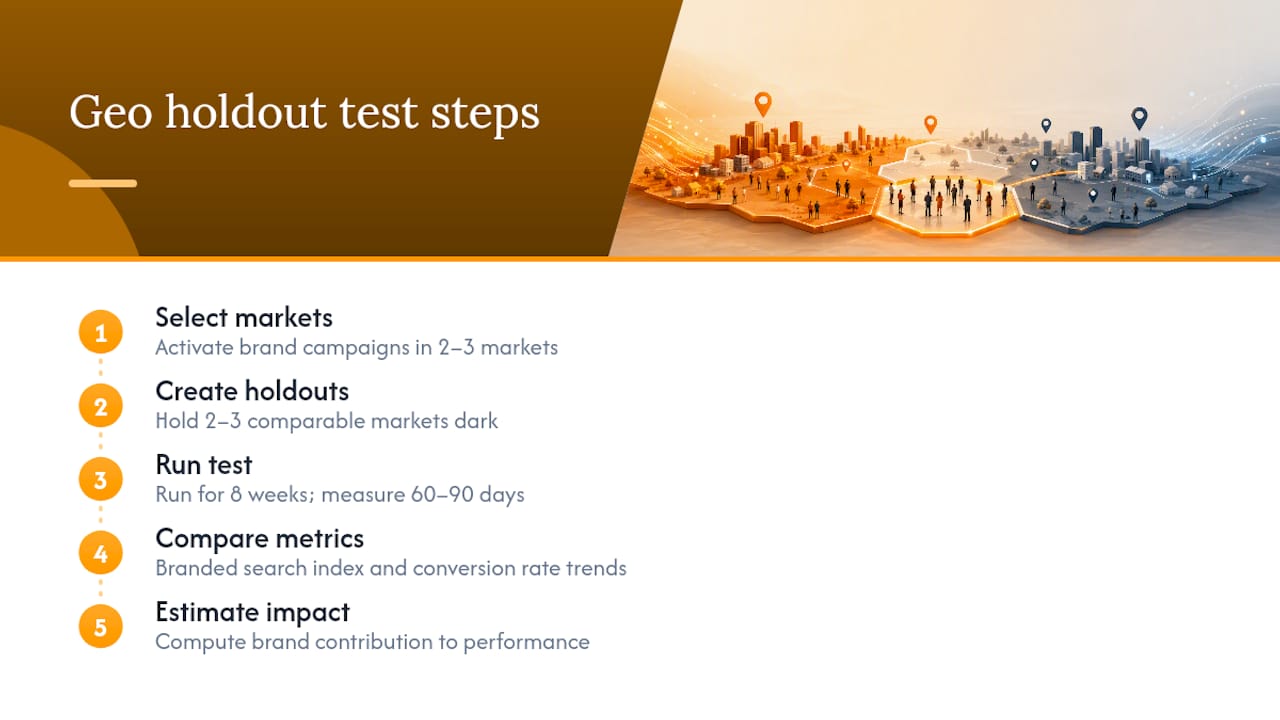
For teams ready to validate their own brand investment, a simple geo holdout test is the recommended starting point: activate brand campaigns in two to three markets, hold two to three comparable markets dark for 8 weeks, and compare branded search index and conversion rate trends across the groups. The results give you a defensible, organization-specific estimate of brand’s contribution to performance.
What are the most common pitfalls when balancing brand and performance?
Most integrated programs fail not because the strategy is wrong but because of predictable execution errors and organizational biases.
- Cutting brand to hit short-term ROAS targets. This is the most common mistake. Mitigation: set a minimum brand investment floor as a percentage of total paid budget and treat it as non-negotiable in quarterly reviews.
- Siloed teams with separate dashboards. When brand and performance teams optimize independently, they often work against each other. Mitigation: shared dashboard, shared weekly review, shared creative brief.
- Over-relying on last-click attribution. Last-click systematically undercounts brand’s contribution. Mitigation: implement data-driven attribution in GA4 and run periodic incrementality tests to calibrate.
- Launching brand campaigns without a measurement plan. Brand investment without a pre-defined measurement approach produces no evidence and gets cut at the next budget review. Mitigation: define brand KPIs and baseline metrics before the campaign launches.
- Recency bias in executive reviews. Executives who see a strong performance quarter often push to shift budget toward what is “working” without accounting for the brand investment that made it work. Mitigation: include branded search trend and direct traffic share in every executive review deck.
- Treating the 60/40 split as a universal rule. The Binet & Field directional guidance is a starting point for mature brands in established categories, not a prescription for every business. Mitigation: use the decision checklist above to derive your own starting allocation.
- Neglecting lead nurturing between brand and conversion touchpoints. Brand awareness without a structured mid-funnel nurture sequence loses the demand it creates. Mitigation: map the full customer journey and assign owned-channel tactics to the mid-funnel gap.
Red-flag checklist for budget reviews:
- Is branded search volume trending down while total ad spend is trending up?
- Has blended ROAS declined for two or more consecutive quarters?
- Is the team unable to name a single brand KPI they track regularly?
- Has creative not been refreshed in more than 8 weeks on performance channels?
- Are brand and performance teams in separate budget conversations with no shared metrics?
Any “yes” answer warrants a structural review of how brand and performance are being managed together.
Key Takeaways
An integrated brand and performance approach, calibrated to business stage and measured with incrementality testing, consistently outperforms either discipline run in isolation.
| Point | Details |
|---|---|
| Integration beats isolation | Brand creates demand; performance converts it. Running both as a system produces better long-run ROI than either alone. |
| Stage-aware allocation matters | Pre-PMF businesses should weight performance heavily; mature brands should protect brand investment to defend pricing power and baseline demand. |
| Measure brand with the right tools | Use branded search volume, blended ROAS, and incrementality tests to evaluate brand investment. Last-click attribution alone will undercount it. |
| Shared KPIs prevent team conflict | Brand and performance teams optimizing on separate dashboards will undermine each other. A unified weekly review with shared metrics is the fix. |
| Theartistevolution builds integrated programs | With 18+ years of experience, Theartistevolution designs and manages brand and performance campaigns across healthcare, retail, legal, and CPG sectors. |
The case for treating brand investment as infrastructure
The conventional wisdom in performance-heavy organizations is that brand is a luxury: something you invest in once the performance channels are maxed out. That framing gets the causality backward.
Brand investment is not a reward for strong performance results. It is the infrastructure that makes performance results sustainable. When a business builds genuine brand equity, its paid search campaigns benefit from higher CTRs on branded terms, its conversion rates improve because audiences arrive pre-convinced, and its CAC trends down over time rather than up. The performance metrics look better precisely because brand is doing its job.
The teams that struggle most with this argument are the ones measuring brand on performance timelines. A brand campaign evaluated at 30 days will almost always look inefficient. Evaluated at 12 months, with branded search volume, direct traffic share, and blended ROAS as the metrics, the picture changes. The discipline is in holding the measurement window long enough to see the effect.
The other underappreciated point: brand investment provides a form of insurance against platform volatility. When CPMs spike, when algorithm changes reduce organic reach, or when a competitor floods a performance channel with spend, the businesses with strong brand equity absorb the shock better. Their audiences come back through direct and branded search channels that no platform controls.
The practical recommendation is simple: treat brand investment as a floor, not a variable. Set a minimum percentage of your total marketing budget that goes to brand regardless of short-term performance pressure, run incrementality tests to build the evidence base, and review the allocation quarterly against the signals that actually matter.
How Theartistevolution helps you run brand and performance together
Running brand and performance as an integrated system requires more than a good strategy document. It requires creative production, channel expertise, measurement infrastructure, and the discipline to hold both objectives in view simultaneously. That is exactly what Theartistevolution is built to deliver.

With 18 years of experience managing campaigns for businesses in healthcare, retail, legal, and CPG, Theartistevolution builds programs that connect brand development to measurable performance outcomes. The agency handles everything from brand narrative and creative production to campaign strategy and ongoing management, PPC execution, and measurement setup. Clients get a single team that speaks both brand and performance fluently, with shared dashboards and reporting that make the connection between the two visible.
The right starting point is a marketing assessment: a structured review of your current brand signals, performance channel efficiency, and allocation logic. From there, Theartistevolution builds a stage-appropriate plan that puts your budget where it will compound. Reach out to start the conversation.
Useful sources for further reading
- How Brand Building and Performance Marketing Can Work Together
- How to Balance Brand Marketing vs Performance Marketing | Mailchimp
- Brand Marketing vs. Performance Marketing: Examples + Tips (2025) – Shopify
- Performance marketing vs brand marketing: when to use each and how to balance both | rule1
- Performance Marketing vs. Brand Marketing
- hbsp.harvard.edu
- trademark.harvard.edu