
For B2B lead generation, the most direct path to pipeline on LinkedIn is tightly targeted Sponsored Content paired with Thought Leader Ads, native Lead Gen Forms wired to your CRM, and a disciplined 90-day test plan. That combination gives you professional-grade audience precision, lower friction on lead capture, and enough data to make scaling decisions with confidence.
LinkedIn’s professional audience has grown to over one billion members, making it the highest-concentration B2B channel available to US advertisers. The platform’s targeting depth — job title, seniority, company size, industry, and skills — is unmatched by any other paid social channel. The tradeoff is cost: CPCs run higher than Meta or Google Display, which means a loose ICP will drain budget fast. Tight audience definitions and a clear offer are non-negotiable from day one.
To get a campaign live this week:
- Set your objective in LinkedIn Campaign Manager (Lead Generation for most B2B programs, Website Conversions for landing-page flows).
- Install the LinkedIn Insight Tag on your website before you spend a dollar — it powers retargeting and conversion tracking.
- Build your first audience using job title + seniority + company size, capped at 50,000–150,000 members for a cold campaign.
- Choose Sponsored Content (single image) as your first format — lowest production barrier, strong reach, and easy to A/B test.
- Attach a Lead Gen Form to capture leads without a landing page, and map form fields to your CRM immediately.
- Set a 90-day test window before judging pipeline contribution.
Key Takeaways
LinkedIn B2B advertising produces pipeline when you combine tight ICP targeting, Thought Leader Ads, Lead Gen Forms connected to CRM, and a 90-day test plan before scaling budget.
| Point | Details |
|---|---|
| Start with Sponsored Content + Lead Gen Forms | Single image ads with native Lead Gen Forms give the fastest CPL data with the lowest production barrier. |
| Tight audiences outperform broad ones | Build cold audiences of 50,000–150,000 members; broader audiences dilute lead quality and raise CPL. |
| Install the Insight Tag before spending | Conversion tracking, retargeting, and Qualified Lead Optimization all depend on the Insight Tag being live. |
| Judge performance at 90 days | CPL stabilizes around day 60; pipeline contribution requires a full 90-day window to measure accurately. |
| Theartistevolution manages the full stack | From ICP definition and creative production to CRM integration and reporting, the agency handles end-to-end LinkedIn lead-gen programs. |
Table of Contents
- Which LinkedIn ad formats work best for B2B goals?
- How do you build precise B2B audiences on LinkedIn?
- How do objectives, budgets, and bidding work for B2B buying cycles?
- What creative actually works for B2B LinkedIn ads?
- How do Lead Gen Forms, the Insight Tag, and CRM integration work together?
- What does a practical A/B testing and scaling playbook look like?
- Which KPIs and attribution methods show LinkedIn’s pipeline impact?
- What do real agency tests tell us about LinkedIn B2B campaigns?
- What most B2B teams get wrong about LinkedIn campaigns
- Theartistevolution builds and manages LinkedIn lead-gen programs that scale
- Sources
Which LinkedIn ad formats work best for B2B goals?
LinkedIn offers more format variety than most B2B teams use, and each format fits a different funnel stage. Picking the wrong one is one of the fastest ways to waste budget on a premium-priced platform.
According to tactical guidance for B2B advertisers, Single Image Ads and Thought Leader Ads rank highest for top-of-funnel B2B performance. Here is how each format maps to a job-to-be-done:
Sponsored Content is the workhorse. It includes single image, carousel, video, and document ads, all delivered in the LinkedIn feed. Single image is the fastest to launch and easiest to test. Carousel ads work well for mid-funnel storytelling (product walkthroughs, case study sequences). Document ads — where users scroll a PDF in-feed — consistently outperform static images for engagement when the content is genuinely useful.
Sponsored Messaging and Conversation Ads land directly in LinkedIn inboxes. Conversation Ads let you build branching message trees with multiple CTA buttons. They work for warm audiences and event invitations but face deliverability limits: LinkedIn caps how often a member receives them, and open rates vary significantly by audience quality.
Text Ads and Dynamic Ads appear in the right-rail sidebar. They carry low CPCs but also low engagement. Dynamic Ads auto-personalize with the viewer’s name and photo, which can lift CTR for retargeting. Neither format should anchor a B2B lead-gen program, but both are useful for retargeting at low incremental cost.
Video Ads run in-feed and support awareness and consideration goals. Short-form video (under 30 seconds) outperforms longer cuts for completion rate. The first three seconds determine whether someone keeps watching, so lead with the hook, not the logo.
Thought Leader Ads amplify individual employee posts as paid ads. Because they come from a person rather than a company page, they carry more credibility and typically see higher engagement rates than equivalent company-page Sponsored Content. LinkedIn’s updated algorithm actively favors employee-driven content over company page posts, which makes Thought Leader Ads a structural advantage, not just a creative preference.
Lead Gen Forms are not a standalone format but attach to Sponsored Content and Sponsored Messaging. They pre-fill member data from LinkedIn profiles, which dramatically reduces form-completion friction compared to a landing page.
| Ad Format | Best For | Key Creative Specs | Bidding Model | Measurement |
|---|---|---|---|---|
| Single Image (Sponsored Content) | Cold awareness, top-of-funnel lead gen | headline ≤150 chars | CPC, CPM, Max Delivery | CTR, CPL, Lead Gen Form completions |
| Carousel | Mid-funnel product/case story | 2–10 cards | CPC, CPM | Card clicks, CTR per card |
| Document Ad | Mid-funnel education, gated content | PDF/PPTX, up to 300 pages | CPC, CPM | Downloads, engagement rate |
| Video Ad | Awareness, consideration | 3s–30min (aim 15–30s) | CPV, CPM | View rate, completion rate |
| Thought Leader Ad | Trust, top-of-funnel engagement | Organic post from employee profile | CPC, CPM | Engagement rate, CTR |
| Conversation Ad | Warm audiences, event invites | Multi-button message tree | CPSend | Open rate, CTA click rate |
| Text/Dynamic Ad | Retargeting, low-cost reach | image, 25-char headline | CPC | CTR, impressions |
Practical pick: For most mid-market B2B teams launching their first paid LinkedIn program, start with a Single Image Sponsored Content campaign using a Lead Gen Form. It requires the least production effort, gives you clean CPL data fast, and creates the audience pool you will need for retargeting in weeks two through four.
Pro Tip: Pair your first Sponsored Content campaign with one Thought Leader Ad from your CEO or a senior practitioner. The contrast in engagement rates between the two will tell you more about your audience’s content preferences than any survey.
How do you build precise B2B audiences on LinkedIn?
Audience quality determines whether LinkedIn’s premium CPCs pay off. The platform’s firmographic targeting is its core advantage, but most teams underuse it or build audiences that are too broad to generate useful signal.
Translating your ICP into LinkedIn targeting criteria
- Start with job title and seniority. Map your ICP’s decision-maker roles to LinkedIn’s job title taxonomy. Add seniority filters (Director, VP, C-Suite) to avoid reaching individual contributors who cannot buy.
- Layer company size and industry. If you sell to mid-market SaaS companies, filter by company size (201–1,000 employees) and industry (Computer Software, Internet). This alone cuts irrelevant impressions significantly.
- Add skills or groups for precision. Skills targeting reaches members who have listed specific competencies — useful for technical buyers. LinkedIn Groups can reach niche professional communities, though group quality varies.
- Exclude current customers. Upload your customer account list as a Matched Audience exclusion. Spending budget on existing accounts wastes money and skews CPL data.
- Save the audience and check the estimated size. Aim for 50,000–150,000 for cold campaigns. Below 50,000 limits delivery; above 300,000 usually means the ICP definition is too loose.
Using Matched Audiences and ABM targeting
Matched Audiences lets you upload contact lists, account lists, or use website retargeting to build audiences from your own data. For an ABM program, upload your target account list (minimum 300 companies for meaningful delivery) and layer job title filters on top. This creates a named-account audience that mirrors a traditional ABM motion.
LinkedIn’s data export tools can help you build and clean contact and account lists before uploading them to Campaign Manager, which improves match rates and reduces wasted impressions.
LinkedIn also offers Predictive Audiences, which use your Lead Gen Form completers or contact list as a seed to find similar members. Minimum seed size is 300 contacts. Predictive Audiences work best once you have at least 90 days of lead data to seed from.
Pro Tip: Resist the urge to build a “safe” large audience. On LinkedIn, broader is rarely better. A 400,000-member audience that includes procurement managers, HR directors, and IT admins alongside your actual buyers will dilute your CPL and make optimization nearly impossible. Tighter audiences cost more per impression but convert at a rate that justifies it.
ABM checklist:
- Upload target account list (min. 300 accounts) as a Matched Audience
- Layer decision-maker job titles and seniority on top
- Exclude current customers and recent closed-lost accounts
- Add a lookalike expansion only after the seed campaign has 500+ leads
- Review audience overlap between ad groups to avoid internal competition
How do objectives, budgets, and bidding work for B2B buying cycles?
LinkedIn Campaign Manager organizes campaigns around three objective tiers: awareness, consideration, and conversions. Choosing the wrong objective is a common mistake that sends the algorithm optimizing for the wrong signal.
Map objectives to funnel jobs:
- Awareness (Brand Awareness, Reach): Optimizes for impressions. Use for net-new account penetration before any direct-response push.
- Consideration (Website Visits, Engagement, Video Views): Drives traffic or interaction. Use when your offer needs education before a lead form makes sense.
- Conversions (Lead Generation, Website Conversions): Optimizes for form completions or on-site conversion events. This is the right objective for most B2B lead-gen campaigns.
Budget allocation and pacing
Cold campaigns, retargeting campaigns, and ABM campaigns each need separate budgets. As retargeting audiences build, shift budget toward them because retargeting CPLs are typically lower.
LinkedIn’s own guidance and practitioner analysis both confirm that small budgets — under $3,000/month — rarely generate enough impressions to produce statistically usable learning. A $1,500/month campaign spread across three ad sets will starve each one. Consolidate budget into fewer, better-funded campaigns during the learning phase.
Daily budgets give you more control over pacing. Lifetime budgets work for fixed-duration campaigns (events, product launches) where you want LinkedIn to pace automatically. For ongoing lead-gen programs, daily budgets are easier to manage and adjust.
Bidding basics
- Maximum Delivery (automated): LinkedIn spends your full budget at the lowest available cost. Good for the first two to four weeks while the algorithm learns.
- Manual CPC: You set a bid ceiling. Useful when you have CPL targets and want to cap spend per click. Requires active monitoring.
- Target Cost: You set a target CPL and LinkedIn tries to hit it. Works best once you have 50+ conversions in the campaign’s history.
- Enhanced CPC: LinkedIn adjusts your manual bid up or down based on conversion likelihood. A middle ground between manual and automated.
Pro Tip: Start every new campaign on Maximum Delivery for the first 30 days. Switching to manual bidding before the algorithm has enough conversion data forces it to optimize blind, which usually raises CPL rather than lowering it.
Timeline reality: Expect 30 days before you see consistent lead volume, 60 days before CPL stabilizes, and 90 days before you can make a defensible claim about pipeline contribution. Judging a LinkedIn campaign at two weeks is like reading a book’s first paragraph and deciding it is bad.
What creative actually works for B2B LinkedIn ads?
Creative is where most B2B LinkedIn programs lose ground they gained through good targeting. The feed is competitive, and generic brand imagery does not stop a scroll.
Core creative checklist:
- Lead with a specific value statement, not a category claim (“Cut sales cycle by 30 days” beats “The leading B2B platform”).
- Keep the intro copy to two to three lines before the “see more” truncation — the hook must work in that space.
- Use a direct, single CTA (“Download the guide,” “Book a demo,” “Get the report”) rather than a vague one (“Learn more”).
- Include a social proof element: a client logo, a specific outcome, or a recognizable industry name.
- Format for mobile first. A majority of LinkedIn traffic comes from mobile devices, so text must be legible at small sizes and images must read without zooming.
Video specs and short-form guidance
For Video Ads, the first three seconds carry the entire weight of the hook. State the problem or the payoff in the opening frame, not after a logo animation. Aim for 15–30 seconds for awareness and consideration goals. Add captions — most LinkedIn video plays without sound. AI video production tools can speed up short-form creative production significantly, especially for teams without a dedicated video editor.
Personalization and fatigue management
Dynamic fields in Sponsored Content let you insert the viewer’s first name, company name, or job title into ad copy. Used sparingly, this lifts CTR. Overused, it reads as a gimmick. A better personalization lever is creative variation by segment: different headlines and images for healthcare buyers versus legal buyers, even when the underlying offer is the same.
Ad fatigue sets in fast on LinkedIn because audiences are smaller than on Meta. Watch frequency: when a campaign’s frequency exceeds 4–5 impressions per member per month, CTR typically drops and CPL rises. Rotate creative every three to four weeks, or sooner if frequency climbs.
Thought Leader Ads and employee amplification
Thought Leader Ads amplify an employee’s organic post as a paid ad. The post must have been published within the last 30 days. The employee needs Creator Mode enabled on their profile for the best reach. Building a genuine thought leadership program before running paid amplification produces better results than boosting random posts — the content quality has to be there first.
Brands that pair company pages with creator-led employee content consistently see higher organic reach and better paid performance because the algorithm rewards content that generates genuine engagement before the paid boost begins.
Pro Tip: When you identify an employee post that is already generating organic engagement above your account average, that is your signal to boost it as a Thought Leader Ad within 48 hours. Organic momentum carries into paid distribution.
How do Lead Gen Forms, the Insight Tag, and CRM integration work together?
Lead capture is where the strategy either pays off or leaks. A well-built tracking stack turns LinkedIn spend into pipeline data. A poorly built one leaves you with a spreadsheet of names and no idea which campaigns drove revenue.
Lead capture options:
- Native Lead Gen Forms pre-fill from LinkedIn profile data, which reduces friction and typically produces higher form completion rates than landing pages. The tradeoff: leads are less qualified on average because the low-friction experience attracts more casual interest. Mitigate this by asking one or two qualifying questions beyond the pre-filled defaults (company size, current challenge, timeline).
- Landing pages with UTM tracking give you more control over the post-click experience and allow for longer qualification flows. They require a working Insight Tag and clean UTM parameters on every ad URL.
The tracking stack
The LinkedIn Insight Tag is a JavaScript snippet that goes on every page of your website. It enables website retargeting audiences, conversion tracking for landing-page goals, and demographic reporting on your site visitors. Install it before you run a single dollar of spend.
Conversions API (CAPI) sends conversion events server-side, which improves attribution accuracy in environments where browser-based tracking is limited by ad blockers or iOS privacy changes. For programs spending over $10,000/month, CAPI is worth the implementation effort.
CRM mapping checklist:
- Map LinkedIn campaign name, ad set name, and creative ID to CRM source fields.
- Pass UTM parameters through to the CRM lead record automatically.
- Set a lead score field that distinguishes LinkedIn leads from other sources.
- Define an SLA for sales follow-up on LinkedIn leads (24 hours is a reasonable starting target).
- Create a “LinkedIn MQL” stage in your pipeline to track conversion from lead to sales-qualified opportunity.
Pro Tip: Once your CRM is capturing qualified leads, send a “Qualified Lead” conversion event back to Campaign Manager via CAPI or the Insight Tag. This enables Qualified Lead Optimization, which trains LinkedIn’s algorithm to find members who resemble your actual buyers rather than just anyone who fills out a form. It is one of the highest-leverage optimizations available on the platform.
What does a practical A/B testing and scaling playbook look like?
Testing on LinkedIn requires more patience than on Meta or Google because audiences are smaller and CPCs are higher. A test that would reach statistical significance in two weeks on Meta might take six weeks on LinkedIn.
Test matrix
- Audience test: Run two ad sets with identical creative but different audience definitions (e.g., job title targeting vs. skills targeting for the same ICP). Minimum 1,000 impressions per variant before drawing conclusions.
- Creative test: Same audience, two different images or headlines. Keep one variable constant per test.
- CTA test: Same audience and image, different CTA copy or offer (demo vs. guide vs. assessment).
- Format test: Single image vs. document ad vs. Thought Leader Ad for the same offer.
- Landing experience test: Lead Gen Form vs. landing page for the same creative.
Run one test at a time per campaign. Changing multiple variables simultaneously makes it impossible to know what drove the result.
Scaling criteria
Scale a campaign when it meets two conditions: CPL is at or below your target, and lead quality (MQL rate) is acceptable to sales. Do not scale on volume alone.
Larger jumps reset the algorithm’s learning phase and can spike CPL temporarily. Cloning a well-performing ad set and running it in parallel is often more stable than increasing budget on the original.
Common pitfalls:
- Pausing and restarting campaigns frequently resets learning — let campaigns run for at least two weeks before making changes.
- Running too many ad variations simultaneously fragments impressions and prevents any single ad from reaching significance.
- Ignoring frequency until CPL has already risen significantly.
Pro Tip: Use LinkedIn’s ad duplication feature to clone high-performing ad sets rather than editing them. Editing a live ad set can reset its delivery history. Duplication preserves the original while letting you test a variation cleanly. Search Engine Land’s 2026 test recommendations flag ad duplication as one of the five highest-priority experiments to run this year.
Which KPIs and attribution methods show LinkedIn’s pipeline impact?
Revenue-focused B2B teams need more than CTR and CPL. The metrics that matter are the ones that connect LinkedIn spend to closed revenue.
Core KPI definitions:
| KPI | What It Measures | Why It Matters |
|---|---|---|
| CTR (Click-Through Rate) | Clicks ÷ impressions | Creative relevance signal; benchmark varies by format |
| CPL (Cost Per Lead) | Spend ÷ leads generated | Efficiency of lead capture; must be read against lead quality |
| Lead-to-MQL Rate | MQLs ÷ total leads | Qualification signal; low rate means audience or offer mismatch |
| MQL-to-SQL Rate | SQLs ÷ MQLs | Sales alignment signal; reveals follow-up and qualification gaps |
| Pipeline Influenced | Opportunities touched by LinkedIn | Revenue impact beyond direct attribution |
| Closed-Won Contribution | Revenue from LinkedIn-sourced deals | Ultimate ROI metric; requires CRM attribution |
Attribution basics: UTM parameters on every ad URL feed into your CRM and analytics platform. For multi-touch attribution, LinkedIn’s own reporting shows view-through and click-through conversions, but these are self-reported and will overcount. Cross-reference with CRM data to get a grounded view of pipeline contribution.
Account-level measurement is more useful for ABM programs than lead-level attribution. Track which target accounts have been reached, engaged, and converted rather than counting individual leads in isolation.
Reporting cadence: Weekly for in-flight optimization (CTR, frequency, CPL trends). Monthly for pipeline contribution and MQL/SQL rates. Quarterly for closed-won attribution and LTV analysis.
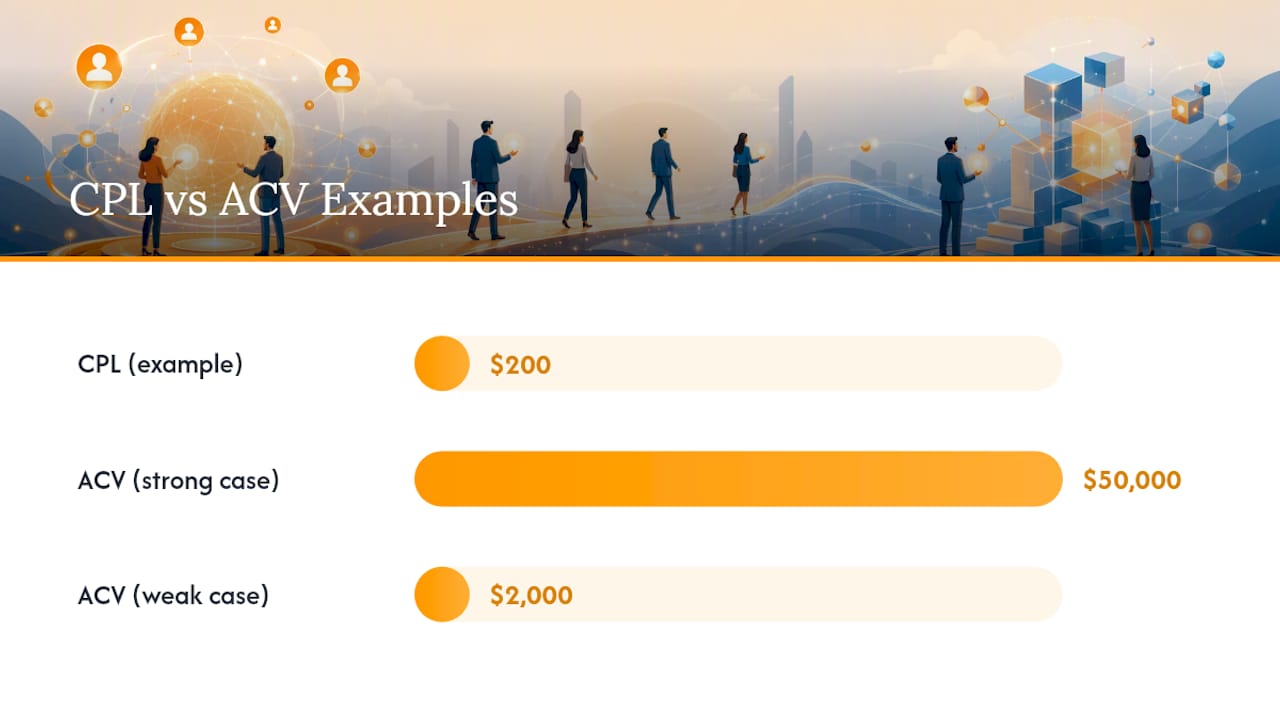
When CPLs look high, compare them to the average deal size and sales cycle length. LinkedIn’s premium CPCs are justified when the customer lifetime value is large enough and the funnel is ready to convert. A $200 CPL on a $50,000 ACV deal is a strong return. The same CPL on a $2,000 ACV product is not.
For budget planning, LinkedIn’s Media Planner tool lets you forecast reach and frequency before committing spend, which makes budget conversations with finance and sales more grounded.
Align reporting with sales by sharing a monthly “LinkedIn pipeline report” that shows leads generated, MQL rate, SQL rate, and open opportunities. Sales teams that see LinkedIn’s contribution to their pipeline become advocates for the channel rather than skeptics.
What do real agency tests tell us about LinkedIn B2B campaigns?
Theartistevolution has run LinkedIn lead-generation and outreach programs for clients across agency, retail, and CPG sectors. Two documented programs illustrate the operational patterns that matter most.
The LinkedIn lead generation program for an expanding agency focused on outreach sequencing and audience precision to generate qualified conversations for a service business scaling into new markets. The program’s structure prioritized ICP definition and message relevance over volume, which is the right trade-off on a platform where audience size is limited.
The LinkedIn outreach case study documents an outreach-to-lead workflow that combined organic engagement with paid amplification, demonstrating how the two motions reinforce each other when sequenced correctly.
For 2026, the tests worth running now, based on practitioner recommendations from large-scale 2025 client programs:
- Short-form video (under 15 seconds): Test as a top-of-funnel awareness format before pushing to a Lead Gen Form.
- Thought Leader Ads: Amplify your best-performing organic employee posts within 48 hours of publication.
- Personalized creative by segment: Build separate creative variants for each major ICP segment rather than running one universal ad.
- Qualified Lead Optimization: Send qualified lead events back to Campaign Manager via CAPI to train the algorithm on real buyer signals.
- Ad duplication for speed: Clone top-performing ad sets to test new variables without disrupting delivery on the original.
Methodology note: early signs of lift on LinkedIn typically require at least 500 impressions and 20 conversions per variant before the data is directional. Anything below that threshold is noise, not signal.
What most B2B teams get wrong about LinkedIn campaigns
The gap between what LinkedIn promises and what most teams actually experience comes down to three operational failures that no amount of targeting sophistication can fix.
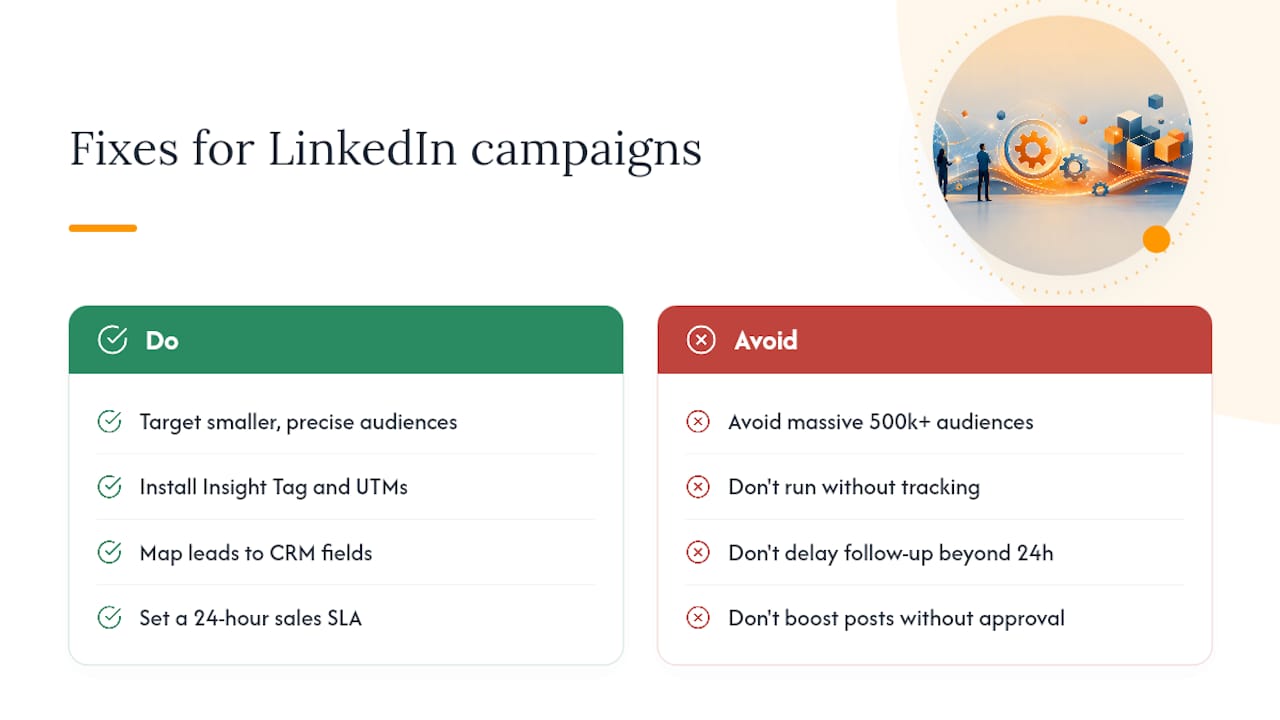
The first is audience breadth. Teams build 500,000-member audiences because they are afraid of running out of reach, then wonder why CPL is high and lead quality is low. LinkedIn’s precision is the product. Using it means accepting smaller, more expensive audiences in exchange for better-qualified leads.
The second is inadequate tracking. Running LinkedIn spend without a properly configured Insight Tag, clean UTM parameters, and CRM field mapping means you cannot close the loop between ad spend and pipeline. Sales will never trust the channel, and you will never be able to justify budget increases. Fix the tracking before you scale the spend.
The third is misalignment with sales. LinkedIn leads that sit in a CRM for five days before a sales rep touches them convert at a fraction of the rate of leads followed up within 24 hours. The SLA between marketing and sales is as important as the campaign itself. If sales does not have a clear process for LinkedIn leads, the program will underperform regardless of how well the ads are built.
On Thought Leader Ads specifically: before amplifying an employee’s post, get explicit written approval from that person. Governance matters, especially in regulated industries like healthcare and legal where a boosted post can create compliance exposure. Build a simple approval workflow before you launch an employee amplification program, not after.
Theartistevolution builds and manages LinkedIn lead-gen programs that scale
Running LinkedIn ads for B2B is not just a media buy. It requires ICP definition, creative production, tracking architecture, CRM integration, and sales alignment working together. Theartistevolution’s campaign management services cover the full stack: LinkedIn campaign strategy, Sponsored Content and Thought Leader Ad production, Lead Gen Form setup, Insight Tag and CAPI configuration, and CRM integration for closed-loop reporting.
With over 18 years managing campaigns for clients in healthcare, legal, retail, and CPG, the agency brings documented LinkedIn lead-generation experience to every engagement. Case studies covering agency lead generation and thought leadership positioning are available for review. To get a structured assessment of your current LinkedIn program and a prioritized action plan, request a marketing assessment and a member of the team will follow up within one business day.
Sources
The sources below are the primary references for configuration, deeper strategy, and agency proof points referenced throughout this guide.
Official LinkedIn product documentation:
- LinkedIn ads for B2B: the tactical guide (2026)
- 5 B2B LinkedIn Ads tests to run in 2026
- B2B LinkedIn Strategy for the New Algorithm
- LinkedIn Ads: The Honest B2B Guide for 2026
Practitioner guides and test recommendations:
Theartistevolution case studies and resources:
Use the official docs for configuration decisions. Use the practitioner guides for strategy and testing priorities. Use the agency case studies to understand how these programs run operationally before committing to a build.