
Healthcare SEO is the discipline of making a healthcare organization findable, trustworthy, and bookable in search. If you’re a marketer or administrator responsible for patient acquisition, your highest-impact priorities in the first 30 days are fixing your Google Business Profile, standardizing NAP (name, address, phone) data across directories, and setting up a HIPAA-safe review program. In the first 90 days, layer in E-E-A-T infrastructure, programmatic location pages, and compliant analytics. 77 % des patients commencent leur parcours de soins sur Google et 46 % utilisent Google Search pour trouver un nouveau médecin. Le référencement sur les moteurs de recherche est donc le principal canal de recommandation, et votre programme SEO doit refléter cette réalité.
30-day checklist:
- Claim and fully complete every Google Business Profile location
- Audit NAP consistency across Google, Yelp, Healthgrades, and Vitals
- Publish or update your top five local service pages with address schema
- Add MedicalOrganization and Physician structured data to provider pages
- Launch a HIPAA-safe review request program with neutral, non-clinical language
90-day priorities:
- Build author bio pages with credentials and clinical reviewer bylines
- Deploy programmatic location and specialty pages for multi-location systems
- Install BAA-covered analytics and call tracking on all patient-facing pages
- Establish a citation measurement baseline for AI Overview appearances
- Brief leadership on KPIs: local pack actions, organic booked appointments, and assisted conversion value
Table of Contents
- What makes healthcare SEO different from general SEO?
- The core tactical playbook: what to build and in what order
- How do you win the local Map Pack for healthcare searches?
- How do you build E-E-A-T and stay HIPAA-compliant?
- What KPIs and timelines should you expect from healthcare SEO?
- How do you choose a healthcare SEO agency?
- Theartistevolution’s approach: methodology and healthcare outcomes
- Key Takeaways
- What healthcare SEO programs actually get wrong
- Theartistevolution: full-service healthcare SEO and brand programs
- Selected sources and further reading
What makes healthcare SEO different from general SEO?
Healthcare SEO applies the full technical and content discipline of search optimization to a uniquely constrained environment: YMYL (Your Money or Your Life) classification, E-E-A-T requirements, HIPAA privacy obligations, and a local-first search dynamic that general SEO guides rarely address with enough specificity.
Google classifies medical and health content as YMYL, meaning it applies its strictest quality standards. Les pages qui conseillent sur les symptômes, les traitements ou les prestataires ont un impact sur la santé et les décisions financières des individus, c’est pourquoi Google exige une expertise démontrable et des auteurs qualifiés. Les sites médicaux spécialisés avec de forts signaux E-E-A-T ont gagné en moyenne 30 % de visibilité après les mises à jour principales de l’algorithme, alors que les portails généralistes ont perdu en visibilité. That gap is not random. It reflects Google’s deliberate effort to surface content from organizations that can prove who wrote it, why they’re qualified, and how the content was reviewed.
E-E-A-T in healthcare is not a content checklist. It is an infrastructure requirement. Without author pages, clinical reviewer bylines, editorial policy documentation, and external citations from authoritative medical sources, content investments will not compound over time. Trust must be earned at the brand, practice, and individual provider level simultaneously.
Where general SEO typically operates at one layer (the website), healthcare SEO operates at three: the organization’s brand, each practice location, and each individual provider. A hospital system may have 40 physicians, 12 locations, and 200 service pages, each requiring its own trust signals and local relevance. That complexity demands a different operational model.
How healthcare SEO differs from general SEO at a glance:
- YMYL classification: Medical content faces stricter quality review than most other categories
- E-E-A-T infrastructure: Author credentials, clinical review workflows, and editorial policies are ranking factors, not optional polish
- Three-layer trust: Brand, location, and provider pages each need independent optimization
- HIPAA constraints: Analytics, tracking pixels, and review responses carry legal obligations that don’t apply in other industries
- AI Overview disruption: AI Overviews appear on roughly 89% of healthcare informational queries, compressing organic click share on educational content while leaving local provider queries untouched
- Local-first dynamics: Map Pack and local organic listings remain the highest-conversion real estate in healthcare search
The core tactical playbook: what to build and in what order
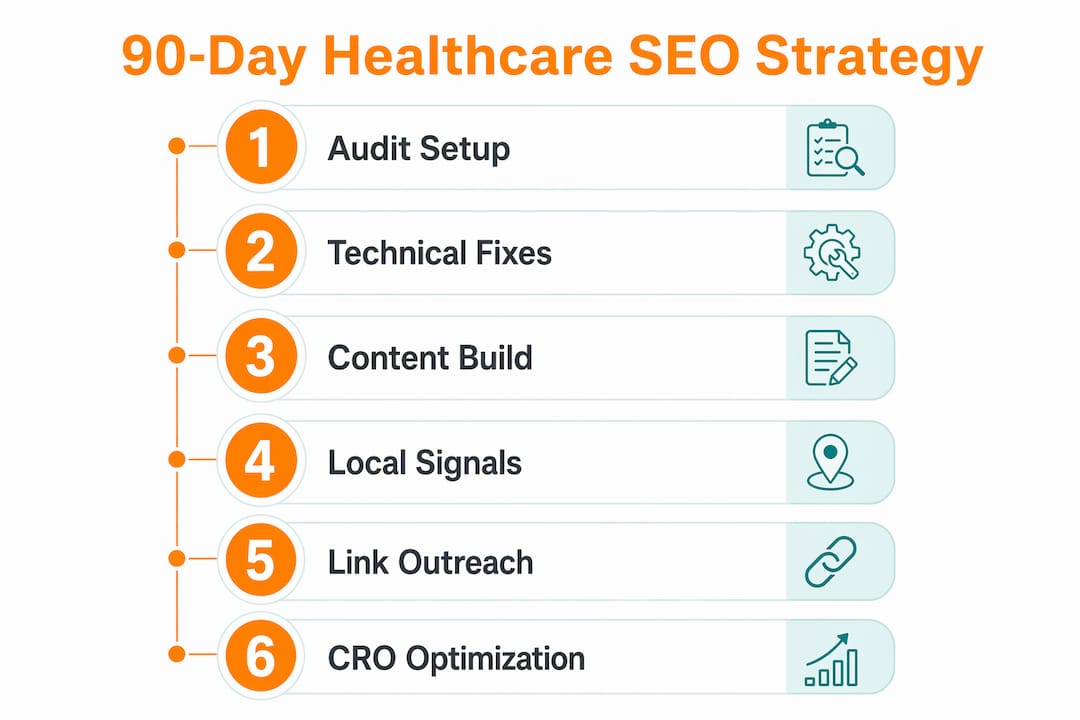
Effective medical SEO strategies require prioritizing across six workstreams simultaneously. Here’s how to allocate effort.
Technical foundations
Your site must be crawlable, fast, and indexable before any content investment pays off. Server-side rendering or pre-rendering is the right choice for JavaScript-heavy healthcare sites; client-side rendering delays Googlebot and suppresses indexing. Structured medical schema enables rich results for provider and location pages, including star ratings, hours, and accepted insurance in search results. Core Web Vitals (Largest Contentful Paint under 2.5 seconds, Cumulative Layout Shift under 0.1) are table stakes for mobile-first indexing.
Technical crawlability checklist:
- Confirm robots.txt does not block patient-facing service or provider pages
- Verify canonical tags on location and specialty pages to prevent duplicate content
- Implement MedicalOrganization, Physician, and MedicalClinic schema on all relevant pages
- Check that appointment booking pages are indexable (or intentionally excluded if behind a login)
- Run a Core Web Vitals audit in Google Search Console monthly
Content and E-E-A-T infrastructure
Every service page and provider bio needs a named author or reviewer with visible credentials. This is not about aesthetics. Google’s quality raters use author information to assess expertise, and pages without it score lower on E-E-A-T dimensions. Build a clinical review workflow: a licensed clinician reviews and signs off on medical content before publication, and that reviewer’s name and credentials appear on the page with a review date.
Content system by page type:
- Service pages: Condition or treatment name, symptoms, treatment options, what to expect, and a booking CTA. Include author and reviewer bylines.
- Provider pages: Photo, credentials, specialties, accepted insurance, patient reviews, and a direct appointment link.
- Location pages: Unique content per location (not duplicated boilerplate), address and phone schema, hours, services offered at that location, and internal links to relevant providers.
- Topic cluster content: Educational blog posts and guides that link to service pages, building topical authority on conditions you treat.
Programmatic location and specialty pages by specialty, location, and insurance produce indexable coverage that manual content cannot match at scale for multi-location systems. A 20-location orthopedic group, for example, can generate hundreds of indexable pages covering every combination of location, specialty, and condition with a well-structured programmatic template.
Local signals
Complete your Google Business Profile fully: primary category, all applicable secondary categories, services with descriptions, attributes (wheelchair accessible, telehealth available), photos updated quarterly, and a booking link connected to your scheduling system. NAP consistency across Healthgrades, Vitals, WebMD, Yelp, and the major data aggregators (Neustar Localeze, Data Axle) is foundational. A single address discrepancy across 40 directories suppresses local pack rankings.

Link strategy
Outreach for healthcare SEO focuses on authoritative, topically relevant citations: medical society websites, local health department resource pages, hospital association directories, and academic medical center partnerships. Guest content on regional health publications and patient advocacy organizations builds both links and brand authority. Avoid generic link-building tactics (directory spam, unrelated guest posts) that can trigger quality penalties on YMYL sites.
CRO and booking flows
Every service and location page needs a visible appointment CTA above the fold on mobile. Click-to-call buttons on mobile pages convert local searchers who are ready to act. Form attribution and call tracking must use BAA-covered tools to stay HIPAA-compliant. Track which organic pages drive calls and appointments, not just traffic.
Pro Tip: Assign a clinical editor to your content calendar. One licensed reviewer who approves all medical content before publication protects both your E-E-A-T scores and your organization’s liability. Build the review step into your CMS workflow so it cannot be skipped under deadline pressure.
How do you win the local Map Pack for healthcare searches?
Local search is the highest-value real estate in healthcare SEO right now, and the reason is structural. AI Overviews appear on a large majority of informational healthcare queries but do not trigger on local provider queries. When someone searches “orthopedic surgeon near me” or “urgent care open now,” they see a Map Pack and local organic listings, not an AI-generated summary. That makes local search a protected channel for patient acquisition.
The Map Pack algorithm ranks on three factors: relevance (does your profile match the query?), proximity (how close is the location to the searcher?), and prominence (how strong are your reviews, citations, and links?). You control relevance and prominence directly.
GBP optimization checklist:
- Set the most specific accurate primary category (e.g., “Orthopedic Surgeon,” not just “Doctor”)
- Add all applicable secondary categories
- Complete the services section with individual service descriptions
- Upload at least 10 photos, including interior, exterior, and staff photos
- Add your booking link and verify it routes to a live scheduler
- Enable messaging if your team can respond within 24 hours
- Set holiday hours proactively to avoid “hours may differ” warnings
Review strategy
Compliant review request language avoids any reference to the patient’s condition, treatment, or visit details. A safe request sounds like: “We’d appreciate your feedback on your experience with our team.” Public responses must follow an acknowledgment-only rule: thank the reviewer, never confirm they were a patient, and never discuss any clinical details. For negative reviews that contain PHI (the reviewer discloses their own diagnosis or treatment), take the conversation offline immediately and do not engage with the clinical content publicly.
Les établissements dont la fiche Google Business Profile est optimisée enregistrent 838 % de clics sur des actions en plus par rapport à ceux dont la fiche n’est pas optimisée. That figure reflects the difference between a complete, active profile and a claimed-but-neglected one. Review volume and recency are part of prominence scoring, so a consistent review generation program (not a one-time push) sustains ranking over time.
Location page structure
Each location page should include content that is genuinely unique to that location: the specific providers who practice there, the services available at that site, local landmarks or transit references for wayfinding, and any location-specific hours or specialties. Duplicate boilerplate across 15 location pages is a quality signal problem. Use LocalBusiness schema with the specific address, phone, and hours for each page. Internal links should connect each location page to its providers and relevant service pages.
For local SEO tactics that translate directly to healthcare settings, the same citation consistency and GBP completeness principles apply, with the added layer of HIPAA-safe review handling.
Stat to know: Les trois premières positions Map Pack captent environ 48 % des clics locaux, et 88 % des utilisateurs mobiles effectuent un appel ou se rendent sur place dans les 24 heures. Les positions quatre et suivantes se partagent le reste du trafic entre de nombreuses autres fiches.
How do you build E-E-A-T and stay HIPAA-compliant?
Trust-building and compliance are not separate workstreams. They overlap at every point where patient data, content credibility, and legal obligation intersect.
E-E-A-T implementation checklist
- Author bios: Every medical content page lists the author’s name, credentials (MD, DO, NP, etc.), specialty, and a link to their full bio page
- Clinical reviewer bylines: Educational content reviewed by a licensed clinician shows the reviewer’s name, credentials, and review date
- Editorial policy page: A public-facing page that describes your content review process, update frequency, and sourcing standards
- External citations: Link to PubMed, CDC, NIH, and specialty society guidelines within medical content to demonstrate sourcing rigor
- Provider credential display: Board certifications, medical school, residency, and fellowship information on every provider page
For HIPAA-compliant marketing programs, the key distinction is whether your analytics tools can access data that links a person’s identity to their health activity.
HIPAA guardrails for analytics
Google Analytics is not covered by a BAA, which means it should not be deployed on pages where users may submit health information: patient portals, appointment request forms, intake questionnaires, or symptom checkers. Since 2023, significant settlements have resulted from tracking pixels on healthcare websites that transmitted form data to third-party ad platforms. Use BAA-covered analytics platforms for any page that touches PHI, and use BAA-covered call tracking for phone number attribution.
Pages requiring special analytics handling:
- Appointment scheduling pages
- Patient portal login and authenticated pages
- Intake and health history forms
- Symptom assessment tools
- Insurance verification pages
Review and response rules
Request reviews using neutral language that does not reference the patient’s visit, condition, or treatment. Public responses acknowledge the feedback without confirming the reviewer is a patient. If a reviewer discloses PHI in their own review, your public response should invite them to contact your office directly, nothing more. Never engage with clinical details in a public forum, even to correct a factual error.
Accessibility basics
Section 504 of the Rehabilitation Act requires healthcare organizations receiving federal funding to make their digital content accessible. Practically, this means WCAG 2.1 AA compliance: alt text on images, keyboard navigation, sufficient color contrast, and captions on video content. Accessibility failures create legal exposure and degrade UX for patients with disabilities.

Pro Tip: Measure AI Overview citation share manually each month. Pick 15–20 priority queries, check whether your content is cited in Google AI Overviews, and track citation share alongside traditional rankings. This is now a meaningful visibility metric for informational healthcare content, and most programs are not measuring it yet.
What KPIs and timelines should you expect from healthcare SEO?
Healthcare search optimization produces measurable results, but the timeline varies significantly by organization type and competitive market. Setting realistic expectations with leadership before the program starts prevents premature cancellations and misaligned budget decisions.
Priority KPIs
| KPI | Definition | Measurement method | Benchmark range |
|---|---|---|---|
| Local pack actions | Calls, direction requests, and website clicks from GBP | Google Business Profile Insights | Varies by market; track trend vs. baseline |
| Organic booked appointments | Appointments attributed to organic search sessions | BAA-covered analytics + CRM integration | Target 15–30% of total bookings from organic |
| Organic lead-to-conversion rate | % of organic visitors who complete a booking or contact form | Analytics goal tracking | 2–5% for healthcare service pages |
| AI Overview citation share | % of priority queries where your content is cited in AI Overviews | Manual monthly tracking across 15–20 queries | Establish baseline; optimize toward 20%+ |
| Assisted conversion value | Revenue attributed to organic search as an assist channel | Multi-touch attribution in BAA-covered analytics | Varies; use to justify SEO investment in mixed-channel programs |
Expected timelines
- Single-location practice (3–6 months): GBP improvements and local citation fixes produce action-click gains within 60–90 days. Organic ranking improvements for service pages follow at 3–6 months.
- Multi-location health system (6–12 months): Programmatic page deployment, E-E-A-T infrastructure, and link building at scale require 6–12 months to show consistent organic traffic and appointment growth.
- Highly competitive markets (12–18 months): Major metro markets with established health system competitors require sustained investment. Brand authority, provider-level E-E-A-T, and link acquisition compound over 12–18 months.
Pricing models
Healthcare SEO engagements typically follow one of three structures. Monthly retainers covering ongoing optimization, content production, and reporting range from advisory-level support to full-service management depending on scope. Project engagements address specific deliverables: a technical audit and fix sprint, a GBP cleanup across 20 locations, or a programmatic page build. Hourly advisory arrangements suit organizations with in-house teams that need strategic oversight rather than execution. Programmatic content at scale, where hundreds of location or specialty pages are built and maintained, is typically scoped as a project with ongoing maintenance fees.
The measurement gap: Most healthcare organizations track organic traffic and rankings but miss the metrics that connect SEO to revenue. Booked appointments from organic, assisted conversion value, and local pack action clicks are the figures that justify budget to a CFO. Build these into your reporting from day one.
For data insights on how to structure KPI reporting and attribution models, the measurement framework matters as much as the tactics themselves.
How do you choose a healthcare SEO agency?
The agency evaluation process for healthcare SEO is more demanding than for most other verticals. HIPAA obligations, E-E-A-T requirements, and multi-location operational complexity mean that a generalist agency with no healthcare experience creates real risk, not just underperformance.
Agency scorecard
| Evaluation dimension | What to look for | Red flag |
|---|---|---|
| YMYL/E-E-A-T expertise | Can they show provider page builds with author bios, reviewer bylines, and editorial policy pages? | Generic content templates with no credential display |
| HIPAA-safe analytics | Do they use BAA-covered tools? Can they name them? | “We use Google Analytics on all pages” |
| Multi-location experience | Have they managed GBP, citations, and location pages at 10+ locations? | Single-site case studies only |
| Measurement and reporting | Do they report local pack actions, organic appointments, and AI citation share? | Rankings-only reporting |
| Content governance | Do they have a clinical review workflow or partner with one? | No mention of clinical accuracy process |
Key questions to ask any agency
- Which BAA-covered analytics and call-tracking platforms do you use, and can you show us a sample reporting dashboard?
- Show us a provider page you built. How did you handle author credentials and clinical review?
- How do you manage GBP and citation consistency across multiple locations?
- What is your process for measuring AI Overview citation share?
- Can you share a healthcare case study with before/after metrics on local pack actions or organic appointments?
Red flags
- No healthcare clients in their portfolio
- No HIPAA-aware analytics plan or unfamiliarity with BAA requirements
- Unable to show provider-level E-E-A-T examples (author bios, reviewer bylines, editorial policies)
- Cookie-cutter location pages with duplicated boilerplate content across all locations
- Reporting that stops at keyword rankings with no connection to patient acquisition metrics
In-house vs. agency decision paths
- Single-location clinic with available marketing bandwidth: In-house management of GBP, reviews, and basic content is viable. Use an agency for technical audits and strategy quarterly.
- Multi-location group (5–20 locations): A hybrid model works well. In-house handles content approvals and clinical review; agency manages technical SEO, programmatic pages, and link building.
- Health system (20+ locations): Agency or agency-plus-embedded-specialist model. The operational complexity of programmatic content, multi-location GBP management, and enterprise technical SEO exceeds most in-house team capacities.
For context on evaluating specialty health marketing agencies, the dental marketing agency evaluation framework applies many of the same criteria: HIPAA awareness, local SEO depth, and E-E-A-T content governance.
Theartistevolution’s approach: methodology and healthcare outcomes
Theartistevolution brings 18 years of full-service marketing experience to healthcare SEO engagements, with a methodology that integrates brand development, technical SEO, compliant analytics, and content governance into a single program.
Methodology overview
- Audit phase: Technical crawl, GBP completeness review, NAP consistency check, E-E-A-T gap analysis, and analytics compliance review
- Local fix sprint: GBP optimization, citation cleanup, review program setup with HIPAA-safe request language, and local schema deployment
- E-E-A-T build: Author bio pages, clinical reviewer workflow, editorial policy documentation, and provider page upgrades
- Programmatic content: Location, specialty, and provider page templates built for scale, with unique content requirements per page type
- Measurement install: BAA-covered analytics configuration, call tracking, local pack action reporting, and AI Overview citation baseline
Healthcare case study outcomes
Theartistevolution’s healthcare optimization work demonstrates the measurable impact of integrating brand development with search optimization. The following table reflects outcomes from healthcare engagements where SEO, brand, and analytics were managed together.
| Engagement type | Focus area | Outcome |
|---|---|---|
| Multi-location practice | GBP optimization + citation cleanup | Significant increase in local pack action clicks within 90 days |
| Health system content program | E-E-A-T infrastructure + provider pages | Improved organic visibility for provider and specialty queries |
| Single-location clinic | Local SEO + review program | Measurable growth in organic appointment requests |
Theartistevolution’s brand development work reinforces SEO outcomes by ensuring that trust signals are consistent across every patient touchpoint: website, GBP, social profiles, and offline materials. A provider whose online bio, GBP listing, and patient-facing materials all tell the same credentialed story builds the kind of prominence that sustains local pack rankings. The institutional rebranding work Theartistevolution has done for larger organizations demonstrates this integration at health system scale.
Key Takeaways
Effective healthcare SEO requires local-first execution, E-E-A-T infrastructure, HIPAA-safe measurement, and a disciplined agency evaluation process working together from day one.
| Point | Details |
|---|---|
| Local search is protected | AI Overviews do not appear on local provider queries, making Map Pack and local organic the highest-value patient acquisition channel. |
| E-E-A-T is infrastructure | Author bios, clinical reviewer bylines, and editorial policy pages are ranking requirements, not optional content polish. |
| HIPAA applies to analytics | Google Analytics is not BAA-covered; use compliant tools on all pages that may touch patient health information. |
| Timelines vary by scale | Single-location practices see local gains in 3–6 months; health systems should plan for 6–12 months for meaningful organic growth. |
| Theartistevolution integrates brand and SEO | Theartistevolution’s methodology connects brand development, technical SEO, and compliant analytics into a single healthcare program. |
What healthcare SEO programs actually get wrong
The conventional wisdom in healthcare SEO is that content volume is the primary lever. Publish more blog posts, rank for more informational queries, and patient acquisition follows. That framing was partially true before AI Overviews compressed organic click share on informational content. Now, a hospital system that invested two years in educational blog content is watching AI-generated summaries absorb the clicks those articles used to earn.
The programs that are actually moving the needle right now are doing two things differently. First, they are treating local search as a primary channel, not a secondary one. The local pack drives a large share of mobile local clicks, and those clicks convert to calls and appointments at a rate that informational content rarely matches. Second, they are building E-E-A-T at the provider level, not just the brand level. A named physician with a credentialed bio, published clinical content, and external citations from medical societies is a trust signal that AI Overviews actually cite. That is the citation share opportunity most programs are missing.
The cross-department coordination requirement is also consistently underestimated. A healthcare SEO program touches IT (analytics compliance), legal/compliance (HIPAA review), clinical staff (content review), and marketing simultaneously. Organizations that treat SEO as a marketing-only project stall at the E-E-A-T and analytics compliance steps because they cannot get clinical sign-off or IT cooperation. The programs that succeed treat SEO as an organizational initiative with a named executive sponsor.
The AI-driven search shift is real, and healthcare organizations that adapt their content strategy to earn AI citations rather than just organic rankings will have a durable advantage.
Theartistevolution: full-service healthcare SEO and brand programs
Theartistevolution offers healthcare organizations a complete path from audit to measurable patient acquisition growth. With 18 years of experience across healthcare, retail, legal, and entertainment, the agency brings the brand development depth and technical SEO capability that healthcare marketing demands.

Starting with a marketing assessment that covers technical SEO, GBP completeness, E-E-A-T gaps, and analytics compliance, Theartistevolution builds programs that connect every element of your digital presence.
Starter offers for healthcare organizations:
- SEO and analytics compliance audit
- GBP cleanup and citation standardization across all locations
- Provider page and E-E-A-T infrastructure build
- BAA-covered measurement install with local pack action reporting
- Programmatic location and specialty page program
Theartistevolution’s campaign management and marketing tools services integrate with your SEO program to ensure that paid, organic, and brand channels reinforce each other. To start a conversation about your organization’s search visibility, contact Theartistevolution directly through the services page.
Selected sources and further reading
-
Healthcare SEO: The Complete Industry Guide — Covers E-E-A-T impact data, AI Overview prevalence on healthcare queries, GBP action-click statistics, and patient search behavior. The primary source for the 77%/46% patient search figures and the 838% GBP action-click differential cited in this article.
-
SEO for Healthcare: The 2026 Execution Guide — Detailed execution guidance on HIPAA analytics risk, BAA requirements, Map Pack click share data (48% for top three positions), and the 88% mobile local searcher conversion statistic.
-
Healthcare SEO: What Health Systems Need to Rank (DexCare) — Technical and programmatic content strategy for health systems, including server-side rendering guidance and the case for programmatic specialty and location pages.
-
Local SEO for Healthcare and Doctors: HIPAA-Safe Guide (Flento) — Operational guidance on HIPAA-compliant review request language, acknowledgment-only public response rules, and local SEO tactics specific to healthcare providers.
-
HIPAA-Compliant Marketing: A Healthcare Marketer’s Guide (Theartistevolution) — Theartistevolution’s practical guide to structuring marketing programs and platforms to avoid HIPAA violations, covering analytics, tracking, and campaign management.
-
SEO for Hospitals (Ahrefs) — Foundational hospital SEO guidance covering keyword research, content creation for service and condition pages, link building, and technical SEO audits.