
Brand voice guidelines are a short, practical document that tells everyone who writes for your business how it should sound. A good one defines three to five personality traits, shows each in side-by-side examples, lists the words you use and avoid, and explains how tone shifts from a welcome email to a billing reminder. A strong one is built from your audience and your positioning, not from adjectives that sound nice. That is the work we do in brand development at The Artist Evolution, and this guide walks through the same logic so you can see what a usable voice looks like.
TL;DR
- Voice is your stable personality. Tone is how that personality flexes for the moment, such as a launch, a patient reminder or a service apology.
- Choose three core traits, write what each means in practice, and pair every trait with a “say this, not that” example.
- Build the voice from audience research and your own positioning, then test it on real surfaces: an error message, a welcome email, a support reply.
- A guide only works if it is short enough to use, shared with everyone who writes, and built into your approval workflow.
- Healthcare, legal, dental, consulting, retail and CPG brands each need explicit rules for sensitive moments, not just a list of adjectives.
Table of Contents
- Voice, tone and style: what each one controls
- What brand voice guidelines should include
- How to develop your brand voice, step by step
- Brand voice examples worth studying
- Tone by situation: the part most guides skip
- Keeping the voice consistent across channels
- Common mistakes in brand voice guidelines
- Where we can help
- Our perspective on brand voice
- FAQ
- Sources
Voice, tone and style: what each one controls
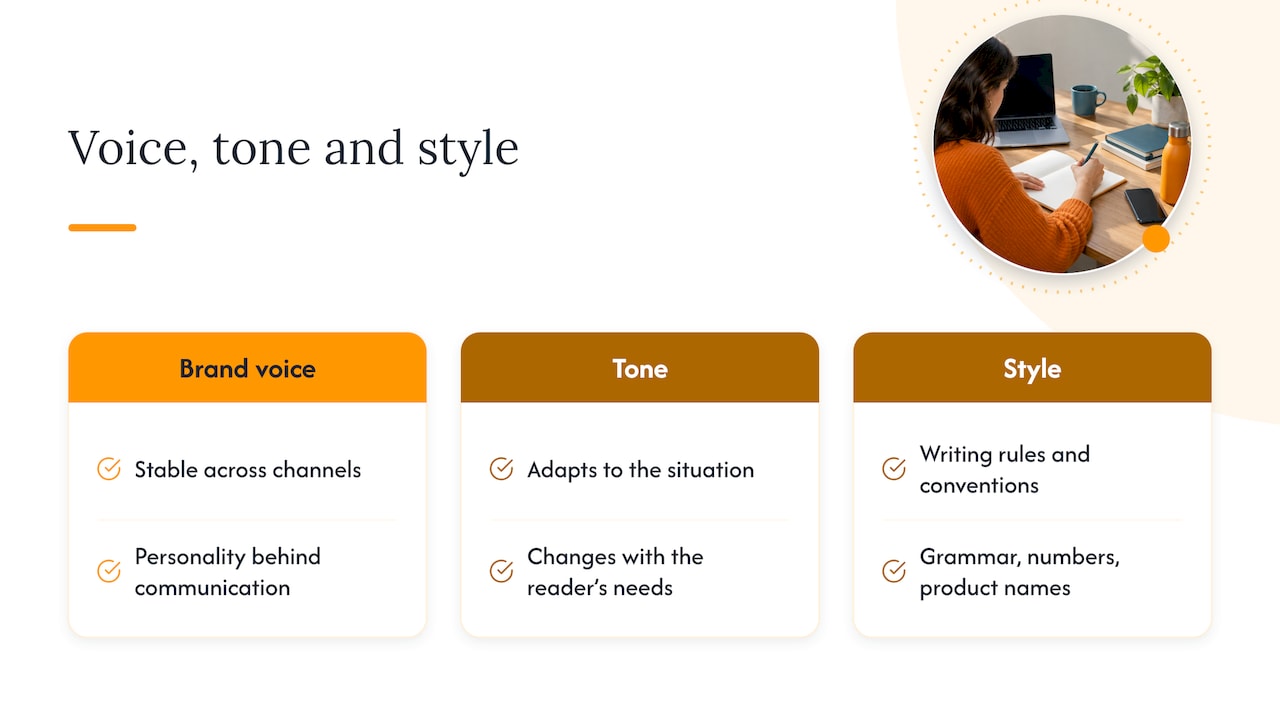
These three terms get mixed up, and the confusion is why many guides end up as a page of adjectives nobody can apply.
Brand voice is the recognizable personality behind your communication. Amazon Ads describes it as the brand personality and emotion conveyed in how a brand speaks, with tone, messaging and communication style as its key elements. It stays relatively stable whether the reader is looking at a press release, a LinkedIn post or a product page.
Tone is how that voice adapts to a situation. Presspage’s comparison of the two puts it simply: the person speaking has not changed, but the situation has. A product launch can sound upbeat. A crisis response needs empathy and precision. The voice is the same in both.
Style is the rulebook underneath: grammar, abbreviations, capitalization, how you write numbers and what you call your products.
Two quick tests keep them apart. For voice, ask: would this still sound like us in another channel? For tone, ask: does this sound right for what is happening to the reader right now?
Here is how that looks for a dental practice. The voice might be warm, plainspoken and reassuring. The tone in an appointment reminder is brisk and friendly. The tone in a message about a root canal follow-up is calm and careful. Same practice, same personality, different dial settings.
What brand voice guidelines should include
A guide needs enough detail that a new hire or freelancer with little brand knowledge can make decisions while drafting. Presspage lists 13 areas a thorough document covers. For most small and mid-sized businesses, these are the ones that do the heavy lifting:
- Purpose and positioning. Why you exist and who you are for. Everything else hangs from this.
- Three to five personality traits, with boundaries. For example “confident, not arrogant.” The boundary does more work than the trait.
- Audience profiles. Who reads you and what they need from you.
- Preferred vocabulary and words to avoid. The terms you own and the jargon you drop.
- Do’s and don’ts with side-by-side rewrites. Examples teach faster than definitions.
- Grammar and style rules. Person (“we” and “you”), contractions, punctuation habits.
- Channel and format variations. What changes between email, social, web copy and print.
- Tone by situation. Good news, bad news, urgent news, sensitive news.
- Crisis communication rules. Which traits are dialed down and who approves what.
- AI guardrails. What generative tools may draft and what a person must review.
- On-brand and off-brand samples. Real paragraphs, not descriptions.
If that looks long, remember the finished guide can be a few pages. The length comes from examples, not explanation.
The vocabulary list that settles arguments
A vocabulary guide is the part writers use most. Search Engine Land’s template shows the idea: if approachability is a core attribute, avoid words such as “leverage,” “optimize,” “synergy” and “robust,” and prefer “use,” “improve,” “work together” and “strong.” Your list will differ by industry. A law firm might write “your case” instead of “the matter.” A retailer might choose “pick up in store” over “fulfillment.” A healthcare provider might choose “your visit” over “the encounter.”
How to develop your brand voice, step by step
The process below combines the steps most practitioners agree on. At each one, we note where it tends to go wrong.
Step 1: Describe the audience as people, not segments
Start with who is reading: customer interviews, reviews, support calls, sales call notes, intake forms. You are looking for how they feel when they reach you, not how they talk. A patient searching for a specialist is often anxious. A founder reading about a consultant is often skeptical. A shopper is often just short on time.
Where it goes wrong: mirroring customer slang. The goal is to define the relationship between your brand and the reader, such as an experienced advisor or a patient teacher, not to imitate their speech.
Step 2: Connect the voice to your friction points
Search Engine Land reframes voice from “what sounds nice?” to “what does our audience need from us?” It maps common customer friction to voice solutions:
| Reader friction | Voice that helps |
|---|---|
| Skepticism about quality | Proof-heavy, transparent |
| Feeling like a number | Personal, specific |
| Boredom with the category | Energetic, unexpected |
| Intimidation | Welcoming, judgment-free |
A legal firm whose prospects feel intimidated needs a welcoming, plain voice. A consulting firm facing skeptical buyers needs a proof-first one. This step is where positioning turns into sentences.
Step 3: Interview the people who know the business
Talk to founders, senior staff and the people who answer customers daily. Review your mission, values and existing content. Throw out anything that would describe a competitor equally well. “Innovative, customer-focused and trusted” fits every company and distinguishes none.
Step 4: Pick exactly three core attributes
Search Engine Land advises three, because more becomes hard to remember and apply. Have each team member list three attributes independently before you compare notes. Then write one sentence per attribute explaining what it means in practice.
An example for a pediatric dental group:
- Warm: we talk to parents the way a trusted neighbor would. We do not use clinical shorthand.
- Clear: one idea per sentence, and we explain every procedure name the first time it appears.
- Steady: we stay calm and specific when the news is hard.
Step 5: Add a chart of what it sounds like and what it does not
A “sounds like, doesn’t sound like” chart is the most useful single page in any guide. HubSpot’s tone exercise is a good starting point: list the adjectives you want, list adjectives describing your three to five best-performing pieces, then highlight what overlaps. Judge “best-performing” by engagement such as comments and shares, not only impressions.
The chart should look like this:
| Trait | We sound like | We don’t sound like |
|---|---|---|
| Clear | “Your appointment is Tuesday at 9.” | “Your appointment has been scheduled for the aforementioned date.” |
| Warm | “Questions? Call us any time.” | “Please direct all inquiries to our office.” |
| Confident | “We handle this every day.” | “We’re the best in the world!” |
Step 6: Pressure-test on the surfaces that break a voice
Voices fail on small, ugly moments. Write an error message, a welcome email and a support reply in your new voice. If the traits cannot produce those, they are adjectives, not a voice. Then show drafts to real customers and note their emotional reactions, not just whether they “like” it.
Step 7: Roll it out and build it into approvals
Share the guide with everyone who creates or reviews content, including agencies and freelancers. Add it to the checklist in your approval workflow. Review it once or twice a year as products, audiences and channels change.
This is the stage where documents most often die in a shared folder. Our brand development work covers building the brand foundation that a voice guide rests on, so the guide arrives connected to positioning, messaging and visual identity rather than floating alone.
Brand voice examples worth studying
Study how published guides turn a trait into a rule.
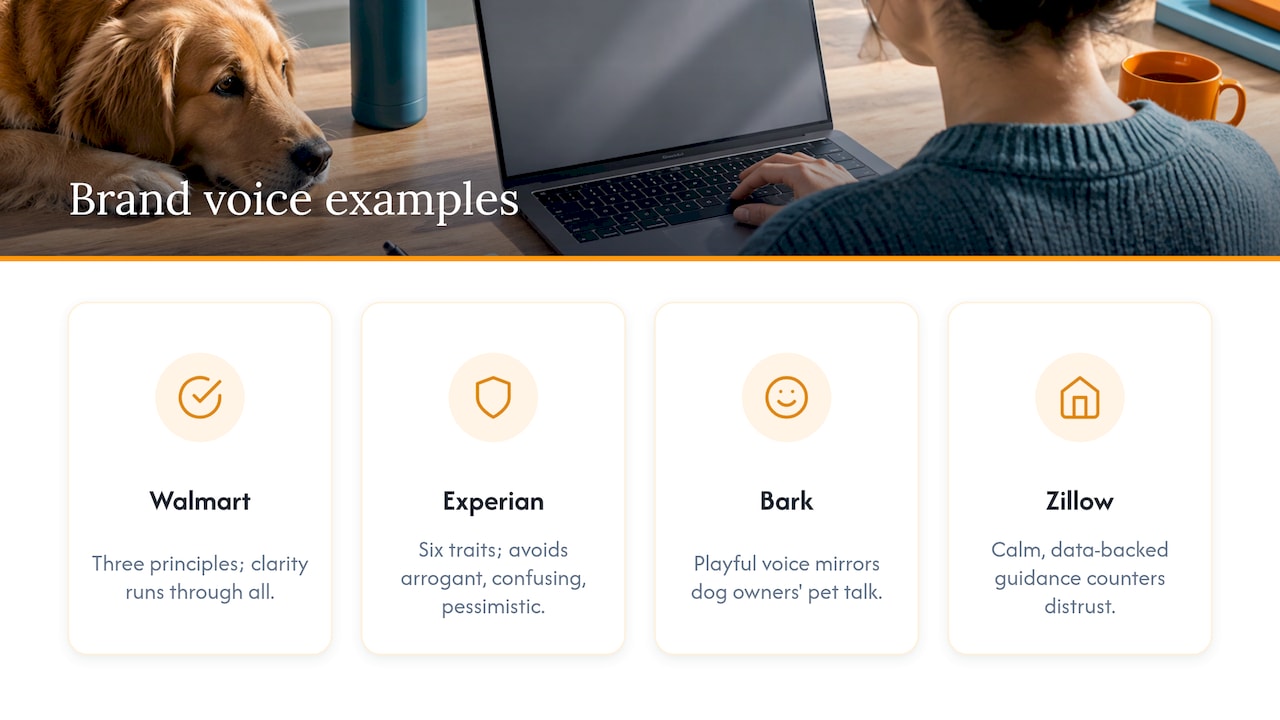
Walmart publishes three principles: conversational, captivating and confident, with a fourth C, clarity, running through everything. Its do and don’t rules include simple words, no industry jargon, wordplay without contrived jokes, and specific rather than vague statements. The lesson for retail and CPG: give your writers a rule they can check a sentence against.
Experian defines its voice through six traits: helpful, inquisitive, smart, resourceful, confident and optimistic. It also lists what the voice avoids, including arrogant, confusing and pessimistic. The lesson for consulting and professional services: naming the opposite of each trait protects you from drifting into the wrong register, and it applies from social posts to white papers.
Bark and Zillow show positioning at work in Search Engine Land’s examples. Bark’s playful voice mirrors how dog owners talk about their pets. Zillow counters real estate’s trust problem with calm, data-backed guidance instead of urgency. Each voice answers a frustration in its category.
Notice the common thread. None of these is “friendly and professional.” Each states a clear choice and a limit.
Tone by situation: the part most guides skip
Tone rules are where brands in sensitive industries earn trust. Ledger’s brand site uses the four tone dimensions from the Nielsen Norman Group as sliding scales: formal to casual, serious to funny, respectful to irreverent, and matter-of-fact to enthusiastic. You can do the same in a simple grid.
| Situation | Formal–casual | Serious–funny | Matter-of-fact–enthusiastic |
|---|---|---|---|
| Appointment reminder | Casual | Serious | Matter-of-fact |
| New location announcement | Casual | Light | Enthusiastic |
| Billing or legal notice | Formal | Serious | Matter-of-fact |
| Service delay apology | Neutral | Serious | Matter-of-fact |
A healthcare provider should note which topics need a serious, plain tone every time, such as test results, billing and anything touching a diagnosis. A legal firm should set the register for client updates versus blog content. Humor and exclamation points are the first things to switch off in those moments.
Write crisis rules before you need them. Presspage recommends defining which traits stay fixed and which are paused, which words need approval, who drafts and approves holding statements, and who may speak publicly. Early messages should stick to confirmed facts, care for the people affected, the actions being taken and when the next update comes.
Keeping the voice consistent across channels
Consistency means a reader recognizes you in email, on your website, in a text message and on social. Keep one central document with your mission, personas, dos and don’ts, descriptive words, words to avoid and a plan by channel. Klaviyo Academy’s guide adds useful habits: adapt the message to each channel’s strengths, make sure messages do not conflict, test one element at a time, and keep talking to customers to track sentiment.
There is one nuance worth knowing. A 2025 HEC Montréal master’s thesis with 349 participants found that inconsistent logo spacing affected ad choice, while inconsistent tone formality and pronouns did not. The authors read this as a sign that marketers should be strict about brand-reflecting elements and flexible about context-reflecting ones such as tone. It supports the voice-and-tone split above: fix the personality, let the delivery flex.
A short weekly routine
- Pick two recent pieces from different channels and run both through the “would this sound like us elsewhere?” test.
- Add one new on-brand and one off-brand sample to the guide each quarter.
- Update the vocabulary list whenever a product, service or term changes.
Common mistakes in brand voice guidelines
- Too many traits. Seven adjectives cannot be remembered. Cut to three.
- Adjectives without examples. “Authentic” means nothing until a rewrite shows it.
- No boundary. “Confident” without “not arrogant” invites bragging.
- No priority when traits conflict. Say which wins, for instance clarity over cleverness.
- A guide that lives in a folder. If it is not in the approval checklist and the onboarding pack, it will not be used.
Where we can help
If your voice currently depends on whoever happens to be writing that week, the fix is a documented system tied to your positioning. At The Artist Evolution, brand development is one of our core services, and we bring more than 18 years of agency experience across startups and household brands, in sectors including healthcare, legal, retail and entertainment. Our brand development service covers building the identity your voice guidelines express, and our team works as an extension of yours so the guide reaches every campaign.

If you want a view of the whole picture first, our marketing assessment is a good place to begin. You can also read how we approach brand messaging frameworks and practical brand style guides, or see a brand story development case study.
Our perspective on brand voice
Most voice guides fail for a simple reason: they are written as a branding exercise and then handed to people who need a writing tool. We think of voice as the bridge between strategy and execution. If the document does not help a writer decide between two sentences in under a minute, it is not finished.
That is why we start with positioning and audience, then move to examples. The traits come last, once we know what the audience needs from the brand. A healthcare provider building patient engagement, a legal firm trying to be found online and a CPG brand competing for shelf attention all need different voices, even if all three would describe themselves as “professional and approachable.”
We also believe the voice has to travel. Our multidisciplinary team brings strategy, content, advertising and web together, so the same voice shows up in an ad, a landing page and an email. Consistency is easier when the people who write the guide also help run the campaigns.
Write three traits. Give each a boundary. Show it in a rewrite. Then put it to work everywhere your brand speaks.
Derek
FAQ
What is the difference between brand voice and tone of voice?
Brand voice is the consistent personality of your communication. Tone is how that personality adjusts to a situation, such as celebrating a milestone or addressing a problem. Asana’s explanation uses the example of speaking to consumers versus executives, or announcing a launch versus a hiring freeze.
How many traits should a brand voice have?
Three is the number we recommend, in line with Search Engine Land’s advice that more become hard to remember and apply. Up to five can work if each has a clear boundary and a rewrite example. Fewer, sharper traits are used more often.
How long should brand voice guidelines be?
Long enough for someone with little brand knowledge to make drafting decisions, and short enough to be opened daily. For most small and mid-sized businesses that means a few pages built around the chart, vocabulary list, tone-by-situation grid and samples. Add detail only where writers keep getting stuck.
How often should we update our brand voice guidelines?
Review them once or twice a year, and whenever you launch a new service, enter a new channel or change audience. Add fresh on-brand samples regularly so the guide reflects how you actually write.
Should our guidelines cover AI tools?
Yes. Presspage includes AI guardrails among the areas a thorough guide covers. Specify what AI may draft, which phrases it should use or avoid, and that a person reviews anything sensitive before it goes out. “Say this, not that” examples give these tools a clear pattern to follow.
Sources
- Amazon Ads: What is Brand Voice?
- Presspage: How to Write Brand Voice Guidelines
- Search Engine Land: How to develop your brand’s tone of voice
- HubSpot: Craft your best brand voice
- Walmart Brand Center: Brand Voice
- Experian: Expedition Leader Tone of Voice Guide
- Ledger: The Tone
- Klaviyo Academy: Build a strong brand voice
- HEC Montréal thesis on brand consistency
- Asana: What is a Brand Voice?