
The best brand taglines are short, specific to one company and built around one idea that customers can repeat. Nike’s “Just do it” and De Beers’ “A diamond is forever” are the classic proof: a few words that carry a whole point of view. Below you’ll find examples sorted by the job each tagline does, the patterns behind them, the difference between a tagline and a slogan, and a practical process for writing your own.
TL;DR
- A tagline is the short phrase that sits beside your name for years. A slogan serves a single campaign and is expected to change.
- Strong taglines do one of four jobs: state a belief, promise a benefit, describe the product, or invite action.
- Write yours from a positioning statement, produce dozens of options, then cut hard. Never fall for the first good idea.
- Test every candidate for clarity, distinctiveness and fit with your voice before it goes on a website, package or truck.
- If you can swap your competitor’s name into the line and it still works, keep writing.
Table of Contents
- Brand tagline examples worth studying
- What these taglines have in common
- Tagline vs. slogan: what’s the difference?
- How to write a brand tagline, step by step
- Brand tagline ideas by type of business
- Common tagline mistakes
- Our perspective: a tagline is the last thing you write
- Need help with your brand line?
- Frequently asked questions
- Sources
Brand tagline examples worth studying
A list of famous lines is only useful if you know why each one works. Start with the two that Ad Age’s 1999 Advertising Century ranking placed at the top: “A diamond is forever” from De Beers at number one, and Nike’s “Just do it” at number two. Both have outlived the campaigns that launched them, which is exactly what a tagline is supposed to do.
Taglines that state a belief
These lines say what the brand stands for, not what it sells.
- Nike: “Just do it.” Three words, no product mentioned. It turns every customer into someone who acts, and it works for running shoes, apparel or a gym membership.
- Apple: “Think Different.” HubSpot lists it among popular taglines. It positioned the buyer as a nonconformist before it described any computer.
- L’Oréal: “Because You’re Worth It.” It speaks to self-worth and self-care rather than to ingredients, which is why it has aged so well.
Taglines that promise a benefit
Benefit lines are often the safest choice for a company that needs to be understood in a second.
- Target: “Expect More. Pay Less.” Two short commands that name both the upside and the price promise. The parallel structure makes it easy to remember.
- Walmart: “Save money. Live better.” Cause and effect in four words. ActiveCampaign’s list of company slogans includes it with State Farm’s “Like a good neighbor, State Farm is there” and Toyota’s “Let’s go places.”
- State Farm: “Like a good neighbor, State Farm is there.” It turns an abstract promise, reliable insurance, into a familiar human relationship.
Taglines that invite a question or an action
- Capital One: “What’s in Your Wallet?” The line asks the customer to look at what they already carry, which makes the card the answer.
- Toyota: “Let’s go places.” An invitation instead of a claim. It works across a sedan, a truck and a hybrid.
A modern example: one platform, many executions
Burger King spent years with inconsistent advertising, then, as Adweek reported, settled on a single brand platform, “You Rule,” in late 2022. The lesson is less about the words and more about discipline: one idea, repeated across every channel, builds recognition that scattered clever lines never do.
Quick reference table
| Brand | Tagline | Job it does | What to borrow |
|---|---|---|---|
| Nike | Just do it | States a belief | Let the customer be the hero |
| De Beers | A diamond is forever | States a belief | Tie the product to an emotion that lasts |
| Apple | Think Different | States a belief | Define who the buyer is |
| Target | Expect More. Pay Less. | Promises a benefit | Use parallel structure |
| Walmart | Save money. Live better. | Promises a benefit | Show the payoff, not just the feature |
| Capital One | What’s in Your Wallet? | Invites a question | Make the reader answer in their head |
| Toyota | Let’s go places. | Invites action | Keep it broad enough to stretch |
What these taglines have in common
Look past the famous names and the same traits repeat. Mailchimp’s guide to taglines describes effective ones as clear and simple, memorable, authentic to the brand and emotionally appealing. That matches what you see in the table.
- They are short. Most run from two to seven words. Brevity forces a decision about what matters most.
- They carry one idea. “Save money. Live better.” has two clauses, but one story. Lines that try to say three things say nothing.
- They sound like the brand. Nike’s line is blunt and athletic. L’Oréal’s is warm and affirming. Swap them and both fall flat.
- They are repeatable. A customer can say it aloud without checking. Rhythm, parallel phrases and plain words help.
- They age well. None of them mentions a product feature that will be obsolete in five years.
Adweek’s Jake Hancock makes a related point in a piece on taglines: brand love is earned, not bought, and companies have used taglines to shape how people feel about them. A tagline can start that feeling, but only consistent behavior finishes it.
Tagline vs. slogan: what’s the difference?
People use the words interchangeably, and in casual conversation that’s fine. When you are building a brand, the distinction matters because it decides how long you plan to keep the line.
The Cambridge Dictionary defines a tagline as a short, easily remembered phrase used in advertising so people recognize a company or its products. In practice, HubSpot frames the split this way: a tagline supports the business’s goals over the long haul, while a slogan supports a specific campaign and has a shorter shelf life.
| Tagline | Slogan | |
|---|---|---|
| Purpose | Express the brand’s identity and promise | Promote a campaign, product or offer |
| Lifespan | Years or decades | Weeks to a couple of years |
| Where it lives | Logo lockup, website header, packaging, email signature | Ads, landing pages, event materials |
| Who approves it | Leadership, since it shapes the brand | Marketing team, within brand guidelines |
| Change frequency | Rarely, usually at a rebrand | Often, by campaign |
A simple rule of thumb: if you would be comfortable seeing the line on your building sign in ten years, it’s a tagline. If it only makes sense while a promotion is running, it’s a slogan.
How to write a brand tagline, step by step
The research on tagline writing agrees on the core method: begin with a positioning statement or unique selling proposition, edit it for brevity, and generate many options before narrowing. Here is how we’d run it with a client team.
Step 1: Write down what you actually stand for
Before you write a line, write a plain-language positioning statement: who you serve, what you do, why you’re different, and what proof you have. If this is hard, the tagline will be too. Our brand messaging framework walks through how marketing leaders turn that foundation into consistent language.
Step 2: Pick the job the tagline must do
Choose one of the four jobs from the examples above: belief, benefit, description or invitation. A dental specialist often needs a benefit or description line, because patients are scanning for reassurance and clarity. A lifestyle brand can afford a belief line because the product is already visible.
Step 3: Generate far too many options
Set a target of 50 to 100 rough lines in a single sitting. Quantity improves quality, because the obvious ideas come out first and get them out of the way. It also means you are never forced to settle for one idea you’ve grown attached to.
Useful prompts to get unstuck:
- Finish the sentence: “We exist so that customers can ______.”
- What does a happy customer say in one sentence when recommending you?
- What is the problem your category is known for, and how do you remove it?
- What would the opposite of your competitor’s promise sound like?
- Which verb best describes what you do: build, protect, simplify, restore, move, grow?
- Write the line as a customer review headline, then trim it.
Step 4: Cut with criteria
Take your top ten and score each one:
- Clear: would a stranger understand it in three seconds?
- Distinct: could a competitor say the same thing without changing a word?
- True: can your team deliver on it every day?
- Sayable: does it read well aloud, and does it fit on a logo lockup or a mobile screen?
- Durable: will it still be right if you add services or enter a new market?
Keep the line that wins on clear and true, even if another is cleverer. Cleverness that needs explaining is a liability.
Step 5: Test it in the wild
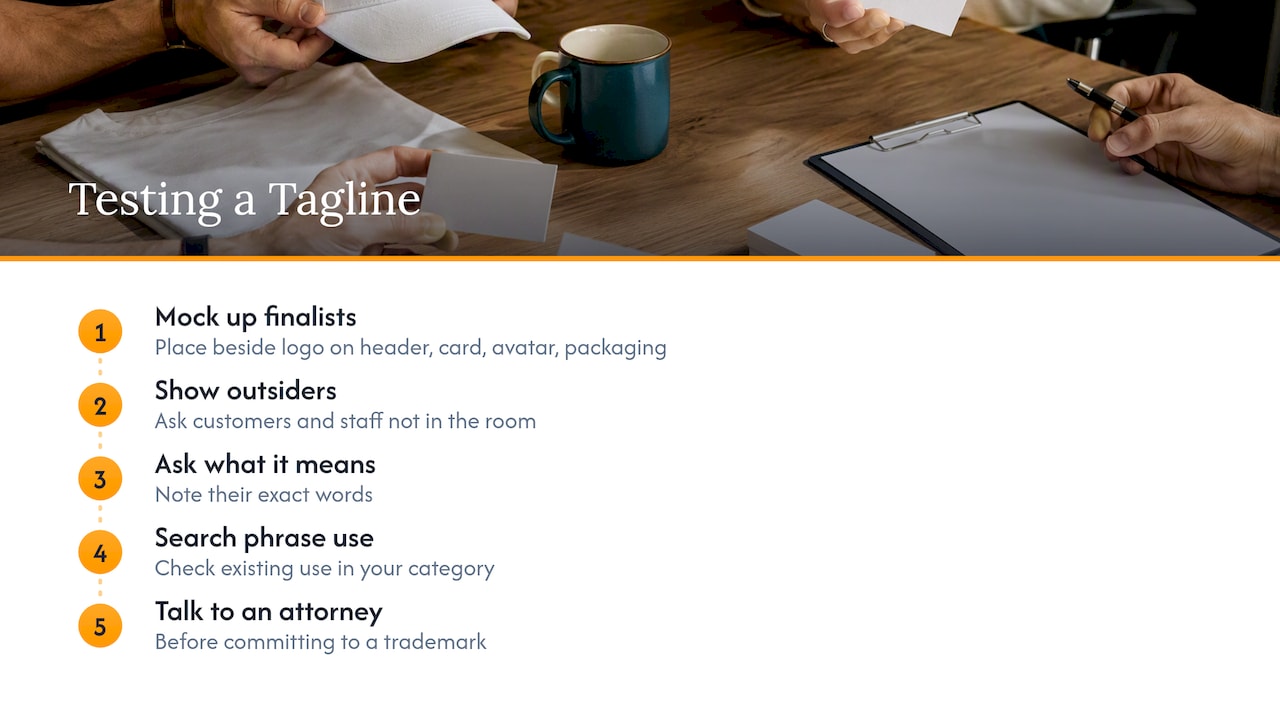
Put the finalists next to your logo in a mockup of your website header, a business card, a social avatar and a piece of packaging or signage if relevant. Show them to customers and staff who weren’t in the room. Ask what they think the company does, and note the exact words they use. Those words often improve the line.
Also run a quick search for existing use of the phrase in your category, and talk to an attorney before you commit to a line you plan to protect as a trademark. We are marketers, not lawyers, and clearance is a legal question.
Brand tagline ideas by type of business
The examples below are original patterns, not finished lines. Use them to see how a structure flexes across industries, and then rewrite them in your own words.
| Business type | Pattern | Illustrative direction |
|---|---|---|
| Dental or healthcare practice | Benefit plus reassurance | “Care that feels like care.” |
| Law firm | Outcome plus authority | “Clear counsel. Confident next steps.” |
| Consulting firm | Insight plus action | “From insight to impact.” |
| Retail shop | Invitation plus personality | “Find the thing you didn’t know you needed.” |
| CPG product | Sensory benefit plus simplicity | “Real taste. Nothing extra.” |
| Startup | Belief plus category challenge | “Built for the way you actually work.” |
Notice that several of these are intentionally plain. Healthcare and legal audiences are often making a high-stakes decision, and plain, steady language builds trust faster than wordplay. For physical products, your line also has to work next to competitors on a shelf, which is why positioning comes first. We cover that in our guide to CPG brand positioning.
Common tagline mistakes
- Describing the category instead of the brand. “Quality service you can trust” fits almost every business on earth.
- Chasing a pun. Wordplay is memorable once and tiring by the tenth time you see it.
- Stuffing in keywords. A tagline written for search engines reads like it.
- Promising what operations can’t deliver. A tagline sets an expectation, and customers hold you to it.
- Changing it every year. Recognition accumulates with repetition. Burger King’s experience of moving from scattered messaging to one platform shows the value of staying put.
- Skipping the story. A line without a brand story behind it is just words. Emotional connection comes from the full picture, which we explore in the psychology of branding.
Our perspective: a tagline is the last thing you write
We have worked on brands for more than 18 years, for startups and for household names across healthcare, legal, retail and entertainment. The most common request we hear is, “Can you come up with a tagline?” The most common problem is that the company hasn’t yet agreed on what it wants customers to believe.
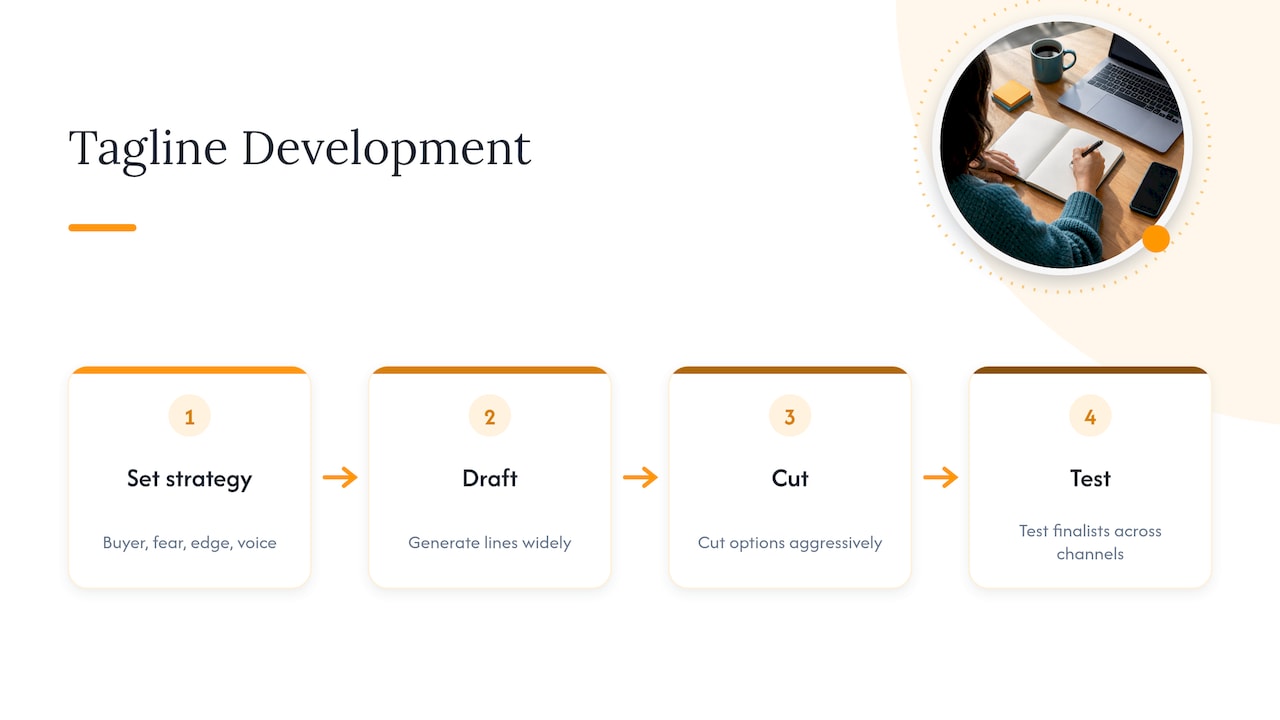
Our view is simple. A tagline is a compression of strategy. When positioning, audience and voice are settled, the line often appears in the first working session. When they aren’t, no amount of brainstorming helps, and you end up with a clever phrase that sales, marketing and leadership each interpret differently.
So we start upstream: who the buyer is, what they fear, what you do better than anyone else, and how you want to sound. Then we draft widely, cut aggressively and test the finalists in real placements, from website headers to packaging to ad creative. We care less about whether a line wins an award and more about whether it holds up across every channel for years. If you can say it in a meeting, print it on a truck and hear a customer repeat it back, it’s doing its job.
— Derek
Need help with your brand line?
If you’re working on a tagline and want a team that connects it to positioning, messaging and campaigns, our brand development service is built for that. We bring strategy and execution together, so the line you choose shows up consistently on your site, in your ads and across your materials. You can see how we approach narrative work in our brand story development case study.
Not sure where your brand stands today? Start with a marketing assessment and we’ll show you where your messaging is working and where it isn’t.
Frequently asked questions
What is a good tagline for a brand?
A good tagline captures what your brand stands for in a short, memorable phrase and helps you stand apart from competitors. It should match your voice, speak to what your audience cares about, and be something you can deliver on. If a customer can repeat it and a competitor can’t borrow it, you’re close.
How long should a tagline be?
Most memorable taglines are between two and seven words, though there’s no hard rule. Shorter lines are easier to remember and fit better beside a logo. If your line needs a comma and a second clause to make sense, try cutting it in half.
Can a company have both a tagline and a slogan?
Yes, and many do. The tagline is the permanent expression of the brand, while slogans change with campaigns, seasons or product launches. Keep slogans consistent in tone with the tagline so they reinforce each other instead of competing.
When should I change my tagline?
Change it when your positioning, audience or services change in a way the old line can no longer cover, such as a merger, a new market or a full rebrand. Don’t change it just because you are tired of it. Your team sees it every day, but customers see it far less often.
Do small businesses need a tagline?
Not always, but it helps when your name doesn’t explain what you do. A short descriptive line next to the name saves a first-time visitor a step. For a local practice or shop, clarity beats creativity.
Sources
- Ad Age Advertising Century: Top 10 Slogans
- How Burger King Drank Wendy’s Milk Shake, Adweek
- Taglines Are Fun and Effective. But There’s an Art to Them, Adweek
- Tagline definition, Cambridge English Dictionary
- On Writing a Tagline (and Pitching It, Too), HubSpot
- 31 Companies With Really Catchy Slogans and Brand Taglines, HubSpot
- 63 Famous Company Slogans and Taglines, ActiveCampaign
- How to Write the Perfect Tagline, Mailchimp