
A brand discovery workshop is a structured working session where the people who run a business agree on what the brand stands for, who it serves and how it should sound and look. Done well, it replaces opinions with decisions. You leave with a shared answer to purpose, audience, positioning and personality, and a clear brief for everything built afterward. This guide gives you the agenda, the questions, the exercises and the follow-up deliverables we use to run one.
TL;DR
- A brand discovery workshop aligns decision-makers on purpose, audience, positioning, personality and visual direction before any design or messaging work starts.
- Invite the final decision-maker and the person who owns brand strategy, plus a few people who talk to customers every day.
- Send a short survey beforehand so people think alone first, then use the room for debate and decisions.
- Plan three to four hours of focused work: opening, business and audience, positioning, personality, visual direction, wrap-up.
- The workshop is only finished when it produces written outputs: a positioning statement, audience profiles, a personality and voice sketch, and next steps with owners.
Table of Contents
- What a brand discovery workshop is, and what it should settle
- Who should be in the room
- Preparation: the survey and the brief
- A practical branding workshop agenda
- Brand discovery questions worth asking
- Brand workshop exercises that produce decisions
- The brand discovery process after the workshop
- Common mistakes to avoid
- Our perspective
- Turn your workshop into a working brand
- FAQ
- Sources
What a brand discovery workshop is, and what it should settle
Think of it as the first working meeting of a brand project. The agency or internal brand lead facilitates, and the leadership team does the thinking. The goal is not a logo or a tagline. The goal is a set of agreed answers that make later creative work faster and easier to approve.
A good session settles five things:
- Purpose: why the company exists beyond revenue.
- Audience: who you serve, what they need and what triggers a purchase.
- Positioning: why customers pick you over the alternatives they consider.
- Personality and voice: how the brand would behave as a person, and what it would never say.
- Visual direction: the look and feel the team agrees on, and the hard no’s.
If your team argues about these in every meeting, a workshop will save you months. If you are a startup, it gives you a foundation before you spend on a website or ads. If you are an established company heading into a refresh, it surfaces where leaders quietly disagree. Healthcare practices, dental specialists, law firms and consulting firms get a lot from it, because trust and differentiation carry so much weight in those categories.
Who should be in the room
Keep the group small enough that everyone speaks. At minimum you need the business decision-maker and the person responsible for brand strategy. One brand-strategy guide notes that larger organizations may need several decision-makers present. We agree, with one caution: more than eight people usually means less honesty and more politics.
A balanced group looks like this:
- The final decision-maker: founder, CEO, managing partner or practice owner. Without them, decisions get reopened later.
- The brand or marketing lead: owns the outcome and carries it forward.
- A customer-facing voice: sales, patient coordinator, client services. They know the words customers actually use.
- An operations or product voice: keeps promises realistic.
- The facilitator: guides time and conversation, and does not push an opinion.
If you also care about how the brand lands with future hires, bring in HR. Brand work and recruiting overlap, and resources on building an employer brand through video recruitment show how a clear brand story carries into hiring.
Preparation: the survey and the brief
Most workshops are won or lost before the meeting. Two preparation steps do the heavy lifting.
Send a short discovery survey
People reveal more when they answer alone. Toptal’s remote workshop guide recommends that at least two stakeholders complete the survey without conferring, covering mission, visual keywords, positioning against competitors, target personas, messaging, website strategy, and business goals and measures of success. It also suggests keeping the survey to roughly 30 minutes. We follow the same logic: short enough that people finish it, specific enough that the differences between answers become your first agenda items.
When answers match, you can move fast. When they conflict, you have found the real work.
Gather the inputs
Ask for what already exists and review it before the session:
- Current website, social profiles and sales materials
- Existing brand guidelines, logos and templates
- Customer reviews, survey results and common sales objections
- A list of direct and indirect competitors
- Any research on your audience
Then set the time, confirm attendance and share a one-page agenda so nobody arrives surprised.
A practical branding workshop agenda
This half-day format works for most small and mid-sized organizations. Adjust the timing for a bigger group or a full-day session.
| Time | Block | What happens | Output |
|---|---|---|---|
| 0:00 to 0:20 | Opening | Goals, ground rules, review of survey themes | Shared purpose for the session |
| 0:20 to 1:00 | Business and purpose | Why the company exists, how it started, what success looks like | Purpose statement draft |
| 1:00 to 1:40 | Audience | Priority audiences, needs, triggers, objections | Ranked audiences, rough profiles |
| 1:40 to 1:55 | Break | ||
| 1:55 to 2:35 | Competition and positioning | Alternatives, strengths, whitespace | Positioning draft |
| 2:35 to 3:15 | Personality and voice | Traits, tone, words to use and avoid | Personality sketch |
| 3:15 to 3:45 | Visual direction | Admired brands, no-go list, constraints | Visual keywords |
| 3:45 to 4:00 | Wrap-up | Recap decisions, assign owners, set next dates | Action list |
A few facilitation habits make this agenda work. Start each block with silent writing, then discuss. Use a visible timer. Park side topics on a list rather than letting them eat the clock. End every block by reading the decision aloud, so the room confirms it.
Brand discovery questions worth asking
Questions should be open, specific and slightly uncomfortable. Below are the sets we lean on, grouped by block.
The business
A branding questionnaire from AgencyPro frames the basics well: what the organization does, how it makes money, why it exists beyond profit, how it began, what triggered this project and what success should look like 12 months after completion. We add:
- What do customers say about you when you are not in the room?
- What is the one thing you would never compromise on?
- Which part of the business do you want to be famous for?
The audience
- Who buys from you today, and who do you wish bought more?
- What event or problem makes someone start looking for you?
- What do they worry about before they say yes?
- Where do they look first: search, referrals, social, directories?
For a healthcare or dental practice, add: what makes a new patient feel safe in the first thirty seconds? For a law firm: what does a client need to believe before they pick up the phone?
Differentiation
The same AgencyPro guide suggests asking which direct and indirect alternatives buyers consider and why customers choose you. Push on the answer. “Quality” and “service” are claims every competitor makes. Ask for the proof: a story, a process, a result, a specialty.
Personality and voice
- If the brand were a person at a dinner party, how would they talk?
- Which three traits fit, and which three definitely do not?
- What language must we never use?
Visual direction
Clipform’s branding questionnaire guide presents a useful trio: which three brands the team admires and why, what the absolute visual no’s are, and whether existing assets or guidelines limit the work. The “why” matters more than the names. It reveals whether people respond to color, tone, simplicity or status.
Brand workshop exercises that produce decisions
Exercises earn their place only if they end in something written down. These six are reliable.
1. Golden Circle for purpose
Ask why the brand exists, how it works differently and what it sells, in that order. Miro’s brand strategy template recommends this sequence for defining purpose. Have each person write answers silently, then cluster the sticky notes and vote on the strongest “why.”
2. Top three values and top three audiences
Miro’s Brand Sprint template has participants define what, how and why, then rank the top three values and top three audiences. Forced ranking is the point. A brand that lists twelve values stands for none of them.
3. Personality sliders
Place the brand on spectrums: formal to casual, bold to reserved, playful to serious, premium to accessible. Each person marks their own position first. The spread shows where the team disagrees, and the discussion that follows is where alignment happens.
4. Competitor map
Plot competitors on two axes that matter to buyers, such as specialized versus generalist and high-touch versus self-serve. Then ask what each does right and what you can do differently. Look for an open space you can truthfully own.
5. Customer journey triggers
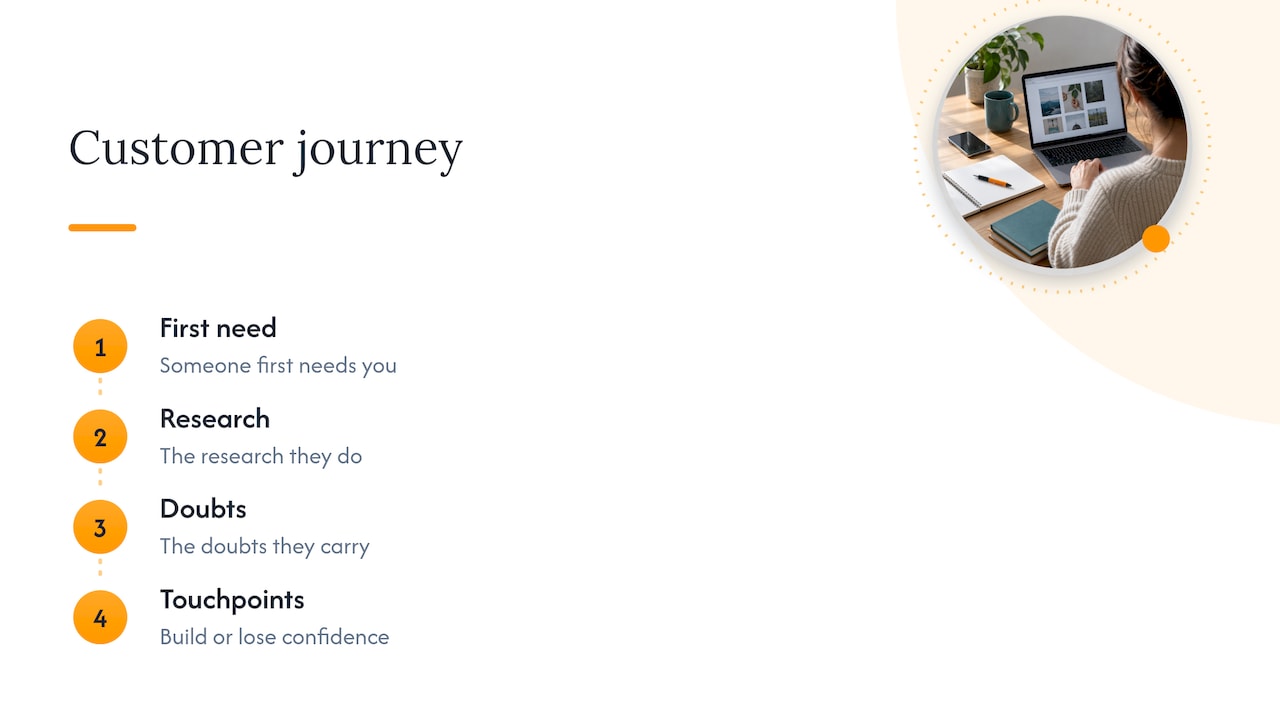
Walk through the moment someone first needs you, the research they do and the doubts they carry. Mark every touchpoint where the brand either builds or loses confidence. This exercise is especially strong for healthcare, legal and consulting teams, where trust builds slowly.
6. Mood board and no-go list
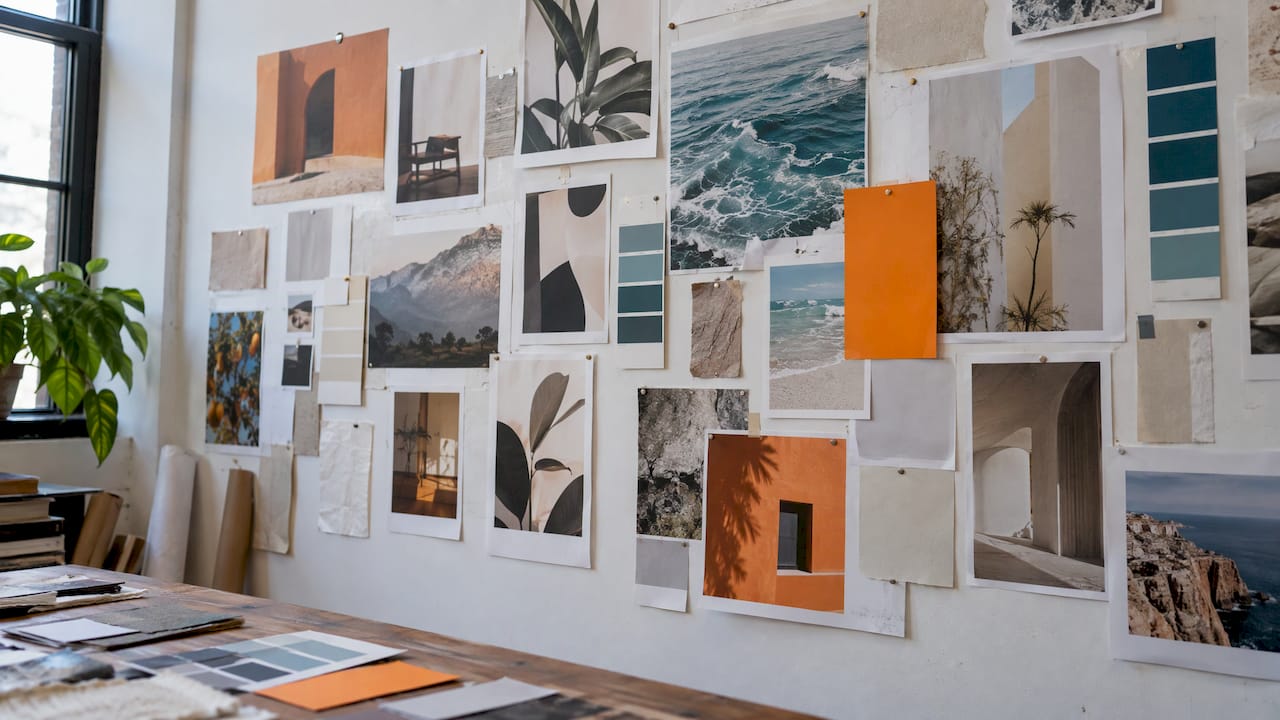
Give each person ten minutes to collect images, colors and brand examples they respond to, plus a few they reject. Compare. Agree on three to five visual keywords and a short list of things the brand will never look like.
The brand discovery process after the workshop
The session is one stage in a longer process. A typical path looks like this:
- Information gathering: survey, document review and stakeholder conversations.
- Analysis and preparation: the facilitator finds patterns and conflicts and sets the agenda.
- The workshop itself: decisions on purpose, audience, positioning, personality and visual direction.
- Synthesis: within a few business days, the notes become a written brand brief.
- Validation: test the draft against real customers, front-line staff and sales conversations.
- Implementation: messaging, identity, website and campaigns built on the agreed foundation.
If you want to see how this connects to the build phase, our guide to the brand development process walks through strategy, kits and a 90 day launch.
Deliverables that should follow
A workshop with no paper trail fades in two weeks. Expect these outputs:
- Brand brief: purpose, audience, positioning and personality on a few pages
- Positioning statement: one clear sentence your team can repeat
- Audience profiles: needs, triggers, objections and channels
- Messaging framework: the core message, proof points and phrases to use or avoid. See our brand messaging framework guide for the structure
- Visual direction notes: keywords, references and the no-go list
- Action plan: owners, dates and the next decision meeting
Once the visuals are set, a practical brand style guide keeps everyone consistent. And if you are comparing agencies and budgets, the brand strategy cost checklist helps you ask the right questions phase by phase.
Common mistakes to avoid
- Skipping the decision-maker. If they are not present, the group will redo the work.
- Starting with logos and colors. Visual talk is easy and feels productive, but it belongs at the end, after purpose and audience.
- Letting the loudest voice win. Silent writing and voting give quieter people equal weight.
- Treating it as a one-off. Write the outputs down and put them into onboarding, sales decks and the website.
- Ending without owners. Every action needs a name and a date.
Our perspective
We have spent more than 18 years helping startups and household brands, and the pattern is consistent. Campaigns rarely stall because of weak creative. They stall because leaders were never aligned on who the brand is for and what it promises.
That is why we treat discovery as the start of execution, not a separate exercise. Our in-house team, from strategy to creative to digital, takes what the room decides and turns it into brand development, messaging, websites and campaigns that stay on message. Because the same people who facilitate also build, nothing gets lost in translation.
Our advice: protect the time, bring the real decision-makers and insist on written outputs. A few focused hours at the start make every later dollar of media and creative work more effective.
Derek
Turn your workshop into a working brand
If you want a partner who can run the session and carry the results into execution, our brand development service covers strategy, identity and messaging, built by a multidisciplinary in-house team. Not sure where your current marketing stands? Start with a marketing assessment.
To see how discovery turns into results, read our brand story development case study, or contact The Artist Evolution to plan your session.
FAQ
How long should a brand discovery workshop be?
Most small and mid-sized teams get what they need in three to four hours of focused work, plus a break. Larger organizations or multi-brand companies often split it into two sessions. Keep each session short enough that people stay sharp.
What is the difference between a brand workshop and a brand discovery workshop?
The terms overlap. Discovery usually refers to the first session, where you uncover purpose, audience and positioning. Later brand workshops may focus on narrower topics such as messaging, naming or visual identity.
Can we run a brand discovery workshop remotely?
Yes. Use a pre-session survey, a shared digital whiteboard and shorter blocks split across two days. Silent writing works especially well online, because it prevents one person from dominating the call.
What should we have ready afterward?
A written brand brief, a positioning statement, audience profiles, personality and voice notes, visual direction keywords and an action plan with owners and dates. These become the briefing documents for every designer, writer and agency you work with.
Who should facilitate?
Someone neutral who can challenge ideas without taking sides: an experienced brand strategist from an agency or a skilled internal leader who does not own the outcome. Neutrality keeps the conversation honest.
Sources
- The Brand Discovery Session Formula
- Remote Brand Strategy Workshops: A Step-by-step Guide
- Branding questionnaire template: 50 questions to copy
- Clipform branding questionnaire guide
- Miro brand strategy template
- Miro Brand Sprint template
- Build an employer brand through video recruitment