
Account-based marketing works when you treat a defined set of high-value accounts like individual markets, align sales and marketing around them, and back the effort with reliable operations. Skip any one of those three legs and the program stalls. If you’re starting today, do three things first: build a prioritized account list scored on fit and intent, run a joint sales-marketing workshop to lock ownership and definitions, and fix lead-to-account matching and routing before you launch a single campaign.
Here’s the timeline to set expectations with your leadership team:
- Days 1 to 30: account list built, tiers assigned, alignment workshop complete
- Days 60 to 90: first engagement signals show up (site visits, content downloads, meeting acceptance)
- Months 6 to 12: measurable pipeline influence from targeted accounts
- Months 12 to 18: full ROI evaluation against program investment
Pro Tip: Don’t wait for a “perfect” account list before launching. Start with a focused set of top accounts to prove the model works, then expand tiers once matching and routing are stable.
Key Takeaways
Account-based marketing succeeds when sales-marketing alignment, tiered account selection, and reliable matching and routing all operate together, not as separate workstreams.
| Point | Details |
|---|---|
| Start with alignment | Run a joint sales-marketing workshop before launch to lock account ownership and priority order. |
| Choose the right tier | Keep Tier 1 lists to a manageable number of accounts to preserve genuine one-to-one personalization. |
| Fix operations first | Prioritize lead-to-account matching and routing SLAs before scaling creative production. |
| Set realistic timelines | Expect engagement signals in 60 to 90 days and measurable pipeline in 6 to 12 months. |
| Work with an execution partner | Theartistevolution runs assessment, orchestration, and creative personalization together through its campaign management and marketing assessment services. |
Table of Contents
- What Is an Account Based Marketing Strategy?
- What Are the Three Types of ABM Programs?
- How Do You Build and Score Your Target Account List?
- How Do Matching, Routing, and Orchestration Work Together?
- What Personalization Tactics Actually Move Target Accounts?
- What KPIs and Benchmarks Should You Track?
- How Long Does It Take to Roll Out ABM?
- What Do Successful ABM Programs Look Like in Practice?
- What the Conventional ABM Advice Gets Wrong
- Ready to Build an ABM Program That Actually Runs?
- Frequently Asked Questions
- Sources
What Is an Account Based Marketing Strategy?
An account based marketing strategy flips the traditional funnel. Instead of casting wide and filtering down, you pick your target accounts first and build everything, content, ads, outreach, sales plays, around winning them specifically. Salesforce describes this as treating each target company as a “market of one,” where marketing and sales share a single account plan rather than running parallel, disconnected motions.
This isn’t a rebrand of demand generation. Demand gen fills the top of the funnel broadly and lets scoring sort out who’s worth pursuing. ABM reverses the sequence: you decide who matters, then generate demand exclusively inside those walls. Most B2B revenue teams run both simultaneously, using demand gen to fill pipeline at scale and ABM to concentrate resources on the accounts that move the revenue needle most.
The benefits show up in a few consistent places:
- Higher pipeline quality because every touch targets a company you’ve already vetted as a fit
- Larger deal sizes, since ABM programs typically target accounts with bigger budgets and more complex buying committees
- Shorter sales cycles, driven by multi-threaded engagement across a buying committee instead of chasing a single lead
- Stronger retention and expansion, because Salesforce ties post-sale account alignment between marketing, sales, and service to better upsell and cross-sell outcomes
The tradeoff is effort concentration. ABM demands more per-account investment than a broad campaign, which is exactly why account selection and tiering, covered next, determines whether the program pays off.
What Are the Three Types of ABM Programs?
Not every account deserves the same level of investment, and the biggest strategic mistake teams make is running a one-to-many program with one-to-one expectations. The Pedowitz Group frames ABM as three distinct program types, each with its own resourcing model and outcome profile.
- One-to-one (Tier 1). Fully custom campaigns built around individual named accounts, typically 10 to 50 companies to keep the personalization genuinely one-to-one rather than diluted across too many targets. Expect executive-level content, custom microsites, and direct AE involvement in every play.
- One-to-few (Tier 2). Accounts grouped into small clusters by shared industry, use case, or buying trigger, usually ranging from dozens to a few hundred companies. Personalization happens at the cluster level: templated assets swapped with industry-specific proof points and language.
- One-to-many (Tier 3, programmatic). Hundreds to thousands of accounts targeted through scaled digital tactics, intent-based ad targeting, and dynamic web personalization. Individual account customization gives way to segment-level messaging.
The failure mode isn’t picking the wrong tier. It’s mislabeling one tier as another and then measuring it against the wrong benchmark, expecting Tier 3 programmatic reach with Tier 1 close rates, or starving a genuine Tier 1 account list of the executive time it needs to convert.
Pro Tip: If your “ABM program” has 400 accounts and one shared nurture sequence, you’re running programmatic marketing with an ABM label on it. That’s fine, just call it what it is so your sales team doesn’t expect one-to-one attention.
How Do You Build and Score Your Target Account List?
Start with your closed-won customers, not a purchased list. The Pedowitz Group’s core recommendation is to mine your existing best-fit customers for the firmographic patterns, employee count, industry, tech stack, growth stage, that actually predict a good fit, then build your ideal customer profile from those patterns rather than guessing.

Firmographic fit alone gets you a list of companies that resemble your best customers. It doesn’t tell you who’s actually in-market right now. That’s where intent data comes in. Gartner’s guidance on intent signals distinguishes between first-party intent (activity on your own site and content) and third-party intent (research behavior across the web tracked by intent data providers). Layering both onto your firmographic list tells you not just who fits, but who’s actively researching a solution like yours.
From there, build a scoring model that blends three inputs:
- Fit score: firmographic and technographic alignment with your ICP (industry, size, tech stack, growth signals)
- Intent score: first-party and third-party research activity indicating active buying motion
- Relationship warmth: existing pipeline, past opportunities, or champion relationships inside the account
Weight these based on what your closed-won data actually shows drives conversion, not an arbitrary 33/33/33 split. Some teams find intent matters more for Tier 3 volume plays, while relationship warmth carries more weight for Tier 1 accounts where a single champion can open doors.
None of this scoring model matters without a joint workshop where sales and marketing agree on account ownership and priority order before the list goes live. This is the step teams skip, and it’s the one that causes the most downstream friction. Sales reps who discover they’ve been assigned target accounts they didn’t choose, or don’t recognize, will disengage from the program regardless of how good your content is. Run the workshop, get sign-off on the list, and document who owns what before a single email goes out.
How Do Matching, Routing, and Orchestration Work Together?
This is the part of ABM that gets the least attention and causes the most silent failure. You can have a perfect account list and brilliant creative, but if your systems can’t connect a website visit or form fill back to the right account and route it to the right rep in time, none of it converts.
LeanData’s execution guide identifies lead-to-account matching as one of the most common points of ABM breakdown. Match rate, the percentage of inbound leads and activity correctly tied back to a named target account in your CRM, is the metric that determines whether your entire program’s data is trustworthy. A low match rate means engagement is happening on your target accounts and you simply can’t see it, which makes every downstream report unreliable.
Routing rules should scale with tier. Tier 1 accounts need immediate, real-time routing to a named AE the moment a target account shows engagement, a page visit, a content download, an email open from a buying committee member. Tier 2 can tolerate routing within a business day to an account owner or pod. Tier 3 typically routes into a broader queue or nurture track rather than to an individual rep.
Orchestration is not the same thing as automation. The ABM Pulse defines orchestration as multiple coordinated actions firing across channels and teams in response to intent triggers, not a single automated email sequence. A true orchestration play might trigger a LinkedIn ad, a personalized email, and a sales alert simultaneously when a target account visits your pricing page.
Start with three to five core orchestration plays rather than trying to build twenty on day one. A trigger-based play, say, target account engagement on a competitor comparison page firing a coordinated ad, email, and sales notification, needs a human owner and clear documentation, or it decays within a quarter as tools change and staff turn over.
The technology stack behind this generally falls into four categories:
- CRM as the system of record for account and contact data
- Intent data providers surfacing third-party research signals
- Orchestration platforms coordinating multi-channel, trigger-based plays
- Sales engagement tools executing the outreach sequences orchestration triggers
Mapping your specific vendors to these four categories, rather than buying tools ad hoc, keeps the stack from becoming four disconnected systems that each claim to be your “ABM platform.” Theartistevolution’s approach to marketing technology starts by auditing exactly this kind of stack fragmentation before recommending new tools.
What Personalization Tactics Actually Move Target Accounts?
Personalization scales differently depending on your tier, and the biggest budget mistake is applying Tier 1 creative effort to a Tier 3 list, or generic templates to a Tier 1 account that deserves custom work.
- Tier 1 assets: custom account microsites, executive briefing documents referencing the account’s specific initiatives, and case studies swapped to feature a customer in their exact vertical. Personalized video, a short clip referencing the account by name and their specific challenge, performs especially well for warming up a buying committee before a first call.
- Channel sequencing: warm up the account on LinkedIn with targeted content before any outreach, layer in targeted display or LinkedIn ads once engagement starts, then follow with personalized email and coordinated sales outreach. Gartner’s tactical playbook recommends prospect-specific offers, content or incentives built around a named account’s likely pain point, paired with retargeting to keep your brand present through a long buying cycle.
- Events and direct mail work best reserved for Tier 1 and 2 accounts where the cost per touch is justified by deal size. A well-timed physical mailer to a buying committee ahead of a scheduled demo still outperforms another email in most inboxes.
- Scaling for Tier 2 and 3: build modular templates with swappable industry proof points and dynamic web content that adjusts messaging by visitor segment rather than writing unique copy for every account.
Pro Tip: Budget your creative production hours by tier before the quarter starts. A realistic split is heavy custom production for Tier 1, templated-with-substitution for Tier 2, and fully dynamic or programmatic for Tier 3. Trying to hand-craft assets for 300 accounts is how ABM programs quietly die from creative bottleneck.
For teams building out video specifically, structured approaches to B2B video advertising offer useful frameworks for where personalized video earns its production cost versus where a templated version performs just as well. General personalization frameworks, like the tactics outlined in proven content personalization approaches, translate well to web and email personalization at the Tier 2 and 3 level.
What KPIs and Benchmarks Should You Track?
Track two categories of metrics: account-level outcomes and operational health. Conflating them is how ABM dashboards become noise instead of signal.
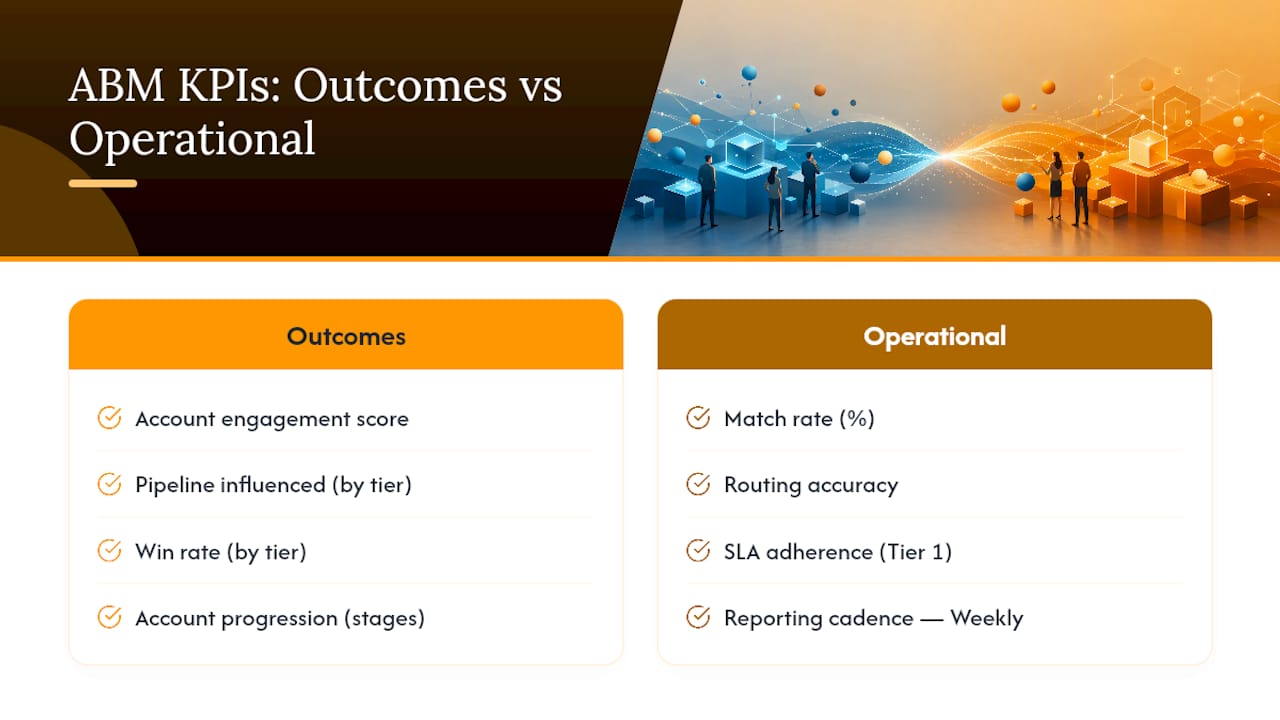
On the outcome side, prioritize account engagement score (a composite of visits, content consumption, and email response across the whole buying committee, not just one contact), pipeline influenced by tier, win rate by tier, and account progression through defined stages from target to opportunity to customer. Leadfeeder’s guidance emphasizes tracking engagement and progression at the account level specifically, since a single contact converting tells you almost nothing about whether the account as a whole is moving.
On the operational side, watch match rate (the percentage of activity correctly tied to target accounts), routing accuracy, and SLA adherence (how consistently Tier 1 leads get real-time routing versus slipping into a queue). A program with great creative and a broken match rate will always underreport its own success.
Set your reporting cadence and expectations around a realistic curve. The Pedowitz Group’s benchmarks put initial activation signals, engagement, meeting acceptance, early content consumption, at 60 to 90 days. Measurable pipeline influence typically shows up in the 6 to 12 month range. Full ROI evaluation needs 12 to 18 months to account for enterprise sales cycle length. Report weekly on operational health metrics and monthly or quarterly on pipeline outcomes; anything faster on the outcome side just measures noise.
A dashboard that separates these two metric categories visually keeps leadership from panicking over a slow pipeline month when the operational fundamentals, match rate, routing speed, are actually healthy.
How Long Does It Take to Roll Out ABM?
Plan your rollout in three distinct phases, each with different resourcing needs and success markers.
- Days 1 to 90: foundation. Finalize the account list and tiers, run the sales-marketing alignment workshop, configure lead-to-account matching and routing rules in your CRM, and launch three starter orchestration plays, no more. This phase is entirely about getting the operational plumbing right before creative scale matters.
- Months 3 to 9: scale. Expand content production for Tier 1 and 2 accounts, add two to four more orchestration plays once the first three are running cleanly, and refine your scoring model based on which fit and intent signals actually predicted conversion in the early cohort.
- Months 9 and beyond: maintain and optimize. Reassess tier assignments quarterly as accounts move through the funnel or new intent signals emerge, retire orchestration plays that have stopped performing, and formalize the reporting cadence into a standing leadership review.
Resourcing realistically requires a dedicated marketing ops or RevOps owner for matching and routing, a content resource split across tiers, and committed AE time, particularly for Tier 1, where sales involvement in creative and outreach isn’t optional. Budget bands scale with tier: Tier 1 programs run heaviest per-account due to custom creative and direct AE time, while Tier 3 programmatic spend is lower per-account but higher in aggregate media cost.
The most common pitfall is treating month one launch enthusiasm as the finish line. Programs that stall usually do so around month four or five, right when the initial account list needs refreshing and the first orchestration plays need real maintenance rather than a “set it and forget it” assumption.
What Do Successful ABM Programs Look Like in Practice?
Real ABM execution shows up most clearly in how a program handles the handoff between strategy and creative delivery. Theartistevolution has spent more than 18 years building brand and campaign programs for clients across healthcare, retail, legal, and consulting, sectors where buying committees are large and sales cycles are long, exactly the conditions ABM is built for.
A few patterns show up consistently across the agency’s documented engagements:
- Brand-first account creative. The Brand Story Development work illustrates how narrative and positioning get tailored to a specific audience before any channel tactics get built, the same sequencing Tier 1 ABM creative requires.
- Institutional-scale rebranding. The Institutional Rebranding case study shows how messaging shifts get executed across a large organization’s touchpoints, a comparable operational challenge to rolling out consistent Tier 1 or Tier 2 account messaging across multiple stakeholders.
- Engagement-driven campaign design. The Brand Engagement with Unique Campaigns case study demonstrates the kind of measurable engagement lift that account-level ABM reporting is built to capture.
Across these engagements, the operational discipline, measurement, creative personalization, and channel coordination, mirrors exactly what a well-run ABM program requires: campaign strategy that doesn’t stop at the creative brief but carries through to ongoing management and reporting.
What the Conventional ABM Advice Gets Wrong
Most ABM content treats personalization as the hard part. It isn’t. Writing a custom executive brief for 30 accounts is a content production problem you can solve with a competent writer and a week of research. The hard part, the part that actually kills programs, is the unglamorous plumbing: match rates, routing SLAs, and who owns account 47 when the AE who requested it changes territories.
I’d go further than most guides will: if you have to choose between spending your first quarter’s budget on creative production or on fixing lead-to-account matching, fix the matching. Beautiful account-specific content that never gets seen by the right rep at the right moment is wasted spend, and a lot of ABM programs quietly waste exactly that way while leadership blames the creative team for “engagement that isn’t converting.”
The conventional advice also underplays how long real pipeline attribution takes. Teams that expect ROI proof by month four are set up to kill a program that was actually working, just not yet visible. Six to twelve months for pipeline signal is not a hedge. It’s how enterprise buying cycles actually move.
Prioritize operational readiness first, tier discipline second, and creative scale third. In that order, not reversed.
Ready to Build an ABM Program That Actually Runs?
If you’ve read this far, you already know the gap between a good ABM strategy on paper and one that runs cleanly week after week comes down to execution: the matching, the routing, the creative production cadence, and the reporting that keeps leadership bought in past month four. Theartistevolution runs that entire operational layer for you instead of leaving you to stitch together five point tools and hope your internal team has the bandwidth to maintain it.
A first conversation with our team typically starts with a marketing assessment, mapping your current account data, tech stack, and sales alignment gaps against what a working ABM program actually needs. From there, we scope campaign strategy and ongoing management that covers account-specific creative, orchestration setup, and the reporting cadence your leadership team needs to trust the numbers. Clients in healthcare, legal, retail, and consulting have leaned on this exact process to move from a stalled account list to a program with real pipeline behind it. If your ABM effort has stalled at the account-list stage, or your matching and routing are quietly breaking your data, book a marketing assessment and we’ll show you exactly where the gaps are.
Frequently Asked Questions
What’s the difference between ABM and demand generation?
Demand generation casts broadly and scores leads down to find the best fits. Account-based marketing reverses that sequence: you select target accounts first, then build every campaign specifically around winning them. Most revenue teams run both together rather than choosing one exclusively.
How many accounts should a Tier 1 ABM program include?
Keep Tier 1, one-to-one programs to roughly 10 to 50 accounts. Beyond that range, the personalization typically dilutes into templated Tier 2 style content, even if the program is still labeled one-to-one internally.
How long before an ABM strategy shows results?
Expect initial engagement signals within 60 to 90 days, measurable pipeline influence within 6 to 12 months, and a full ROI picture at the 12 to 18 month mark, given typical enterprise sales cycle length.
What causes most ABM programs to fail?
Broken lead-to-account matching and routing are among the most common failure points. A program can have excellent creative and still underperform if engagement isn’t being correctly tied to the right account and routed to the right rep in time.
Do we need special software to run an account based marketing strategy?
You need four capabilities at minimum: a CRM as your system of record, an intent data source, an orchestration layer for coordinated multi-channel plays, and a sales engagement tool for outreach execution. These can come from a consolidated platform or several integrated tools, as long as match rates and routing stay reliable across all of them.
Sources
- Account-Based Marketing (ABM) | Salesforce
- ABM Strategy for B2B: Building an Account-Based Marketing Program That Actually Closes Business
- Account-Based Marketing (ABM): The Complete Execution Guide