
Law firm content marketing means publishing useful, accurate material (articles, FAQs, videos, guides) that answers the questions prospective clients ask before they hire a lawyer, so your firm is found, trusted and contacted. It works best as a system: a clear goal, a calendar, content tied to the way people search, ethics review before publishing, and measurement that connects pages to calls and forms. This guide walks through each part, and shows where a full-service team that handles strategy, SEO and reporting together saves a firm the most time.
TL;DR
- Content marketing earns visibility by answering prospective clients’ questions in plain language during their research phase, before they pick a firm.
- Start with a business goal (more consultations in one practice area, for example), then build a calendar with channels, frequency and an approval process.
- Lawyer advertising rules differ by state and changed in 2026 in places such as Alabama and New York, so review each piece against your own state’s rules.
- Measure what matters to the firm: contact-form submissions, phone clicks and signed matters, not page views alone.
- Consistency beats bursts. A team that plans, writes, optimizes and reports in one place keeps the calendar moving.
Table of Contents
- What law firm content marketing is, and why it works
- What most firms are not publishing
- Step 1: Set a goal and name the reader
- Step 2: Build an editorial calendar that survives a busy month
- Step 3: Choose formats that answer real questions
- Step 4: Optimize and distribute
- Step 5: Check advertising rules before you publish
- Step 6: Measure what the firm actually cares about
- Who should write it
- Put a content engine behind your firm
- FAQ
- Sources
What law firm content marketing is, and why it works
Prospective clients rarely start by searching for a lawyer’s name. They search for what is happening to them: how long a green card takes, what happens after an arrest, whether a will needs probate. Content marketing puts your firm’s answer in front of that person.
The American Bar Association’s Law Practice Magazine says client-centric content such as blog posts, FAQs and explainer videos helps potential clients find a firm during their research phase, and that educational content that demystifies complex legal issues builds trust and improves search rankings. That is the whole logic: useful content earns the click, and the clarity of the answer earns the trust.
There is also a competitive angle for smaller practices. A law review analysis of firm blogging by Walter Effross observes that a blog may be a more effective business development tool for small firms than large ones, because large firms already have brand recognition and market to narrower audiences. If your firm is struggling with online visibility, content is the lever that does not depend on size.
How content differs from advertising
Paid search and Local Services Ads buy attention for as long as the budget runs. Content builds assets you keep: a page that ranks keeps answering questions months later. The two work together. A well-built practice-area page converts paid clicks better, and strong content gives your ads something credible to land on. If paid is part of your plan, see our guide to law firm PPC and our walkthrough of Local Service Ads for lawyers.
What most firms are not publishing
The ABA’s 2023 Websites & Marketing TechReport shows how much open ground there is. Among law firm websites, 96% include partner profiles and 74% include associate profiles. Only 54% include in-house legal articles (down from 62% in 2022), and just 15% include consumer guides. Also, 64% of firms do not syndicate their website content at all.

In other words, most sites tell visitors who the lawyers are and stop there. The visitor who wants to understand their situation before calling finds little. A firm that publishes plain-language guides for its core practice areas is competing against a thin field.
Step 1: Set a goal and name the reader
Before writing anything, decide what the content must do for the business. The National Law Review’s guidance on legal content argues that strategy should align with business development goals so every piece centers on bringing in business. Translate that into something specific:
- A practice area to grow. For example, more family-law consultations from your metro area.
- A client profile. A first-time business owner facing a contract dispute asks different questions than an in-house counsel.
- A conversion action. A phone call, an intake form or a consultation request.
Write one sentence that joins the three: “We want more [client type] to request a consultation about [matter].” Every topic on the calendar should serve that sentence.
Match topics to search intent
People search at different stages. Early questions (“what is the statute of limitations for…”) call for explainers. Later ones (“how much does a divorce lawyer cost in [city]”) call for cost, process and timeline pages. Local searches (“estate planning attorney near me”) are won through your site and your Google profile together. Our guides on local SEO for lawyers and your Google Business Profile cover that side.
Step 2: Build an editorial calendar that survives a busy month
Most law firm blogs die the same way: a burst of posts, then a trial date, then silence. The fix is a calendar with ownership. The ABA says an editorial calendar should include the channels where content is published, how often, and the approval process content must pass before publication. It can also track authors, editors, bottlenecks and post-publication results, so you can refine timing.
A workable starting point for a small or mid-sized firm:
- Pick a frequency you can hold. Two strong pieces a month beat eight rushed ones in January and none after.
- Assign three roles per piece: who drafts, who reviews for legal accuracy, who approves for advertising compliance.
- Plan around the calendar of your practice. Tax season, school year, hurricane season or open enrollment all create predictable questions.
- Leave room for news. A new court decision or rule change is a chance to publish quickly and be cited.
Our content calendar playbook shows how marketing teams structure this in practice.
Step 3: Choose formats that answer real questions
The ABA’s 2025 guidance recommends client-centric blog posts, FAQs and explainer videos, using immigration timelines, processes and costs as examples. Effective video formats include answers to legal questions, process and timeline explainers, dos and don’ts, and client success stories and testimonials (the last subject to your state’s rules, discussed below).
| Format | Best for | Example for a law firm |
|---|---|---|
| Practice-area page | People ready to hire | “Truck accident attorney in Dallas” with process, timeline and what to bring |
| Blog post or FAQ | Early research questions | “What happens at a first custody hearing?” |
| Explainer video | Building comfort and familiarity | A two-minute walk-through of the probate steps |
| Consumer guide | Capturing contact details and showing depth | “Checklist: documents to gather before your consultation” |
| Newsletter or client alert | Staying in front of past clients and referral sources | A summary of a new state rule |
Why video deserves a place
People hire people. Ruby Lichte Powers argues in the ABA piece that video humanizes a practice because clients want to see that their attorney is knowledgeable, approachable and trustworthy, qualities that are hard to convey in writing alone. A short video on your practice page can do what a bio paragraph cannot. Our piece on the benefits of a brand explanation video explains how that format works for a brand.
Write the way clients talk
The National Law Review advises to “show, not tell”: demonstrate leadership rather than claiming it, and drop legalese because most clients are not lawyers. It also recommends creating once and publishing everywhere, while adjusting the message for each channel, since identical posts across platforms suggest a lack of platform mastery. A practical test: if a smart friend outside the law would not understand the first paragraph, rewrite it.
Step 4: Optimize and distribute
Content that is never found is a cost, not an asset. Optimization for a law firm comes down to a few habits:
- One page, one question. Build pillar pages for each practice area and supporting articles that link back to them.
- Clear title, headings and local signals so search engines and readers know what the page covers and where you practice.
- A visible next step. A phone number, a short form and a sentence about what happens after contact.
- Fast, mobile-friendly pages. Many legal searches happen on phones, often in stressful moments.
- Reuse. One guide can become a short video, a LinkedIn post, a newsletter item and an FAQ block.
Distribution is where firms leave the most on the table. As noted above, 64% of firms do not syndicate their content. Sharing your best pieces to social channels, referral partners and email lists multiplies the return from the same work.
This is also where search optimization and content meet. Content brings the questions into your site, and technical and on-page SEO make sure search engines can read, rank and surface it. Our SEO agency service combines the two.
Step 5: Check advertising rules before you publish
Law firm content is regulated in a way most business content is not. In most states, material that promotes your services can count as lawyer advertising, governed by state versions of the ABA Model Rules 7.1 through 7.3, so your state bar’s rules apply to your blog, videos and testimonials. Effross recommends that firm sites carry disclaimers that content is provided for informational purposes only and is not legal advice, and that warnings about completeness and accuracy appear prominently near the content rather than only in a terms page.
Rules have moved recently, and they differ by state:
- Alabama. The Alabama State Bar reports that the state’s Supreme Court adopted amendments to Rules 7.1, 7.2 and 7.3, effective January 1, 2026. They include keeping ad copies for six years instead of filing within three days, shorter specific disclaimers in place of a general one, testimonials only from people with actual knowledge, and a 21-day wait before emailing known personal-injury victims, with an “ADVERTISEMENT” label.
- New York. The New York State Bar Association reports that amendments effective June 1, 2026 essentially adopt the ABA’s 2018 advertising rules as Rules 7.1 and 7.3, move Rule 7.4’s subject matter into Rule 7.1©, leave Rule 7.2 unchanged and keep Rule 7.5 on professional notices and firm names.
- The ABA Model Rules. According to a New York County Lawyers Association ethics committee report, the ABA’s overhaul replaced the physical office address requirement with “contact information” and merged Rules 7.4 and 7.5 into 7.1 and 7.2.
Because these rules are state-specific and still changing, confirm the current text with your state bar’s ethics counsel or advertising rules page before launching a campaign. We built a four-step prelaunch checklist for U.S. law firm ads that you can run each piece through. Build the compliance review into the approval step of your calendar so it never becomes a last-minute scramble.
Step 6: Measure what the firm actually cares about
Page views are a vanity number unless they turn into conversations. NJICLE materials on blogging for lawyers recommend using Google Analytics and Google Search Console and setting goals such as contact-form submissions and phone-number clicks. They suggest matching the metric to the format:
- Blogs: unique users, returning readers, page views.
- White papers, case studies and ebooks: conversions and leads.
- Newsletters and client alerts: opens, clicks and firm interactions.
Keep expectations grounded in how clients actually find lawyers. The ABA TechReport found that only 35% of firms reported a client retaining them directly through the firm’s website (up from 25% in 2022). Among firms with blogs, 29% reported a client retained directly or through a referral from the blog (45% for solos). Many matters begin with a referral that the content then reinforces: a referred client Googles you first, and your pages either confirm the recommendation or leave questions. Track both direct inquiries and “how did you hear about us?” answers at intake.
That last step matters. Content creates the call, but how the call is handled decides whether it becomes a client. Our law firm intake process guide covers the seven steps from first call to signed client, and our GA4 reporting guide shows how to build reports that tie traffic to leads.
Review results on a regular rhythm. Quarterly works for most firms: find the pages that bring inquiries and extend them, find pages that rank but do not convert and strengthen their calls to action, and update anything that a rule or statute change has made out of date.
Who should write it
The ABA TechReport shows the split. About 72% of solo practitioners with websites create their own content, while among firms of 100 or more attorneys, 79% most often rely on marketing staff, followed by more than one lawyer (63%) and technology staff (27%). Most small and mid-sized firms sit between those poles: they have lawyers with expertise but no dedicated marketing department.
That gap is where a full-service marketing team helps. Your attorneys supply the knowledge and sign off on accuracy. The team handles the rest: strategy, calendar, drafting support, design, video, SEO, publishing, paid campaigns and reporting. Our team has been doing this for more than 18 years across industries including legal, and it works as an extension of your own team, so lawyers spend minutes on a piece rather than hours.
Our perspective
We see the same pattern whenever a firm says its online visibility is not where it should be: the expertise is real, but it is invisible to the people searching. Lawyers know the answers. The website does not say them.
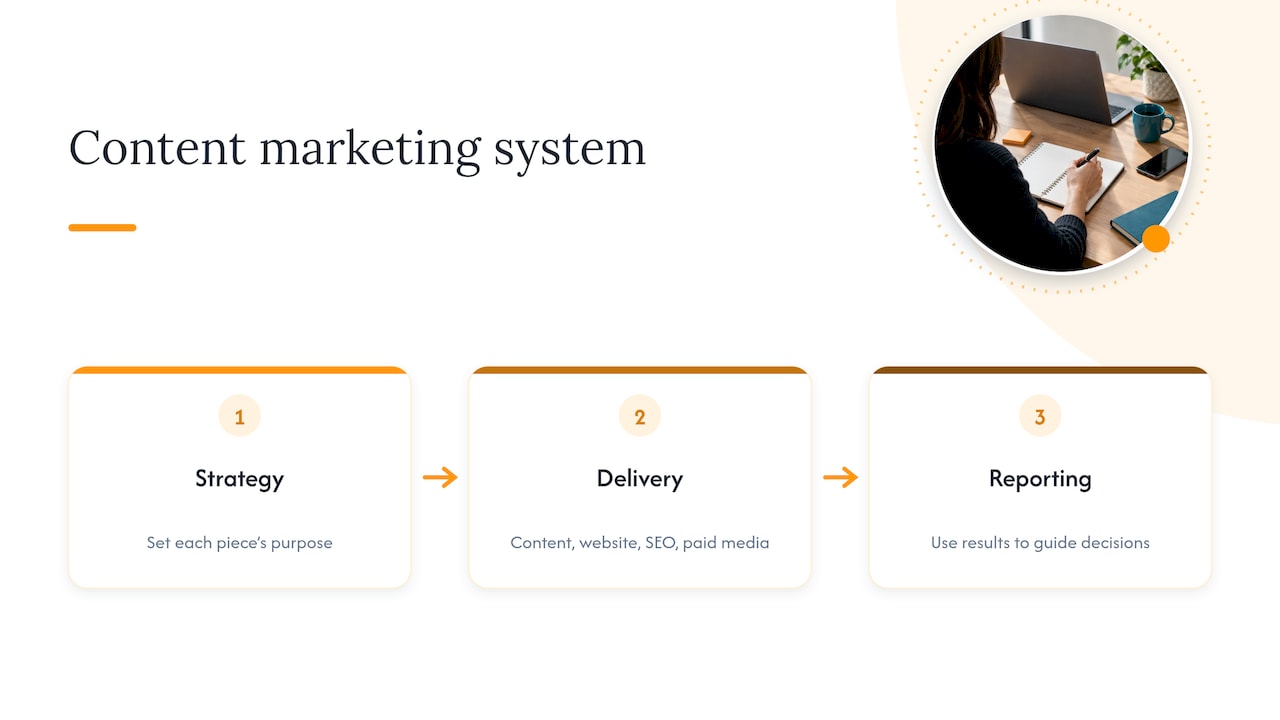
Our approach is to treat content as part of one marketing system, not a standalone task. Strategy comes first, so each piece has a purpose. Content, website, SEO and paid media follow from that strategy, and reporting closes the loop so decisions come from results. Because we bring a multidisciplinary in-house team and a proven playbook system to the work, a firm does not have to coordinate five vendors to get one coherent campaign.
For law firms, we pair that with a habit of designing every piece around advertising rules and a clear path to a consultation. The result we aim for is simple: the right person finds your answer, trusts it and picks up the phone.
Derek
Put a content engine behind your firm
If your firm has the expertise but not the hours, we can build and run the program with you: a marketing plan, brand and website foundations, SEO, paid search and reporting that shows which content produces inquiries. Our Strategy & Management service is the starting point, and our Search Engine Optimization Agency service builds the search visibility that gets your content read. Start with a conversation about your practice areas and goals.

If your brand still feels generic next to local competitors, our law firm branding guide shows what a distinctive identity looks like for solo and small firms.
FAQ
How often should a law firm publish new content?
Choose a frequency your team can sustain for a year, whether weekly, twice a month or monthly. The ABA’s guidance on editorial calendars lists frequency as a core setting alongside channels and approvals. A steady monthly pace with strong practice-area pages usually outperforms a burst of posts that stops.
What are the 3 C’s of content marketing?
One widely cited version, from NBC News, is: be compelling, always customize, and keep consistency. For a law firm that means answering a real client question distinctively, speaking to a specific client type and matter, and publishing on a steady schedule in a recognizable voice.
Does a blog post count as lawyer advertising?
It can. In many states, content that promotes your services falls under the state’s advertising rules, and several states updated those rules in 2026. Add clear disclaimers, review each piece against your state bar’s current text, and keep copies as your state requires. Our prelaunch checklist walks through the review.
How long does law firm content marketing take to work?
Content builds over months, not days, because pages need to be indexed, earn rankings and gain trust. Many firms pair content with paid search so inquiries start sooner while organic pages mature. Set a review at three to six months and judge by inquiries and signed matters, not traffic alone.
Should a small firm hire help or write content in-house?
Solo attorneys often write their own content, and that works while the volume is small. As you add practice areas, video, SEO and reporting, a coordinated team keeps quality and consistency up without pulling lawyers out of billable work. Many firms start with a marketing assessment to see which pieces they need first.
Sources
- Mastering Law Firm Marketing: Innovative Strategies to Attract and Retain Clients (ABA Law Practice Magazine, 2025)
- Building Blogs (and Law Firm Web Sites): Ethically (Washington College of Law Review)
- 2023 Websites & Marketing TechReport (ABA)
- Plan and Organize Content Using an Editorial Calendar (ABA Law Practice Magazine, 2024)
- Strategic Legal Content Marketing (National Law Review)
- Your Guide to Alabama’s Updated Lawyer Advertising Rules (Alabama State Bar)
- Amendments Adopted To Advertising Rules (New York State Bar Association)
- NYCLA Professional Ethics Committee comments on attorney advertising and solicitation
- Blogging and Podcasts for Lawyers (NJICLE materials)
- The 3 C’s of Content Marketing (NBC News)