
A brand audit checklist works when it does three things: it inventories every place customers meet your brand, scores each one against the same criteria, and ends in a ranked fix list. Below is the checklist we use as a starting point: seven areas, a 1-5 score for each, and a simple way to decide what to fix first. It is written for owners and marketing leads at healthcare practices, law firms, dental specialists, consulting firms, retailers, CPG companies and new businesses.
If you would rather have a team run it with you, our marketing assessment is the place to start.
TL;DR
- A brand audit compares what your brand says and shows everywhere against what customers actually see, believe and remember.
- Audit seven areas: strategy, visual identity, messaging, digital presence, customer experience, competitors and internal alignment.
- Score every touchpoint 1-5, then rank fixes by impact and effort. Strategy gaps come before design fixes.
- Regulated fields (healthcare, dental, legal) add compliance checks to the audit: privacy, advertising rules and review practices.
- Plan for about four weeks if you do it in-house, and repeat it once a year.
Table of Contents
- What a brand audit is, and who needs one
- Before you start: scope, owner and timeline
- Step 1: Inventory every touchpoint
- The seven-area brand audit checklist
- Step 2: Ask your audience
- Compliance checks for healthcare, dental and legal brands
- Step 3: Score and prioritize
- A worked example
- Step 4: Report and act
- Doing it yourself versus doing it together
- Put the audit to work with The Artist Evolution
- FAQ
- Sources
What a brand audit is, and who needs one
A brand audit is a structured review of how your brand is defined, how it looks and sounds across channels, and how your audience perceives it. The output is not a report to file. It is a scored list of what is working, what is inconsistent and what to change first.
You need one when:
- You are launching and want the identity right before you spend on ads or a website.
- Your practice, firm or product line has grown through acquisitions, new locations or new service lines, and nothing looks quite the same anymore.
- Leads are flat and you cannot say whether the problem is the message, the look, the website or the offer.
- You plan a rebrand and need a baseline to prove the result later.
- You are a retailer or CPG brand whose packaging, shelf presence, site and social channels have drifted apart.
The audit is the foundation of any optimization effort. You cannot set a sensible goal until you know where you stand today, and most teams are surprised by how inconsistent their brand looks once everything sits side by side.
Before you start: scope, owner and timeline
Spend the first few days on setup. Skipping it is the most common reason audits stall.
- Write one objective. “Find out why patient inquiries from our website are down” is a good objective. “Look at our brand” is not.
- Name one owner. One person collects, scores and reports. Others contribute.
- Set the scope. Decide which locations, service lines or product lines are in. A dental group with five offices should audit all five, because patients compare them.
- Pick a score scale and keep it. We use 1 (off-brand or missing) to 5 (consistent, distinctive, working).
- Block four weeks. Week 1: setup and inventory. Week 2: internal review. Week 3: external research and competitors. Week 4: scoring, prioritizing and the action plan.
Step 1: Inventory every touchpoint
Before you judge anything, list everything. A touchpoint is any place a customer, patient, client or employee meets your brand. A mid-sized business often has dozens, and the ones nobody owns are usually the weakest.
Group them into three buckets:
- Internal: onboarding decks, job descriptions, hiring outreach, email signatures, internal announcements, training material.
- External: website, landing pages, Google Business Profile, social profiles, email newsletters, ads, brochures, signage, packaging, sales decks, proposals, video.
- Customer experience: phone greeting, intake or booking flow, waiting room or storefront, FAQ pages, invoices, follow-up emails, return or cancellation policies, review replies.
Put each one in a spreadsheet with columns for location or URL, owner, last updated and the five scores below. Screenshots beat descriptions.
The seven-area brand audit checklist
Score each area from 1 to 5 using the questions below. Where a touchpoint appears in several areas, score it in each.
1. Brand strategy and positioning
This is the area that decides how much every other fix is worth.
- Is there a written mission, a clear promise and a defined target customer?
- Can you finish this sentence in one line: “We help [who] do [what] so they can [result]”?
- Can three people on your team describe the brand the same way without conferring?
- Is your position different from competitors, or could a rival’s name replace yours on the homepage?
- Do your service lines or product lines relate to each other in a way customers understand?
If you answer “no” or “not sure” to most of these, treat it as a strategy problem rather than a design problem. A new logo will not fix it. Our guide to the brand messaging framework shows how to write the foundation down.
2. Visual identity
- Is the logo used correctly: right version, clear space, minimum size, no stretched or recolored copies?
- Are colors and fonts consistent across site, print, social, signage and packaging?
- Does photography look like one brand, or like a mix of stock and snapshots?
- Are templates (slides, proposals, social posts) available, and do people use them?
- Is there a current brand guide, and does anyone outside marketing know where it lives?
Score by sampling. Pull ten recent assets at random from different departments and locations and compare them side by side. The gaps are obvious within minutes.
3. Messaging and voice
- Does the headline on your homepage say what you do and for whom within five seconds?
- Is the tone the same on the website, in emails, on social media and in the sales deck?
- Are the key messages (three to five) repeated, or does every channel say something different?
- Do proof points (results, credentials, case studies) back up each claim?
- Does language fit the audience: plain for patients and consumers, precise for buyers and referral partners?
Collect the actual text from your website, sales deck, email sequences, paid ads, social bios and support documents into one document. Read it in a single sitting. Contradictions and outdated claims stand out.
4. Digital presence
- Does the website load fast, work on mobile and make the next step obvious?
- Is your business name, address and phone number identical on your site, your Google Business Profile and directories?
- Do you rank for the searches your customers actually use? For a law firm that means practice area plus city. For a dental specialist, the procedure plus city.
- Are social profiles active, on-brand and complete?
- Do ads, landing pages and the website say the same thing?
Pair this review with analytics: traffic sources, conversion rate, click-through rate on ads and top landing pages. Our SEO and pay-per-click teams work from the same data when they audit visibility.
5. Customer experience
- Walk the journey as a customer: find you, contact you, book or buy, receive the service or product, get follow-up. Where does the brand promise break?
- How long does it take to get a reply to an inquiry?
- Are reviews recent, and do replies sound like your brand?
- Are policies (returns, cancellations, fees, delivery) written clearly and the same everywhere?
- Do frontline staff know what the brand promises?
For a healthcare practice, this is where patient engagement is won or lost: reminders, intake forms, patient portal messages and the tone of the front desk.
6. Competitive positioning
- Pick three to five competitors your customers actually compare you with.
- Record their positioning, message, look, pricing signals and channels.
- Mark where you are distinct and where you blend in.
- Note the gap nobody owns. That is usually your opening.
Measure awareness too. Ask a small sample of customers to name brands in your category without prompting (unaided recall), then whether they have heard of yours (aided recall), then show your logo or tagline without the name and see if they identify it. Low recall despite steady ad spend points to a memorability problem in the identity.
7. Internal alignment
- Do employees describe the brand the way leadership does?
- Do sales and customer-facing teams use approved messaging, or write their own?
- Is someone accountable for brand decisions across locations or departments?
- Do new hires learn the brand in onboarding?
If employees struggle to define the brand, customers will too. Interview a few people in sales, customer service and front-line roles, and ask what they say when a prospect asks, “What makes you different?”
Step 2: Ask your audience
Internal opinion is not evidence. Add a short survey of customers, prospects and, if you can reach them, former customers. Three questions are enough:
- What three words describe us?
- Why did you choose us (or someone else)?
- What would make you recommend us?
Compare their answers with what you wrote in the strategy area. The distance between the two is your brand perception gap. Our guide to brand lift measurement explains how to track that gap over time.
Compliance checks for healthcare, dental and legal brands
If you work in a regulated field, add these checks to the digital and customer experience areas.
- Patient privacy in marketing. Under the HIPAA Privacy Rule, using patient information for certain marketing communications generally requires the patient’s written authorization. The HHS guidance on HIPAA and marketing explains what counts as marketing. Check testimonials, patient photos, email lists and retargeting setups against it, and confirm questions with your compliance officer or healthcare attorney.
- Lawyer advertising. The ABA’s Model Rule 7.1 on communications about a lawyer’s services prohibits false or misleading statements about a lawyer or the lawyer’s services. States adopt their own versions, so review your site copy, case-result claims and taglines against your state bar’s rules.
- Reviews and testimonials. The FTC’s final rule on fake reviews and testimonials bans fake or misleading reviews. Audit how you collect, display and reply to reviews.
- Consistency across locations. Multi-office practices and firms should check that each location lists the same services, credentials and contact details.
Step 3: Score and prioritize
Now turn the notes into numbers.
Score each touchpoint on four things: visual identity, messaging, tone and experience, each 1-5. Average them. Then label every touchpoint:
| Average score | Label | What to do |
|---|---|---|
| Below 3.0 | Fix | Schedule it now |
| 3.0 to 4.0 | Refine | Bundle into the next update |
| Above 4.0 | Maintain | Protect it, and copy what works |
Then score each of the seven areas from 1 to 5 and total them out of 35:
| Total | Reading |
|---|---|
| 29 to 35 | Strong brand; protect and sharpen |
| 22 to 28 | Solid with clear vulnerabilities |
| 15 to 21 | Real revenue is slipping through the gaps |
| Below 15 | The brand is working against you |
These bands are our own working scale, meant for comparing your brand against itself year over year, not against other companies.
Rank the fixes with an impact and effort grid. Give each fix an impact score (1-5: how much it affects leads, trust or revenue) and an effort score (1-5: how much time and money). Then sort:
- High impact, low effort: do these first. Examples: correcting business listings, updating the homepage headline, replacing outdated logo files.
- High impact, high effort: make a project plan with an owner and deadline. Examples: repositioning, a website rebuild, a packaging refresh.
- Low impact, low effort: batch these into spare time.
- Low impact, high effort: drop or postpone.
One rule overrides the grid: if Strategy and Positioning scores 2 or lower, fix that first. Visual and website work built on an unclear position gets redone.
A worked example
Take a three-location dental specialty group. The audit finds:
- Strategy: 2. Each office describes the practice differently.
- Visual identity: 3. Two logo versions in use, one office with old signage.
- Messaging: 3. The homepage lists procedures, not outcomes for patients.
- Digital presence: 2. Phone numbers differ between the site and two directories.
- Customer experience: 4. Reviews are strong and staff replies are warm.
- Competitors: 3. Nearby practices all use the same “gentle, family-friendly” language.
- Internal alignment: 2. Front desk staff have never seen a brand guide.
Total: 19 out of 35. The fix list starts with a one-page positioning statement (strategy), then corrects directory listings (quick win), then rewrites the homepage headline and unifies the logo. The new website and signage come after, once the message is settled. In four weeks the group has a ranked plan instead of a vague sense that things feel off.
Step 4: Report and act
Keep the report short. A one-page summary with the total score, the three biggest gaps and the first five fixes is more useful than a 60-page deck nobody reads. Include:
- Scores by area, with screenshots as evidence
- The ranked fix list with owners and dates
- Metrics to track: share of search, branded search volume, website conversion rate, review volume and rating, recall in your next survey
- A date for the next audit, ideally in 12 months, with a lighter check after any rebrand or acquisition
If the audit points to a rebuild, our brand development process lays out the stages, and the 90-day rebranding strategy shows how to prove return on it.
Doing it yourself versus doing it together
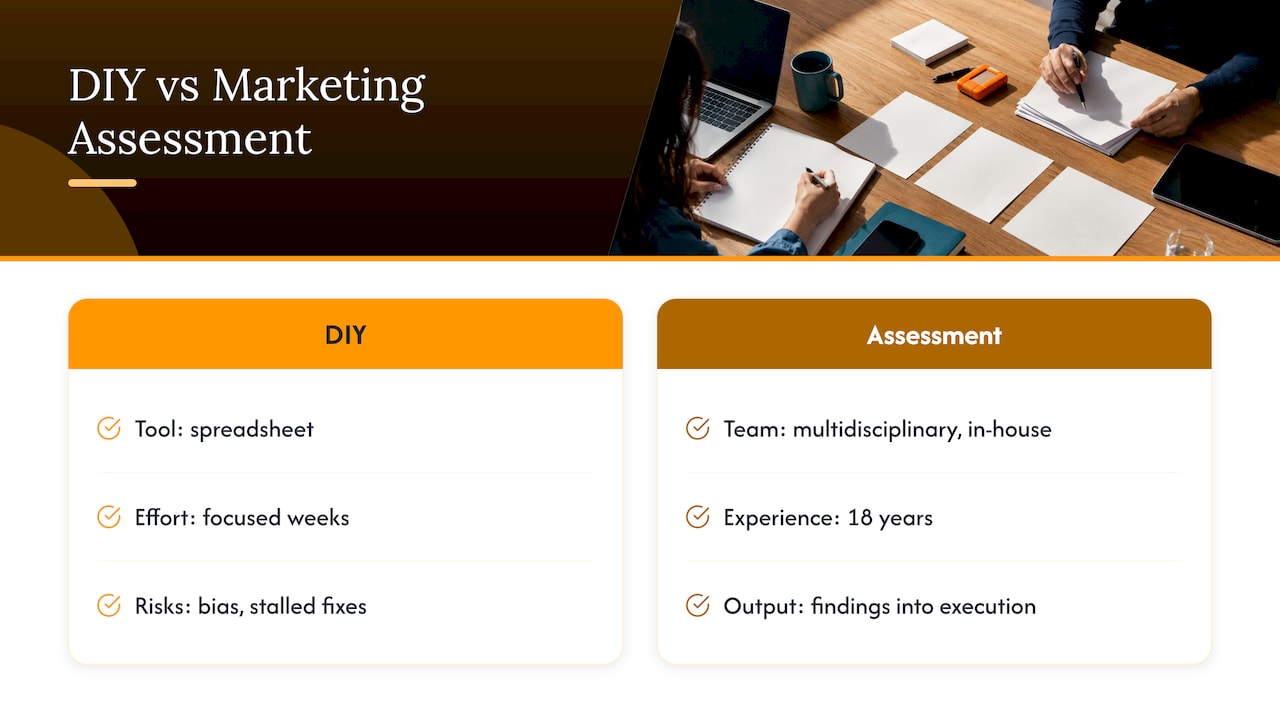
You can run this checklist with a spreadsheet and a few weeks of focused effort. The hard parts are objectivity and follow-through: the people closest to the brand rarely score it harshly, and fix lists stall when marketing, operations and leadership each own a piece.
That is where our marketing assessment fits. We bring a multidisciplinary in-house team, 18 years of experience across startups and household brands, and the ability to move from findings into execution. Retail and CPG brands can start with the TAEretail marketing assessment.
Our perspective
Most audits we see fail in the same place: they produce a beautiful diagnosis and no plan. We built our approach around the opposite order. Start with strategy, because every colour, headline and ad depends on it. Score everything on one scale so the conversation moves from opinions to evidence. Then turn findings into a ranked list that somebody owns.
We also believe the audit is only half the job. Our team works across brand development, website design, SEO and pay-per-click, so a finding like “our message is unclear and our search visibility is weak” can become one connected plan instead of three separate vendor projects. That is what we mean when we say we act as an extension of your team.
If you are a healthcare provider, legal firm, dental specialist, consulting firm, retailer or new business, the starting point is the same: know exactly where you stand, then move on the fixes that matter most.
Derek
Put the audit to work with The Artist Evolution
If your audit shows that strategy, identity and digital presence all need attention, our brand development service builds the foundation: positioning, identity and the story behind it. Our marketing assessment gives you a clear read on where your marketing stands today, so the next investment goes where it counts.
Talk to us through theartistevolution.com and bring your scored checklist. It makes the first conversation faster and the plan sharper.
FAQ
What should a brand audit include?
A brand audit should include your strategy and positioning, visual identity, messaging and voice, digital presence, customer experience, competitor comparison and internal alignment. Add customer feedback and a ranked action list. Without the action list, the audit is only a diagnosis.
How long does a brand audit take?
Allow about four weeks for a thorough in-house audit: one week to set scope and inventory touchpoints, one for the internal review, one for customer and competitor research, and one to score and write the plan. A small business with few touchpoints can finish sooner.
How often should you run a brand audit?
Once a year is a sound rhythm, with an extra review before a rebrand, after a merger or acquisition, when you open new locations or when leads drop without an obvious cause. Keep the same scale each year so you can compare results.
Can I use a brand audit template?
Yes. A template needs a touchpoint inventory, a 1-5 score for each area, notes and screenshots as evidence, an impact and effort ranking, and an owner and date for every fix. The checklist and tables in this article cover each of those columns, so you can copy them straight into a spreadsheet.
What is the difference between a brand audit and a marketing audit?
A brand audit examines identity, message and perception. A marketing audit looks at channels, spend and performance. They overlap, and the cleanest order is brand first, because channel results depend on a clear brand.
Sources
- HHS: HIPAA Privacy Rule guidance on marketing
- American Bar Association: Model Rule 7.1, Communications Concerning a Lawyer’s Services
- FTC: final rule banning fake reviews and testimonials