
The FTC Endorsement Guides say one thing at their core: an endorsement must be honest and not misleading. If someone is paid, gifted or otherwise connected to a brand and talks about it, the audience needs to know. If someone shares a result, it has to be real and typical, or you have to say what is typical. The rest of this guide shows how that plays out in influencer posts, reviews, testimonials and UGC campaigns, and what your team should do before the next campaign goes live.
TL;DR
- The Guides live at 16 CFR Part 255. They are not a statute, but they show how the FTC applies Section 5 of the FTC Act, and ignoring them invites enforcement.
- Disclose any material connection (payment, free product, discounts, family or business ties) clearly and conspicuously, right where the endorsement appears.
- Brands and influencers share responsibility. Hiring an influencer does not hand off your compliance duty.
- Endorsers must be truthful, must have actually used the product, and exceptional results need a note on what is typical.
- The 2023 update focused on the “significant minority” standard for connections the audience would not expect. Build your process around it.
Table of Contents
- What the Endorsement Guides are, and what they are not
- What counts as a material connection
- How to make a disclosure clear and conspicuous
- Honesty rules beyond disclosure
- What changed in the 2023 update
- Enforcement: what is at stake
- A compliance checklist for brands
- Our perspective: compliance is a brand asset
- Build compliant campaigns with a team that plans for it
- FAQ
- Sources
What the Endorsement Guides are, and what they are not
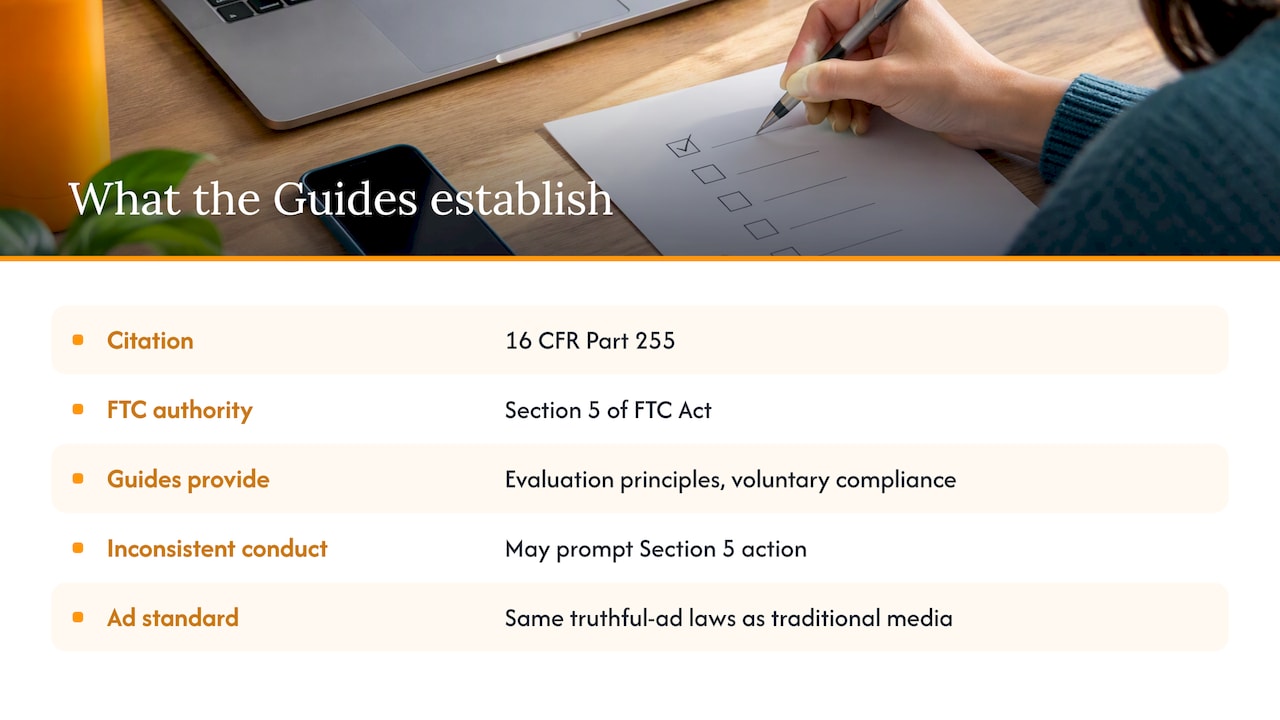
The Endorsement Guides are codified at 16 CFR Part 255. That answers the common question of which section of the Code of Federal Regulations covers consumer endorsements. The Guides are administrative interpretations of Section 5 of the FTC Act. They lay out general principles the FTC uses to evaluate endorsements and testimonials, and they give marketers a basis for voluntary compliance.
“Voluntary” does not mean optional in practice. Under 16 CFR 255.0, practices that are inconsistent with the Guides may lead to corrective action under Section 5 if, after investigation, the Commission has reason to believe the conduct is unlawful under the statute. In plain terms: the Guides are the FTC’s own yardstick, so use them as yours.
The FTC also stresses that influencers and marketers are subject to the same truthful advertising laws as traditional media, whatever new platform or technique they use. A TikTok video, a podcast read, a Google review request and a TV spot are all measured against the same honesty standard.
Endorsement vs. testimonial
People often ask about the difference. Under the Guides, there is none that matters for compliance. The FTC treats the two identically and uses the word “endorsement” to cover both, as Part 255 explains.
The definition in 16 CFR 255.0 is broad. An endorsement is any advertising, marketing or promotional message that consumers are likely to believe reflects the opinions, beliefs, findings or experiences of someone other than the sponsoring advertiser. That covers:
- Influencer posts and stories
- Customer reviews you solicit or feature
- Patient, client or customer testimonials on your website
- Expert or celebrity endorsements
- Affiliate content
If a message looks like it comes from someone other than you, assume the Guides apply.
What counts as a material connection
The disclosure rule sits in 16 CFR 255.5. An endorser must clearly and conspicuously disclose a connection to the seller when that connection might materially affect the weight or credibility of the endorsement, and a significant minority of the audience does not understand or expect it.
Material connections include:
- Monetary payments
- Free or discounted products or services
- Business, family or personal relationships
- Any other benefit that could shape how the endorser talks about you
Two points from the FTC’s Disclosures 101 for Social Media Influencers catch brands off guard. First, influencers must disclose even if they believe their opinion is unbiased, and even if they got a free product with no requirement to post. Second, an influencer posting from abroad is still covered by U.S. law when it is reasonably foreseeable that the post will affect U.S. consumers.
Who is responsible: the brand or the influencer?
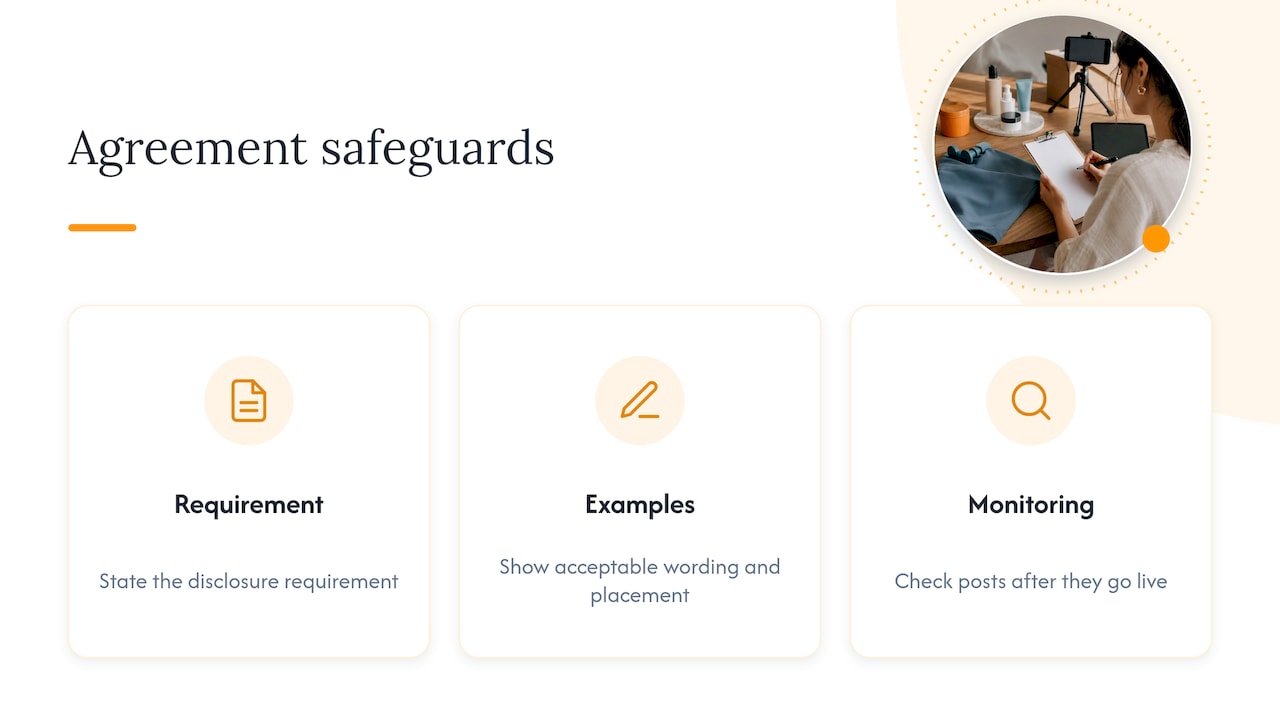
Both. The FTC has described disclosure responsibility as a two-way street in which the influencer and the brand each share the obligation to make sure relationships are properly disclosed. A brand that writes the contract, sends the product and approves the content cannot credibly say disclosure was someone else’s job.
That is why your influencer agreements should state the disclosure requirement, show examples of acceptable wording and placement, and give you a way to check posts after they go live.
How to make a disclosure clear and conspicuous
The Guides’ standard is practical. A clear and conspicuous disclosure must be difficult to miss, easily understandable and, on social media, unavoidable. The FTC’s influencer guidance turns that into placement rules.
| Format | What the FTC guidance says | What to do |
|---|---|---|
| Image or text post | Disclosure should be placed with the endorsement, not buried where viewers must click “more” or lost in a group of hashtags. | Put the disclosure in the first line, above the “more” cutoff on mobile. |
| Video | Disclosures should appear in the video itself, not only in the description. Using both audio and visual is more likely to be clear. | Say it out loud and add an on-screen label while the product is shown. |
| Live stream | Disclosures should be repeated periodically. | Build in reminders so late joiners see them. |
| Short-form | Same standard: hard to miss, with the endorsement. | Use on-screen text that stays long enough to read, plus a spoken mention. |
The placement points come from Disclosures 101. The advice about putting a disclosure above the “more” button on mobile is in the FTC’s guidance on clear and conspicuous disclosures.
Wording that works
Simple beats clever. Say plainly that the content is paid, sponsored or that the product was free. Avoid vague tags and jargon that an average viewer may not understand. If a disclosure needs decoding, it is not clear.
A few habits make the difference:
- Put the disclosure in the same place as the claim it qualifies, not in a profile bio or footer.
- Test it on a phone, with sound off and then on.
- Check that a platform’s built-in paid-partnership tool is not the only signal if it could be easily missed.
- Repeat it for each post or video, not once per campaign.
Honesty rules beyond disclosure
Disclosure is the headline, but the Guides also govern what endorsers say. The FTC’s FAQ on the Endorsement Guides summarizes the requirements: endorsements must be honest, must reflect the endorser’s actual experience, and cannot make claims the marketer could not legally make itself.
In practice:
- Real use only. Per Disclosures 101, endorsers cannot talk about their experience with a product they have not tried. Paid endorsers must give an honest opinion.
- No claims you could not make yourself. If a health, financial or performance claim would need substantiation in your own ad, it needs the same substantiation in an influencer’s mouth.
- Typical results. The FTC advises that unrepresentative testimonials may be misleading unless you disclose the results consumers can generally expect. A “lost 30 pounds” or “doubled my traffic” story needs context about what is typical.
- Connections that affect credibility. Any connection the audience would not expect must be disclosed, as covered above.
Reviews and incentives
If you ask customers for reviews, the same logic applies. A reward, discount or free product tied to a review is a connection a reader would want to know about. Do not edit or select reviews in a way that gives a false picture of customer experience, and do not post reviews from people who never used the product.
What changed in the 2023 update
The FTC published its revised Guides in the Federal Register in July 2023. The update clarified that a material connection must be disclosed when a significant minority of the audience does not understand or expect it. That is the test your team should apply, not a hunch about whether followers “probably know.”
The FTC also recognized that some well-known influencers may be so closely tied to a brand that their audience already expects a paid relationship. It declined to publish a full list of such cases. The safe reading is simple: unless you are certain the audience expects the relationship, disclose.
The agency’s own framing is common sense. Consumers want to know whether a reviewer has been paid or has a relationship with a company because that knowledge affects how they weigh the recommendation.
Enforcement: what is at stake
The Guides themselves are not a statute, but the FTC can act under Section 5 of the FTC Act against deceptive practices. Businesses should also know about Notices of Penalty Offenses. According to the Federal Register notice, the FTC can seek civil penalties from companies that received such a notice about endorsements and then went on to engage in deceptive practices.
For a growing company, the cost is rarely just a fine. An investigation pulls in legal fees, pauses campaigns, forces content takedowns and damages the trust you spent years building.
A compliance checklist for brands
Use this before every influencer, UGC or review campaign:
- Map every endorsement channel. Influencers, affiliates, ambassadors, review requests, customer stories, employee posts.
- Write disclosure terms into contracts. Require clear wording, placement above any “more” cutoff, and on-screen plus spoken disclosure for video.
- Provide examples. Show approved and unapproved disclosure formats.
- Brief on claims. Give endorsers a list of what they can and cannot say, and require real product use.
- Monitor after launch. Review live posts, not just drafts, and have a process for fixing or removing non-compliant content.
- Handle results claims carefully. If a testimonial shows exceptional outcomes, add what is generally expected.
- Keep records. Contracts, briefs, approvals and monitoring notes show good-faith compliance.
- Retrain regularly. New hires, new platforms and new formats all create new risk.
Industry-specific cautions
The Guides apply to everyone, but some sectors layer on more rules. Law firms have bar advertising rules on top of FTC standards; our prelaunch checklist for law firm ads covers that. Healthcare providers also need to think about patient privacy when featuring testimonials, which we address in our HIPAA compliant marketing guide. A patient story that is fine under the FTC’s honesty standard can still be a privacy problem.
Our perspective: compliance is a brand asset
After 18 years of building campaigns for startups, retailers, healthcare practices, legal firms and consumer brands, we have seen the same pattern. The campaigns that last are the ones audiences believe. Disclosure is not a tax on authenticity. It is what makes authenticity credible.
We treat the Guides as part of the creative brief, not a legal afterthought. When we plan influencer or user-generated programs, disclosure language, placement and claim boundaries are set before a single post is drafted, so creators can work naturally inside clear lines. That is far easier than rewriting content after it has gone live. Our thinking on partnering with influencers and on how user-generated content turned local buzz into retail impact both start from this principle.
Our advice to marketing leaders: pick a short, plain disclosure standard, put it in every contract, and audit it monthly. Teams that do this move faster, because nobody stops to debate what is allowed.
— Derek
Build compliant campaigns with a team that plans for it
If your brand uses influencers, reviews or UGC and you want the strategy and the guardrails built together, our campaign strategy and ongoing management team can run the program as an extension of yours. If you are not sure where your current marketing stands, a marketing assessment is a practical first step. You can also start from our home page to see how our in-house team covers brand, digital advertising, SEO and content.
FAQ
Are the FTC Endorsement Guides law?
Not by themselves. They are administrative interpretations of Section 5 of the FTC Act and give a basis for voluntary compliance. But conduct that departs from them can lead to corrective action if the FTC concludes it is unlawful under the statute, so treat them as the working standard.
Do I have to disclose a free product if the influencer did not have to post?
Yes. The FTC says influencers must disclose material connections even when they believe their opinion is unbiased or when they received a free product with no requirement to post. Free and discounted products are listed as material connections in the Guides.
Where should the disclosure go on a video?
Inside the video itself, not only in the description. Using both audio and on-screen text is more likely to be clear and conspicuous. For live streams, repeat the disclosure periodically so new viewers see it.
Does the brand or the influencer get in trouble?
Both can. The FTC describes disclosure responsibility as shared between the influencer and the brand. That is why contracts, briefs and post-launch monitoring matter on the brand side.
Which part of the CFR covers consumer endorsements?
16 CFR Part 255, titled Guides Concerning Use of Endorsements and Testimonials in Advertising. The key disclosure rule is section 255.5, and definitions, including what counts as clear and conspicuous, are in section 255.0.
Sources
- eCFR: 16 CFR Part 255, Guides Concerning Use of Endorsements and Testimonials in Advertising
- eCFR: 16 CFR 255.0, Purpose and definitions
- eCFR: 16 CFR 255.5, Disclosure of material connections
- FTC: Disclosures 101 for Social Media Influencers
- FTC: Disclosures 101 for Social Media Influencers (PDF guide)
- FTC: Influencers, are your #materialconnection #disclosures #clearandconspicuous?
- FTC: The FTC’s Endorsement Guides, What People Are Asking
- FTC: Advertisement Endorsements
- Federal Register: Guides Concerning the Use of Endorsements and Testimonials in Advertising