
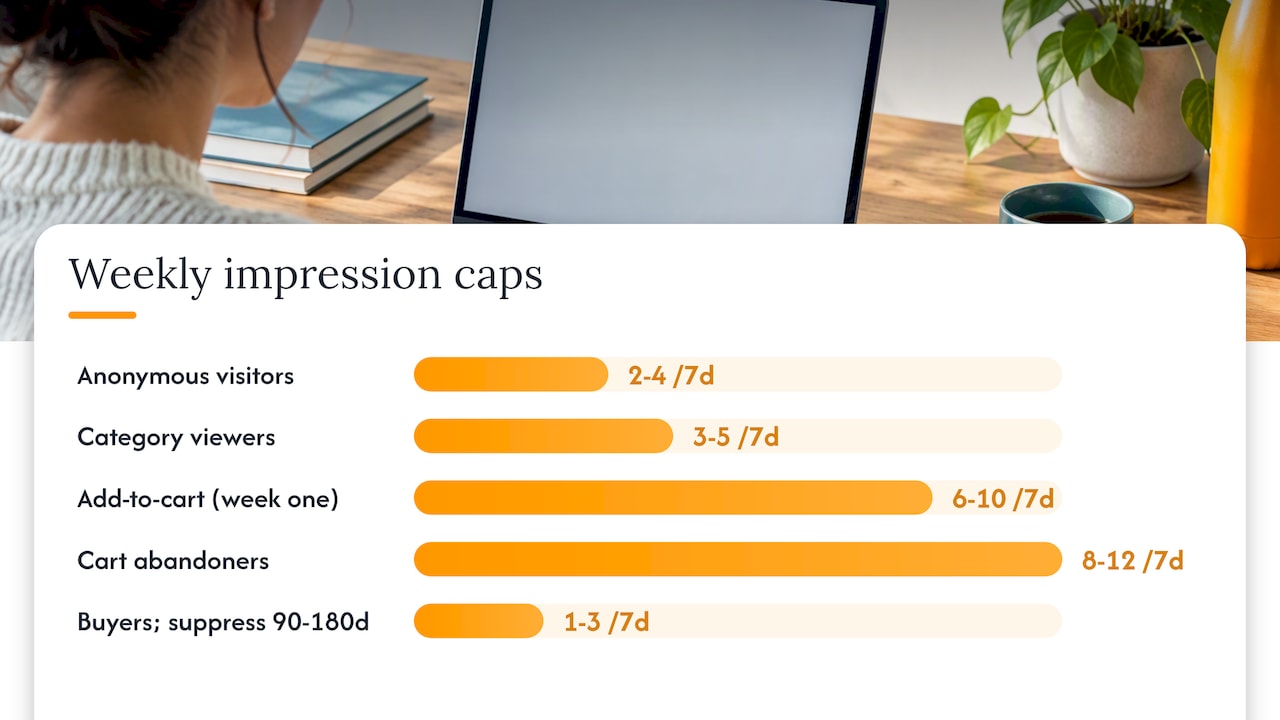
The right retargeting frequency cap depends on audience intent, not a single magic number: start with segment-based caps, low-intent at 2 to 4 impressions per week, mid-intent at 3 to 5, and cart abandoners front-loaded at 6 to 10 impressions over seven days, then validate with 7 to 14 day holdouts. Google Ads and social ad managers give us the controls to set these limits, but testing against CPA and CTR tells us whether the numbers are actually working.
TL;DR:
- Cart abandoners can start with 8 to 12 impressions in the first week, but monitor marginal CPA because many may convert without ads.
- Recent purchasers should receive only 1 to 3 impressions weekly for retention and stay excluded from acquisition campaigns for 90 to 180 days.
- High frequency segments should rotate creative every seven days with at least three variants, while medium frequency groups can refresh every 10 to 14 days.
- Run a holdout against a control group, change one variable at a time, and compare CPA and incremental return before making a cap permanent.
- For Google Display campaigns, only viewable impressions count toward a frequency cap, so served impressions may overstate each person’s actual exposure.
Table of Contents
- What a frequency cap is and how platforms enforce it
- Practical starting caps by audience intent (a testable matrix)
- Audience windows, membership duration and platform limits
- Creative rotation and sequencing rules to prevent fatigue
- Signals to watch and an experimental protocol
- Step-by-step implementation checklist
- Practitioner’s take on applying these frequency rules at scale
- Why the standard frequency advice falls short
- How The Artist Evolution helps you put these caps into practice
- FAQ
- Sources
What a frequency cap is and how platforms enforce it
A frequency cap limits how many times a single person sees an ad within a set period, whether that’s a day, a week, or a month. The concept sounds simple, but where and how we apply it changes the outcome significantly.
Most platforms let us set caps at the campaign, ad group or ad set, or individual ad level. Google Ads applies manual frequency caps through campaign settings, and for Display campaigns specifically, only viewable impressions count toward that cap, not every impression served. That distinction matters because served impressions can include ads that never actually appeared on screen, which would otherwise inflate how often we think someone saw a message.
Video campaigns work a bit differently: caps there apply at the campaign level and can cover impressions, views, or both. Social platforms typically offer similar controls within their ad managers, though terminology and defaults vary by platform and by campaign objective.
Beyond hard caps, most ad managers also offer softer delivery tools built around target frequency or reach-based buying, which aim for an average exposure level across an audience rather than a strict per-user ceiling.
- Hard caps set a strict maximum number of impressions per user per time unit.
- Target frequency and reach buying aim for an average exposure goal across the audience instead of a fixed ceiling.
- Viewable impressions, not served impressions, count toward Display caps in Google Ads.
- Caps can be layered: campaign-level, ad group level, and ad level limits can all apply at once.
Choosing between a hard cap and a softer reach-based tool depends on the goal. A hard cap protects against obvious overexposure on a small retargeting pool, while target frequency buying suits broader prospecting where we care more about efficient average delivery than a strict individual limit.
Practical starting caps by audience intent (a testable matrix)
Audience intent should drive the starting cap, not the other way around. Industry best-practice guidance points to segment-based starting points that we can then test and adjust based on real performance.
Anonymous site visitors and broad traffic sit at the bottom of the intent scale. A cap of 2 to 4 impressions per 7 days keeps us visible without wearing out our welcome, paired with a 14 to 30 day audience duration and low-pressure messaging that introduces the brand rather than pushing a sale.
Category or product page viewers have shown a bit more interest, so a slightly higher cap of 3 to 5 impressions per 7 days within the same 14 to 30 day window tends to work well. Rotating creative every 10 to 14 days keeps this segment from seeing the same ad on repeat.
Add-to-cart or checkout initiators warrant a front-loaded approach: 6 to 10 impressions in the first 7 days, then a step-down to 2 to 3 per week as urgency fades. A 7 to 30 day lookback window captures the relevant window of purchase intent.
Cart abandoners represent the highest-intent segment most retargeting programs have, and cart abandonment happens at meaningfully high rates across categories, which is exactly why this segment gets the most aggressive treatment. Starting with 8 to 12 impressions in the first 7 days alongside tight sequencing makes sense, but marginal CPA needs close monitoring since this group is also the most likely to convert anyway.
Recent purchasers should see far less, if anything: 1 to 3 impressions per 7 days for upsell or retention purposes, with suppression from acquisition campaigns for 90 to 180 days so we’re not spending acquisition budget on people who already bought.
Engaged video viewers who watched a meaningful portion of a video ad sit in a middle ground: 3 to 6 impressions per 7 days over a 7 to 21 day window reflects their warmer status without assuming purchase intent.
B2B and long-sale-cycle audiences need a completely different cadence. A low 2 to 4 impressions per 14 days, paired with membership windows stretching from 90 to 365 days, matches how slowly these buyers actually move through a decision process.
- Anonymous/broad traffic: 2 to 4 per 7 days, 14 to 30 day window.
- Category/product viewers: 3 to 5 per 7 days, rotate creative every 10 to 14 days.
- Add-to-cart/checkout: front-load 6 to 10 in week one, step down to 2 to 3 per week.
- Cart abandoners: 8 to 12 in first 7 days, monitor marginal CPA.
- Recent purchasers: 1 to 3 per 7 days, suppress from acquisition for 90 to 180 days.
- Engaged video viewers: 3 to 6 per 7 days, 7 to 21 day window.
- B2B/long-cycle: use a low frequency and a longer membership window.
Pro Tip: Log the starting cap, audience size, and baseline CPA for each segment before you launch a test, so you have a clean comparison point when you adjust later.
Audience windows, membership duration and platform limits
Choosing a lookback window is really about matching the retargeting pool to how long people actually take to decide. Short-cycle commerce, think impulse purchases or low-cost consumer goods, usually performs best with 7 to 30 day windows and front-loaded frequency right after the triggering action.
Mid-cycle purchases, like higher-consideration retail or subscription services, tend to need longer windows since the decision process stretches out longer. Long-cycle purchases, including most B2B sales and big-ticket consumer items, often require longer windows to stay relevant across a drawn-out evaluation period.
Platform defaults matter here too. GA4 and social platforms have their own membership-duration and lookback limits, so check current platform settings before building long-cycle remarketing lists. Checking current platform limits before building out an audience structure saves a rebuild later.
- Short-cycle commerce: 7 to 30 day windows, front-load impressions early.
- Mid-cycle purchases: use longer windows for considered buys.
- Long-cycle/B2B: use longer windows to match slow decisions.
- Membership-duration and lookback limits vary by platform, so check current settings.
Audience size interacts with all of this in a way that’s easy to overlook. A small retargeting pool combined with a healthy daily budget can push frequency up fast, sometimes without us noticing until CPA starts climbing. Matching spend to audience size, or broadening the segment when the pool is too small, keeps frequency from spiraling on its own. Our guide to PPC budget allocation walks through sizing retargeting spend against audience pools in more detail.
Creative rotation and sequencing rules to prevent fatigue
Frequency and fatigue aren’t the same thing. A person can see an ad repeatedly without feeling fatigued if each exposure shows something a little different; the fatigue sets in when the same static creative repeats without variation.
High-frequency segments, like cart abandoners, benefit from rotating creative every 7 days with at least three variants in the pool. Medium-frequency segments can rotate every 10 to 14 days, and low-frequency, low-cadence segments like B2B audiences can rotate monthly without much risk.
- Start with a reminder ad that reintroduces the product or offer.
- Follow with a benefit-focused ad that addresses a specific objection or value point.
- Add social proof, such as reviews or usage numbers, to build trust.
- Close with a time-limited offer to create urgency for the highest-intent segment.
This sequence works particularly well for cart abandoners and checkout initiators, where the goal is converting fading intent before it disappears entirely.
Sequencing often solves a problem that raising frequency can’t. When a single ad starts underperforming, the instinct is to show it more often, but that usually accelerates fatigue instead of fixing it. Swapping in a new message at the next step of the sequence keeps the creative fresh and avoids wasting impressions on something that’s already stopped working.
Pro Tip: Build your sequence as four separate ads in the ad group rather than one ad with multiple messages, so the platform’s delivery system can actually rotate them based on performance.
Signals to watch and an experimental protocol
Frequency caps aren’t a set-and-forget setting. Watching a handful of signals tells us when a cap needs adjusting before performance takes a real hit.
Reach stalling while impressions keep climbing is another clear flag: the same people are seeing the ad again and again instead of the audience growing.
Short A/B holdouts remain the most reliable way to validate whether a frequency change actually improves outcomes, since comparing a held-out group against a test group isolates the effect of the cap itself rather than broader market shifts.
- Run holdouts against the retargeting audience to measure incremental impact.
- Try short cap-reduction tests before committing to a permanent change.
- Compare CPA and incremental return between the test and control groups before scaling a decision.
When the flags above show up, a few immediate fixes tend to help: reducing the cap, excluding recent purchasers from the pool, rotating in fresh creative, or broadening the audience if it’s grown too small for the budget. Making one change at a time and observing the result for a few days keeps the test clean enough to learn from.
Step-by-step implementation checklist
Putting these rules into practice comes down to a handful of concrete steps inside the ad platform itself.
- In Google Ads, navigate to campaign settings, then additional settings, then frequency management to set a manual cap at the campaign, ad group, or ad level.
- For Video campaigns, set the cap at the campaign level and choose whether it applies to impressions, views, or both.
- In Ad Manager, add multiple frequency caps per line item if needed; the most restrictive rule in the stack is the one that actually applies.
- Build a dashboard tracking impressions, reach, average frequency, CTR, and CPA broken out by audience segment.
- Schedule creative rotation dates in advance so variants swap out on the cadence set for each segment.
- Set suppression rules for recent purchasers and any other segment that should be excluded from active retargeting.
- Document each holdout test, including the cap tested, test duration, and resulting CPA, so decisions stay evidence-based over time.
Our Performance Max strategy guide covers how signals and exclusions prevent frequency overlap when retargeting runs alongside automated campaign types.
Practitioner’s take on applying these frequency rules at scale
We apply a measurement-first, segment-based frequency approach across the retargeting campaigns we manage, because a single blanket cap rarely performs as well as caps built around actual buyer intent. Front-loading cart abandoners, suppressing recent purchasers, rotating creative on a defined schedule, and running structured A/B holdouts aren’t separate tactics; they work together as one operational system.
Running this at scale means documenting every test clearly enough that results can be shared with stakeholders in plain terms: what cap was tested, over what period, against what baseline, and what changed. That documentation is what turns a frequency adjustment from a guess into a decision backed by evidence, and it’s the same discipline we bring to every account we manage.
Why the standard frequency advice falls short
Most frequency cap advice treats the number itself as the answer, as if “3 per week” is a universal truth waiting to be discovered. It isn’t. The number only means something in the context of audience intent, creative variety, and how quickly a holdout test confirms it’s working.
The bigger miss in conventional advice is skipping the test step entirely. Plenty of guidance stops at “here’s a good starting cap” without mentioning that the cap needs validation against a control group before anyone trusts it. A cap that works beautifully for cart abandoners can tank performance for a cold, broad audience, and the only way to know is to measure both.
If there’s one thing worth prioritizing above everything else in this article, it’s building the holdout habit before optimizing the exact numbers. Get the measurement discipline right first, and the right caps reveal themselves through the data rather than through guesswork.
— Derek
How The Artist Evolution helps you put these caps into practice
Setting the right starting caps is only half the job; the other half is the ongoing testing, rotation, and reporting that keeps frequency working in our favor over time. Our campaign strategy and ongoing management service handles exactly that: building segment-based caps, front-loading high-intent audiences, running the holdout tests described above, and adjusting based on CPA and CTR trends before fatigue sets in.
For accounts specifically built around Google Ads, our Google Ads management agency service configures frequency management settings at the campaign, ad group, and ad level, paired with dashboard reporting broken out by segment. Broader pay-per-click management support extends the same measurement discipline across every platform in the mix.
- Segment-based caps built around your actual buyer intent, not a generic default.
- Documented A/B holdouts so every frequency change is backed by evidence.
- Creative rotation and sequencing schedules managed on your behalf.
- Performance reporting that tracks CPA, CTR, and frequency by segment over time.
If your retargeting campaigns feel like they’re either underperforming or wearing out your audience, contact us about campaign management and we’ll walk through what’s working and what needs adjusting.
FAQ
What is a good frequency cap for retargeting?
A good starting point depends on audience intent: 2 to 4 impressions per week for low-intent audiences and 3 to 5 for mid-intent audiences; for cart abandoners, test a higher front-loaded frequency tends to work as a testable baseline. The right number for your campaign comes from validating these starting points against CPA and CTR through a short holdout test.
What is a frequency cap?
A frequency cap is a setting that limits how many times a single person can see the same ad within a specific time period, such as per day, week, or month. Google Ads applies these caps at the campaign, ad group, or ad level, and for Display campaigns only viewable impressions count toward the limit.
Is retargeting still effective?
Retargeting remains effective because it focuses spend on people who’ve already shown interest, which is especially valuable given how often shoppers abandon carts before completing a purchase. Effectiveness does depend on managing frequency carefully, since changes in how platforms track users, including shifts tied to Privacy Sandbox, continue to affect how precisely caps can be enforced.
What frequency is too high on Meta ads?
There’s no single universal ceiling, but a rising frequency combined with a CTR drop against a recent baseline can signal that the cap is too high. Watching CPA alongside frequency, rather than frequency alone, gives a clearer read on when a cap needs to come down.
How do privacy changes affect frequency capping?
Shifts like Privacy Sandbox change how platforms identify and group users, which can make frequency capping less precise than it was under older tracking methods. Our guide to privacy-safe targeting covers how to adjust targeting and measurement as these changes continue to roll out.
Sources
- Use frequency capping – Google Ads Help
- What Is Retargeting? Types, Tools, and Best Practices
- Statista
- En