
A marketing agency-client SLA works when it names concrete deliverables, timelines and quantities, a concise list of several outcome KPIs, a reporting cadence, an approval window and a change-order process. We built the template below around those six pillars so you can copy the structure straight into your next services agreement or statement of work.
TL;DR:
- Keep recurring legal terms in the MSA and campaign scope, deliverables, timelines, and KPIs in the SOW, so updates do not reopen core contract terms.
- Give clients five business days to review each deliverable; if they provide no written feedback, treat it as approved and adjust timelines for approval delays.
- Track 5 to 7 outcome KPIs tied to priorities, using named data sources; map paid media to acquisition costs and qualified leads, not clicks alone.
- Use weekly updates for launches and blockers, monthly reports for KPI trends and spend, and quarterly reviews to reset strategy, budgets, and metrics.
- Set a missed KPI trigger, remediation review, fee or scope adjustments, and mediation before termination in advance, rather than negotiating under pressure.
Table of Contents
- Where the SLA Fits: MSA, SOW, and Template Sections to Copy
- Core SLA Clauses You Can Copy Into Your SOW
- Choosing the Right KPIs for Your Marketing SLA
- Setting a Reporting Cadence and a One-Page Report Format
- Handling Missed Targets: Contingent Clauses and Escalation
- Rolling Out the SLA: Onboarding and Ongoing Monitoring
- How We Put SLAs to Work on Real Campaigns
- Drafting a Marketing SLA? Let Us Handle the Structure
- FAQ
- Sources
Where the SLA Fits: MSA, SOW, and Template Sections to Copy
A marketing agency-client SLA rarely stands alone. It usually lives inside two connected documents: the master services agreement (MSA), which holds the legal terms that repeat across every project (confidentiality, liability, payment terms), and the statement of work (SOW), where campaign-specific deliverables, timelines and KPIs belong. Marketing agency contract guidance from Marketer recommends keeping these separate so updating a campaign’s scope never means reopening the whole contract.
Once that split is clear, the template itself needs the following sections:
- Scope and channels: which platforms, services and campaigns the agreement covers.
- Deliverables and quantities: exact counts (posts, ads, pages, reports) per period.
- Reporting cadence: when reports go out and in what format.
- KPI list: the 5 to 7 outcome metrics both sides will track.
- Approval process: how long the client has to review work.
- Change-order process: how out-of-scope requests get priced and approved.
- Fees and invoicing: rates, billing schedule, late fees.
- Termination and offboarding: notice period, access transfer, final invoice.
- Asset ownership and confidentiality: who owns creative files and data after the contract ends.
When drafting, define every term precisely. “Timely feedback” means nothing in a dispute. “Feedback within 5 business days” does. Specify exactly which data source each KPI pulls from (Google Analytics, a CRM, an ad platform) so no one argues over numbers later. Our guide to protecting intellectual property in agency contracts walks through ownership language in more detail.
Core SLA Clauses You Can Copy Into Your SOW
A handful of clauses do most of the work in a marketing SLA. Each one closes a gap where misunderstandings tend to form.
The approval SLA sets a fixed review window so delays never get blamed on the agency. Sample clauses in agency contract guidance from marketer.law recommend a five-business-day review period with a deemed-approval fallback:
Client shall review and approve or reject each deliverable within five (5) business days of delivery. If no written feedback is received within that window, the deliverable is deemed approved, and the agency may proceed to the next phase. Delays in client approval adjust project timelines accordingly and do not constitute a breach by the agency.
The change-order clause protects both sides from scope creep. When a request falls outside the SOW, the agency documents the added hours or deliverables, provides a cost estimate, and waits for written sign-off before starting the work.
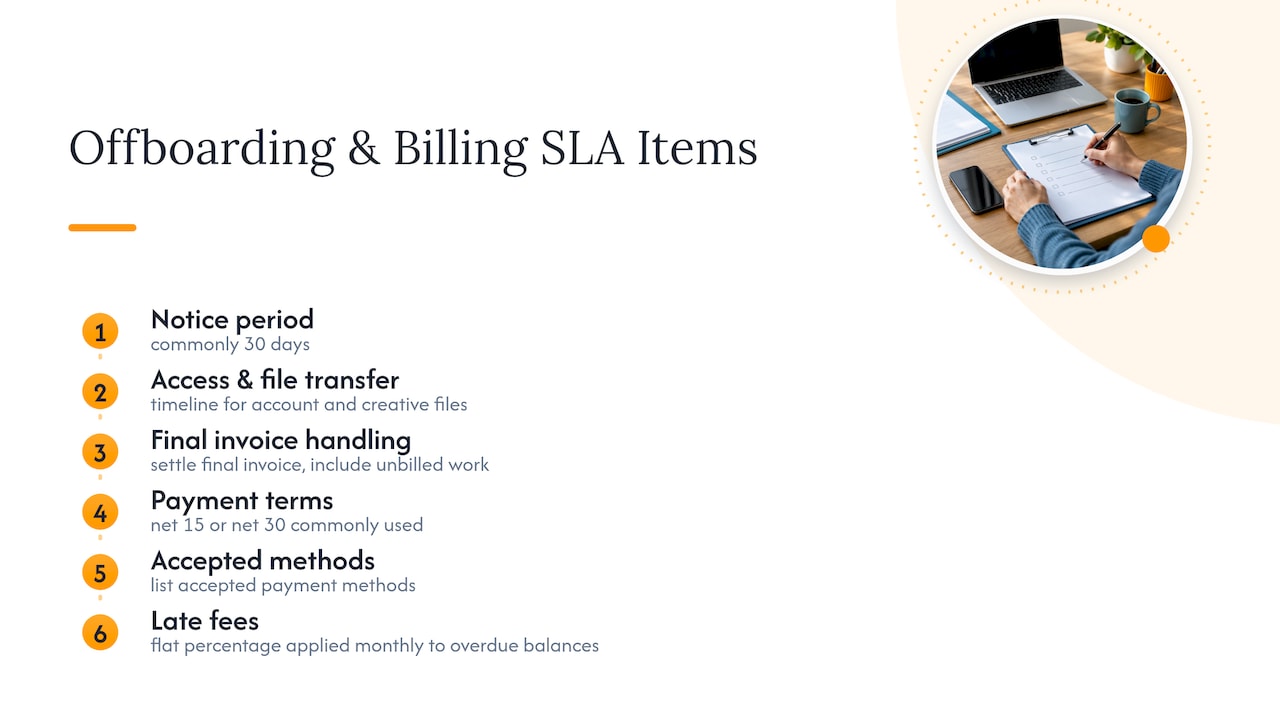
The termination and offboarding clause should specify a notice period (commonly 30 days), a timeline for transferring account access and creative files, and how the final invoice gets settled, including any work completed but not yet billed.
The invoicing clause should state net terms (net 15 or net 30 are common), accepted payment methods, and a late fee, often a flat percentage applied monthly to overdue balances. Our overview of contract clauses worth adding covers ownership and IP language that pairs well with these terms.
Choosing the Right KPIs for Your Marketing SLA
Most marketing SLAs fail not because they lack metrics, but because they track too many of the wrong ones. Activity metrics like impressions, posts published, or emails sent measure effort, not business impact. A focused SLA tracks 5 to 7 outcome metrics tied directly to business priorities, according to American Marketing Association guidance, which warns that piling on more metrics dilutes focus rather than sharpening it.
A workable outcome KPI set often includes:
- Revenue attributable to marketing, tracked against sales data or CRM records.
- Cost per acquisition (CPA), to judge efficiency across channels.
- Qualified leads, filtered by sales-accepted criteria, not raw form fills.
- Conversion rate, from lead to opportunity or opportunity to close.
- Lead-to-customer rate, which shows how well leads actually convert.
- LTV:CAC ratio, for businesses with repeat purchase cycles.
- Retention or repeat purchase rate, especially relevant for subscription or CPG brands.
Each channel feeds these outcomes differently. Paid media activity (clicks, CPC) should map to CPA and qualified leads. Content metrics (time on page, downloads) should map to lead-to-customer rate. SEO metrics (rankings, organic sessions) should map to revenue attributable to marketing over a longer window. The AMA Marketing ROI Calculator offers a standardized way to compute cost per lead and ROI percentage across these channels, which keeps both sides working from the same math. A deeper walkthrough of channel-to-outcome mapping is available in this guide to measuring website success. We also break down KPI selection and reporting structure in our post on agency-ready marketing reports.
Setting a Reporting Cadence and a One-Page Report Format
A reporting cadence works best when it matches the decision it supports. Weekly check-ins handle operational issues. Monthly reports track KPI performance. Quarterly reviews reset strategy and budget.
- Weekly: a short operational update covering what launched, what’s blocked, and what needs client input.
- Monthly: a performance report built around the agreed KPI list, with spend and trend data.
- Quarterly: a strategy session that revisits goals, budget allocation, and whether the KPI list still fits.
The monthly report works best as a single page: the top outcome metric and its trend against target, total spend, key wins, current risks or blockers, and next steps or asks for the client. Tying this cadence to billing milestones (a monthly report before the invoice goes out) keeps reporting from sliding. Our post on marketing reporting dashboards shows how to build the dashboard that feeds this one-pager automatically.
Handling Missed Targets: Contingent Clauses and Escalation
Targets get missed. A well-written SLA plans for that instead of pretending it won’t happen. Negotiation guidance from the Program on Negotiation at Harvard Law School recommends contingent, “if-then” clauses that convert disagreements about the future into pre-agreed next steps rather than renegotiations from scratch.
- If a KPI misses target for a defined consecutive period, then both sides schedule a joint remediation review within a fixed timeframe.
- If the remediation plan doesn’t restore performance within a specified period, then fees adjust or the SOW scope gets revised.
- If disagreement remains after remediation, then both sides move to mediation before considering termination.
Document any renegotiation trigger clearly: a product launch, a seasonal shift, or a change in tracking setup can all explain a KPI miss without pointing to agency performance.
Pro Tip: Write the remediation step into the contract before you need it. Negotiating a process while you’re both frustrated almost always produces a worse outcome than agreeing to one in advance.
Rolling Out the SLA: Onboarding and Ongoing Monitoring
An SLA only works if someone operationalizes it the week it’s signed.
- Before signing, confirm KPI definitions, baseline numbers, and who has access to each data source.
- At kickoff, assign an owner on each side for every KPI, set up the shared reporting doc or dashboard, and put recurring governance meetings on the calendar.
- Monthly, review KPI performance against target using the one-page report format.
- Quarterly, revalidate that the KPI list still matches business priorities, and document any change orders agreed during the period.
Staying engaged after signing, rather than treating the contract as a one-time event, is a theme echoed in Harvard’s negotiation guidance on contract follow-through, which points to regular meetings and documented governance as the difference between agreements that hold and ones that quietly fall apart.
How We Put SLAs to Work on Real Campaigns
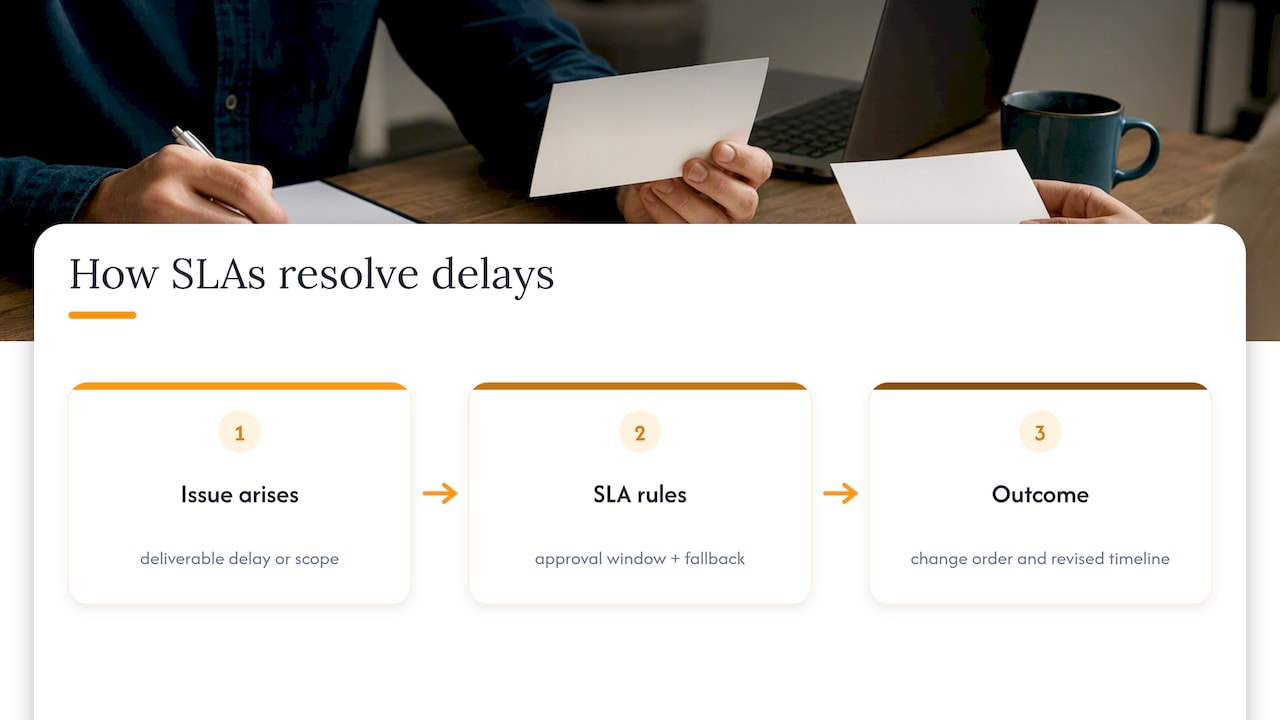
With extensive experience managing campaigns across various industries, we’ve learned that an SLA earns its keep the first time a deliverable gets delayed or a scope question comes up mid-quarter. A clear approval window and a documented change-order process turn what could become a dispute into a two-line email and a revised timeline.
We’ve seen this play out on multi-channel campaigns where a client’s internal review process slowed deliverable sign-off. Because the SOW specified a defined approval window with a deemed-approval fallback, the project timeline adjusted automatically instead of becoming a blame conversation. If you want to see how we structure KPIs and reporting for campaigns like this, our marketing assessment and marketing plan services are a good starting point.
— Derek
Drafting a Marketing SLA? Let Us Handle the Structure
Writing a marketing SLA from scratch takes time most business owners don’t have, and getting the KPI list or approval terms wrong costs more than the hours it takes to draft them properly. We build the SOW, the KPI framework and the reporting cadence as part of setting up campaign strategy and ongoing management, so the agreement reflects deliverables we actually track from day one rather than boilerplate language borrowed from another industry.
Whether you need brand development, pay-per-click management, or search engine optimization folded into one agreement with one reporting cadence, we structure the contract around outcomes your leadership team actually cares about. Reach out through The Artist Evolution to talk through your next SOW before you sign anything.
FAQ
What should a marketing SLA include at minimum?
A marketing SLA should define deliverables and quantities, a reporting cadence, a concise list of several outcome KPIs, an approval window with a deemed-approval fallback, and a change-order process for out-of-scope work, following agency contract guidance. Termination terms and asset ownership belong in the same document or the linked MSA.
How many KPIs should a marketing SLA track?
A focused SLA tracks a concise number of outcome metrics tied to business priorities, as recommended in AMA metric guidance. Tracking more metrics than that tends to dilute focus rather than clarify performance.
What is a reasonable approval SLA for agency deliverables?
A common approval window is a fixed period of several business days, after which the deliverable is deemed approved if the client hasn’t responded, per sample language in marketer.law’s contract guide. This keeps project timelines moving without putting the agency at fault for client-side delays.
What happens if KPI targets are missed under the SLA?
A well-structured SLA uses contingent, “if-then” clauses that trigger a joint remediation review after a defined period of missed targets, an approach described in Harvard’s negotiation guidance. This replaces an adversarial renegotiation with a pre-agreed process both sides already accepted.
Does a marketing SLA need to address advertising disclosure rules?
Yes, especially for campaigns involving endorsements, influencer content or testimonials, since the FTC’s endorsement guides require clear disclosure of material connections. A brief clause confirming both parties will follow applicable disclosure rules keeps the agreement aligned with current advertising law.
Sources
- The Marketing Metric Survival Guide (No Statistics Required) — American Marketing Association
- How to defend against scope creep at the negotiation table — Program on Negotiation, Harvard Law School
- Guides Concerning the Use of Endorsements and Testimonials in Advertising — FTC
- Marketer