
A marketing agency contract has to name the deliverables, spell out the fee structure, and state who owns the work once it’s paid for. Attach a detachable scope of work, confirm the intellectual property assignment language, and lock down payment and kill-fee terms before anyone starts a single campaign. Check those three items first: the SOW, the IP clause, and the termination math.
TL;DR:
- Clear scope of work should be attached as a separate document to prevent ambiguity, with specific deliverables, quantities, and acceptance criteria.
- Ownership of campaign assets generally transfers upon full payment or milestone-based acceptance, with background IP explicitly reserved by the agency.
- Termination clauses should include specific notice periods, kill fees, and mutually capped liability, avoiding vague or one-sided protection clauses.
- Retainer pricing should incorporate explicit hour caps, overage rates at full hourly cost, and policies for unused hours to maintain margin stability.
- Contract language on IP transfer timing and scope detail is crucial, and red flags include uncapped liability, vague scope, auto-renewals without notice, or IP clauses that are never triggered.
Table of Contents
- What Should a Marketing Agency Contract Include?
- Sample Clauses You Can Adapt
- How to Set Fees Without Bleeding Margin
- Who Owns the Work: IP and Deliverables Explained
- Termination, Kill Fees, and the Red Flags to Watch
- How to Structure an SOW and Handle Change Orders
- Pre-Signing Checklist and Scripts to Fix Common Problems
- How a marketing agency might structure its own contracts
- An Editorial Take on Contract Templates and Agency Practice
- When a Contract Template Isn’t Enough
- Primary Sources for Contract Language and Legal Context
- Sources
- FAQ
What Should a Marketing Agency Contract Include?
A marketing agency contract works only if it covers eight areas without ambiguity. Skip one, and you’ve left a gap that either party can exploit later, usually the one with more leverage.
Here’s the priority checklist, in the order most disputes actually arise:
- Scope of services tied to a detachable SOW. The contract body should state general service categories (SEO, paid media, brand development), while a separate statement of work carries the specific deliverables, quantities, and due dates. This mirrors how SEC-filed master marketing agreements structure enterprise contracts. Out-of-scope items get named too, not just implied.
- Fee structure and billing cadence. Retainer, project-based, or hourly, plus deposit requirements and invoice timing. Template providers like LawDepot build customizable payment schedules into their standard forms for exactly this reason.
- IP ownership and background IP. State whether deliverables transfer as work made for hire or via assignment on payment, and reserve any pre-existing agency tools or frameworks as background IP.
- Confidentiality and data handling. Cover client data, campaign performance data, and advertising compliance obligations, including how AI-generated content gets disclosed under current rules.
- Performance metrics and reporting cadence. Define what “done” looks like: specific KPIs, reporting frequency, and acceptance criteria for each deliverable.
- Term, renewal, and termination triggers. Notice periods, auto-renewal language, and what counts as cause for immediate termination.
- Change orders and dispute resolution. How scope changes get priced and approved, plus whether disputes go to mediation, arbitration, or court.
- Liability caps and indemnification. A ceiling on what either party owes the other if something goes wrong, and who indemnifies whom for what.
Most disputes trace back to one of two failures: a vague scope that lets either side redefine “the work,” or an IP clause nobody read closely until the relationship ended. Practical Law’s drafting notes for online marketing services agreements treat IP allocation and performance standards as the two provisions worth the most negotiating time, and that matches what actually generates conflict once a campaign is underway.
Sample Clauses You Can Adapt
You don’t need to draft from scratch. Below are template fragments covering the five clauses that cause the most friction, with notes on how to adjust each for your situation.
-
Scope clause referencing a detachable SOW.
“Agency shall perform the services described in Exhibit A (Statement of Work), which may be amended only by written agreement of both parties. Services not explicitly listed in Exhibit A are considered out of scope.”
This structure, common in master marketing agreements filed with the SEC, lets the core agreement stay stable while individual SOWs handle campaign specifics. Add acceptance criteria to each SOW line item: “Deliverable accepted upon written client approval or 5 business days after delivery, whichever comes first.”
-
Fee and retainer clause with cap and overage.
“Client shall pay Agency a monthly retainer of [amount], covering up to [X] hours of service. Hours exceeding this cap are billed at Agency’s standard hourly rate of [rate]. A deposit of [amount] is due upon signing. Ad spend is passed through at cost, with no markup, and billed separately from the retainer.”
Adjust the cap based on your team’s actual capacity, not an optimistic estimate. If you’re managing paid media, the ad-spend pass-through line matters as much as the service fee itself.
-
Intellectual property clause options.
Three common structures show up in agency contracts, and each shifts risk differently:
- Work made for hire: “All deliverables produced under this Agreement are works made for hire, owned by Client upon creation.” Simplest for the client, but agencies often push back if it includes their proprietary frameworks.
- Assignment on payment: “Agency assigns all right, title, and interest in the deliverables to Client upon receipt of full payment for the applicable SOW.” This is the default structure in most contract templates, and it’s the one to negotiate carefully.
- Background IP reservation: “Agency retains ownership of pre-existing tools, templates, and methodologies used in performing the Services, and grants Client a non-exclusive license to use such Background IP solely as incorporated into the deliverables.”
Templates routinely condition full IP transfer on full payment. That protects the agency from doing free work, but it also means a client who pays late, or disputes an invoice, can end up without clear title to campaign assets they thought they owned outright.
If you’re the client, negotiate for assignment upon delivery of each milestone rather than waiting for the entire engagement to close out, following expert content marketing tips for agency growth. If that’s not workable, ask for an escrow arrangement instead.
-
Confidentiality and data-processing clause.
“Each party agrees to maintain the confidentiality of the other’s proprietary information. Agency shall process Client data in compliance with applicable privacy laws, including the California Consumer Privacy Act where applicable, and shall function as a service provider under such laws. Agency shall disclose the use of AI-generated content in advertising materials as required by applicable state and federal guidance.”
That last sentence matters more than it used to. Regulatory guidance now expects contracts to allocate responsibility for AI-related advertising disclosures, and leaving that unassigned is an easy way to end up on the wrong side of an FTC inquiry.
-
Termination and kill fee language.
"Either party may terminate this Agreement with 30 days’ written notice. Client may terminate immediately for Agency’s material breach not cured within 10 days of written notice.
Adjust the notice period and kill fee percentage based on how much upfront work the agency does (strategy development, onboarding) relative to the contract length.
How to Set Fees Without Bleeding Margin
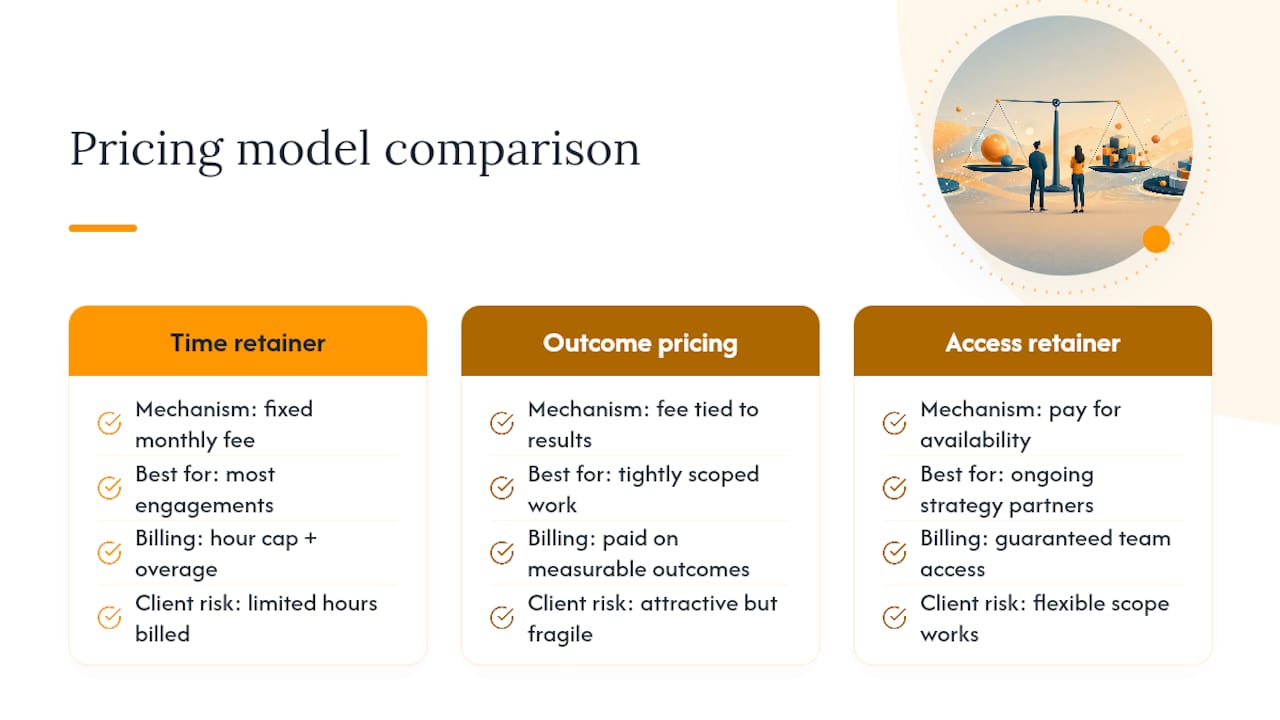
Three pricing models dominate marketing services agreements, and picking the wrong one is how agencies quietly lose money every month.
Time-based retainer with cap and overage is the default recommendation for most engagements. The client pays a fixed monthly fee covering a defined number of hours, and anything beyond that cap bills at the standard hourly rate. This structure, recommended as the standard approach for boutique agencies, keeps both sides honest: the agency isn’t punished for efficient work, and the client isn’t stuck footing unlimited hours.
Outcome-based pricing ties fees to specific results, like leads generated or revenue attributed to a campaign. It sounds appealing to clients but rarely survives contact with reality, since marketing outcomes depend on factors outside the agency’s control (product quality, sales follow-up, market conditions). Use this only for tightly scoped, highly measurable work like a single paid search campaign.
Access-based retainers, where the client pays for guaranteed availability of a team rather than specific hours, work best for ongoing strategic partnerships where the scope shifts constantly.
Here’s the math for calculating a defensible retainer under the time-based model:
It’s the difference between a retainer that survives six months of “just one more small ask” and one that requires a renegotiation conversation every quarter.
Build these mechanics into the contract itself: an explicit hour or deliverable cap, an overage rate equal to your full hourly rate (never discounted), a rollover policy for unused hours (most agencies cap rollover at one month or disallow it entirely), a minimum term of three to six months, and an annual pricing review clause.
Pro Tip: Present three retainer tiers instead of one flat number. Clients anchor against the middle option, and you avoid the awkward back-and-forth of negotiating a single price down.
Add late payment and suspension language too: “Agency may suspend services if payment is more than 15 days past due, without liability for resulting delays.” Without this, you’re stuck performing work for a client who isn’t paying, which is worse than not having the client at all.
Who Owns the Work: IP and Deliverables Explained
Three structures govern IP ownership in marketing contracts, and the difference between them determines whether you actually receive the assets you’re paying for.
Work made for hire places ownership with the client automatically, from the moment of creation, provided the contract explicitly invokes that legal category. Assignment on payment transfers ownership only after invoices clear, which protects the agency but can leave a client without clear title if a payment dispute arises mid-project. Perpetual license never transfers ownership at all. The agency keeps the copyright and grants the client an ongoing right to use the materials, a structure more common in software-heavy MarTech engagements than traditional campaign work.
What should actually transfer to you as the client:
- Final creative assets (ad copy, graphics, video files) in editable source formats, not just finished exports.
- Website code and design files, unless built on a licensed third-party platform.
- Campaign account credentials and admin access (ad accounts, analytics, CRM integrations).
- Content calendars, brand guidelines, and strategy documents developed specifically for your engagement.
Common exceptions worth expecting rather than fighting: proprietary reporting dashboards, internal project management templates, and any pre-existing frameworks the agency uses across multiple clients. Those fall under background IP, and a well-drafted master services agreement reserves them explicitly so nobody argues about it later.
To minimize risk on payment-conditioned assignment, negotiate milestone-based transfer: each deliverable’s IP assigns upon acceptance and payment of that specific invoice, rather than waiting for the full contract value to clear. Record the transfer mechanism directly in the SOW, with a line like “IP in Deliverable 3 transfers to Client upon written acceptance and payment of Invoice 3.” The USPTO’s trade secret guidance underscores why this explicit language matters: ownership that isn’t stated in writing is far harder to enforce if a dispute lands in front of a court.
Termination, Kill Fees, and the Red Flags to Watch
Most marketing contracts use a 30 to 60 day notice period for termination without cause, giving both sides time to wind down deliverables and transition accounts. Immediate termination for cause typically requires a material breach (non-payment, failure to deliver, confidentiality violation) that goes uncured after a written notice period, usually 10 to 15 days.
Kill fees compensate the agency for work already committed when a client exits early. Agencies typically set this fee at a proportion of the remaining contract value or a month’s retainer to fairly cover their losses. Anything beyond that starts to look like a penalty rather than compensation, and courts in some jurisdictions will decline to enforce fees that function as punitive damages rather than a genuine pre-estimate of loss.
Liability caps and indemnities deserve equal scrutiny. A cap set at total fees paid under the agreement is standard. Mutual indemnification, where each party indemnifies the other for its own negligence or breach, is more balanced than a one-sided clause that puts all the risk on the client. Guidance on indemnification structuring points out that uncapped indemnities are one of the most common ways agencies (or clients) end up exposed to liability far beyond the contract’s actual value.
Red flags worth flagging in redlines:
- No cap on liability or indemnification obligations.
- IP assignment that never triggers, even after final payment.
- Auto-renewal with no reminder notice before the renewal date.
- Vague scope language like “ongoing marketing support” with no attached SOW.
- Unilateral rate increase rights with no client approval step.
A contract with two or more of these red flags together signals a document written entirely in one party’s favor, and that’s worth a direct conversation before signing.
How to Structure an SOW and Handle Change Orders
A statement of work should function as a standalone document that survives a contract renewal without needing a rewrite. Structure it around five components:
- Deliverable list with specific quantities and formats (e.g., “8 social posts per month, 2 blog articles, 1 monthly report”).
- Acceptance criteria for each deliverable, stated in objective terms (“approved copy delivered within 3 business days of brief submission”).
- Timeline with milestone dates, not just an overall project end date.
- Pricing tied directly to the deliverables listed, referencing the master contract’s fee terms.
- Named approvers on both sides, so nobody wastes a week waiting to find out who can actually sign off.
Change orders keep scope creep from quietly eating your margin. The workflow should run in three steps: the agency provides a written estimate for the additional work, the client provides written approval (email is fine, verbal is not), and the work gets invoiced separately from the base retainer or added to the next billing cycle. Skipping the written approval step is how “just one quick addition” turns into a quarter’s worth of unpaid work.
Tie acceptance testing to payment triggers directly in the SOW: “Payment for Deliverable 2 is due upon Client’s written acceptance or 5 business days after delivery, whichever occurs first.” That single sentence resolves most billing disputes before they start.
Keep version control simple: date-stamp every SOW and change order, store them alongside the master agreement, and reference the version number on every invoice. It sounds unglamorous, but it’s the difference between a five-minute email resolution and a month-long argument over which draft was actually approved.

Pre-Signing Checklist and Scripts to Fix Common Problems
Before signing, confirm these items are addressed somewhere in the contract or SOW, not just implied in a sales conversation:
- Deliverables are itemized with quantities, not described in general terms.
- Payment terms specify amount, due date, and late payment consequences.
- IP transfer language states exactly when ownership moves to you.
- Termination notice period and kill fee amount are both stated in numbers.
- Confidentiality and data handling obligations name specific compliance standards.
- Liability cap and indemnification terms are mutual, not one-sided.
If you spot a problem, here are three scripts that work in redline comments or a follow-up email:
For vague scope: “Can we attach an SOW exhibit with specific deliverables and quantities before we finalize this? We want to avoid ambiguity for both sides.”
For payment-only IP assignment: “We’d like IP to transfer upon acceptance of each milestone rather than the full engagement. Can we adjust the assignment clause to reflect that?”
For uncapped liability: “Our standard practice is to cap liability at total fees paid under the agreement. Can we align on that language here?”
Add one acceptance clause to every SOW regardless of what the base contract says: “Client shall have 5 business days to review and approve each deliverable in writing; deliverables not rejected in writing within this period are deemed accepted.” That single addition prevents the most common billing dispute in agency relationships: work delivered, used, and then disputed months later.
How a marketing agency might structure its own contracts
Marketing agency engagements typically start with a detachable statement of work, not a vague service description. That structure lets different clients under the same core agreement have their own deliverables, timeline, and pricing detailed in separate SOWs.
Fee structures stay explicit from the first proposal: retainer caps, overage rates, and ad-spend pass-through terms are stated before any campaign launches, not negotiated after a surprise invoice. IP commonly transfers to the client upon payment for each deliverable, a practice used to avoid holdback disputes that arise when assignment waits for an entire engagement to close.
Case studies like the institutional rebranding project and the SEO improvement engagement following a national relaunch show these clause structures in practice, from SOW to final asset handover. For a deeper look at what a well-scoped agreement covers for professional services specifically, the 90-day planning framework for marketing leaders breaks down what belongs in an SOW before a single campaign launches.
An Editorial Take on Contract Templates and Agency Practice
The conventional advice on marketing contracts treats the document as a formality, something you download, fill in blanks, and file away. That’s backwards. The contract is where the actual relationship gets defined, and most disputes trace back to a clause nobody negotiated because it seemed standard.
Templates from sources like LawDepot or ContractDraft are a legitimate starting point, not a finished product. The mistake founders make is treating the IP and termination clauses as boilerplate to skim past, when those two sections determine whether you own your campaign assets and how much it costs you to walk away. Fee structure gets negotiated hard; ownership and exit terms rarely do, and that imbalance is exactly backwards given what’s actually at stake.
If you prioritize one thing before signing anything, make it the payment-to-IP-transfer timeline. Everything else in a marketing services agreement is negotiable after the fact. That one usually isn’t.
— Derek
When a Contract Template Isn’t Enough
Downloading a template works fine for a single small project with a freelancer. It works less well once you’re negotiating a retainer with caps, overage rates, ad-spend pass-through, and IP transfer timing across multiple deliverables, which is exactly where most founders discover a generic template doesn’t hold up under real negotiation.

Theartistevolution builds contracts around a working SOW from the first conversation, not after the fact. With 18 years drafting agreements across healthcare, retail, legal, and consulting clients, our team structures fee caps, IP assignment, and reporting cadence so you know exactly what you’re getting and when it transfers to you. If you’re evaluating whether a full engagement makes sense, our marketing assessment reviews your current scope and pricing before you commit to anything. For ongoing work, the campaign management service runs on the same cap-plus-overage retainer structure covered above, with an SOW attached before day one. Start with a conversation about your scope at Theartistevolution.
Primary Sources for Contract Language and Legal Context
Four resources are worth bookmarking before you draft or review a marketing agreement. LawDepot’s marketing contract template and ContractDraft’s marketing services agreement template both offer fillable clauses covering scope, payment, and basic termination, useful as a first draft. Practical Law’s master online marketing services agreement provides deeper drafting notes on IP allocation and fee structuring for anyone negotiating a higher-value engagement.
For structural reference, the SEC-filed master marketing agreement shows how a real enterprise agreement handles work orders under one master framework. On the IP side, the USPTO’s trade secret policy explains the legal reasoning behind explicit ownership language, which is worth understanding before you sign away, or accept, any assignment clause.
This article is general information, not a substitute for advice from a qualified lawyer. Consult a qualified legal professional about your own circumstances before acting on anything here.
Sources
- Free Marketing Contract Template | Customizable Agreement
- Master marketing agreement (SEC exhibit)
- Master online marketing services agreement (Practical Law / Westlaw)
- Marketing services agreement template (ContractDraft)
- Indemnification clauses in commercial contracts (Thomson Reuters)
FAQ
Can I legally write my own marketing agency contract?
Yes, business owners can draft their own marketing services agreement, and template providers like LawDepot offer fillable starting points covering scope, fees, and termination. Complex engagements involving significant IP transfer, multi-year terms, or ad-spend management benefit from a lawyer’s review before signing.
How does a marketing agency typically get paid?
Most agencies use one of three models: a monthly retainer with a defined hour or deliverable cap, project-based fees for one-time work, or hourly billing for ad hoc requests. A time-based retainer with a cap and overage rate is the most common structure recommended for ongoing campaign management.
What counts as a red flag in a marketing contract?
Uncapped liability, IP assignment language that never actually triggers, vague scope with no attached SOW, and auto-renewal without a reminder notice are the most common red flags. Any one of these is worth a redline conversation before you sign; two or more together suggest the contract was drafted entirely in the other party’s favor.
What are the basic requirements for a contract to be valid?
A valid contract generally needs an offer, acceptance, consideration (something of value exchanged), mutual consent, legal capacity of both parties, a lawful purpose, and reasonably definite terms. Definitions vary slightly by jurisdiction, so confirm specifics with a licensed attorney if a dispute seems likely.
Do marketing agencies typically offer contract review or SOW drafting help?
Theartistevolution builds a detachable SOW into every engagement from the first assessment conversation, covering deliverables, fee caps, and IP transfer timing before work begins. Pricing for Strategy & Management and related services is available directly through the site rather than published as a flat rate.