
Use Performance Max when you can provide accurate conversion data, high-quality creative, and at least moderate conversion volume: your job is to feed and steer the AI, not micromanage placements. The priority order is simple: fix measurement first, build asset groups around real customer intent second, and layer in audience signals third. If you do one thing this week, set up clean conversion tracking and load your strongest creative assets before touching anything else.
TL;DR:
- Ensure your conversion tracking accurately reflects revenue or lead quality and that you have consistent volume before launching Performance Max campaigns.
- Structure asset groups based on customer intent, minimizing the number of groups to maximize data concentration and avoid dilution of learning signals.
- Prioritize high-quality, varied creative assets and refresh them regularly to maintain “Excellent” ad strength and testing effectiveness.
- Use campaign-level negative keywords, brand exclusions, and device or schedule controls to manage placements and reduce leaks without micromanaging individual placements.
- Give new or restructured campaigns at least two to three weeks to stabilize before optimizing further, and use performance insights to refine audience signals and exclusions.
Table of Contents
- What Performance Max is and when it earns a place in your mix
- Campaign structure and asset group strategy: mapping intent to asset groups
- Audience signals and search themes: how to feed, not force, the algorithm
- Creative and asset best practices to reach “Excellent” ad strength
- Controls and steering: negatives, exclusions, device and schedule settings
- Bidding, conversion measurement, and value settings that drive correct optimization
- Reporting and diagnostics: search term insights, placements, and API checks
- Ramp-up, budgets, and timelines: how long to wait and how to plan spend
- Advanced tests and a four-step net-new customer framework
- Agency playbook: a 30/60/90 checklist for Performance Max
- Where Performance Max fits and what trips teams up
- How The Artist Evolution helps you run Performance Max well
- FAQ
- Sources
What Performance Max is and when it earns a place in your mix
Performance Max is a goal-based campaign type that runs across Search, Shopping, YouTube, Display, Discover, Gmail, and Maps from a single campaign, using Google’s automation to handle bidding, creative assembly, and placement decisions, according to Google’s own documentation. That consolidation is the appeal: one campaign reaching every surface Google owns, with machine learning making the moment-by-moment calls a human team cannot make at scale.
The payoff shows up as incremental conversions, but only when the inputs are solid. Before launching, check that you have:
- Conversion tracking that reflects revenue or lead quality, not just clicks or form fills.
- A baseline of consistent conversion volume to give Smart Bidding something to learn from.
- Creative assets, images, video, and copy, that are genuinely strong rather than repurposed banner leftovers.
Skip Performance Max if any of those three are missing. Fix them first, launch second.
Campaign structure and asset group strategy: mapping intent to asset groups
Structure is where most accounts lose control of Performance Max before they ever touch a setting. The rule of thumb: consolidate budget when conversion volume is thin, and split only when a genuinely distinct product line, margin profile, or funnel stage justifies separate signals and separate reporting.
A workable framework looks like this:
- Group by commercial intent first, not by internal org chart: high-margin products, promotional pushes, and evergreen catalog items each deserve their own asset group.
- Name asset groups for what a human needs to know at a glance, such as “Winter Promo, Outerwear” rather than “Group 3.”
- Keep asset-group counts proportional to conversion volume: more groups mean each one gets a thinner slice of learning data, and Smart Bidding performs better with concentrated volume than scattered fragments, a pattern confirmed in reporting analysis from Search Engine Land.
Splitting a single high-performing campaign into five thinly-funded variants usually backfires. Each loses the volume that made the original stable.
Pro Tip: Before creating a new asset group, ask whether the split adds a genuinely different signal, like a new audience or product margin, not just a new label.
Audience signals and search themes: how to feed, not force, the algorithm
Audience signals are suggestions, not fences; for deeper methodology on targeting, consider AI audience targeting strategies for more organic traffic to complement your approach AI audience targeting strategies for more organic traffic. Google can and does find converters outside the lists you provide, and practitioner commentary describes signals as a starting point for the algorithm rather than a hard constraint, per Search Engine Land’s analysis of PMax audience signals. Treat them as a nudge in the right direction, not a leash.
The signals worth prioritizing:
- Customer Match lists built from your actual buyers or high-value leads, refreshed regularly so they do not go stale.
- Remarketing lists segmented by funnel stage, cart abandoners separate from product-page browsers.
- Custom intent audiences built around competitor and category search behavior.
- Lookalike-style audience expansion from your strongest converting segments.
To check whether your signals are actually steering anything, use the Source column inside campaign-level search term insights. It shows whether traffic is landing on search themes you fed the AI or drifting toward terms you never anticipated, which tells you whether to refine signals or leave them alone.
Creative and asset best practices to reach “Excellent” ad strength
Google recommends supplying many high-quality assets and allowing text customization and final URL expansion to stay on by default, per Google’s asset and creative guidance. The more real variety you give the system, the more combinations it can test across channels.
A practical minimum mix:
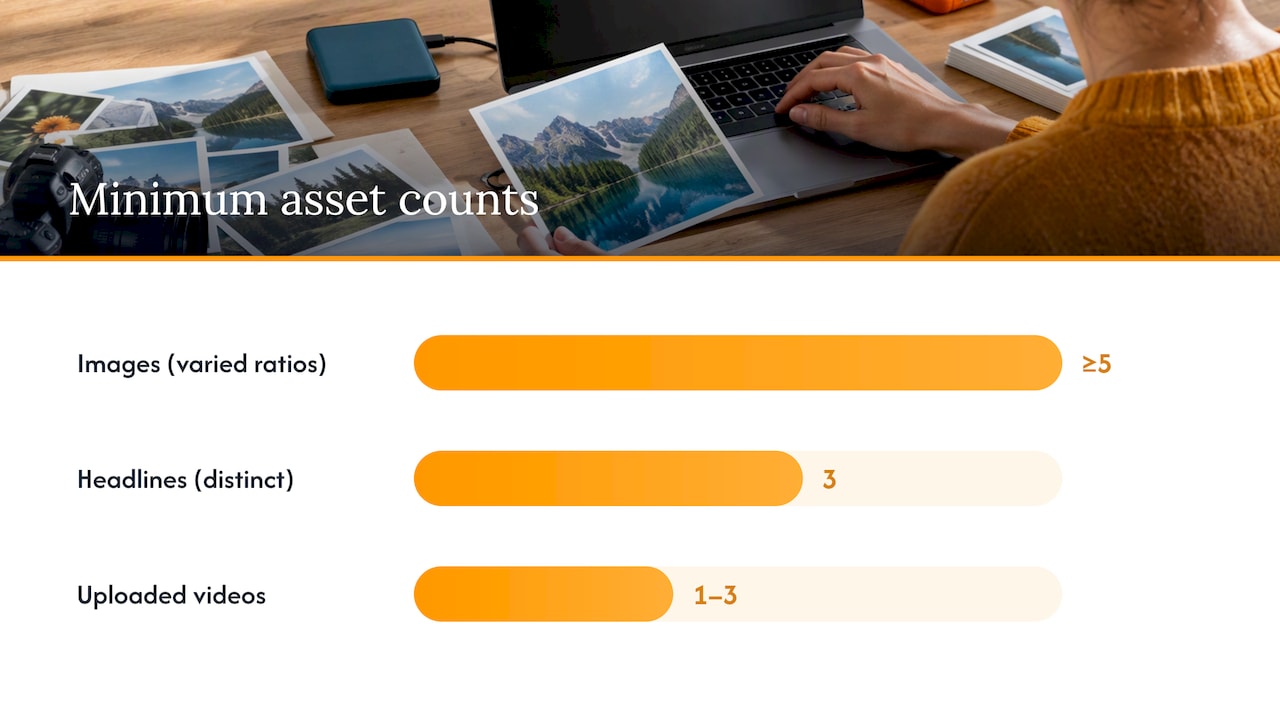
- At least five images in varied aspect ratios (square, landscape, portrait) and three headlines that are not rewordings of each other.
- One to three uploaded videos in native YouTube formats, 15 to 30 seconds, rather than relying on auto-generated video built from static images.
- Long and short descriptions written for different contexts, a Shopping surface versus a Gmail placement reads differently.
Auto-generated video can look thin next to a format-native upload, so give the system real footage whenever you have it. Refresh assets every few weeks and watch the ad strength label: “Excellent” generally reflects more usable variety, not a magic score to chase for its own sake.
Pro Tip: Swap out your weakest-performing image or headline every few weeks rather than overhauling the whole asset group at once, so you can tell what moved the needle.
Controls and steering: negatives, exclusions, device and schedule settings
Performance Max used to feel like a black box. Campaign-level negative keywords, brand exclusions, placement reporting, and demographic or device exclusions are now genuine steering levers, and practitioner consensus holds that the most effective PMax work focuses on these controls rather than chasing every individual placement, according to Search Engine Land’s breakdown of controllable PMax elements.
Apply them in this order:
- Add campaign-level negative keywords for irrelevant or low-intent queries surfaced in search term insights, and layer in brand exclusions when you are running a separate branded Search campaign and do not want Performance Max cannibalizing those clicks.
- Exclude your own Customer Match lists where appropriate so the campaign is not spending to “reconvert” people who already converted.
- Use device exclusions and ad scheduling when budget is tight and one device or time window consistently underperforms.
These controls will not give you placement-by-placement micromanagement, but they close the biggest leaks.
Bidding, conversion measurement, and value settings that drive correct optimization
Bid strategy choice depends on what you actually know about conversion value. Use Maximize Conversion Value with a target ROAS when different conversions carry meaningfully different revenue, Maximize Conversions or a target CPA when a lead or sale is worth roughly the same regardless of source.
Set conversion value rules so that high-intent actions, like a qualified lead versus a newsletter signup, are weighted accurately. Import offline conversions (OCI) when a meaningful share of value happens after the click, a closed sale from a sales team, a verified appointment, a shipped order. Apply new-customer value premiums only when they reflect a realistic acquisition economics difference, not a number picked to make the campaign look better.
Smart Bidding needs a baseline of consistent conversions to stabilize. Google’s own guidance recommends allowing several weeks of ramp time before judging results, as outlined in its asset and creative guidance for Performance Max. Judging a campaign at day ten tells you almost nothing.
Reporting and diagnostics: search term insights, placements, and API checks
Blended reporting is the single biggest reason teams misjudge Performance Max. A few habits fix most of it:
- Check campaign-level search term insights and the Source column weekly to see which themes are driving spend and whether they match your intent.
- Review placement reports to spot low-quality Display or video inventory, then build exclusion lists rather than hoping the algorithm self-corrects.
- Pull asset-group and channel-level data through the Google Ads API when you need to segment performance by network type or product feed, a step developers can execute directly against Google’s Performance Max campaign reporting documentation.
Without these checks, you are managing a campaign you cannot actually see.
Ramp-up, budgets, and timelines: how long to wait and how to plan spend
Give a new or restructured Performance Max campaign at minimum two to three weeks before drawing conclusions, and expect six or more weeks for full stabilization on accounts with lower conversion volume, consistent with Google’s own ramp guidance for the campaign type.
- Use Performance Planner ahead of major seasonal events so budget shifts are planned, not reactive.
- When migrating Smart Shopping inventory into Performance Max, keep budgets roughly level during the transition rather than cutting spend at the same time the algorithm is relearning.
- Watch for stabilizing cost-per-conversion and shrinking day-to-day swings as the signal that learning has settled.
Advanced tests and a four-step net-new customer framework
Once the core campaign is stable, test for net-new customer acquisition using a four-step framework: exclude brand terms, exclude site visitors and email subscribers, exclude existing purchasers, then apply New Customer bidding or a bid premium, a sequence detailed in Search Engine Land’s net-new customer guidance.
- Layer the three exclusion types before touching bidding.
- Apply New Customer bidding or a modest premium once exclusions are live.
- Measure success against raw order counts and offline lifetime value, not reported ROAS, since a premium inflates the reported conversion value itself.
Pro Tip: Run this test only once baseline volume is stable: thin data plus new exclusions is a recipe for a hard-to-read result.
Agency playbook: a 30/60/90 checklist for Performance Max
A workable rollout: Days 1 to 30, fix conversion tracking and build asset groups around real intent. Days 31 to 60, layer audience signals, add negative keywords and exclusions, and start checking search term insights weekly. Days 61 to 90, test bidding refinements and the net-new customer framework. The Artist Evolution has applied structures like this across 18 years of campaign management work spanning retail, healthcare, legal, and entertainment clients, with case studies documenting the results.
Where Performance Max fits and what trips teams up
Performance Max works best as one piece of a broader paid mix, not a replacement for every other campaign type: dedicated Search still earns its place for high-intent branded or competitive terms where you want tighter control. The three mistakes I see most: launching without clean conversion data, feeding the system weak or recycled creative, and splitting campaigns into so many asset groups that none of them ever accumulates enough volume to learn. For a lean team, the single highest-leverage move is spending a week on measurement and assets before touching structure or bidding at all.
— Derek
How The Artist Evolution helps you run Performance Max well
Getting Performance Max right takes clean measurement, strong creative, and steady attention to exclusions and reporting, which is exactly where a pay-per-click management agency earns its keep. The Artist Evolution pairs PPC management with brand development for asset production and OCI setup, so campaigns launch with the inputs the algorithm actually needs.

A starter engagement typically begins with a measurement and creative audit, then moves into structure and signal setup. Reach out through The Artist Evolution to scope what that looks like for your account.
FAQ
Is Performance Max worth it?
It is worth it for advertisers who can supply accurate conversion data, strong creative, and consistent conversion volume, since those inputs are what the automation needs to perform well. Without them, results tend to be inconsistent regardless of budget.
How does Performance Max work?
It runs ads across Search, Shopping, YouTube, Display, Discover, Gmail, and Maps from one campaign, using Google’s automation to handle bidding, creative combinations, and placement selection, per Google’s Performance Max overview. Advertisers provide assets, audience signals, and conversion goals, and the system optimizes delivery against those goals.
Is $20 a day good for Google Ads?
Budget adequacy depends on your conversion value and sales cycle rather than a fixed daily figure, since Performance Max needs enough volume to let Smart Bidding learn. A thin budget on a high-cost conversion will take longer to stabilize than the same spend on a low-cost, high-volume product.
What are two benefits of Performance Max?
It consolidates reach across every major Google-owned channel in a single campaign, and it automates bidding and creative testing at a scale manual management cannot match, according to Google’s product documentation. Both benefits depend on feeding the system clean data and strong assets.
Sources
- About Performance Max campaigns – Google Ads Help
- Performance Max campaign reporting – Google Ads API (Developers)