
Brand strategy work typically runs from a few thousand dollars for a minimal visual refresh to varying amounts for a full strategy-driven identity built by a seasoned team. The rule that keeps budgets sane: match your spend to your company’s stage and to outcomes you can actually measure, not to what a competitor spent. The next sections break down why quotes vary so widely and how to read them.
TL;DR:
- Most brand strategy projects range from $1,000 to over $50,000, depending on scope, research depth, team seniority, and deliverables.
- Higher fees generally include deeper primary research, more senior strategist involvement, and extensive implementation support, reducing later rollout costs.
- Comparing proposals requires detailed, itemized scope including research methods, deliverables, revision rounds, and asset ownership to avoid hidden costs.
- Budgeting should consider total project costs, including rollout, production, and potential revisions, which often exceed the strategy fee.
- The ideal delivery model depends on scope and capacity, with agencies suited for comprehensive, cross-functional work, while freelancers or in-house teams are better for narrow, specific projects.
Table of Contents
- What drives brand strategy cost
- Practical pricing breakdown: tiers and per-deliverable ranges
- Agency vs freelance vs in-house: economics and when each model fits
- How to budget, compare proposals, and negotiate scope
- Hidden costs, timelines, and implementation expenses to plan for
- Agency perspective: how The Artist Evolution scopes and demonstrates value
- Author Derek’s short verdict and next steps
- How The Artist Evolution can help with brand strategy and rollout
- Sources
- FAQ
What drives brand strategy cost
Two proposals for the “same” project can differ by tens of thousands of dollars, and the gap almost always comes down to five factors buyers overlook when comparing quotes side by side.
Scope is the biggest lever. A project that includes research, positioning, naming, full visual identity, verbal identity, and detailed guidelines costs more than one that stops at a logo and color palette, and the deliverables list should spell out exactly where the work ends. Team composition matters just as much: a proposal built on senior strategist hours produces sharper positioning than one staffed mostly by junior designers, even at a similar sticker price. Research depth is a quiet cost driver too. Interviews with 15 stakeholders and a competitive audit across a dozen brands cost more than a two-hour internal workshop, and that depth shows up later in how well the strategy actually differentiates you.
Timeline compresses or expands cost in predictable ways:
- Rush timelines add premium fees, often 20 to 30% on top of standard pricing.
- Distributed or specialized teams (motion designers, brand writers, packaging experts) add coordination cost even when hourly rates look reasonable.
- Rollout and production. Think packaging changes, signage, or a full website rebuild. These sit outside the “strategy” line item but belong in your total budget.
- Asset ownership terms affect price: full buyout of files and source assets usually costs more than a license to use finished deliverables.
Pro Tip: Ask every bidder to itemize research hours, senior strategist hours, and production costs separately. A single lump-sum number hides where your money is actually going.
Practical pricing breakdown: tiers and per-deliverable ranges
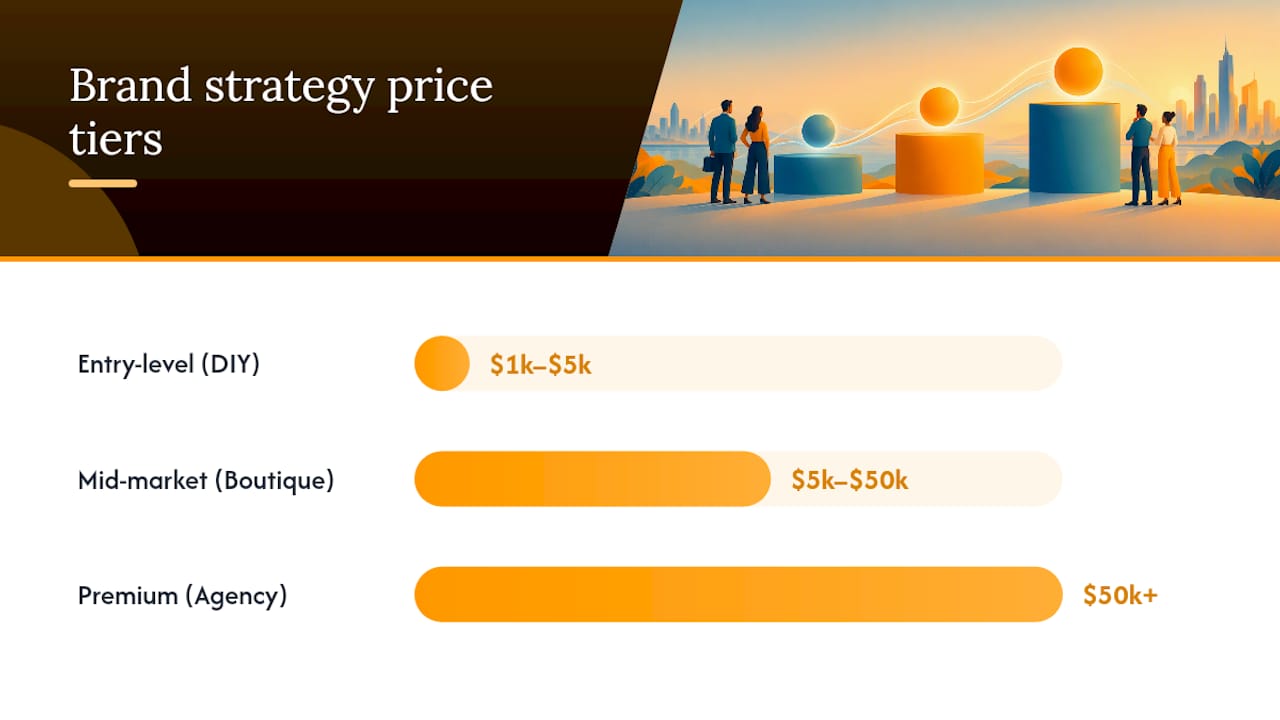
Brand strategy pricing clusters into three broad tiers, and understanding which tier a quote falls into tells you more than the number itself. According to Shopify’s branding package guide, packages commonly split into entry-level (roughly $1,000 to $5,000), mid-range ($5,000 to $50,000), and premium ($50,000 and up), with deliverables and research depth scaling accordingly.
- DIY or budget tier (under $5,000): Templates, AI-assisted logo tools, or a freelancer producing a basic visual identity with little to no strategic research.
- Boutique or mid-market tier ($5,000 to $50,000): A small studio or independent consultant delivering positioning work, a full identity system, and a usable style guide, often over 6 to 10 weeks.
- Premium or agency tier ($50,000 and up): A full-service team running deep research, cross-functional strategy, naming, identity, messaging, and implementation support across a multi-month engagement.
Per-deliverable ranges help when you are comparing proposals that bundle things differently. Brand strategy alone (positioning, audience definition, competitive analysis) commonly runs from a few thousand dollars at the low end to well over $20,000 when it includes primary research. Naming projects vary enormously depending on trademark screening and the number of rounds, and visual identity work (logo, color, typography system) is often priced separately from verbal identity (tone, messaging architecture, tagline development), which you can see broken down in this guide to brand messaging framework for marketing leaders. Brand guidelines documents range from a lean one-pager to a 60-page book, and website design is almost always quoted separately from strategy work.
Clutch’s branding pricing data shows most branding projects reviewed on the platform fall between $10,000 and $49,999, with average agency hourly rates in the $100 to $149 range. That band lines up with the mid-market tier and gives you a sanity check when a quote seems unusually low or high for the scope described.
Higher fees typically buy three things: deeper primary research instead of desk research alone, more senior strategist time actually shaping the positioning rather than just reviewing it, and implementation support after the strategy is finished, meaning help translating the new identity into templates, signage, and marketing collateral. A cheap quote that skips implementation support often costs more later, once your team tries to roll out a new identity without guidance and burns hours reinventing decisions the strategy work should have already settled.
Agency vs freelance vs in-house: economics and when each model fits
The delivery model changes both your cost structure and your incentives. Retainer pricing rewards ongoing management and consistency but can feel expensive if you only need a one-time project. Project-fee pricing gives budget certainty but requires a tightly defined scope up front, since anything outside that scope becomes a change order. Hourly pricing offers flexibility for undefined work but puts the cost-control burden entirely on you to track hours.
- Choose an agency when you need cross-functional capability (research, design, writing, digital rollout) under one roof, along with governance to keep the brand consistent across teams and vendors afterward.
- Choose a freelancer or marketplace when the scope is narrow, such as a logo refresh or a single naming project, and you have internal capacity to manage the rest.
- Keep work in-house when your team already has strategic marketing skill and mainly needs design execution, or split the work: hire outside help for research and positioning, then execute visual production internally.
Hybrid approaches, where you cost-partition strategy work to specialists and production work to your own team, often deliver the best value when budgets are tight but strategic quality still matters.
How to budget, compare proposals, and negotiate scope
Before comparing prices, request a phase-by-phase scope from every bidder. This is the single most useful document for turning non-comparable quotes into an apples-to-apples decision.
- Ask for research methods and sample size, including how many stakeholder interviews or workshops are included.
- Get an explicit list of deliverables: positioning statement, messaging architecture, identity system, guideline format.
- Confirm the number of concepts presented and how many revision rounds are included before extra fees kick in.
- Clarify file ownership: do you receive source files and full rights, or a license to use finished assets.
- Nail down rollout support and payment terms, including deposit size and milestone triggers.
Once you have that detail, normalize each quote into a cost-per-outcome figure: divide total price by the number of core deliverables you actually need, not the number the agency bundled in.
Negotiation levers that work without damaging the relationship: cap revision rounds at two or three, split the engagement into research and execution phases so you can stop after phase one if needed, and tie payment milestones to specific deliverables rather than calendar dates.
Pro Tip: A simple budgeting rule of thumb is to allocate brand strategy spend as a percentage of annual marketing budget, often in the 5% to 15% range for a company actively rebranding, rather than as a fixed dollar figure disconnected from your overall marketing plan.
Hidden costs, timelines, and implementation expenses to plan for
Sign-off is not the finish line. According to Shopify’s rebrand cost guide, production and rollout costs, not the strategy fee itself, are the most common source of budget overruns once a project moves from concept to execution.
- Production costs include packaging redesigns, new photography, motion assets, and website development, which are typically quoted separately from strategy.
- Implementation labor covers training your team on the new brand, updating templates, and rolling out assets across every touchpoint.
- Revision-driven cost growth happens when “just one more round” turns into five, so cap revisions in the contract before work starts.
- Timelines vary by scope: a quick visual refresh takes 4 to 8 weeks, while a full strategy-driven rebrand commonly runs 3 to 6 months or longer, especially once implementation is included.
Shopify’s guide also notes that rebrand projects for small and midsize businesses commonly start near $10,000 to $15,000, while enterprise rebrands can exceed $70,000 once production and timeline pressures are factored in.
Agency perspective: how The Artist Evolution scopes and demonstrates value
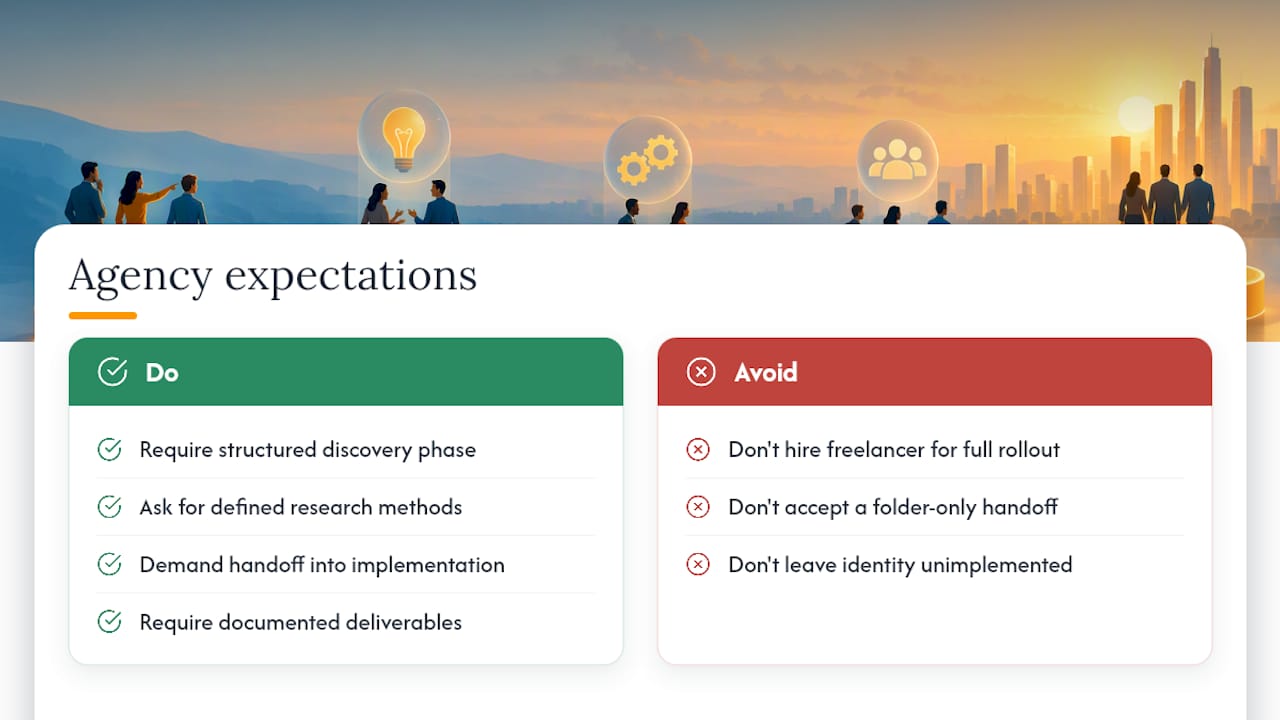
A mature full-service agency scopes brand strategy differently than a solo freelancer: expect a structured discovery phase, defined research methods, and a clear handoff into implementation rather than a folder of files and a goodbye email. The Artist Evolution’s brand development work sits alongside strategy and management services, so positioning decisions get built with rollout in mind from the start.
Case work like the brand story development project and the institutional rebranding engagement shows the pattern: strategy informs identity, and identity gets carried through campaign execution rather than left for the client to figure out alone. Clients working with a full-service team should expect defined phases, documented deliverables, and support translating the finished strategy into live marketing materials.
Author Derek’s short verdict and next steps
If you are pre-revenue or early-stage, spend at the DIY or boutique tier and save budget for validation. Once you have product-market fit and real marketing spend behind you, the premium tier starts paying for itself through consistency and speed of execution. Two moves before you sign anything: build the phase-by-phase scope checklist above, and talk to whoever will run implementation, not just whoever pitches the strategy.
— Derek
How The Artist Evolution can help with brand strategy and rollout
You do not have to choose between a cheap logo shop and a six-figure agency retainer with no clear scope. The Artist Evolution builds brand strategy and identity work as part of a full-service model, meaning brand development connects directly to campaign execution instead of stopping at a style guide you have to figure out how to use.
If you are not sure which tier fits your stage, a marketing assessment is a low-commitment way to align budget with realistic scope before signing anything larger. Work like the brand engagement case study shows how strategy carries through into measurable campaign results rather than sitting on a shelf. Start with a conversation about your stage and goals, and scope follows from there.
Sources
Pricing ranges in this article draw on Clutch’s branding pricing guide, Clutch’s broader agency pricing data, and Shopify’s guides on branding packages and rebrand costs. Implementation examples reference The Artist Evolution’s case studies and service pages.
- Branding Pricing Guide August 2026 – Clutch
- Branding Package Guide: Costs & Examples (2026) – Shopify
FAQ
What is the 3-7-27 rule in branding?
Definitions of this rule vary across marketing sources and it is not a standardized industry framework, so treat any specific numbers attached to it with caution. Some versions describe attention spans or impression counts needed before a brand registers with an audience, but no authoritative source in this article confirms a single definition.
Is $500 too much for a logo?
It depends entirely on what you need: a template-based logo from a freelancer or design marketplace can reasonably cost under $1,000, while a logo built from real strategic positioning and market research sits well above that. Shopify’s tiered branding package guide places entry-level packages, logo included, in the roughly $1,000 to $5,000 range.
Is rebranding risky?
Rebranding carries real risk mainly around scope creep, inconsistent rollout, and losing brand recognition if the change is not communicated clearly. Practitioner reporting in Shopify’s rebrand guide points to production costs and implementation gaps, not the strategy work itself, as the most common source of trouble during rollout.
What are the 5 C’s of branding?
The “5 C’s” is used inconsistently across marketing resources, with different sources listing different terms, so there is no single agreed definition to point to here. If you encounter this framework in a proposal, ask the agency to define exactly what each C means in their process rather than assuming a standard meaning.
How much does agency brand strategy typically cost per hour?
According to Clutch’s pricing data, average agency hourly rates for branding work commonly fall between $100 and $149. That figure is a useful sanity check on quotes, though final project pricing depends heavily on scope, seniority mix, and location.