
The most effective patient acquisition marketing playbook prioritizes three levers in order: local visibility, conversion infrastructure, and targeted paid search. Get those three right before you touch anything else.
That means a fully optimized Google Business Profile and local SEO first, because they’re the cheapest volume driver most practices have. Then online scheduling and intake that remove friction between a click and a completed visit. Only after those foundations are solid should you scale Google Ads or paid social, since paid traffic hitting a broken booking flow just burns budget.
This week, audit your Google Business Profile categories and confirm your booking link works on mobile. Track one number starting now: the percentage of website visitors who complete a booking, not just the ones who click “schedule.”
Key Takeaways
Patient acquisition marketing succeeds when local visibility, conversion infrastructure, and disciplined PAC tracking work together rather than in isolation.
| Point | Details |
|---|---|
| Fix conversion before scaling ads | Optimize scheduling and intake first, since paid traffic hitting a broken funnel wastes budget. |
| Track PAC, not cost per lead | Calculate PAC using completed visits and include staff, tech, and agency costs. |
| Sequence channels deliberately | Build Google Business Profile and SEO authority before layering in paid search. |
| Use a 90-day roadmap | Fix foundations in days 1 to 30, then referrals and content, then paid launch. |
| Get expert help executing | Theartistevolution offers a marketing assessment and managed campaign services to implement this playbook. |
Table of Contents
- What Is Patient Acquisition Marketing, and Why Does It Matter?
- How Does Patient Acquisition Differ From Retention?
- Which Patient Acquisition Strategies Should You Prioritize?
- What Is Patient Acquisition Cost, and How Do You Calculate It?
- How Should You Track and Measure Acquisition Performance?
- What Does a 90-Day Patient Acquisition Roadmap Look Like?
- What Mistakes Waste the Most Acquisition Budget?
- Which Technology Should You Prioritize for Acquisition?
- How The Artist Evolution Helps You Turn This Playbook Into Results
- Frequently Asked Questions
- Sources
What Is Patient Acquisition Marketing, and Why Does It Matter?
Patient acquisition marketing is the set of strategies and channels a practice uses to convert prospective patients into scheduled, completed appointments. It drives three outcomes that matter to the C-suite: new patient volume, revenue growth through lifetime value expansion, and a stronger referral pipeline that lowers future acquisition costs.
The opportunity is larger than most marketers assume. About 12.4% of the population still lacks a regular healthcare provider, and CDC access-to-care data confirms this gap persists across income and geography. Every acquisition dollar should map to one of these:
- New patient volume that fills open appointment slots
- Revenue growth via higher lifetime value per acquired patient
- A referral pipeline that compounds and reduces future acquisition cost
How Does Patient Acquisition Differ From Retention?
Acquisition brings new patient volume through the door. Retention keeps existing patients scheduling, referring, and generating lifetime value. Confusing the two leads practices to overspend on ads while an under-resourced front desk lets booked patients slip away.
Prioritize by growth stage:
- New practices (under 2 years): fund acquisition heavily, especially local SEO and Google Business Profile.
- Growth-stage practices: split budget between acquisition and retention, since referral lift from happy patients starts compounding.
- Mature practices: shift budget toward retention and reputation, using acquisition dollars only for underperforming service lines.
If you need patients within 60 days, fund paid search. If you have 6 months, fund SEO and referrals instead.
Which Patient Acquisition Strategies Should You Prioritize?
Sequence matters more than most marketers realize. A sequenced playbook that builds local SEO and Google Business Profile authority before layering in paid amplification consistently outperforms jumping straight to ads. Here’s the priority order, with the action steps and KPIs for each.
-
Google Business Profile and local listings. A fully optimized profile with complete categories, 50 or more reviews at 4.5 stars or higher, weekly posts, and a real photo strategy often generates more appointment requests than modest paid ad spend in mid-size markets. Claim and verify every location, post weekly updates, and respond to every review within 48 hours. Track profile views and the click-to-call rate.
-
Website conversion and self-scheduling. Your homepage and service pages are worthless if booking takes six clicks. Add self-scheduling above the fold, cut form fields to the essentials, and test load speed on mobile. Track visit-to-booking conversion rate and form abandonment.
-
Google Ads (paid search). Best for short decision-cycle specialties like urgent care or dental emergencies. Build service-specific landing pages, use call tracking on every ad group, and set geo-radius targeting tightly around your service area. Track cost per completed appointment, not cost per click.
-
SEO and service pages. Build dedicated pages for each procedure or condition, not one generic “services” page. Target long-tail, symptom-based queries. Track organic session-to-booking conversion and page-level ranking movement.
-
Reputation management. Reviews influence both Google ranking and patient trust simultaneously. Automate review requests post-visit and train front-desk staff to flag dissatisfied patients before they leave a public complaint. Track review velocity and average star rating.
-
Referral networks. Physician-to-physician and community referrals often carry the highest lifetime value because they arrive pre-qualified. Build a simple referral tracking form and check in quarterly with top referring providers. Track referral volume by source and conversion rate.
-
Data and predictive analytics. Use past patient data to identify which zip codes, insurance types, and demographics convert best, then bias targeting toward them. Track cost per acquisition by segment.
-
Paid social. Works best for elective, high-consideration specialties like dermatology or orthodontics where visual proof matters. Use before-and-after content and patient education video. Track cost per lead and downstream booking rate, not just engagement.
-
Offline and community outreach. Health fairs, employer partnerships, and local sponsorships still work, especially for pediatric, dental, and primary care. Track unique promo codes or dedicated phone lines by event.
-
Healthcare CRM and marketing automation. Automate appointment reminders, no-show recovery, and lead nurture sequences. Track lead response time and lead-to-appointment conversion.
Short-cycle specialties (urgent care, dental pain, ENT) should weight budget toward paid search and same-day booking. Long-cycle specialties (elective surgery, fertility, cosmetic) should weight toward content, paid social, and nurture sequences, since decision cycles and cash-pay economics vary by 10x across specialties.
What Is Patient Acquisition Cost, and How Do You Calculate It?
Patient Acquisition Cost, or PAC, is total acquisition spend divided by the number of new patients who complete their first appointment, not just those who inquire or schedule. Use “completed visit” as your definition of a new patient, since counting mere leads inflates apparent efficiency and hides poor conversion.
Include every cost component, not just ad spend:
- Paid media spend across all channels
- Agency or freelancer fees
- Staff time spent on scheduling, follow-up, and lead qualification
- Technology subscriptions (CRM, scheduling software, call tracking)
Benchmark: Aim for PAC under roughly 20% of a patient’s lifetime value as a general sustainability threshold across most specialties.
For a primary care practice with a modest annual patient LTV, that ceiling might sit in the low hundreds of dollars per new patient. A specialist with a high-value procedure and years of follow-up visits can sustainably absorb a PAC several times higher, because PAC benchmarks and acceptable ratios shift with specialty and market tier.
How Should You Track and Measure Acquisition Performance?
You cannot optimize what you cannot attribute. Set up lead-source tracking before you spend another ad dollar:
- UTM parameters on every campaign link, no exceptions
- Unique tracking phone numbers per channel
- A required “how did you hear about us” field in every intake form
- Unified attribution across ad platforms, call tracking, and practice management systems
Map your conversion funnel with real milestones: inquiry, scheduled appointment, completed first visit, second visit booked. Each stage drop-off tells you where friction lives.
Run this cadence:
- Daily: campaign spend and lead volume dashboards
- Monthly: PAC by channel, compared against your target
- Quarterly: LTV-to-PAC ratio across your full patient base
What Does a 90-Day Patient Acquisition Roadmap Look Like?
Fix foundations before adding paid volume on top of a leaky funnel.
- Days 1 to 30: Optimize Google Business Profile, fix online scheduling, and install lead-source tracking (UTMs, call tracking, intake fields). Owner: marketing lead. Deadline: end of week 4.
- Days 31 to 60: Publish service-specific SEO pages, launch structured referral outreach to top providers, and train front desk on review requests. Owner: marketing plus clinical liaison. Deadline: end of week 8.
- Days 61 to 90: Launch Google Ads with call tracking and geo-targeting, and layer in paid social if your specialty supports it. Owner: marketing plus operations for scheduling capacity. Deadline: end of week 12.
Set baseline KPIs on day one (current booking conversion rate, current PAC by channel if measurable) and re-check at 30, 60, and 90 days. If conversion hasn’t moved by day 60, the leak is likely in scheduling, not the ad copy.
What Mistakes Waste the Most Acquisition Budget?
The costliest mistakes hide in the metrics teams celebrate. Watch for:
- Tracking gaps that leave whole channels unattributed, making budget decisions blind
- Low landing page conversion that quietly doubles your real cost per patient
- Optimizing for cost per lead instead of PAC, since a cheap lead source that converts poorly produces a higher real cost per patient than an expensive one that converts well
- Undercounted staff time, which makes PAC look artificially healthy
Loop legal and operations into every campaign review to keep patient data handling aligned with HIPAA-compliant marketing practices.
Pro Tip: Move your online self-scheduling button above the fold on both desktop and mobile. This single layout change routinely lifts booking completion more than most paid campaign tweaks.
Which Technology Should You Prioritize for Acquisition?
Build your stack in this order to avoid tracking blind spots: booking software first, then CRM, then analytics, then ad platform connections, then reputation management. Each category needs to deliver something specific:
- Healthcare CRM: lead nurture automation and no-show recovery
- Booking and self-scheduling: real-time availability visible without a phone call
- Call tracking: attribution for every phone-driven inquiry
- Analytics: unified reporting across channels, not siloed platform dashboards
- Reputation platform: automated review requests and response workflows
Before buying anything, check these criteria:
- HIPAA compliance built in, not bolted on
- Single sign-on support for staff adoption
- Open APIs so systems can talk to each other
- Support for consumer and social-determinants-of-health data to sharpen targeting
The right marketing tools reduce duplicate data entry and close the attribution gaps that make PAC calculations unreliable.
A Real-World Example of Marketing and Operations Working Together
One multi-location healthcare client struggled with strong ad-driven inquiry volume that wasn’t converting into completed visits, a classic symptom of disconnected marketing and scheduling.
After connecting campaign management directly to booking and intake workflows, similar interventions have driven appointment-request growth alongside meaningfully improved PAC in documented healthcare optimization work. The lessons: fix scheduling before scaling ad spend, track completed visits rather than raw leads, and keep clinical staff looped into campaign timing.

What Actually Works Now for Patient Acquisition
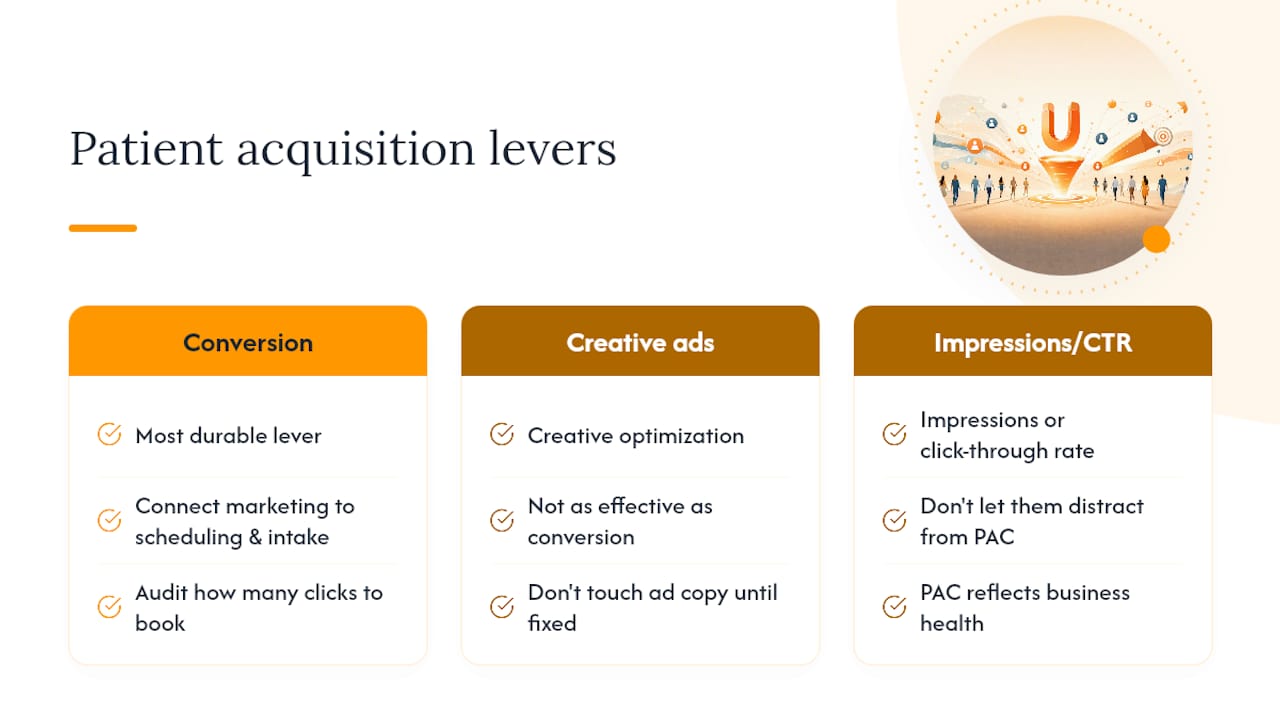
The most durable lever isn’t a clever ad. It’s removing friction between interest and a booked visit, which is why connecting marketing to scheduling and intake outperforms most creative optimization. Test this in under a week: audit how many clicks it takes a stranger to book with you. If it’s more than three, fix that before touching your ad copy. One caution: don’t let impressions or click-through rate distract you from PAC, the metric that actually reflects business health.
How The Artist Evolution Helps You Turn This Playbook Into Results
Running this entire playbook alone, while also managing patient care, isn’t realistic for most practice leaders. Theartistevolution gives you a full-service alternative to piecing together your own stack of freelancers and disconnected tools, with 18 years of experience translating marketing spend into measurable patient volume across healthcare, dental, and other regulated industries.

Theartistevolution’s services map directly onto the priorities in this article: a diagnostic marketing assessment to find your biggest conversion leaks, Google Business Profile and local SEO work, pay-per-click management built around completed-visit tracking rather than raw clicks, and ongoing campaign management that keeps every channel accountable to PAC, not vanity metrics. Start with a 90-day assessment to identify where your funnel is leaking patients and get a prioritized action plan built for your specialty and market. Request your marketing assessment today and get your baseline PAC benchmarks before your next budget cycle.
Frequently Asked Questions
What is a good patient acquisition cost benchmark?
The exact dollar figure varies significantly by specialty, since cash-pay procedures tolerate a higher PAC than insurance-reimbursed primary care visits.
How is patient acquisition marketing different from general healthcare marketing?
Patient acquisition marketing focuses specifically on converting prospective patients into scheduled, completed appointments. Broader healthcare marketing includes brand awareness, community reputation, and retention efforts that don’t tie directly to new patient volume.
What’s the fastest patient acquisition strategy for a new practice?
Google Ads paired with a fully optimized Google Business Profile typically produces results within 30 to 60 days, provided your booking flow is already frictionless. Skipping the booking fix first wastes the ad spend.
How often should practices review patient acquisition KPIs?
Review campaign dashboards daily, PAC by channel monthly, and your overall LTV-to-PAC ratio quarterly. That cadence catches leaks before they become expensive.
Do HIPAA rules apply to patient acquisition marketing?
Yes. Any marketing activity that touches patient data, including retargeting pixels, review requests, and CRM automation, needs to align with HIPAA-compliant marketing practices. Loop in legal review before launching new tracking tools.
Sources
- CDC — Access to health care (FastStats)
- Patient Acquisition Playbook for Medical Practices 2026 — GetPracticeHelp
- Patient Acquisition Cost Guide — Improvado
Use these benchmarks to set internal PAC targets rather than relying on generic industry averages.