
Choose Klaviyo for DTC e-commerce brands where lifecycle revenue and Shopify attribution are core KPIs. Choose Mailchimp when speed to launch, broad marketing utility, and a lower entry cost matter more than purchase-triggered automation.
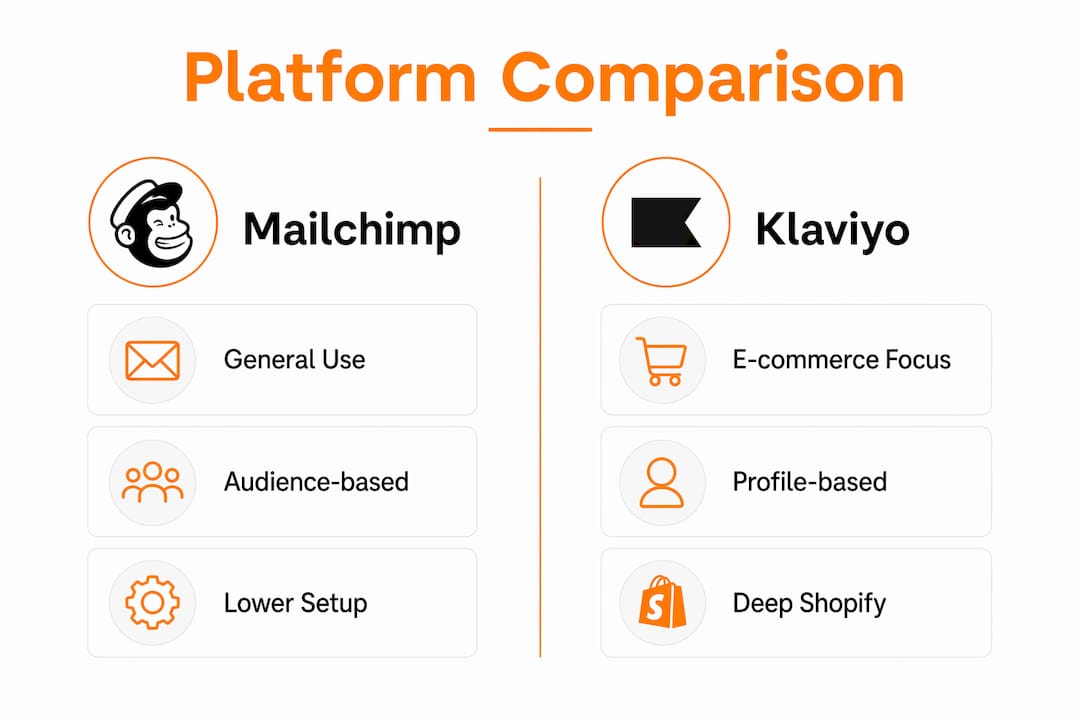
- Klaviyo wins for Shopify stores, DTC operators, and any brand where email and SMS directly drive attributed revenue. Its profile-centric data model, unlimited segmentation conditions, and predictive analytics make it purpose-built for lifecycle revenue.
- Mailchimp wins for service businesses, consultants, healthcare practices, and early-stage brands that need newsletters, simple automations, and a familiar editor without a steep learning curve.
- The deciding factor is business model, not list size: if email is a revenue channel tied to purchase behavior, Klaviyo’s data model pays for itself. If email is a communication channel for a non-commerce audience, Mailchimp is the more efficient choice.
Table of Contents
- Mailchimp vs Klaviyo: Side-by-Side Comparison
- How the data models drive different outcomes
- Which platform fits your tech stack?
- Pricing models and real-world cost differences
- Setup effort and time to first revenue
- Migration checklist: switching platforms without losing revenue
- How to choose: a decision checklist for marketing leaders
- How Theartistevolution chooses and implements platforms
- Key Takeaways
- The platform decision most agencies get backwards
- Theartistevolution helps you pick, pilot, and launch the right platform
- Sources and further reading
Mailchimp vs Klaviyo: Side-by-Side Comparison
Industry testing consistently positions Mailchimp as the general-purpose all-rounder and Klaviyo as the e-commerce specialist. Here is how they compare across the dimensions that matter most to agency buyers.
| Dimension | Mailchimp | Klaviyo |
|---|---|---|
| Best for | General business, newsletters, service brands | DTC e-commerce, Shopify stores, lifecycle revenue |
| Pricing model | Per total contacts (including unsubscribed) | Per active profiles only |
| Entry price | ~$13/mo (Essentials, 500 contacts) | ~$20/mo (Email, 500 profiles) |
| Segmentation | Moderate (up to 5 conditions, tag/attribute-based) | Advanced (unlimited conditions, predictive, CLV) |
| Automation | Basic on Essentials; advanced on Standard+ | Advanced flows on every paid plan |
| Shopify integration | Connector-based, workable | Native, real-time event capture |
| Reporting | General campaign metrics, Google Analytics link | Revenue-per-recipient, predicted CLV, flow attribution |
| Ease of use | Easier early on; largest template library | Steeper curve; more powerful once store data is connected |
| SMS | Paid add-on, separate credits | Native channel, same data model as email |
| Migration effort | Low (familiar interface, broad docs) | Medium-high (event tracking, schema mapping required) |
One decisive advantage each:
- Mailchimp: Permanent free plan up to 250 contacts, 100+ templates, and a drag-and-drop editor that requires zero training.
- Klaviyo: Unlimited segmentation conditions and real-time dynamic segments that update automatically as contacts meet criteria.
Shortlist Mailchimp for clients that are not e-commerce-led. Shortlist Klaviyo for any Shopify or WooCommerce brand above $100K GMV where retention automation is a growth lever.
How the data models drive different outcomes
The most important difference between these two platforms is not the feature list. It is the underlying data architecture.
Mailchimp organizes contacts into separate “Audiences.” A single person on three lists counts as three contacts toward your billing. Klaviyo uses a profile-centric model: one person is one profile regardless of how many segments they belong to. That distinction shapes everything downstream, from cost to segmentation depth to revenue attribution.
Klaviyo’s segmentation has no condition limit. You can build a segment of customers who purchased a specific product category, spent over $200 in the last 90 days, have a predicted churn risk above 60%, and have not opened an email in 45 days. Mailchimp caps segments at 5 conditions and relies on tags and attributes rather than real-time behavioral events. For a DTC brand running abandoned-cart, post-purchase, and win-back flows simultaneously, that gap is significant.
On automation, Klaviyo triggers flows from real-time events: a browse abandonment, a cart add, a purchase. Mailchimp’s deeper workflows are locked behind the Standard plan, and even there the logic is more general-purpose than store-focused. Klaviyo includes advanced flows, predictive analytics, and AI segments on every paid plan.
Revenue impact: A 90-day Shopify comparison showed the data-first platform produced $3,600/month more net attributed revenue on a 35,000-subscriber test, after accounting for a $200/month price gap.
Pro Tip: Before committing to either platform, pull a sample of your highest-value customer segments and test whether the platform can replicate them natively. If you need more than 5 behavioral conditions to define your best buyers, Mailchimp will limit you.
Which platform fits your tech stack?
For Shopify-native brands, Klaviyo’s integration is not just deeper — it is a different category of connection. Klaviyo captures cart events, product views, and order data in real time without additional middleware. Shopify integration depth is a decisive factor for retention and revenue automation at scale. Mailchimp connects to Shopify via a connector, syncing customers and orders, but it does not match the granularity of Klaviyo’s native event capture.

Both platforms support WooCommerce, BigCommerce, and Magento. For CRM integrations, Mailchimp pulls ahead slightly: it connects with Google Analytics, Canva, QuickBooks, and Vimeo natively. Klaviyo does not have a native Google Analytics integration, though it can pass data through UTM parameters and webhooks.
For agencies building stacks around analytics platforms, Mailchimp’s Google Analytics link is a genuine convenience. For agencies building stacks around e-commerce data, Klaviyo’s real-time Shopify sync eliminates the reconciliation work that connector-based setups require.
- Klaviyo fits: Shopify + CDP + ad platforms + SMS (unified in one data model)
- Mailchimp fits: CRM + Google Analytics + social ads + landing pages (broader but shallower)
Pro Tip: During any pilot, run a live Shopify sync for 7 days and verify that browse-abandonment events, cart events, and order completions are all flowing correctly before building flows. A broken event stream discovered post-launch costs far more to fix than a pre-launch test.
Pricing models and real-world cost differences
The billing logic is where many agencies get surprised. Mailchimp charges on total contacts, including unsubscribed and duplicate contacts across audiences, until you manually remove them. Klaviyo charges only on active profiles, excluding suppressed and unengaged contacts.
| List size | Mailchimp (Standard) | Klaviyo (Email) | Notes |
|---|---|---|---|
| 500 contacts | ~$13/mo | ~$20/mo | Mailchimp cheaper |
| 1,000 contacts | ~$15/mo | ~$35/mo | Mailchimp ~2x cheaper |
| 5,000 contacts | ~$75/mo | ~$100/mo | Gap narrows |
| 10,000 contacts | ~$185/mo | ~$150/mo | Klaviyo cheaper |
| 25,000 contacts | ~$450/mo | ~$400/mo | Klaviyo cheaper |
The price crossover sits between 5,000 and 10,000 contacts. Below that band, Mailchimp wins on cost. Above it, Klaviyo is typically cheaper, and the gap widens with list growth.
Watch for these hidden cost behaviors:
- Mailchimp: Unsubscribed contacts count toward your tier until you archive them manually. A legacy list with 20% unsubscribes inflates your bill.
- Klaviyo: SMS credits are purchased separately. For brands running combined email and SMS flows, budget for both channels.
- Both platforms: Free tiers restrict human support after an introductory period (30 days for Mailchimp, 60 days for Klaviyo). Budget for a paid tier on any mission-critical client program.
Setup effort and time to first revenue
Mailchimp is faster to launch. The drag-and-drop editor, 100+ prebuilt templates, and familiar interface mean a competent marketer can send a campaign on day one. For service businesses, consultants, or healthcare practices that need newsletters and basic drip sequences, the simpler platform delivers speed without a technical investment.
Klaviyo requires more upfront work. Here is what a typical agency onboarding involves:
- Connect the Shopify or e-commerce store and verify event tracking (browse, cart, purchase).
- Map existing customer data to Klaviyo’s profile schema.
- Configure suppression lists and consent flags for CCPA and GDPR compliance.
- Build or import core flows: welcome series, abandoned cart, post-purchase, win-back.
- Set up SMS as a native channel if the client uses it.
- Configure revenue attribution windows and test with a live order.
That process typically takes 2–4 weeks with a developer, an analytics owner, and a creative resource involved. Mailchimp’s equivalent setup runs 3–5 days for a competent marketer working alone. For DTC stores above $100K GMV, Klaviyo’s ecommerce-native flows typically pay back the higher setup cost within 3–6 months through better attribution and predictive segments.
Migration checklist: switching platforms without losing revenue
Migrations fail most often at two points: deliverability dips from a new sending IP, and broken attribution from missing event tracking. Plan for both.
- Audit your current data. Export all contacts, segments, tags, and suppression lists. Identify duplicates and unsubscribed contacts before importing.
- Map segments to the new data model. Klaviyo’s profile model and Mailchimp’s audience model do not translate directly. Rebuild segments from behavioral data, not just tags.
- Export and recreate templates. HTML templates transfer; WYSIWYG blocks often do not. Rebuild key templates natively in the new editor.
- Recreate flows before cutover. Never go live on a new platform without testing every active automation end-to-end.
- Set up webhooks and event tracking. For Klaviyo migrations, verify that all Shopify events are firing before deactivating Mailchimp flows.
- Warm the new IP. Ramp send volume over 2–4 weeks to protect deliverability. Start with your most engaged segment.
- Preserve suppression lists. Import all unsubscribes and hard bounces on day one. Sending to suppressed contacts on a new IP is the fastest way to damage sender reputation.
Pro Tip: Run a dry-run pilot on a 500-contact segment before full cutover. Send the same flow on both platforms simultaneously for 7 days, then compare open rates, click rates, and attributed revenue. This validates your new setup and gives you a clean attribution baseline before you decommission the old platform.
Key migration risks:
- Deliverability dip from new IP (mitigate with IP warming)
- Lost suppression lists (export before migration, import before first send)
- Broken revenue attribution (test event tracking before going live)
- Duplicate profiles from mismatched email formats
How to choose: a decision checklist for marketing leaders
The right platform is the one that matches your client’s business model, not the one with the longest feature list.
Choose Klaviyo when:
- The client runs a Shopify, WooCommerce, or BigCommerce store
- Email and SMS are measured by attributed revenue, not just opens
- Lifecycle automation (abandoned cart, post-purchase, win-back) is a growth priority
- The team has bandwidth to invest in setup and data architecture
- The list is above 10,000 active profiles where Klaviyo’s billing becomes cost-competitive
Choose Mailchimp when:
- The client is a service business, consultant, healthcare provider, or early-stage brand
- Speed to launch matters more than revenue attribution precision
- The team is small and non-technical
- Budget sensitivity is high and e-commerce depth would go unused
Vendor discovery questions to ask in demos:
- How does your platform count contacts for billing? Do suppressed contacts count?
- What is the data retention window for behavioral events?
- What support SLAs are included at each tier?
- Is there a sandbox or test environment for flow testing before go-live?
Red flags:
- A platform that counts suppressed contacts toward billing when the client has a large legacy list
- No test environment for flow validation before cutover
- Support locked behind the highest pricing tier for a mission-critical program
Analytics-driven platform selection consistently produces better ROI outcomes than choosing by brand familiarity alone.
How Theartistevolution chooses and implements platforms
At Theartistevolution, platform selection is a business model decision before it is a technology decision. Two client scenarios illustrate the difference.
For a retail e-commerce client with a 40,000-contact Shopify store and stagnant repeat-purchase rates, the agency selected Klaviyo. The priority was building behavior-based lifecycle flows: abandoned cart, post-purchase upsell, and a churn-risk win-back sequence. Within 90 days, the client’s email channel moved from a broadcast tool to a measurable revenue driver, with attributed revenue tracked per flow and per recipient.
For a regional healthcare practice entering a new market, the agency chose Mailchimp. The client needed a fast-launch newsletter program, appointment reminders, and a welcome series for new patients. No e-commerce data, no purchase events, no need for predictive CLV. Mailchimp’s template library and simple editor had the program live in under a week.
The platform that matches your data model and business objective will always outperform the platform with the most features. Klaviyo’s depth is only an asset when the store data is there to feed it. Mailchimp’s speed is only an asset when complexity is not the goal.
Theartistevolution’s approach to customer retention programs starts with the business model, then selects the platform, then builds the flows. That sequence matters because the wrong platform choice creates technical debt that compounds with every campaign.
Key Takeaways
For e-commerce brands, Klaviyo’s profile-centric data model and unlimited segmentation consistently outperform Mailchimp’s general-purpose architecture when lifecycle revenue is the primary KPI.
| Point | Details |
|---|---|
| Business model drives platform fit | Klaviyo for DTC e-commerce; Mailchimp for service businesses and general marketing. |
| Billing logic affects TCO | Mailchimp counts unsubscribed contacts; Klaviyo bills active profiles only, which can lower costs for large lists. |
| Price crossover at 10,000 contacts | Below 10,000, Mailchimp is typically cheaper; above it, Klaviyo is cost-competitive and feature-superior for stores. |
| Migration requires IP warming | Skipping IP warm-up after a platform switch is the leading cause of deliverability dips. |
| Theartistevolution matches platform to client model | The agency selects and implements the right platform based on business objective, then builds lifecycle programs around it. |
The platform decision most agencies get backwards
Most agency conversations about Mailchimp vs Klaviyo start with pricing. That is the wrong starting point. Pricing is the last variable to evaluate, not the first.
The question that actually determines the right answer is: does this client’s revenue depend on purchase behavior data? If yes, Klaviyo’s data model is not a premium feature. It is the foundation. If no, Mailchimp’s simplicity is not a limitation. It is the appropriate tool for the job.
What gets overlooked is how quickly the wrong choice compounds. A service business on Klaviyo pays for predictive analytics it will never use and spends weeks on an event-tracking setup that adds no value. A Shopify brand on Mailchimp hits the 5-condition segmentation ceiling right when it needs to build a churn-risk win-back flow. Both mistakes are recoverable, but both cost real time and money.
The agencies that consistently get this right start with the client’s revenue model, map the data architecture that supports it, and then select the platform that fits that architecture. That sequence is more reliable than any feature comparison.
Theartistevolution helps you pick, pilot, and launch the right platform
Choosing between these two platforms is straightforward when you have the right framework. Executing the migration, building the flows, and proving revenue attribution is where most teams need support.
Theartistevolution has spent 18 years selecting and implementing marketing technology tools for clients across retail, healthcare, legal, and CPG. The agency handles platform selection, data migration, flow architecture, and ongoing campaign management so your team focuses on growth, not configuration.

Whether you are moving a Shopify brand to Klaviyo or launching a Mailchimp program for a service business, Theartistevolution builds the program around your revenue model. Request a marketing assessment to get a clear platform recommendation and a migration plan built for your specific client situation.
Sources and further reading
- Klaviyo vs. Mailchimp: I Tested Both Email Platforms for 2026 — G2’s hands-on comparison; use for setup time, support realities, and channel coverage.
- Klaviyo vs Mailchimp: Which Is Best? — Zapier’s editorial review; strong on template differences and Shopify integration depth.
- Klaviyo vs Mailchimp (Pricing and Billing Logic) — Detailed breakdown of billing mechanics and segmentation condition limits.
- Klaviyo vs. Mailchimp 2026 Comparison — Source for the 90-day Shopify attributed revenue comparison ($3,600/month net difference).
- Mailchimp vs Klaviyo Pricing 2026 — Pricing decision framework by business type; useful for procurement conversations.
- Klaviyo vs Mailchimp: Ecommerce vs All-Rounder — Side-by-side feature and pricing table with US dollar figures.
- Klaviyo vs Mailchimp: Why One Beats the Other in Ecommerce — Practitioner-level review covering segmentation limits, support windows, and free-plan feature access.
- Mailchimp vs Klaviyo | Email Tool Spot — Decision-path framework for shortlisting by business model and list size.