
A good video ad script does one job: it gets one specific viewer to take one specific action. It does that in a fixed amount of time, with the picture working even when the sound is off. Everything below is built on that idea: a four-part structure, a word budget for a 30-second spot, a two-column template you can copy, and a worked example. After that come the points that matter if you market a medical practice, a law firm, a dental office, a retail shop or a consumer product.
We have spent 18 years building campaigns for businesses from startups to household brands. The scripts that work are rarely the most clever ones. They are the most disciplined ones.
TL;DR
- Write the whole ad as one sentence first: after watching, the viewer should believe X and do Y. If it needs two actions, it is two ads.
- Budget about 75 spoken words for 30 seconds, roughly 2.5 words per second, and always read the script aloud against a timer.
- Use a five-beat structure: hook, problem, solution, proof, action. Put the brand in the first five seconds.
- Write in two columns, picture on one side and audio on the other, and make sure no key fact lives only in the audio.
- Regulated fields (healthcare, legal, dental) need claims and patient or client stories cleared before filming, not after.
Table of Contents
- What a video ad script actually is
- Before you write a word: five decisions
- The five-beat structure
- The 30-second ad script: how many words fit
- A two-column template you can copy
- A worked example: 30 seconds for a dental practice
- Writing tips that raise the quality of any script
- Scripts for regulated and trust-based businesses
- Where the script goes next
- Why the script should sit inside a campaign
- Our perspective
- Get a script built on a strategy
- FAQ
- Sources
What a video ad script actually is
A video ad script is the plan for everything the viewer sees and hears, in the order and at the timing they will experience it. It is not an essay read over footage. It holds the spoken lines, the shots, the on-screen text, the music and sound cues, and the final action you want.
That is why the script is the cheapest place to fix an ad. Changing a sentence costs minutes. Reshooting a scene because the line ran four seconds long costs a day of production.
The script also gives everyone the same document to react to: the owner, the compliance reviewer, the editor and the media buyer. When those people disagree, they should disagree on paper.
Before you write a word: five decisions
Most weak scripts are weak because these choices were never made. Settle them in a short brief.
- Audience, in one line. “Adults in our metro area who have put off a dental cleaning for over a year” is a line. “Everyone who cares about their health” is not.
- One action. Book a consultation, call, visit the store, start a free trial. Pick one.
- Runtime. Placement decides it. A 6-second bumper, a 15-second social cut and a 30-second spot are different scripts, not trimmed versions of one.
- Platform and sound. Many viewers see ads with the sound off, and the format (vertical or landscape) changes your framing. Check the format rules first; our YouTube ad specs guide lists sizes, lengths and file requirements.
- Tone and mandatories. Choose two or three adjectives (calm, direct, warm). List what must appear: logo, legal line, product shot, license number, price disclaimer.
The one-sentence test is the sharpest tool here. Write: “After this ad, the viewer should believe ___ and do ___.” If you have three benefits you want to cover, choose the strongest. The others become the next ad, not co-stars in this one. Cramming three claims and two calls to action into 30 seconds splits attention, and the viewer remembers none of it.
The five-beat structure
For most business ads, this order works because it follows how people decide.
1. Hook (first 3 to 5 seconds)
The hook earns the next five seconds. Open on a situation the viewer recognizes, a question they already ask themselves or a striking visual. Google’s own creative guidance for YouTube advises introducing the brand or product in the first five seconds and using more than two frames in that opening to hold attention. Do not save the brand name for the end card.
2. Problem
Name the frustration in the viewer’s terms. A law firm’s viewer does not say “suboptimal legal representation.” They say “the other driver’s insurer keeps calling me.” Use their words.
3. Solution
Introduce what you offer and make one claim about it. One. Whatever the claim is, you need to be able to stand behind it with documentation.
4. Proof
Give the viewer something checkable: a number you can substantiate, a credential, a real customer story (with permission), a before-and-after you are cleared to show. Proof is what separates an ad from a promise.
5. Action
Google’s guidance says the call to action should be both audible and visible, with a specific instruction such as visit the site, sign up or buy now. “Call today to book your first visit” with the number on screen beats “learn more.”
This is the classic problem, agitate, solve shape with proof added. It is common in local advertising because it mirrors the way a buyer moves from noticing a need to acting on it.
The 30-second ad script: how many words fit
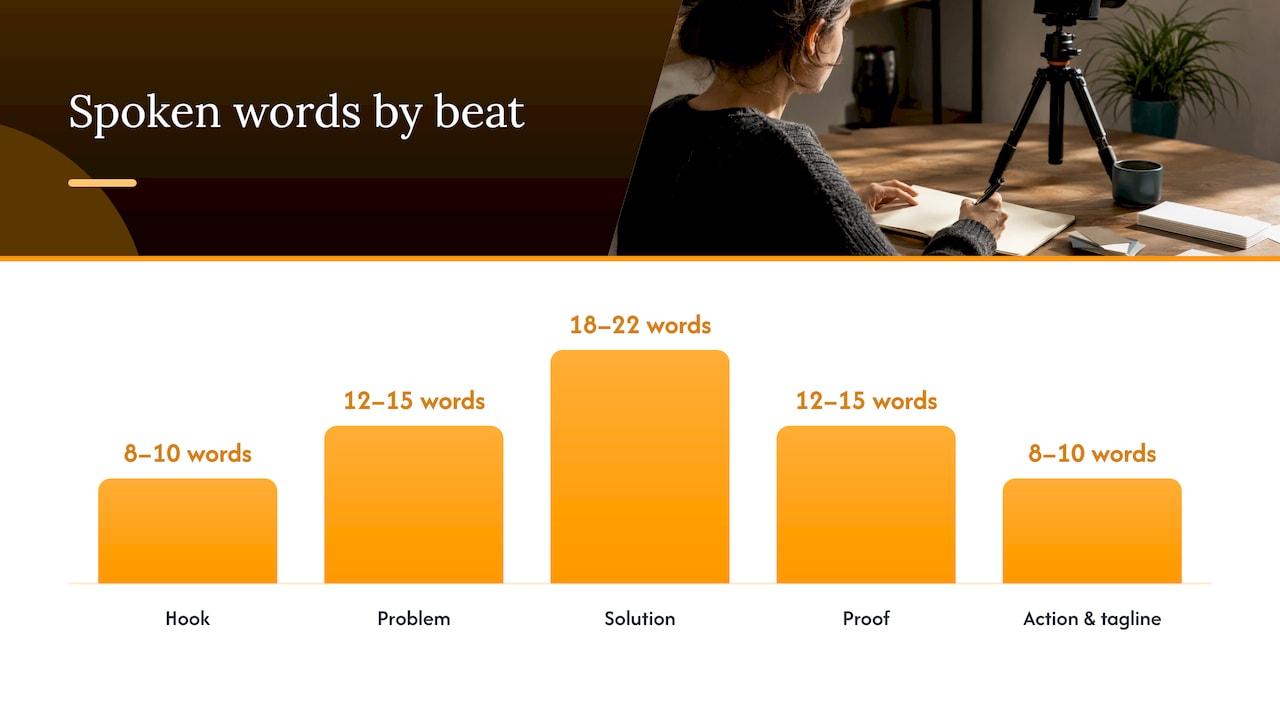
The 30-second spot is the format most people search for, and it is where over-writing is most common. Speech at a natural, conversational pace runs around 2.5 words per second, which puts a full 30 seconds at about 75 words at the very most. Real scripts should aim lower, around 65 to 75, because music, pauses, sound effects and on-screen moments all take time.
Here is a practical way to allocate it.
| Beat | Time | Spoken words (approx.) |
|---|---|---|
| Hook | 0 to 5 sec | 8 to 10 |
| Problem | 5 to 10 sec | 12 to 15 |
| Solution | 10 to 18 sec | 18 to 22 |
| Proof | 18 to 25 sec | 12 to 15 |
| Action and tagline | 25 to 30 sec | 8 to 10 |
Two cautions. First, phone numbers, web addresses and legal disclaimers take longer to say than their word count suggests, so give them real seconds. Second, if the picture carries the hook, the spoken word count in that beat can be close to zero, which is often stronger.
For shorter formats, scale down. A 15-second ad holds about 35 words and a 6-second bumper about 15, so a bumper can carry only the hook, the brand and a single instruction. A 60-second script has room for roughly 150 words, but only add a second idea if you have a second beat to support it.
Always read the draft aloud with a stopwatch, not silently. If it runs past 28 seconds, cut words. Do not speed up the read.
A two-column template you can copy
The standard working format is the A/V script: two columns, one for what the viewer sees and one for what they hear. Add a timing column and one for on-screen text, and you have a document an editor can build from.
| Time | Picture | On-screen text | Voice and sound |
|---|---|---|---|
| 0:00 to 0:03 | Describe the opening shot in present tense | Hook, in as few words as possible | First spoken line, or music only |
| 0:03 to 0:08 | The problem shown, not told | Short problem label | Problem line |
| 0:08 to 0:18 | Product or service in use | One claim | Solution line |
| 0:18 to 0:25 | Proof element (credential, result, real customer) | Proof point | Proof line |
| 0:25 to 0:30 | Logo, contact method | Call to action | Action line plus tagline |
How to fill it in well:
- Picture first. The picture reaches every viewer, sound on or off. Write the picture column before the voice column.
- On-screen text carries the hook and the main claim, in as few words as possible. It should not transcribe the voiceover line by line.
- Name speakers. If a person speaks on camera, mark them, for example “DR. RIVERA:”, and label graphics as “SUPER:”.
- Give mandatories their own rows. Logo, legal line and product shot belong in the timeline, not squeezed into the last frame.
- Keep text out of the frame edges. Platform buttons and captions cover parts of the screen.
- Caption every spoken line, short, high contrast, two lines at most.
A useful check: mute the rough cut. If the beats still make sense, the script works. If not, fix the picture before touching the words.
A worked example: 30 seconds for a dental practice
Here is a complete example, written for a fictional local practice. The name, offer and details are placeholders to show the structure, not a real ad.
| Time | Picture | On-screen text | Voice |
|---|---|---|---|
| 0:00 to 0:03 | Close-up: a woman covers her smile in a family photo | “Hiding your smile?” | “Still hiding your smile in photos?” |
| 0:03 to 0:08 | She declines to be in a group picture, looks away | “Putting it off since 2023” | “Maybe you’ve been putting off the dentist for a while. Most people have.” |
| 0:08 to 0:18 | Bright, calm exam room; friendly hygienist greets her; the practice logo on the wall | “New patient visits, no judgment” | “At Maple Street Dental, your first visit is a conversation, not a lecture. We check, we explain, and we plan around you.” |
| 0:18 to 0:25 | Doctor on camera, license-and-credentials super | “Dr. Rivera, DDS” | “Dr. Rivera has been caring for families in this neighborhood for years.” |
| 0:25 to 0:30 | Same woman, smiling in the photo; phone number and logo | “Book online or call 555-0100” | “Book your first visit today. Maple Street Dental.” |
The voice column holds about 70 words, which lands near 28 seconds at a natural pace. Notice what it does: one audience, one action, a brand named before the 10-second mark, a proof beat built on a real credential, and a call to action that is both spoken and shown. The same skeleton works for a boutique retailer, a consulting firm or a packaged-goods launch, with only the content of each beat changing.
Writing tips that raise the quality of any script
- Write for the ear. Short sentences. Contractions. Read every line aloud; if you stumble, the voice talent will too.
- One claim per beat. A beat that makes two claims makes neither.
- Show the benefit, say the feature. The picture proves the outcome while the voice names what you do.
- Cut adjectives first. “Premier, innovative, comprehensive” says nothing a competitor could not say.
- Let sound add, not carry. No fact should exist only in the audio.
- Build an A/B pair. Write two hooks for the same body. The hook is the part you can test most cheaply once the ad runs.
For how script choices change by format, our guide to brand video types and workflows walks through ten formats. If your script is drifting toward a longer explanatory piece, check how long an explainer video should run before you commit to a runtime.
Scripts for regulated and trust-based businesses
Healthcare providers, dental specialists and law firms write ads under rules that retail and CPG brands do not face. Build these checks into the brief, not the final edit.
- Patient stories and testimonials. A patient appearing on camera or sharing their experience in an ad generally needs written authorization before you use it. Get the signed release before filming and keep it with the project files.
- Outcome claims. Avoid promising results. Describe what you do and how you care for people rather than guaranteeing an outcome.
- Credentials and licenses. Put the name, title and any required license information in the super, and verify it is accurate.
- Legal advertising rules. Law firm advertising is governed by each state’s rules of professional conduct, and they differ. Confirm disclaimers, case-result language and testimonial rules with your state bar’s guidance or your ethics counsel before the script is locked.
- Compliance reviewer on the brief. Give your compliance contact the script, not the finished video.
These are not creative limits. A calm, credible tone with a real person, a clear credential and a clear next step is exactly what a worried patient or a stressed legal client responds to.
Where the script goes next
A finished script is the start of production. Plan for these steps:
- Table read. Read it aloud with a timer and with someone who has not seen it. Ask them to repeat the one action back to you.
- Compliance and approvals. Collect sign-offs on the claims, credentials and releases.
- Storyboard or shot list. Convert the picture column into frames or a shot list.
- Cut-downs. Decide up front which 15-second and 6-second versions will come from the 30-second master, and write their hooks and calls to action now.
- Placement. Match each cut to the platform: social, video platforms, search-adjacent video or television. Our guide to connected TV advertising covers the living-room screen, and our look at why video marketing keeps growing in digital advertising explains where video fits in a wider plan.
- Measure. Define the single metric tied to your one action (calls, bookings, store visits, sign-ups) before launch, and review results against it.
If your concept suits illustration or motion graphics better than live action, for example for a complex service or a product that is hard to film, our animated video work is built on the same scripting discipline described here.
Why the script should sit inside a campaign
A video ad rarely works alone. The viewer who sees your 30-second spot will search your name, land on your website and judge the match between the two. If the promise in the ad is not on the landing page, the click is wasted. That is why the script, the landing page, the paid media plan and the search presence need to be written from the same brief.
This is where an agency that covers strategy and execution together earns its place. At The Artist Evolution, our multidisciplinary in-house team handles brand development, pay-per-click management, SEO and creative production, so the message you script is the message people find everywhere. We have done this for clients across healthcare, legal, retail, entertainment and more. You can see examples in our projects and in the brand engagement case study.
Our perspective
Most video ad scripts fail before the first line is written. The business has not decided what it wants the viewer to do, so the script tries to do everything.
Our approach starts upstream. We define the audience, the single action and the proof we can stand behind, and only then do we write. Our team works from a proven marketing playbook built over 18 years, and we operate as an extension of your team, so strategy and execution are not handed between strangers.
For a dental group, that means a script that sounds like the practice and respects the rules around patient stories. For a law firm, it means visibility that matches how clients actually search. For a retailer or CPG brand, it means an ad that connects to the shelf, the store and the site. The script is where the campaign becomes real, and we treat it that way.
Derek
Get a script built on a strategy
If you would rather start from a plan than a blank page, we can help. Our marketing assessment looks at where your marketing stands, and our Strategy & Management service builds and runs the campaign around your video. Tell us the audience and the one action you want, and we will take it from there.

FAQ
How long should a video ad script be?
It depends on the runtime, not on the page count. At a natural speaking pace of about 2.5 words per second, a 30-second ad holds roughly 65 to 75 spoken words, a 15-second ad about 35 and a 6-second bumper about 15. The script itself is usually one page for a 30-second spot.
What is the best structure for a 30-second ad script?
Hook, problem, solution, proof, action. The hook takes the first three to five seconds and names your brand early, the problem and solution share the middle, the proof makes the claim believable, and the final five seconds hold one clear action that is both spoken and shown on screen.
Do I need a different script for each platform?
Yes, at least a different cut. Placement decides runtime, sound behavior and framing, so a vertical social ad and a television spot should have their own hooks and calls to action, even when they come from the same concept. Plan the cut-downs while you write the master script.
Can I use a template or AI to draft the script?
A two-column template is the right starting format, and a draft from any tool is only a first pass. The decisions that matter, one audience, one action, a provable claim and compliance sign-off, are yours to make, and every line must still be read aloud against a timer.