
Topical authority is the degree to which search engines and AI systems trust a site to comprehensively cover a subject, and that trust translates into rankings across a wider set of related queries, not just the ones you optimize page by page. Building it means mapping tight topic clusters, publishing genuinely complete content, and reinforcing the structure with internal links and relevant external citations. Sites that skip straight to volume without this foundation tend to plateau, while focused sites climb faster and hold their ground through algorithm updates.
TL;DR:
- Building topical authority requires mapping clear topic clusters and producing comprehensive, well-structured content within a narrowly defined niche.
- Focused sites with tight content coverage tend to rank for a broader array of related keywords and perform better through algorithm updates than larger, scattered sites.
- Internal linking with consistent anchor text and external citations from niche-specific sources reinforce topical relevance and help maintain authority.
- Effective tracking includes measuring incremental keyword coverage, cluster traffic, top-three ranking share, and SERP features, over a six to twelve-month period.
- Avoid content creep, thin AI-generated pages, inconsistent links, and chasing volume at the expense of completeness to prevent topical authority from eroding.
Table of Contents
- What topical authority actually means
- Why topical authority moves the numbers that matter
- How to build topical authority step by step
- Tracking whether your topical authority is actually growing
- Where topical authority quietly falls apart
- How this plays out in agency practice
- Where leaders should actually spend their time
- Put a topical authority plan into action with The Artist Evolution
- Sources
- FAQ
What topical authority actually means
Topical authority describes how thoroughly a site covers a specific subject across a network of interlinked pages, and it is earned rather than assigned. According to Ahrefs’ analysis of topical authority, Google’s internal signals, exposed in a 2024 API leak, include a site focus score and a site radius: measures of how concentrated a site’s content is around a core subject and how far individual pages drift from that center. A site with a tight radius on, say, orthodontic care signals something different to search systems than a general health blog that happens to publish one article on braces.
This is a different animal from domain authority. Domain authority (or the popular DR/DA metrics) measures the strength of a site’s backlink profile overall, while topical authority measures subject-matter depth and coverage, independent of how many links point at the homepage. A site can carry a modest backlink profile and still outrank a much larger, better-linked competitor within a specific niche, because Google increasingly favors sites that “own” a topic over ones that simply mention it. Topical relevance is the narrower cousin of both ideas: it asks whether a single page or cluster matches the intent and subject of a query, without judging the site’s overall concentration.
Three concepts worth separating before you plan anything:
- Domain authority: sitewide backlink strength, unrelated to subject focus.
- Topical relevance: how well one page or cluster matches a specific query’s intent.
- Topical authority: how concentrated and complete a site’s coverage is across an entire subject area, measured in part through signals like site focus score and site radius.
Why topical authority moves the numbers that matter
Sites with strong topical authority tend to rank for a broader set of related keywords than the ones they deliberately targeted, because comprehensive coverage across a cluster lets Google connect dozens of adjacent queries to the same authoritative source. That breadth also shows up in SERP features: featured snippets, People Also Ask boxes, and image or video packs cluster around sites that already demonstrate depth on the subject.
A widening share of search now resolves without a click, and Search Engine Land’s guide to topical authority notes that AI overviews and zero-click answers favor sites that show structured, comprehensive coverage rather than isolated, keyword-stuffed pages. Appearing in those AI-generated answers is becoming its own visibility channel, one that rewards the same clustering and internal linking work that builds traditional rankings.
The resilience angle matters just as much. Sites that maintain concentrated topic coverage tend to weather algorithm updates that penalize shallow or scattered content better than sites that spread thin across unrelated subjects, according to Ahrefs. This is also the mechanism that lets a small specialist site outrank a much larger generalist: Google has moved away from rewarding isolated keyword-targeted pages and toward rewarding sites that demonstrably own a subject, regardless of overall size.
How to build topical authority step by step
Building topical authority is a sequencing problem before it’s a content problem. Teams that jump straight to publishing without defining scope end up with clusters that look complete on a spreadsheet but read as scattered to both readers and search systems.
1. Define your topic scope and audience. Pick a niche narrow enough to cover completely within a realistic budget. A dental practice claiming authority over “healthcare” will lose to a competitor claiming authority over “pediatric orthodontics,” because the second site’s radius is tighter and easier to fully satisfy.
2. Run topic-based keyword and entity research. Map the questions, subtopics, and related entities a reader would need answered to consider the subject covered, not just the highest-volume keywords. Semrush’s guide to topical authority recommends this entity-first approach over keyword lists alone, since it surfaces gaps a keyword tool misses.
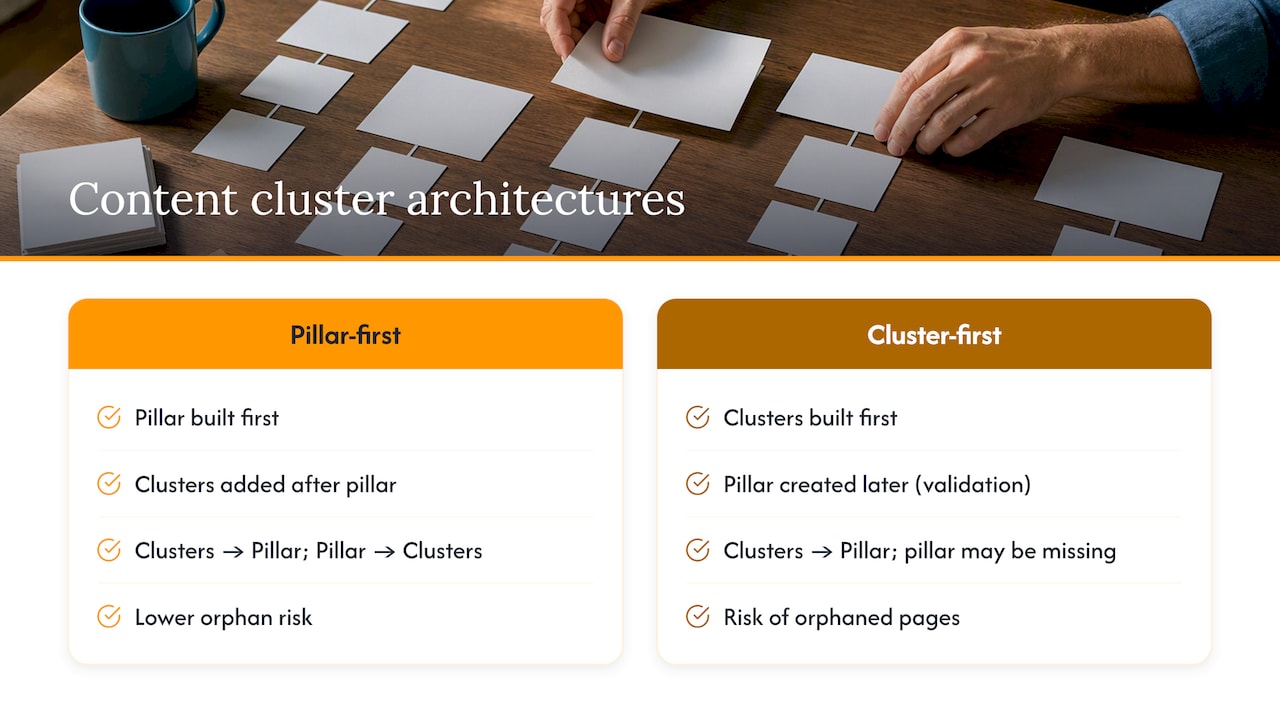
3. Design your cluster architecture. Most teams choose a pillar-first model: one comprehensive pillar page anchors the topic, with narrower cluster pages answering specific subquestions and linking back to the pillar. A cluster-first approach, building the supporting pages before the pillar exists, works when you’re validating demand early, but it risks orphaned pages if the pillar never gets built. Either way, the goal is the same structure our guide to content pillar strategy walks through in more detail.
4. Plan content formats against intent. A comparison query wants a table or list; a how-to query wants steps; a definitional query wants a tight, upfront answer. Matching format to intent for every subtopic, rather than defaulting to the same article template each time, is one of the more overlooked levers in Search Engine Land’s framework.
5. Build hub-and-spoke internal links. Every cluster page links up to the pillar, and the pillar links down to every cluster page, using descriptive, consistent anchor text rather than “click here” or a different phrase each time. Consistent entity naming across anchors helps both crawlers and AI systems understand that the pages belong to the same topic network.
6. Add relevant external links and citations. Earning links from niche-specific sites, contributing expert commentary, and getting cited as a resource within your subject area reinforces topical relevance in a way that generic, unrelated backlinks never will. A partner resource on content cluster strategy covers the mechanics of matching internal architecture to this kind of outreach.
7. Set a governance workflow. Assign an owner, a refresh cadence, and clear rules for when a page gets updated, consolidated into another page, or removed. Semrush frames this governance step as the difference between a cluster that holds its site focus score over time and one that quietly drifts.

8. Sequence the rollout. A realistic 6 to 12 month build starts with the pillar and three to five priority cluster pages in months one and two, expands to the full cluster set by month six, then shifts to gap-filling, refreshing, and link building through month twelve.
Pro Tip: Publish the pillar page last, once every planned cluster page is drafted, so the pillar’s internal links point to content that already exists instead of placeholder promises.
Tracking whether your topical authority is actually growing
Ranking checks alone won’t tell you if a cluster is working. Track a small set of proxy metrics that reflect coverage and concentration, not just individual keyword position.
- Incremental keyword coverage: the count of ranking keywords tied to the cluster that you never explicitly targeted.
- Cluster organic traffic: sessions landing on any page within the cluster, tracked as a group rather than page by page.
- Top-3 ratio: the share of the cluster’s target queries sitting in positions one through three.
- SERP feature share: how many cluster pages hold a featured snippet, People Also Ask entry, or similar placement.
Because site focus score and site radius are internal Google signals without a public dashboard, the closest approximation comes from combining Search Console query data with a crawl-based topic map: group your indexed pages by subject, then check how tightly they cluster versus how many sit outside the intended scope. Rank trackers, content gap tools, and entity co-occurrence checkers round out the toolkit, alongside the visibility tracking approaches outlined in our piece on AI SEO strategies. Review these metrics quarterly. Meaningful movement in cluster traffic and top-3 ratio usually takes six to twelve months, so treat early quarters as structural progress rather than a ranking failure.
Where topical authority quietly falls apart
Most breakdowns trace back to a handful of repeatable mistakes rather than bad luck with an algorithm update.
- Off-topic content creep: publishing pages unrelated to the core subject widens site radius and dilutes focus. Audit regularly and consolidate, redirect, or remove pages that don’t belong.
- Thin or unedited AI-generated content: volume without depth undermines the comprehensiveness that topical authority depends on. Set a quality bar and a human review step before anything publishes.
- Weak or inconsistent internal linking: pages that never reference each other, or that use a different phrase for the same concept each time, make the cluster harder for both readers and crawlers to read as one subject. Standardize anchor text and terminology across the cluster.
- Chasing volume over completeness: prioritizing whichever keyword has the highest search volume, rather than whichever subtopic completes the cluster, leaves visible gaps. Map subtopic completeness first, then layer volume considerations on top.
How this plays out in agency practice
Agencies that run topical authority programs at scale treat cluster mapping as a governance exercise as much as a content one. At The Artist Evolution, that means pairing SEO services with a defined content owner and a review cadence, so clusters stay concentrated instead of drifting as new pages get added over time.
A national relaunch created the kind of fragmented site structure that erodes topical focus fast: new pages, shifting URLs, and inconsistent internal linking across a large content footprint.
The SEO improvement case study documents how restructuring content around clear subject clusters and rebuilding internal linking pathways supported measurable search visibility gains following that relaunch. The operational lesson holds beyond one case: a single owner, a consistent taxonomy, and a scheduled review cycle keep a cluster’s site focus intact long after the initial build.
Where leaders should actually spend their time
Cluster planning and governance deserve investment before content production scales, because a fast publishing pace on a poorly mapped topic just produces more pages to fix later. Track coverage and AI visibility alongside individual rankings. A page sitting at position four inside a complete, well-linked cluster is often worth more than a page at position one that stands alone. Assign one owner and one refresh cadence per cluster: authority erodes fastest when nobody is responsible for noticing the gaps.
— Derek
Put a topical authority plan into action with The Artist Evolution
Mapping clusters, auditing site radius, and rebuilding internal linking is real work, and most in-house teams are already stretched across campaigns, creative, and reporting. The Artist Evolution brings an 18-year multidisciplinary team to exactly this kind of build, combining Search Engine Optimization Agency work with brand development and campaign management so the content strategy, the site structure, and the broader marketing plan move together instead of competing for priority.

For teams that already have a subject in mind but need the cluster mapped, prioritized, and governed correctly, a topical audit is the practical next step: a review of current site radius, gaps against competitors, and a prioritized build plan for the next two quarters. Start that conversation through Strategy & Management and get a plan scoped to your subject before your next content sprint begins.
Sources
- Topical Authority: What It Is, How Google Measures It, and How to Build It
- Topical Authority: Build Trust & Dominate Search Rankings
- What is Topical Authority? (+ How to Build It)
FAQ
What is topical authority in SEO?
Topical authority is the degree to which search engines trust a site to comprehensively cover a specific subject, based on signals like content depth, internal linking, and how concentrated the site’s pages are around that subject. It’s earned through complete cluster coverage rather than assigned by any single metric, according to Ahrefs.
What is the difference between domain authority and topical authority?
Domain authority measures the strength of a site’s overall backlink profile, while topical authority measures subject-matter depth and coverage within a specific subject area. A site with fewer backlinks can still outrank a more heavily linked competitor within a niche it covers more completely.
What is topical relevance in SEO?
Topical relevance describes how well a single page or content cluster matches the intent and subject of a specific search query. It’s a narrower concept than topical authority, which looks at how concentrated and complete a site’s coverage is across an entire subject area rather than one page.
How do I check the topical authority of a website?
There’s no public dashboard for Google’s internal site focus score and site radius signals, so the closest approximation is combining Search Console query data with a crawl-based topic map to see how tightly your indexed pages cluster around a core subject. Tracking incremental keyword coverage, cluster-level organic traffic, and the share of cluster queries ranking in the top three, as outlined by Search Engine Land, gives a practical proxy for progress.