
Most U.S. businesses pay between $1,000 and $7,500 a month for SEO, with small and local operations landing near the $1,000 to $2,500 mark and the SMB median settling around $2,500 to $3,000. Your actual number depends on the pricing model, your competition, and how much technical work your site needs. This guide breaks down the models, the deliverables, sample packages, and a checklist for evaluating any proposal you receive.
TL;DR:
- A typical SMB retainer ranges from $2,500 to $3,000 monthly, with activities like content strategy, technical fixes, and link outreach, depending on site complexity.
- Costs vary significantly based on keyword difficulty, site health, content volume, and competition, which can push prices from around $1,000 to over $25,000 monthly for enterprise programs.
- A budget below $500 per month generally covers activity, not outcomes, as meaningful SEO results require at least $1,000 to $2,500 monthly.
- Different billing models suit various needs: ongoing work fits retainer; one-time projects are better for migrations or audits; advisory is for hourly consulting.
- Regional market factors and industry demand influence pricing, with larger metros and competitive sectors commanding higher retainers, and consistent year-round investment yields better results over sporadic spending.
Table of Contents
- SEO Monthly Pricing at a Glance
- How Do Monthly Retainer, Hourly, and Project SEO Pricing Models Work?
- What Do SEO Budgets Look Like by Business Size?
- What Drives SEO Monthly Pricing Up or Down?
- What Do You Actually Get for $1,000, $2,500, or $8,000 a Month?
- How Should You Set Your SEO Budget and Evaluate a Proposal?
- The Artist Evolution: Proof Behind the Pricing
- Why Does SEO Pricing Vary by Region?
- How Does Market Demand Affect Monthly SEO Pricing Trends?
- Author Perspective: How to Interpret Pricing Across a 12-Month Plan
- How The Artist Evolution Structures Monthly SEO Retainers
- Sources
SEO Monthly Pricing at a Glance
Before you get into the “why,” it helps to see the “how much.” SEO costs break down by business size and by billing structure, and the two intersect in ways that trip up first-time buyers.
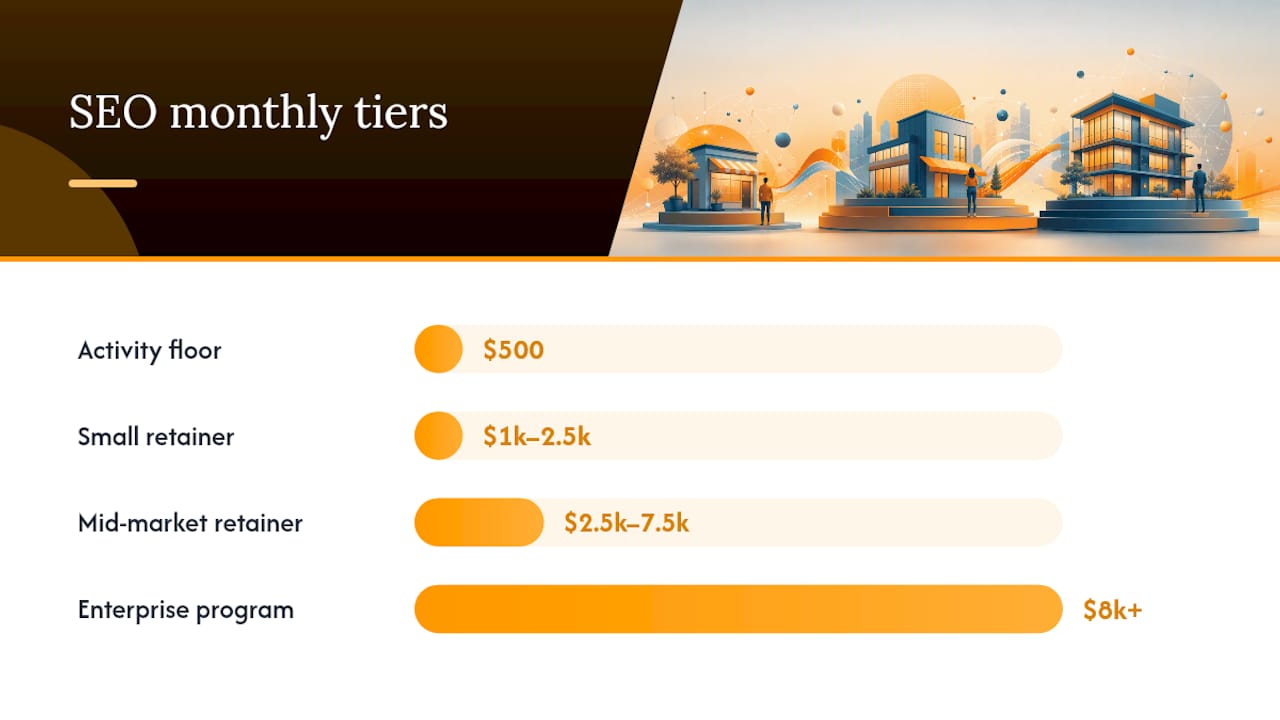
- Small and local business retainers: roughly $1,000 to $2,500 per month, typically covering Google Business Profile management, on-page fixes, and a modest content cadence.
- Mid-market retainers: $2,500 to $7,500 per month, adding content strategy, technical sprints, and link acquisition.
- Hourly consulting: $100 to $300 per hour, common for audits, strategy sessions, or fractional advisory work.
- One-time projects: technical migrations, full-site audits, and ecommerce overhauls can run $1,500 to more than $20,000 depending on site size and complexity.
Statistic Callout: Industry pricing guides consistently point to a median SMB retainer of roughly $2,500 to $3,000 monthly, positioning most small businesses squarely in the middle of the broader $1,000 to $7,500 range rather than at either extreme.
How Do Monthly Retainer, Hourly, and Project SEO Pricing Models Work?
Every SEO cost eventually traces back to one of four billing structures. Understanding how each one works helps you spot when a vendor is misapplying a model to your situation.
- Performance-based pricing. You pay based on results, such as ranking improvements or traffic growth. This model sounds appealing but works best only when both sides agree on measurable, verifiable KPIs upfront, since vague performance clauses invite disputes later.
Scope determines which model makes sense. Ongoing growth work belongs on a retainer. A one-time platform migration belongs on a project quote. Advisory support belongs on an hourly clock.
What Do SEO Budgets Look Like by Business Size?
Your peer group matters more than any single benchmark. A ten-employee dental practice and a 200-location retail chain are not competing for the same SEO dollars, and their deliverables look nothing alike.
- Small and local businesses typically spend $1,000 to $2,500 monthly on local SEO, Google Business Profile optimization, and a light content cadence, usually two to four pieces a month.
- Mid-market companies typically spend $2,500 to $7,500 monthly, funding a content strategy, recurring technical sprints, and structured outreach for backlinks.
- Enterprise programs start around $8,000 and often exceed $25,000 monthly. The jump isn’t just about scale. Enterprise SEO requires governance across multiple stakeholders, legal and compliance review for regulated industries, and dedicated engineering time that a small vendor team simply cannot staff.
If your business sits between two tiers, budget toward the higher one when your site has more than a few thousand pages or when you compete in a crowded vertical like legal or healthcare.
What Drives SEO Monthly Pricing Up or Down?
Two businesses in the same city can get wildly different SEO quotes, and the gap usually comes down to six factors vendors weigh when they scope a retainer.
- Keyword competition and SERP difficulty. Ranking for “personal injury lawyer” costs far more effort than ranking for a niche local service term.
- Technical health and platform complexity. A bloated legacy CMS with years of unresolved crawl errors demands more hours than a clean, modern site.
- Content volume required. A content-heavy strategy with weekly publishing costs more than a maintenance-level cadence.
- Link acquisition difficulty. Outreach in competitive niches (finance, health, legal) costs more because publishers are pickier and more expensive to work with.
- AI and AEO add-ons. Optimizing for AI-driven search and answer engine visibility is increasingly billed as a separate line item rather than folded into a base retainer.
- Vendor seniority and overhead. Senior strategists, premium tool subscriptions (think enterprise-tier rank trackers and technical crawlers), and regional labor costs all shift the price up.
Pro Tip: Ask any vendor to break down their proposed retainer by hours per deliverable. A $3,000 monthly fee that maps to only eight hours of actual work tells you something very different than the same fee mapping to 30 hours.
What Do You Actually Get for $1,000, $2,500, or $8,000 a Month?
Dollar ranges mean little without deliverables attached. Here’s how typical packages break down at three common budget tiers.
- Entry tier ($1,000 to $2,500/mo): Google Business Profile management, basic on-page fixes, two to four blog posts, and monthly reporting. Realistic outcome: steady local visibility gains over three to six months, not a page-one sweep.
- Growth tier ($2,500 to $7,500/mo): A dedicated strategist plus a content writer and a technical specialist, working through a content calendar, quarterly technical audits, and structured link outreach. Expect measurable ranking movement on secondary keywords within 90 to 120 days.
- Enterprise tier ($8,000+/mo): A full pod, strategist, technical SEO, content lead, and often dedicated developer hours, plus cross-team governance for multi-brand or multi-location sites. This tier also typically absorbs enterprise tooling costs that smaller retainers pass through as extras.
Statistic Callout: An entry-level retainer under roughly $500 a month, according to pricing benchmarks, usually signals a vendor selling activity rather than outcomes, since that budget rarely covers enough strategist hours to move rankings meaningfully.
Watch for add-ons that show up as separate line items even inside a stated retainer: AI/AEO optimization, paid link insertions, premium software licenses, and one-off technical fixes like schema overhauls. None of these are dishonest additions, but they should appear in the proposal, not surprise you on an invoice.
How Should You Set Your SEO Budget and Evaluate a Proposal?
Picking a number is the easy part. Picking the right vendor for that number is where most businesses go wrong.
- Demand a scoped proposal, not a generic package. Ask what deliverables, hours, and KPIs are attached to the price.
- Ask who does the work. A senior strategist assigned to your account behaves very differently than a junior generalist working off a template.
- Confirm reporting cadence. Monthly reporting tied to specific KPIs, organic traffic, keyword rankings, and conversions, should be non-negotiable.
- Request sample work or case studies relevant to your industry, not just a generic portfolio.
- Compare in-house cost against outsourcing. A single senior in-house SEO hire often costs more once you factor in salary, benefits, and tooling, while an agency retainer can deliver a full team, strategist, technical specialist, and writer, for a comparable or lower total spend.
Watch for red flags: vague deliverables with no defined scope, guaranteed rankings (no legitimate vendor can promise this), prices dramatically below market that suggest low-impact activity instead of outcome-focused work, and contracts that lock you in for 12 months with punitive exit terms.
Pro Tip: Negotiate a 90-day trial period with clearly defined milestones before signing a long-term contract. It gives both sides a low-risk way to confirm fit before committing real budget.
Tracking the right ROI metrics from month one makes it far easier to justify continued spend when leadership asks what the SEO line item is actually buying.
The Artist Evolution: Proof Behind the Pricing
Theartistevolution has spent 18-plus years building brand and marketing programs for healthcare, retail, legal, and CPG clients, and SEO retainers are structured with the same transparency principle that guides every service: no guesswork, no vague deliverables. One relaunch engagement produced measurable organic visibility gains after a full-scale national rebrand, detailed in the SEO improvement case study. A typical monthly retainer includes a senior strategist, technical and content resources, and reporting tied to the KPIs that matter to your revenue, not vanity ranking screenshots.
Why Does SEO Pricing Vary by Region?
Your zip code affects your SEO quote more than most business owners expect. Agencies in major metro markets, New York, San Francisco, Los Angeles, carry higher overhead, and that shows up directly in retainer pricing. A strategist billing $150 an hour in a smaller market might command $250 or more in a coastal metro with a higher cost of living.

Regional differences also show up in competition, not just labor cost. A law firm in a mid-size city like Scottsdale competes against a smaller pool of local competitors than a firm in Chicago, which changes how much link-building and content work is actually necessary to rank. One regional cost breakdown for Scottsdale illustrates how local market size can shift pricing even within the same general retainer band.
There’s a second regional factor that often gets overlooked: remote-friendly agencies increasingly quote based on client industry and scope rather than client location, which has started to compress some of the old geographic pricing gaps. A business in a smaller market working with a national agency may pay closer to metro rates than local competitors expect, because the agency’s cost structure doesn’t shift with the client’s zip code the way a local freelancer’s does. If you’re comparing quotes, ask whether the vendor prices by market or by scope. It changes what you should expect to pay.
How Does Market Demand Affect Monthly SEO Pricing Trends?
SEO pricing doesn’t move in a vacuum. It tracks broader marketing budget cycles, and those cycles have been tightening. Gartner’s CMO spend survey found marketing budgets have flattened at roughly 7% of overall company revenue, which means SEO is competing harder against paid media, content, and other channels for the same finite pool of dollars.
That pressure cuts two ways for buyers. On one hand, flatter budgets push agencies to compete more aggressively on price and to prove ROI more explicitly in proposals. On the other, rising demand for AI-driven search optimization, AEO and GEO work, is pushing scope, and therefore price, upward even as overall marketing budgets stay flat. The net effect: expect proposals to increasingly separate “traditional SEO” line items from “AI visibility” line items, rather than bundling everything into one flat number the way agencies did a few years ago.

Demand also varies by industry. Legal, healthcare, and finance clients tend to see steeper competition for the same ranking positions, which keeps retainer pricing higher in those verticals regardless of what’s happening with broader marketing budgets.
Author Perspective: How to Interpret Pricing Across a 12-Month Plan
The first 90 days rarely show dramatic ranking movement, and that’s normal. Months four through twelve are where compounding kicks in, technical fixes mature, content builds authority, and links accumulate. Businesses that treat SEO as a 90-day sprint consistently underfund it and then walk away right before returns start showing up.
Steady monthly investment beats sporadic bursts. A business paying $3,000 a month for twelve straight months typically outperforms one that spends $10,000 in month one and nothing for the next five. Align your SEO budget with actual revenue goals, not a vague sense that “we should be doing SEO,” and revisit the number quarterly against real traffic and conversion data.
— Derek
How The Artist Evolution Structures Monthly SEO Retainers
Theartistevolution builds SEO retainers around one principle competitors often skip: scope tied to your actual site condition and market, not a prepackaged tier pulled off a shelf. A discovery call starts with a real look at your technical health, competition, and content gaps before any number gets quoted.

What sets the structure apart is who does the work and what you see along the way. Every retainer includes a senior strategist, not a junior account manager reading from a template, and monthly reporting tied to the KPIs that actually connect to revenue. The agency’s SEO services sit inside a broader marketing operation, so your SEO budget can work alongside brand development and campaign management rather than existing in isolation. Case studies across healthcare, retail, and CPG clients back that approach with measurable outcomes, not just promises.
If you’re ready to see what a scoped monthly retainer would actually look like for your business, start a marketing assessment and get a proposal built around your specific site and market, not a generic package.