
The media planning process is the sequence of decisions that determines where, when and how often your advertising reaches the right people, and how much you spend to do it. In practice it runs through seven steps: set objectives, profile the audience, research the landscape, choose channels, set budget and timing, buy and launch, then measure and optimize. This guide walks through each step, shows what a finished media plan contains, and gives a worked example you can adapt.
TL;DR
- Media planning is the strategy that comes before buying: objectives, audience, channels, budget, timing and measurement are decided first, then ads are purchased.
- The seven steps below map to the classic “five M’s” framework: Mission, Message, Media, Money and Measurement.
- A usable media plan names the audience, goals and KPIs, channels with a rationale, budget split, flight dates, and how results will be judged.
- Build measurement into the plan before launch, and keep a flexible slice of budget to shift toward what works.
- If you want a partner to build and run the plan, our team can do both.
Table of Contents
- What media planning is, and what it is not
- The five M’s: a framework behind the steps
- The media planning process, step by step
- What a media plan contains
- A media plan example
- Common mistakes in the media planning process
- Our perspective: plans should survive contact with the data
- When to bring in a partner
- FAQ
- Sources
What media planning is, and what it is not
Media planning is the process of analyzing audiences, channels, platforms, messaging and advertisements to find the most effective ways to communicate with an audience, as Coursera’s overview puts it. The output is a media plan: a document that links your campaign objective to specific placements, dates and dollars.
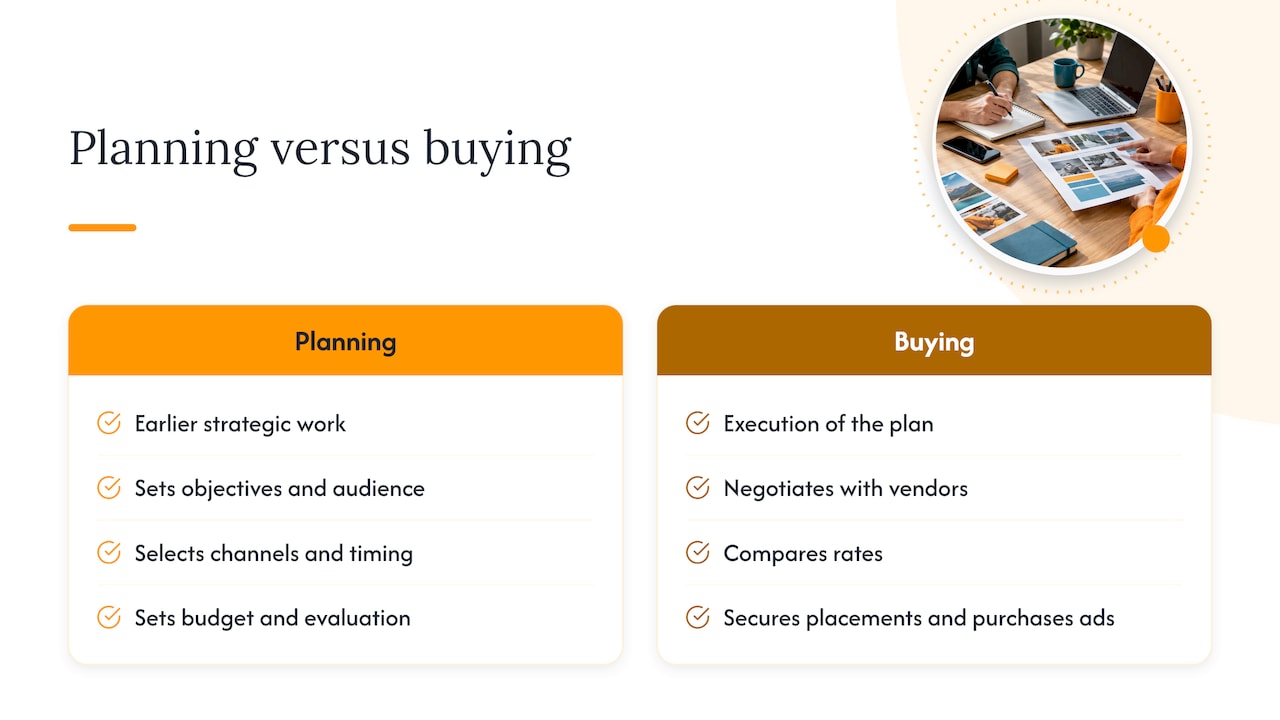
It helps to separate planning from buying. Planning is the earlier, strategic work: setting objectives, defining the audience, selecting channels, budgeting, timing and deciding how performance will be evaluated. Buying is execution. According to the Wisconsin Technical College System’s Promotions textbook, buying means negotiating with vendors, comparing rates and securing placements. Amazon Ads draws the same line: planning sets the campaign parameters, and buying evaluates paid options inside those parameters and purchases the ads.
That order matters. Teams that buy first end up justifying channels after the fact. Teams that plan first can say no to attractive but irrelevant inventory.
The five M’s: a framework behind the steps
Before the steps, a mental model. The Wisconsin Technical College System’s textbook describes the five M’s of media planning:
- Mission: the objective the campaign must achieve.
- Message: what you will communicate.
- Media: the channels that carry the message.
- Money: how the budget is allocated.
- Measurement: how success will be judged.
Every step below answers one or more of these. If a plan is weak, it is usually because one M was skipped, most often Measurement.
The media planning process, step by step
Different publishers count the steps differently. The same textbook uses six steps; Semrush uses ten. The substance is the same. We group the work into seven steps because that is how it tends to flow on real accounts.
Step 1: Review the brief and set objectives
Start with the business problem, not the channel. A media plan must connect to the overall campaign objective, as the Media Advocacy Project’s planning guide stresses. “Get more patients” or “sell more units” is the business goal. The media objective translates it into something a channel can deliver.
Semrush offers illustrative pairings:
- Awareness: impressions and impression share.
- Sales: click-through rates leading to product pages.
- Lead generation: cost per acquisition and click-through rate.
Pick one primary objective and one or two supporting metrics. A plan that chases awareness, leads and sales equally usually delivers none of them well.
Step 2: Profile the target audience
Name who you are trying to reach in terms a media vendor can target. GWI’s guide suggests audience research should cover age or generation, location, lifestyle, attitudes, income and job role, media preferences, touchpoints, purchase influencers and brand affinity.
The media habits matter as much as demographics. GWI cites platform data showing that 31% of Gen Z consumers discover brands through social-media ads, while 32% of millennials do so through traditional search engines. Treat that as an illustration of why one audience rarely shares one channel mix, not as a benchmark for your market.
A practical output of this step is a one-page audience profile: who they are, where they spend attention, what triggers a purchase, and which geography you need.
Step 3: Research the landscape
Research is where assumptions get tested. Amazon Ads recommends looking at audiences, geographies, peers, markets and previous campaigns. Shopify’s guide frames it as internal analysis (your past results, margins, capacity) and external analysis (competitors, seasonality, market trends).
Ask three questions:
- What did we run before, and what did it cost per result?
- Where are competitors visible, and where are they absent?
- What seasonal peaks or local events affect demand?
Your own historical data is the most valuable input. If you have none, treat the first flight as a structured test.
Step 4: Choose the channel and media mix
Now the channel decisions. Shopify advises evaluating channels by budget share, funnel stage, customer segment, geography and product line, and lists social, search, traditional media, influencer marketing, PR and sponsorships as options.
Two principles help:
- Match channel to funnel stage. Search captures existing demand. Video and social create it. Retargeting closes it.
- Coordinate paid with earned. The Media Advocacy Project notes that effective planning coordinates paid media with earned media, and Amazon Ads treats paid and unpaid media as complementary.
Write a one-line rationale for each channel. If you cannot explain why it is there, it comes out.
Step 5: Set the budget and the timing
Budget and schedule are decided together, because timing determines how thin or concentrated your spend is.
Budget. Allocate by channel, and hold back a reserve. Salesforce’s perspective is that media planning is adaptive: budget should include testing money and flexible funds that can shift as performance data arrives. Our own guide to PPC budget allocation explains why tracking has to be right before you decide where the dollars go.
Timing. Decide the campaign duration and how it breaks into flights, meaning periods of active advertising separated by pauses or lighter weight. The University of Wisconsin–Madison’s J345 Manual treats reach as the percentage of the market exposed and frequency as average exposure, and says their combination indicates high- and low-intensity periods. In plain terms: concentrate spend when demand peaks or when you launch, and ease off when it does not.
Step 6: Buy media and launch
This is the execution stage: negotiating, securing placements, and trafficking creative. For digital channels it means building campaigns, uploading assets, setting audiences and confirming tracking. Check minimum spends and delivery timing, and avoid paying twice to reach the same people on overlapping platforms.
If you work with an agency or in-house buyer, hand over the plan as the brief. The buyer’s job is to get the best price and placement inside your parameters, not to rewrite the strategy.
Step 7: Measure, learn and optimize
The Wisconsin Technical College System says evaluation asks whether the campaign reached the target audience, stayed within budget, met its objectives and delivered expected outcomes. Optimization then means changing what you do based on results, including real-time adjustments where digital media allows them.
A few habits make this step work:
- Design measurement before launch. Amazon Ads treats measurement as part of planning: KPIs, tracking and testing are set up in advance, and final results are judged against the KPIs you set at the start.
- Test one thing at a time. Amazon suggests A/B tests of headlines or images.
- Match the review cadence to the channel. GWI recommends reviewing performance daily, weekly or monthly as appropriate.
- Prefer metrics close to revenue. Shopify notes that digital plans should prioritize click-through rate, conversion rate and cost per acquisition when these connect more directly to sales than raw reach and frequency.
For a deeper look at structuring this, see our campaign analytics framework and our guide to marketing reporting best practices.
What a media plan contains
Sources differ on the exact list, but they overlap heavily. The J345 Manual says a media plan covers the scope and timing of paid media, campaign duration, reach and frequency goals, media outlets and the reasons for choosing them, dayparts, geographic emphasis, scheduling strategy, and how media choices relate to the audience. It also calls for a budget-allocation spreadsheet, a flowchart showing spending across the campaign year, and graphs of those allocations.
Amazon Ads groups the contents into research and analysis, objectives and KPIs, media strategy (budget, channels, messages, calls to action, specifications, deliverables and timeline), and implementation, evaluation and measurement.
A checklist you can lift:
- Business goal and media objective
- Target audience profile and geography
- Channels, with a rationale for each
- Budget by channel and by month
- Flight dates and a flowchart
- Reach and frequency expectations
- Creative and message role per channel
- KPIs, tracking method and review cadence
- Contingency budget and decision points
A media plan example
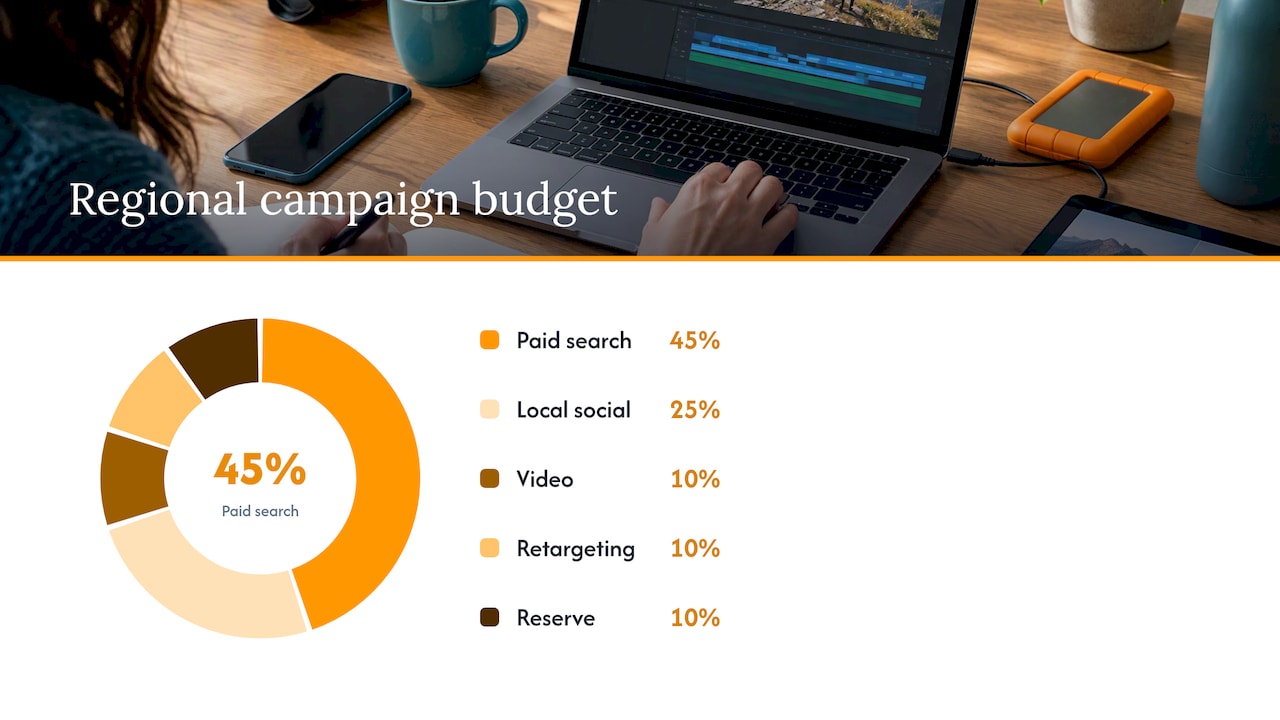
Here is an illustrative plan for a regional dental group launching a new-patient campaign. The figures are a worked example for demonstration, not a benchmark or a client result.
Objective: 120 new-patient consultation requests in 90 days at a target cost per lead set from the practice’s past results.
Audience: Adults 28 to 55 within a 15-mile radius of three locations, who search for dental care or have recently moved.
| Channel | Role | Budget share | Primary KPI |
|---|---|---|---|
| Paid search | Capture active demand | 45% | Cost per lead |
| Local social ads | Build awareness near each office | 25% | Click-through rate |
| Video | Introduce the practice and team | 10% | Completed views |
| Retargeting | Bring back site visitors | 10% | Conversion rate |
| Reserve | Shift to the best performer | 10% | Cost per lead |
Flights: A launch burst in weeks 1 to 4 at full weight, a lighter maintenance period in weeks 5 to 8, and a second push in weeks 9 to 12 using the best-performing creative.
Review: Weekly check on search and retargeting, biweekly on social and video, a decision on the reserve at day 45.
For comparison, Semrush’s published example for a B2B webinar assigns 60% of budget to LinkedIn ads, 20% to YouTube video and 20% to B2B trade-site display. The splits differ because the objective and audience differ, which is the whole point of planning.
Common mistakes in the media planning process
- Starting with channels instead of objectives. “We need TikTok” is a tactic, not a plan.
- No reserve. Without flexible funds, you cannot act on early results.
- Measuring reach when you need revenue. Impressions are fine for awareness goals and misleading for lead goals.
- Fragmented tracking. If conversions are not recorded consistently, optimization is guesswork.
- Treating the plan as finished at launch. A practical plan leaves room to change tactics when KPIs slip, as Semrush points out.
Our perspective: plans should survive contact with the data
We have spent more than 18 years building and managing campaigns for startups through household brands, across retail, healthcare, legal and entertainment. The pattern we see most often is not a lack of ideas. It is a gap between strategy and execution: a thoughtful plan gets handed to people who never saw the thinking behind it, and the budget drifts.
That is why we keep planning, creative, media and reporting under one roof. When the same team that wrote the audience profile also builds the campaigns and reads the dashboards, adjustments happen in days, not quarters. We also insist on a short list of KPIs agreed up front. Five to eight numbers that everyone trusts beat a forty-tab report nobody opens. Our approach to this is laid out in our marketing campaign management framework.
Most of all, we treat a media plan as a hypothesis. The first flight tells you which audience, message and channel combination deserves more money. A plan that cannot change is not strategy, it is a forecast.
— Derek
When to bring in a partner
Planning in-house works when you have people with time, access to the data and buying experience. It strains when the plan spans many channels, many locations or a regulated category.
If that sounds familiar, our team can build the plan and run it. We start with a marketing assessment to see where you are, write the marketing plan, then manage execution through campaign strategy and ongoing management, including pay-per-click management where paid search is the right fit. Pricing is scoped to your goals, so reach out through our site and tell us what you are trying to achieve.
FAQ
What are the five steps in the media planning process?
A common five-step version is: set objectives, define the audience, select channels, set budget and timing, then buy, launch and evaluate. The Wisconsin Technical College System lists six steps by separating scheduling and buying from evaluation. The names change by source, but the order does not.
What are the 5 M’s of media planning?
They are Mission, Message, Media, Money and Measurement. Together they connect the campaign goal to the content, channels, budget and success measures. Use them as a quick check that your plan answers all five.
How do I make a media plan from scratch?
Write the objective and KPIs first, then profile your audience and research past results and competitors. Choose channels with a reason for each, split the budget with a reserve, set flight dates, and define how you will measure and adjust. Put it all in a document with a budget spreadsheet and a flowchart.
What is the difference between media planning and media buying?
Planning is the strategy: who you reach, through which channels, when and with what budget. Buying is execution: negotiating rates, securing placements and purchasing the ads within the plan’s limits.
Sources
- Media Planning: What It Is + How to Write a Media Plan, Coursera
- 6.2 The Media Planning Process, Wisconsin Technical College System
- 6.1 Media Planning Strategies, Wisconsin Technical College System
- What is Media Planning and Why is It Important?, Amazon Ads
- Media Planning, Media Advocacy Project
- Media plan, J345 Manual, University of Wisconsin–Madison
- Media Planning Guide, Shopify
- Media Planning: The Ultimate Guide For Marketers, GWI
- How To Create a Media Plan in 10 Steps, Semrush
- Complete Guide to Media Planning, Salesforce