
A marketing optimization roadmap turns scattered campaign tweaks into a continuous, measurable process that ties every test directly to revenue. The single next step is simple: build a prioritized hypothesis backlog and capture baseline metrics for your top KPI before you touch a single campaign. What follows is a compact executive snapshot, a 30/90/180 action plan, and the governance structure that keeps it running.
TL;DR:
- Building a hypothesis backlog and establishing baseline KPIs within the first 30 days is essential before starting any campaign tests.
- Prioritize tests based on Impact, Confidence, and Ease scores, focusing initially on conversion lifts and incrementality measurements.
- Allocate 60% of the budget to proven channels, 30% to emerging opportunities, and 10% to new experiments, rerunning this mix quarterly.
- Ensure a reliable data foundation with first-party capture, a unified customer view, and clear governance to support accurate testing.
- Maintain a continuous review rhythm with weekly test audits and quarterly re-evaluations to turn test insights into scaled revenue growth.
Table of Contents
- Executive Summary: The Roadmap at a Glance
- Strategic Objectives and Metrics: Pick 3 to 5 Objectives
- Prioritized Initiatives: How to Choose What to Test First
- Testing, Measurement, and Incrementality: The System Your Roadmap Needs
- Budget Allocation and Cadence: Spend by Cost-Per-Pipeline
- Martech and Data Foundation: Fix This Before You Optimize
- Operating Model: Governance, Roles, and Cadence to Ship Winners
- Perspective: Turning the Roadmap into Results
- Change Management and Stakeholder Engagement Strategies
- Integration of Customer Insights and Segmentation into Optimization Efforts
- Risk Assessment and Mitigation Planning for Optimization Initiatives
- Continuous Improvement Frameworks and Feedback Loops
- Editorial Take: Stop Treating the Roadmap as a Document
- Putting the Roadmap to Work with The Artist Evolution
- FAQ
- Sources
Executive Summary: The Roadmap at a Glance
Companies that excel at digital marketing optimization generate roughly 40% more revenue than average performers, and the gap comes from treating optimization as a continuous system rather than a one-time project. The goal here is marketing ROI (MROI) improvement, measured against a primary KPI such as cost per pipeline dollar or revenue per channel.
The roadmap breaks into three windows, each with one owner and one measurable checkpoint:
- 30 days: Build the hypothesis backlog and baseline KPIs; owner is the marketing lead; check is a documented baseline for the top three metrics.
- 90 days: Launch the first wave of A/B and incrementality tests; owner is the test owner; check is statistically meaningful lift on at least one hypothesis.
- 180 days: Reallocate budget based on test results and ship winners into always-on campaigns; owner is the channel manager; check is a quarter-over-quarter MROI improvement.
Strategic Objectives and Metrics: Pick 3 to 5 Objectives
Before any testing begins, translate business priorities into marketing objectives that have both a leading indicator and a lagging revenue metric attached. Vague goals like “improve marketing” produce vague results; specific objectives produce a testable roadmap.
A workable set usually looks like this:
- Increase revenue from paid search: leading indicator is click-through rate on new ad variants, lagging metric is revenue per dollar spent.
- Improve pipeline quality from content: leading indicator is marketing-qualified lead to opportunity conversion rate, lagging metric is closed-won revenue by source.
- Reduce customer acquisition cost: leading indicator is cost per lead by channel, lagging metric is blended CAC over a trailing 90-day window.
- Improve retention and repeat purchase rate: leading indicator is email engagement rate, lagging metric is repeat purchase revenue.
Baselines matter more than targets at the start. Set a lookback window (commonly the trailing 90 days) for each KPI, then define success as a practically meaningful shift, not just a statistically significant one, since a tiny but “significant” lift rarely changes the budget conversation.
Prioritized Initiatives: How to Choose What to Test First
Not every idea deserves equal test traffic. The ICE framework, scoring each initiative on Impact, Confidence, and Ease on a simple 1 to 10 scale, gives teams a shared language for sequencing work instead of arguing from opinion. A high-impact, high-confidence, low-effort test should always jump the queue over a low-confidence idea that sounds exciting.
- Conversion lift initiatives: landing page variants, checkout friction fixes, and form-length tests.
- Awareness initiatives: new creative concepts, channel expansion tests, and audience segment pilots.
- Retention initiatives: lifecycle email sequences, loyalty triggers, and win-back campaigns.
- Creative initiatives: message testing, format testing (video versus static), and offer framing.
- Martech fixes: tracking gaps, tagging errors, and attribution cleanup that distort every test above it.
A living hypothesis backlog, documented with the expected outcome, the test design, and the owner, keeps this from becoming tribal knowledge. The MIT CISR analysis on test-and-learn principles recommends prioritizing by expected revenue impact rather than ease alone, then funding promising tests in stages rather than all at once.
Pro Tip: Score every backlog item with ICE before a meeting, not during one. Debating scores live turns prioritization into a popularity contest.
Testing, Measurement, and Incrementality: The System Your Roadmap Needs
Attribution and incrementality answer different questions, and conflating them wastes test budget. Multi-touch attribution estimates which touchpoints a converting customer interacted with; incrementality testing, using geo holdouts or audience splits, measures whether the campaign caused the conversion at all. Use attribution for day-to-day channel mix decisions and incrementality for high-stakes budget calls, since a channel can look great in attribution while contributing almost nothing incrementally.
- A/B tests for creative, offer, and landing page decisions with fast feedback loops.
- Holdout and geo tests for channel-level incrementality, especially brand and upper-funnel spend.
- Funnel experiments for sequencing and friction points between awareness and conversion.
A practical rule of thumb from HubSpot’s optimization guidance is to avoid calling a test until you have roughly 100 conversions per variant as a lower bound, since smaller samples produce noisy, reversible “wins.” Fragmented first-party data is the most common saboteur of good test design: when tracking gaps hide true conversion counts, even a well-designed test produces an unreliable verdict. Our guide to incrementality testing walks through holdout design in more detail, and reviewing attribution model options for 2026 is a useful companion step before locking in a measurement stack.
Budget Allocation and Cadence: Spend by Cost-Per-Pipeline
Allocate budget by cost-per-pipeline-dollar rather than by channel habit. Rank channels by how efficiently they produce pipeline, set a minimum presence floor for brand-critical channels even when short-term efficiency dips, and reserve a slice of the total budget purely for experimentation.
- Core spend (roughly 60%): proven channels and tactics with established cost-per-pipeline performance.
- Growth spend (roughly 30%): emerging channels or audience segments showing early promise.
- Test spend (roughly 10%): dedicated experimentation budget that funds the hypothesis backlog regardless of short-term pressure to cut it.
Rerun this allocation model every quarter. When a test shows a channel’s incremental contribution is lower than its attributed credit suggests, that is the signal to shift the growth-spend bucket, not to wait for the annual planning cycle.
Martech and Data Foundation: Fix This Before You Optimize
Experiments are only as trustworthy as the data feeding them. McKinsey’s analysis of martech recommends elevating martech decisions to leadership and measuring total cost of ownership against revenue outcomes rather than counting clicks or licenses.
A minimum viable stack for reliable testing includes:
- First-party data capture across owned properties, since third-party signal loss makes this the backbone of any test.
- A customer data platform or customer graph that unifies identity across channels so attribution and incrementality reports agree with each other.
- A unified attribution pipeline feeding one dashboard, not three conflicting spreadsheets.
- Documented data governance, including who owns each data source and a change-control process so a tracking update does not quietly invalidate a running test.
As AI-driven discovery grows, dashboards increasingly need a “share of AI citations” metric alongside traditional visibility measures, since being recommended inside an AI answer is becoming its own channel. Our overview of AI in digital marketing covers how to structure content for that kind of visibility.
Operating Model: Governance, Roles, and Cadence to Ship Winners
A roadmap without clear ownership stalls at the first disagreement. Four roles keep it moving: a test owner who designs and runs each experiment, a data owner who guarantees tracking integrity, a product or ops owner who implements winning variants, and a finance or stakeholder lead who signs off on reallocated budget.
- Weekly: review active tests for early stopping risk or technical issues.
- Monthly: deep-dive one channel’s full-funnel performance against its cost-per-pipeline target.
- Quarterly: reallocate budget and formally graduate winning tests into always-on production.
A promotion rule should require a documented hypothesis, sample size, and result before any test earns a permanent budget line. Our campaign management framework outlines how this handoff works operationally once a test graduates.
Perspective: Turning the Roadmap into Results
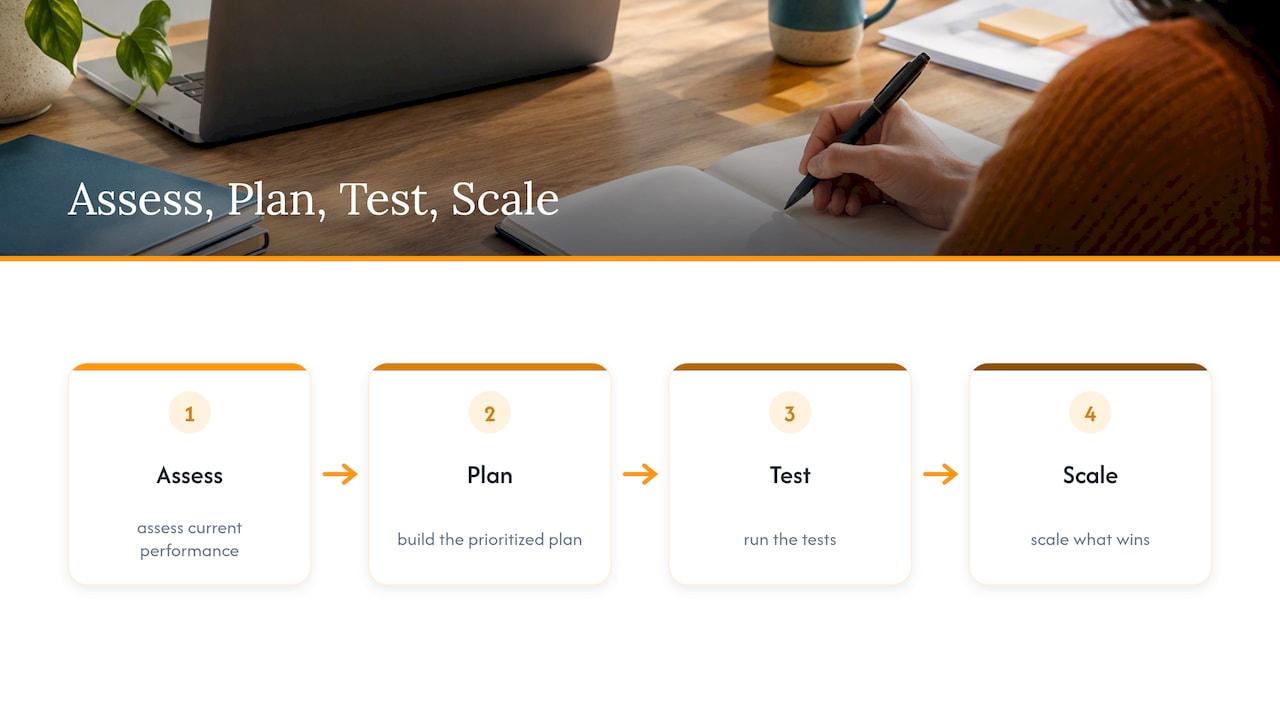
Executing this roadmap over 18 years across industries from retail to healthcare to legal services has reinforced one pattern: the plans that work follow a simple sequence of assessment, planning, testing, and scaling, with a multidisciplinary team handling strategy and execution together rather than handing off between departments. The checklist is consistent: assess current performance, build the prioritized plan, run the tests, then scale what wins.
Change Management and Stakeholder Engagement Strategies
A test-and-learn roadmap fails more often from organizational resistance than from bad math. Stakeholders who are used to annual planning cycles often distrust a model that reallocates budget quarterly, and sales teams can be skeptical of marketing attribution claims they cannot verify themselves.
Address this early by involving finance and sales leadership in setting the KPIs, not just reviewing results after the fact. When a stakeholder helps define what “success” means for a channel before the test runs, they are far less likely to reject the outcome because it contradicts a personal assumption about that channel’s value.
Communicate in the stakeholder’s language. A CFO cares about cost-per-pipeline-dollar and budget efficiency; a sales VP cares about lead quality and close rate; a CEO cares about revenue and growth rate. The same test result, framed three different ways, earns three different kinds of buy-in.
Build a regular reporting rhythm that shows both wins and losses. A roadmap that only reports successes loses credibility the first time a major bet fails publicly. Framing a failed test as a cheap way to avoid a costly mistake, rather than as a failure to hide, keeps stakeholders engaged through the inevitable rough quarters.
Finally, assign a single person to own cross-team communication about the roadmap’s status. Without that owner, updates fragment across email threads and Slack channels, and by the time a quarterly review happens, half the room has a different understanding of what was tested and why.
Integration of Customer Insights and Segmentation into Optimization Efforts
Every hypothesis in the backlog should trace back to a specific customer segment, not a generic “all users” assumption. Segmentation turns a vague test idea like “improve email open rates” into a sharper one: “increase open rates among lapsed customers who purchased once in the last 180 days.”
Start by layering behavioral, demographic, and lifecycle data to build segments that are large enough to test against but specific enough to act on. A segment of ten thousand active subscribers supports a meaningful A/B test; a segment of two hundred rarely does, so segment granularity has to respect the sample-size guidance from the measurement section above.
Customer insights also help explain why a test won or lost, which matters as much as the result itself. If a checkout redesign lifts conversion among mobile users but drags it down among desktop users, scaling the “winner” blindly would undo the gain. Segmented reporting catches that split before it becomes a rollout mistake.
Feed these insights back into the hypothesis backlog directly. A segment that shows unexpectedly high retention after a specific onboarding email becomes the seed for the next quarter’s testing priority, which is how segmentation turns from a reporting exercise into an engine for new ideas rather than a static slide in a quarterly deck.
Risk Assessment and Mitigation Planning for Optimization Initiatives
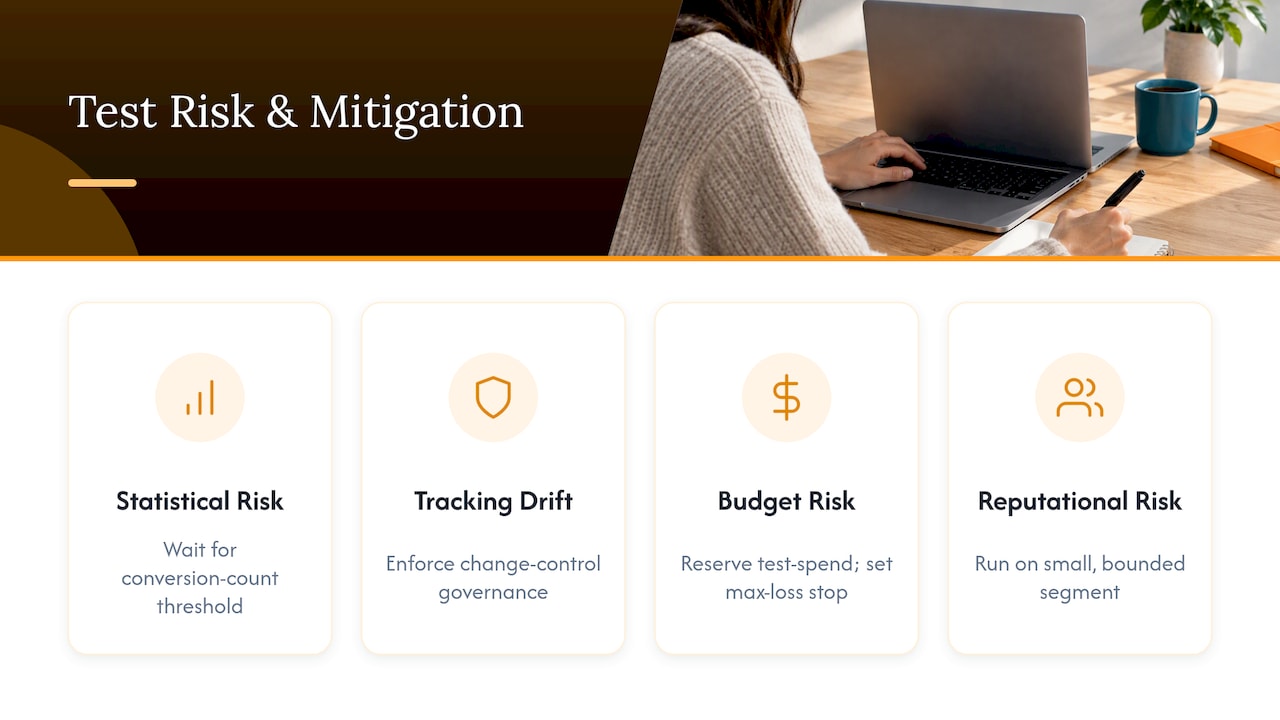
Every test carries some risk, whether that is wasted spend, a damaged customer experience, or a misread signal that sends budget in the wrong direction. Naming these risks before launch is cheaper than discovering them mid-test.
The most common risk is a false positive from an underpowered test, which the sample-size guidance in the measurement section directly addresses: hold off on declaring a winner until the conversion count clears a meaningful threshold. A second common risk is tracking drift, where a tagging change mid-test silently corrupts the data; the change-control governance described in the martech section exists specifically to catch this before it wastes a full test cycle.
Budget risk deserves its own line item. Reserving the dedicated test-spend bucket described earlier means a failed experiment never threatens the core channels carrying most of current revenue. Set a maximum loss threshold per test, a hard stop that ends the experiment early if performance drops well below baseline, rather than waiting for the full planned duration to play out.
Reputational risk matters most for customer-facing tests, like pricing experiments or aggressive retargeting frequency. Running these on a small, clearly bounded segment first limits exposure before any wider rollout.
Document every risk and its mitigation alongside the hypothesis in the backlog. A test owner who has already answered “what’s the worst case and how do we stop it” moves faster during the actual test window, because the response plan is already written.
Continuous Improvement Frameworks and Feedback Loops
A roadmap is not a document you finish; it is a loop you run. The quarterly reallocation cadence described earlier is the macro loop, but a tighter feedback loop operates inside every individual test: hypothesis, result, documentation, and reuse.
Every completed test, win or loss, gets logged with its hypothesis, design, sample size, and outcome in a shared backlog rather than a private slide deck. This turns institutional memory into a searchable resource instead of something that leaves the company when a team member does. The MIT CISR test-and-learn principles point to deep cross-functional engagement as one of the three conditions that make this kind of staged, iterative funding work, since a feedback loop that only lives inside the marketing team misses the finance and product context that makes a result actionable.
Operationally, failed scaling is a more common reason tests fail to produce business impact than weak original insights, according to HubSpot’s optimization research. A continuous improvement framework has to include a clear “ship it” step, not just a “we learned something” step, or winning tests pile up undeployed while the team moves on to the next experiment.
Close the loop by revisiting old assumptions on a schedule, not just when something breaks. A channel that earned its budget floor eighteen months ago may not deserve it today, and the only way to know is to retest the assumption rather than let it calcify into a permanent line item.
Editorial Take: Stop Treating the Roadmap as a Document
The biggest mistake in marketing optimization is treating the roadmap as a deliverable instead of an operating rhythm. Plenty of teams produce a polished 90-page strategy document, present it once, and then run campaigns exactly as before, because nobody built the weekly and monthly review cadence that makes a roadmap actually change behavior.
The conventional advice oversells frameworks and undersells discipline. ICE scoring, test-and-learn principles, and incrementality testing are all useful, but none of them matter if the test-review meeting gets skipped three weeks running because “the quarter got busy.” The frameworks are not the hard part; showing up to the cadence is.
If you take one thing from this roadmap, prioritize the weekly active-test review over the quarterly strategy deck. A quarter without a living backlog and a consistent review rhythm produces guesses dressed up as strategy, no matter how good the original plan looked on paper.
— Derek
Putting the Roadmap to Work with The Artist Evolution
We built our approach around the same assessment-to-scale sequence this roadmap describes, emphasizing that a plan only pays off once someone is accountable for running it. Our Strategy & Management team maps each roadmap phase, assessment, prioritized planning, test execution, and scaling winners, to a concrete service: a Marketing Assessment to baseline where you stand, and a Marketing Plan to turn that baseline into a prioritized backlog your team can execute.

If you want a second set of eyes on your current KPIs and backlog, reach out through our Strategy & Management page and we will walk through where your roadmap stands today.
FAQ
What is a marketing optimization roadmap?
A marketing optimization roadmap is a structured, time-bound plan that links marketing hypotheses, tests, and measurement to specific revenue outcomes. It typically spans short, medium, and longer windows, such as 30, 90, and 180 days, with an owner and a measurable checkpoint at each stage.
How often should I update my marketing budget allocation?
A quarterly cadence works for most teams, since it gives tests enough time to reach a meaningful sample size before reallocating spend.
What’s the difference between attribution and incrementality testing?
Attribution estimates which touchpoints contributed to a conversion, while incrementality testing, using holdouts or geo splits, measures whether the campaign actually caused that conversion. Use attribution for routine channel mix decisions and incrementality for larger budget calls where the stakes justify a dedicated test.
How do I prioritize which marketing tests to run first?
The ICE framework, scoring each initiative on Impact, Confidence, and Ease, gives teams a repeatable way to rank a hypothesis backlog instead of debating by opinion. Initiatives with high expected impact and reasonable confidence should move ahead of easier tests with uncertain payoff.
What data foundation do I need before running reliable marketing tests?
At minimum, you need first-party data capture, a unified customer view such as a CDP, and one attribution pipeline that feeds a single dashboard. Clear data governance, including ownership and change control, prevents tracking changes from quietly invalidating a test already in progress.
Sources
- Digital Marketing Optimization: 10 Best Strategies to Increase Marketing ROI
- Test and learn principles for innovation (MIT CISR)
- Rewiring martech from cost center to growth engine