
Strong marketing agency onboarding gets a new client to a measurable first win inside two weeks, and the single habit that makes it possible is a single intake link with a firm deadline, followed by a structured kickoff meeting. Top-performing service firms complete the entire process in 5 days or fewer, while slower agencies stretch it to three weeks and lose far more clients in the first 90 days. Speed here is not about rushing; it is about sequencing.
TL;DR:
- Agencies that complete onboarding in five days or less achieve faster first wins and reduce early client churn compared to those taking more than three weeks.
- Each onboarding stage must have a clear owner and deadline; skipping any stage often leads to scope confusion or stalled projects.
- Locking in the scope via a signed statement of work, a paid deposit, and an internal team briefing is essential before any creative work or ad spend begins.
- Using a single intake link with an automated reminder system and setting a 72-hour deadline significantly shortens the intake phase and prevents delays.
- Consistent use of templates and automation workflows across CRM, project management, and client portals ensures faster onboarding and a better client experience.
Table of Contents
- What Does the Marketing Agency Onboarding Checklist Look Like?
- What Has to Happen Before Work Begins?
- What Should the Client Intake Questionnaire Ask?
- What Belongs on a 60-Minute Kickoff Agenda?
- Which Tools and Templates Keep Onboarding Consistent?
- How Fast Should Onboarding Actually Take?
- What Mistakes Cause Onboarding to Stall?
- How Theartistevolution Runs Client Onboarding
- When Should You Simplify Onboarding?
- Ready to Put a Real Onboarding System in Place?
- Sources
- FAQ
What Does the Marketing Agency Onboarding Checklist Look Like?
The fastest agencies run onboarding in five stages, each with a named owner and a deadline attached. This structure comes from a widely adopted five-stage onboarding system: Confirm, Collect, Kickoff, Set Up, First Win. Skip a stage and you’ll pay for it later in scope confusion or a stalled launch.
- Confirm (Day 0-1). Account lead sends a signed-contract confirmation and a welcome email with next steps. Sample line: “Welcome aboard. Here’s your onboarding link, due by [date].”
- Collect (Day 1-4). Client fills out the intake questionnaire and uploads brand assets through one shared link. Project manager owns follow-up reminders.
- Kickoff (Day 3-5). Account lead and strategist run the kickoff call, lock KPIs, and confirm the approval workflow.
- Set Up (Day 4-6). Operations creates the project workspace, grants portal access, and assigns internal team roles.
- First Win (Day 7-14). Strategist delivers an early asset (a discovery summary, a media plan draft, or a quick-win recommendation) to prove momentum.
Each stage needs a clear owner, not just a task list. When a task has no name attached, it drifts, and drift is what turns a five-day onboarding into a three-week onboarding.
What Has to Happen Before Work Begins?
No creative work, no ad spend, and no strategy calls happen before three things are locked: a countersigned statement of work, a deposit or first invoice paid, and an internal team briefing. Skipping any of these is one of the most common reasons projects stall before they start.
- Signed and countersigned SOW on file, with scope and deliverables spelled out in plain language.
- Deposit or first invoice sent same day as signature, not “sometime this week.”
- NDA executed if the client works in healthcare, legal, or another regulated sector.
- Internal project created in your project management tool with the account lead, strategist, and any specialists tagged.
- Access list drafted: who on your team needs what login, and by when.
Adding specific contract clauses around intellectual property and scope at this stage prevents disputes months later, when memories of what was agreed get fuzzy.
Pro Tip: Send the invoice and the SOW for signature in the same email thread. Clients who have to hunt for a second link often delay both by days.
What Should the Client Intake Questionnaire Ask?
The intake questionnaire is where most onboarding delays actually happen, not the kickoff call. Ask for too little and you’ll be chasing answers for weeks. Ask for the wrong things and clients abandon the form halfway through.
Prioritize these fields first:
- Primary KPIs and what “success” looks like in the client’s own words.
- Target audience definitions, including any segments to avoid.
- Approval hierarchy: who signs off on creative, and how fast they typically respond.
- Legal, brand, or compliance constraints that affect messaging or design.
- Competitors the client watches and any past campaigns that failed.
Before creative work starts, collect logos, brand guidelines, analytics access, and ad account permissions. This matters more than it sounds. Top agencies collect brand assets before work begins at far higher rates than average, and that single habit correlates directly with fewer revision rounds, according to onboarding benchmark data.
Send everything through one intake link, not five separate emails, and attach a firm deadline. A single intake link with automated reminders is one of the highest-leverage changes an agency can make to shorten this stage.
Pro Tip: Set the intake deadline to 72 hours, not “at your convenience.” Vague deadlines produce vague timelines.
What Belongs on a 60-Minute Kickoff Agenda?
The kickoff meeting is where scope confusion either gets resolved or gets baked into the project permanently. A tight, timed agenda keeps it from turning into a two-hour ramble.
- Introductions and context (5 minutes). Names, roles, and why each person is on the call.
- Goals and KPIs (15 minutes). Confirm what success looks like and how you’ll measure it.
- Scope and deliverables walkthrough (15 minutes). Review the SOW line by line so there’s no ambiguity later.
- Approval workflow (10 minutes). Decide who approves what, and how fast turnaround needs to be.
- Timeline and first deliverable (10 minutes). Confirm the date of the first win.
- Open questions and next steps (5 minutes). Assign owners to every open item.
Lock three decisions before the call ends: final KPIs, the approval chain, and which deliverable ships first. Send a written recap within 24 hours listing every decision, every owner, and every deadline. That recap is your record if scope questions come up in month three.
Which Tools and Templates Keep Onboarding Consistent?
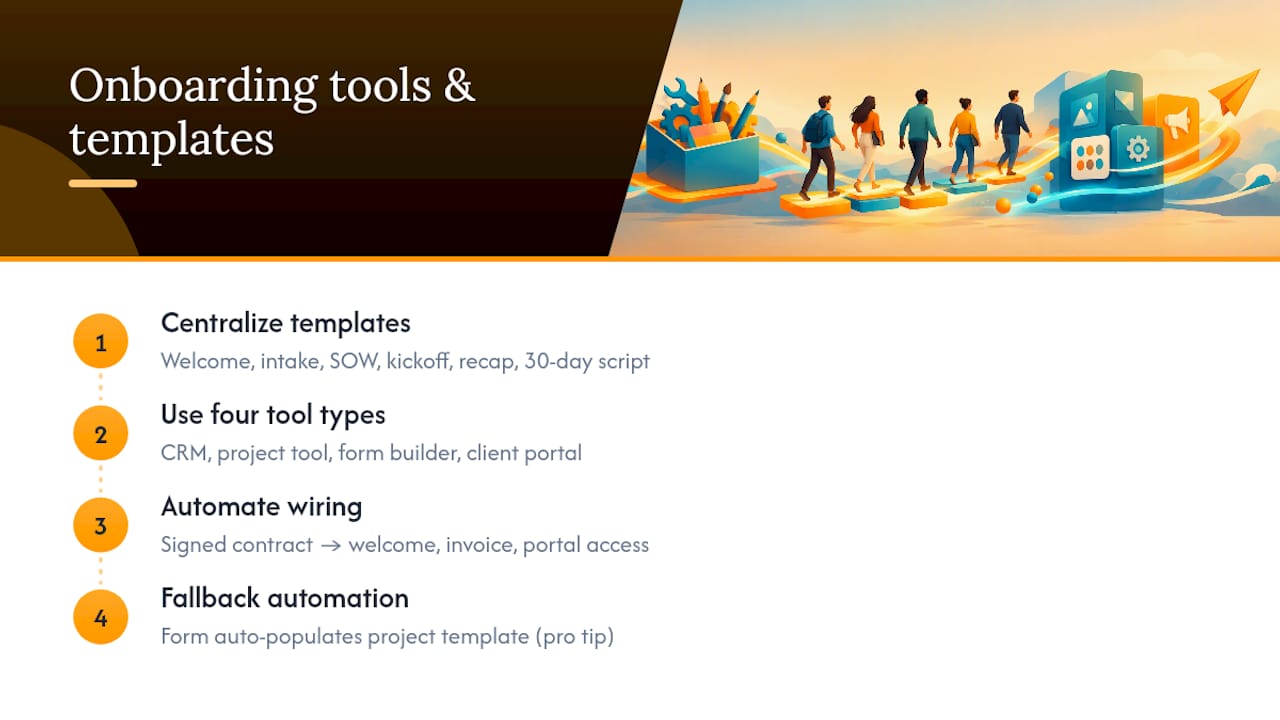
Consistency comes from templates, not memory. Every agency running onboarding well keeps a standard kit: a welcome email, an intake form, an SOW template, a kickoff agenda, a written recap format, and a 30-day review script. Store all six in one shared folder your whole team can access, not scattered across individual inboxes.
On the tooling side, you need four categories working together, regardless of which specific products you use: a CRM to hand off signed deals, a project management tool to track tasks and owners, a form builder for intake, and a client portal for shared files and status updates. Automation guidance from Wrike shows that templatized intake forms feeding directly into project folders cut manual follow-up substantially.
The real leverage sits in the wiring between these tools. A signed contract should automatically trigger three things: a welcome email with the intake link, a first invoice, and portal access provisioning. Set this up once, using automation workflows as your template source, and every future client gets the same clean experience without anyone remembering to send a manual email.
Pro Tip: If your CRM and project tool can’t talk to each other directly, a simple form that auto-populates a project template gets you 80% of the benefit with none of the integration headache.
How Fast Should Onboarding Actually Take?
Time-to-first-value is the metric that predicts retention more than almost anything else. Onboarded clients who reach a real deliverable fast show measurably better outcomes than those left waiting.
Effective onboarding lifts retention by roughly 16 percentage points and can cut time-to-value by about half, with average onboarding across professional services still running 2 to 4 weeks industry-wide. That gap between “average” and “top performer” is almost entirely a process problem, not a staffing problem.
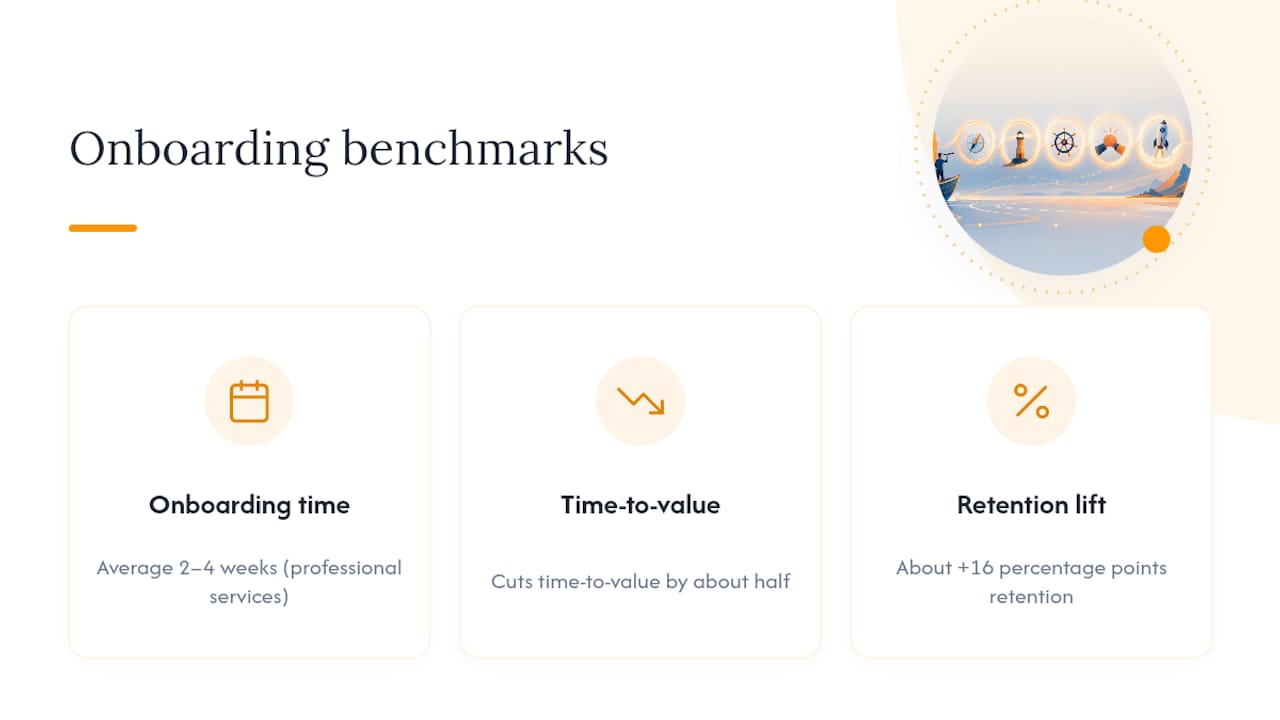
Track completion days, percentage of assets collected before kickoff, and days-to-first-deliverable as your core onboarding health KPIs. If any of these three start slipping, that’s your early warning sign.
What Mistakes Cause Onboarding to Stall?
Most onboarding failures trace back to the same handful of causes, and each has a direct fix.
- Starting work before the contract is signed. Fix: build a hard gate in your project tool that blocks task creation until the SOW is countersigned.
- No named owner for a stage. Fix: assign a single accountable person to each of the five stages, not a team.
- No early deliverable. Fix: commit to shipping something tangible by day 14, even if it’s a discovery summary rather than a finished campaign.
- Scattered intake across emails and calls. Fix: force everything through one link with a deadline.
Common failure patterns like these correlate directly with higher early churn. If onboarding stalls past its deadline, escalate to the account lead within 48 hours rather than letting it drift another week.
Pro Tip: Assign one person as the “onboarding owner” across all five stages, even if different specialists execute each task. Someone has to be able to answer “where are we?” without checking four tools.
How Theartistevolution Runs Client Onboarding
Theartistevolution’s own client onboarding maps directly to the five-stage checklist above, built over many years of running campaigns for a range of clients across industries. Contracts route straight into a CRM implementation roadmap with defined RACI ownership, so nobody wonders who owns intake follow-up. Kickoff decisions get documented against KPI frameworks pulled from our marketing reporting practices, which keeps the 30-day review grounded in numbers instead of impressions.
Three things worth copying directly: lock KPIs in the kickoff call itself, not after; require brand assets before any creative brief goes out; and ship a first deliverable inside two weeks, even a small one.
When Should You Simplify Onboarding?
Not every client needs the full five-stage treatment, and pretending otherwise wastes everyone’s time. A repeat client adding a small project, or a micro-engagement under a few thousand dollars, can skip the formal kickoff and run on a shortened intake and a confirmation email. Save the complete process for new retainers, enterprise accounts, and anything where multiple stakeholders need alignment before work starts. The mistake I see most often isn’t under-onboarding. It’s applying enterprise-grade process to a project that needed a phone call and a signed one-pager.
— Derek
Ready to Put a Real Onboarding System in Place?
Theartistevolution has developed a detailed onboarding process used with clients. Where a DIY template stack requires your team to stitch together forms, a CRM, and a portal by hand, our Strategy & Management team sets up the full intake-to-kickoff pipeline as part of engagement, backed by 18 years of running comprehensive campaigns for brands across healthcare, retail, legal, and consulting.

If your current onboarding is inconsistent from client to client, or your first deliverable takes a month instead of two weeks, that’s a process gap worth fixing before it costs you another account. Our Brand Development team can also step in specifically to handle the asset collection and brand guide work that stalls so many kickoffs. Reach out to scope a 30-day onboarding plan built around your account structure, and get your next client to their first measurable win on a real timeline instead of a hopeful one.
Sources
- Client Onboarding Benchmarks 2026: Top vs. Bottom Performers (Data Report) | OnboardMap
- The Client Onboarding Process: A 5-Stage System | Agiled
- Client onboarding tips for marketing agencies | Wrike
FAQ
What Are the 5 C’s of Effective Onboarding?
Definitions vary across industries, but for marketing agencies the practical version tracks the five-stage system: Confirm, Collect, Kickoff, Set up, and (first) Win. Each stage needs a named owner and a deadline, which is what separates a 5-day onboarding from a 3-week one.
What Are the Steps to Starting a Marketing Agency Onboarding Process?
Start with a countersigned SOW and paid deposit, then send a single intake link with a firm deadline, run a 60-minute kickoff to lock KPIs and approval workflow, provision project access, and ship a first deliverable within two weeks. This sequence mirrors what top-performing firms already do.
How Long Should Agency Client Onboarding Take?
Top performers complete onboarding in 5 days or fewer, while the broader professional services industry averages 2 to 4 weeks according to Agiled’s data. The gap is almost entirely due to process discipline, not team size.
Does Completing Onboarding Mean a Client Is Locked In?
Onboarding confirms the working relationship has started, but it isn’t a guarantee of long-term retention. Agencies that deliver an early win and hit onboarding benchmarks see meaningfully better first-year retention than those who let the process drag.
What Does Theartistevolution Offer for Onboarding Support?
Theartistevolution’s Strategy & Management service covers full onboarding setup, from CRM handoff through kickoff and first deliverable. Pricing is available on request through the site.