
A strong LinkedIn content strategy is the difference between posting into the void and building a pipeline. It’s a documented plan that defines your audience, content pillars, posting cadence, and measurable outcomes. Without one, the algorithm has no idea who to show your content to, and neither does your audience.
LinkedIn’s 2026 algorithm rewards topical consistency and dwell time over vanity metrics. Document and carousel posts now earn the highest engagement of any format, while inconsistent posting trains the algorithm to distrust your signal. The stakes for having a real plan have never been higher.
The core elements of an effective LinkedIn marketing strategy include:
- Audience definition: Specific job titles, company sizes, and problems, not “everyone on LinkedIn”
- Content pillars: 3–5 recurring themes that establish your topical authority
- Format mix: Text posts, carousels, video, and polls rotated deliberately each week
- Posting cadence: 3–5 posts per week, published consistently on the same days
- Engagement tactics: Commenting, responding, and building relationships beyond your own posts
- Measurement: Outcome metrics like inbound DMs and meetings booked, not just likes
How to build your LinkedIn content strategy step by step
1. Define your audience with real specificity
Vague audience definitions produce vague content. Instead of “marketing professionals,” go narrower: “B2B SaaS founders under $5M ARR who are scaling without a full marketing team.” The more specific your audience, the sharper your message, and the higher your conversion from reader to conversation.

Map out the problems that keep your audience up at night, the language they use (not your internal jargon), and where they are in the buying process. That context shapes every content decision that follows.
2. Build 3–5 focused content pillars
Content pillars are the recurring themes you own on LinkedIn. Pick 3–5 topics that sit at the intersection of your expertise and your audience’s biggest problems. Bad pillars are broad (“leadership,” “marketing”). Good pillars are specific (“post-launch SaaS retention,” “hiring your first five salespeople”).
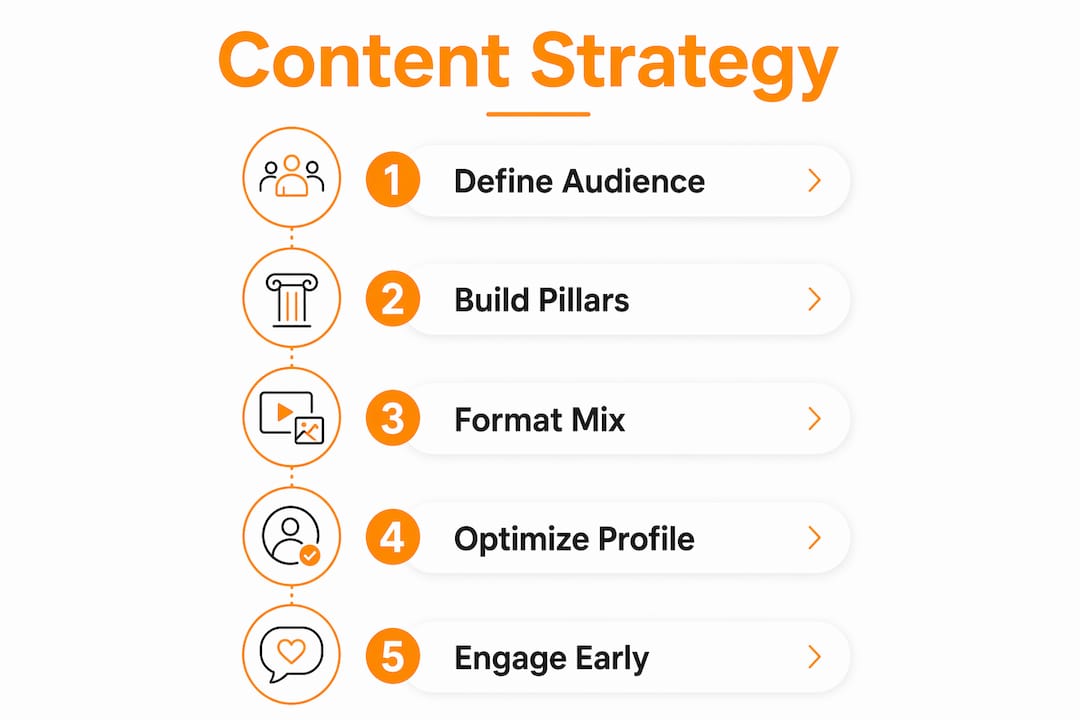
The 70-20-10 content framework gives you a practical distribution: 70% educational and helpful, 20% thought leadership and opinion, and 10% promotional. That ratio keeps your feed valuable without turning every post into a pitch.
3. Choose your format mix and posting rhythm
The 2026 algorithm rewards format variety. A proven weekly rotation looks like this:
| Day | Format | Purpose |
|---|---|---|
| Tuesday | Text post (educational) | Framework, how-to, or data insight |
| Wednesday | Carousel/document | Visual breakdown, tutorial, or checklist |
| Thursday | Story or opinion post | Personal lesson or contrarian take |
| Friday | Poll or engagement post | Audience research, conversation starter |

Post Tuesday through Thursday between 7:00 AM and 10:00 AM in your audience’s time zone. Consistency in timing matters more than finding the perfect slot because the algorithm learns your publishing pattern and anticipates your content.
4. Optimize your LinkedIn profile for content visibility
Your profile is the landing page for every post you publish. A complete, keyword-rich headline and summary tell the algorithm what topics you cover. Complete company pages get 30% more weekly views, and the same principle applies to personal profiles.
Use your headline to state exactly who you help and how. Your featured section should showcase your best-performing content or a lead magnet. Every element of your profile reinforces your topical authority before a visitor reads a single post.
5. Prioritize personal profiles over company pages
Company content appears in roughly 2% of feeds compared to 31% for top personal creators. The algorithm, and the people behind it, trust humans over brands. For B2B LinkedIn strategy, your highest-leverage move is activating leaders and employees who are already active on the platform, not pushing everything through the company page.
Identify employees posting original content with growing networks and relevant audiences. Give them topic focus and prompt them when the brand publishes something worth amplifying. Employee advocacy works best when employees write in their own voice with real proof points, not copy-pasted corporate messaging.
6. Apply LinkedIn content SEO and hashtag best practices
LinkedIn functions as a search engine for professional content. Use specific, relevant hashtags (3–5 per post) that your audience actually follows. Avoid overly broad tags like #marketing in favor of niche ones like #B2BContentStrategy or #SaaSGrowth.
External links in the post body reduce reach significantly. The standard workaround is placing the link in the first comment instead, which preserves most of your distribution while still letting readers click through.
7. Engage actively in the first 90 minutes after posting
The first 90 minutes after publishing are critical. Meaningful comments from people in your industry during that window signal the algorithm to amplify your post. Surface-level likes matter far less than substantive replies that spark conversation.
Commenting thoughtfully on other people’s posts, especially those from your target audience, builds trust and visibility faster than posting alone. Spend 15–20 minutes daily engaging on posts from your ideal prospects. That activity compounds over weeks into real relationship equity.
8. Separate idea capture from content creation
Burnout on LinkedIn almost always comes from staring at a blank page on a Tuesday morning with nothing queued. The fix is separating the “what to say” phase from the “how to write it” phase entirely. Keep a running notes document and capture every customer question, insight, or observation the moment it occurs to you.
Once a week, pull 3–5 ideas from that list and batch-write your posts in a single 60–90 minute session. Schedule them in advance. That system removes the daily decision fatigue that kills most LinkedIn content plans before they compound.
Pro Tip: Build a topic bank of 50+ post ideas drawn from questions you get asked repeatedly, mistakes you’ve made recently, and contrarian takes on your field’s conventional wisdom. You’ll never face a blank page again.
9. Measure outcomes, not just impressions
Vanity metrics tell you whether your content is reaching people. Outcome metrics tell you whether it’s working. Track these weekly:
- Inbound DMs from relevant people
- Connection requests from your target audience
- Meetings or calls booked directly from LinkedIn
- Mentions of your posts in conversations or other content
If engagement is growing but outcomes aren’t, your positioning is off. You’re reaching people, but not the right ones, or your content isn’t making your services visible. Adjust your pillars before you adjust your frequency.
10. Commit to at least 12 weeks before evaluating results
Most people quit before 12 weeks, which is exactly when compounding results begin. The first four weeks train the algorithm and your audience. Weeks 5–8 stabilize post performance. Weeks 9–12 are when inbound DMs, connection requests, and real opportunities start appearing.
A LinkedIn content plan is not an ad channel where you pay today and see leads tomorrow. It’s a platform where authority builds through consistent, specific value delivery. The professionals who see results are almost always the ones who stayed past week eight.
For a deeper look at how LinkedIn content fits into broader outreach, see how consulting firm campaigns integrate content with direct prospecting for compounding pipeline results.
Common LinkedIn content rules and frameworks explained
Three frameworks come up constantly in discussions about posting mix and frequency. Each is a useful heuristic, not a rigid prescription.
- The 5-3-2 rule: For every 10 posts, 5 should be curated content from others, 3 should be original educational content, and 2 should be personal or humanizing posts. This keeps your feed from feeling like a broadcast channel.
- The 4-1-1 rule: For every 6 pieces of content, share 4 educational posts from others, 1 soft promotional post, and 1 hard promotional post. Originally developed for Twitter, it translates well to LinkedIn’s professional context.
- The 95-5 rule: Roughly 95% of your audience is not actively buying right now. Only about 5% are in-market at any given moment. This means the majority of your content should build awareness and trust with the 95%, not pitch the 5%.
- The 70-20-10 framework: As covered above, 70% educational, 20% thought leadership, 10% promotional. This is the most widely validated distribution for B2B content strategy on LinkedIn.
These rules work best as starting points. Your actual mix should evolve based on what your analytics show is resonating with your specific audience. For practical guidance on content calendar management that keeps these ratios on track, a structured planning system makes the difference between intention and execution.
Which agencies can help you execute a LinkedIn content strategy?
Two U.S.-based agencies stand out for professionals who want expert support building and running a LinkedIn content plan.
| Agency | Services Offered | Specialization | Best For | Rating |
|---|---|---|---|---|
| The Artist Evolution LLC | Full-service marketing, content creation, digital advertising, campaign management, SEO | Strategic campaign development, brand development, multi-industry execution | Businesses needing end-to-end strategy and execution across branding and content | 4.9★ (10 reviews) |
| Think Strategy | Brand architecture, creative direction, content system design | Brand building, creative infrastructure, content operations for founders and executives | Organizations needing bespoke brand voice and content system design | 5★ (3 reviews) |
The Artist Evolution LLC suits organizations that need a full-service partner to handle both strategy and execution across channels. With 18 years in business and clients spanning healthcare, retail, legal, and entertainment, the agency brings cross-industry perspective to LinkedIn content development. Their work bridges the gap between a documented strategy and the day-to-day production that most teams struggle to sustain. You can see this in action through their LinkedIn lead generation case study, which shows how content strategy translates into measurable pipeline for a growing agency.
Think Strategy operates as a private studio for founders and executives who need bespoke brand architecture and content system design. It’s the right fit when the core challenge is defining brand voice and building the creative infrastructure to support it, rather than managing ongoing campaigns at scale.
Theartistevolution brings strategy and execution together
If you’ve been managing LinkedIn content in-house and hitting a ceiling, the gap is usually not ideas. It’s the system behind the ideas.
Theartistevolution is a full-service marketing agency with over 18 years of experience building campaigns for businesses from startups to established brands. For teams that need more than a content plan on paper, Theartistevolution handles brand development and ongoing campaign management together, so your LinkedIn presence connects to a broader marketing architecture rather than operating in isolation. If you’re ready to move from random posting to a system that compounds, that’s exactly the kind of partnership Theartistevolution is built for.
Key Takeaways
A LinkedIn content strategy built on topical consistency, format variety, and outcome-focused measurement consistently outperforms random posting, regardless of audience size.
| Point | Details |
|---|---|
| Content pillars drive authority | Pick 3–5 specific topics and rotate through them every week to build topical credibility with the algorithm. |
| Personal profiles outperform company pages | Individual creators reach far more feeds than brand accounts; activate employees with real expertise and growing networks. |
| Commit to 12 weeks minimum | Compounding results start after week 12; most professionals quit just before the algorithm begins amplifying their content. |
| Measure outcomes, not vanity metrics | Track inbound DMs, meetings booked, and connection requests from your target audience, not likes or impressions. |
| Theartistevolution for full-service execution | For businesses needing strategy and execution combined, Theartistevolution covers brand development through ongoing campaign management. |