
Yes, clinics can run Facebook and Instagram ads, provided they follow Meta’s Special Ad Category rules for healthcare advertisers. The most reliable structure is a three-stage funnel: awareness video content to build audiences, retargeting to warm them up, and a conversion campaign built around an appointment lead form or booking page. Before launch, tag every campaign as a Special Ad Category, strip out any health-condition targeting, and connect Meta Pixel with Conversions API under proper consent management.
TL;DR:
- Most clinics should start with awareness campaigns that build audiences through short videos before moving to retargeting and conversion ads.
- Meta’s healthcare ads fall under the Special Ad Category, which removes detailed targeting options and restricts certain creative content.
- Campaigns must use proper tagging, avoid health-condition proxies, and ensure message match between ads and landing pages to stay compliant.
- Technical setup should include Pixel and Conversions API, with strict rules limiting PHI sharing and requiring explicit consent for custom audiences.
- A realistic budget for effective clinic advertising ranges from $500 to $3,000 monthly, with longer attribution windows and ongoing creative testing to optimize results.
Table of Contents
- Which Meta Campaign Objectives Actually Work for Facebook Ads for Clinics
- What Are Meta’s Healthcare Advertising Rules Clinics Must Follow?
- How Do You Target Patients Without Violating Meta’s Rules?
- Creative and Copy That Convert Without Crossing the Line
- Setting Up Pixel, Conversions API, and Consent Without Exposing Patient Data
- What Should a Clinic Budget for Facebook Ads, and How Fast Does It Scale?
- Launch Checklist: Deploying a Compliant Clinic Campaign Step by Step
- Why This Guide Is Grounded in Real Clinic Campaign Work
- The Part Most Clinic Marketers Get Wrong
- Get a Compliant Meta Ad Program Built for Your Clinic
- Sources
- FAQ
Which Meta Campaign Objectives Actually Work for Facebook Ads for Clinics
Most clinics pick the wrong objective first, then wonder why cost per lead looks brutal. The fix starts with matching the objective to where a prospective patient actually sits in their decision, not where the clinic wishes they sat.
Meta’s ad platform still organizes campaigns around three practical buckets for healthcare advertisers: awareness, consideration, and conversion. Each does a different job. Skipping straight to conversion ads before you’ve built an audience almost always inflates cost per lead.
- Awareness (video views, reach). Use this first, always. A 15 to 30 second video introducing a clinician or explaining a common condition builds the audience pool you’ll retarget later. Cost per view is low, and the data you generate here (video watch percentages, page engagement) becomes your first custom audience.
- Consideration (traffic, engagement, messaging). Once you have warm viewers, traffic campaigns pointed at an educational landing page, or Messenger ads inviting questions, move people toward intent without asking for a commitment yet. Messaging objectives work particularly well for clinics because patients often want to ask a quick question (insurance accepted, wait times) before booking.
- Conversion (lead forms, website conversions, Meta lead ads). This is where you ask for the appointment. Meta’s native lead forms load fast and reduce friction, but they hand you contact data without the context a website form gives you. Website conversion campaigns, by contrast, send patients to a page you control, which supports better message match and stronger booking-flow analytics.
Instant lead forms tend to generate more volume at a lower cost per lead, but the quality often lags behind website conversions, where a patient has already read your service page and self-selected. For a new-service launch, such as a weight-management program or a seasonal flu-shot push, run awareness for two to three weeks before switching budget toward lead capture. For ongoing chronic-care education, a slower consideration to conversion path tends to produce better-qualified bookings than an immediate hard ask.
The rollout sequence that holds up across specialties: launch awareness video to a broad geo-and-demographic audience, let it run long enough to build a meaningful retargeting pool, then layer in conversion-focused creative aimed only at people who engaged. Practitioner guides on healthcare campaigns consistently flag that immediate direct-response asks often underperform compared to this staged approach.
What Are Meta’s Healthcare Advertising Rules Clinics Must Follow?
Meta treats most clinic advertising as a Special Ad Category, a classification created originally for housing, employment, and credit ads, then expanded to cover health-related advertising because of past targeting abuses. Once you tag a campaign this way, Meta strips out a chunk of the targeting options you might expect to use.
Detailed age brackets narrow, zip-code radius targeting shrinks, and any targeting parameter that could function as a health-condition proxy gets removed automatically. Meta’s own healthcare advertising guidance confirms lookalike audiences built from patient data also behave differently under this category, favoring broader Special Ad Audiences instead of tight lookalikes.
Creative restrictions matter just as much as targeting limits. Before you write a single line of ad copy, know what gets an ad rejected or a whole account flagged:
- No before-and-after imagery, even for legitimate cosmetic or dermatology results.
- No language implying the viewer already has a condition (“Still struggling with your diabetes?”).
- No guaranteed outcomes (“Cure your back pain in two weeks”).
- No testimonials that describe specific medical results tied to identifiable patients.
- No urgency language that pressures a health decision (“Book now before it’s too late”).
By the numbers: Meta classifies most health-related advertising under its Special Ad Category framework, which permanently removes detailed health-condition targeting options and narrows demographic and geographic precision for every advertiser in the vertical, according to Meta’s own healthcare advertising documentation.
Here’s the part clinic marketers frequently miss: Meta will not sign a Business Associate Agreement. That single fact should shape every technical decision you make downstream. If your pixel fires with a patient’s name, condition, appointment type, or email tied to a health inquiry, you’ve potentially sent protected health information to a platform with no HIPAA obligation to protect it. Practitioner guidance on this exact issue is blunt about the risk, and Sweet Media’s compliance breakdown is worth reading in full before your ad account goes live.
Layer the FTC’s truth-in-advertising standard on top of Meta’s own rules, and the safe path becomes clear. The Federal Trade Commission requires that advertising claims be truthful, evidence-based, and not misleading, which means any outcome statement in your ad copy needs actual clinical backing behind it, not marketing enthusiasm. If your copywriter wouldn’t want to defend a claim to a regulator, don’t run it.
How Do You Target Patients Without Violating Meta’s Rules?
Losing detailed health-condition targeting sounds like a dealbreaker until you realize most successful clinic campaigns never needed it. Geography does more work than most marketers give it credit for.
A tight radius around your physical location, layered with broad age bands and general interest categories (fitness, parenting, local news), often outperforms an attempt to reverse-engineer health-condition targeting through interest proxies. Meta’s platform-level restrictions exist specifically because that kind of proxy targeting drew regulatory scrutiny in the first place, so leaning into it invites the same problems.
- Geo-radius targeting: Start at 5 to 10 miles for urban single-location practices, widening to 15 to 20 miles for suburban or specialty clinics that draw from a broader region.
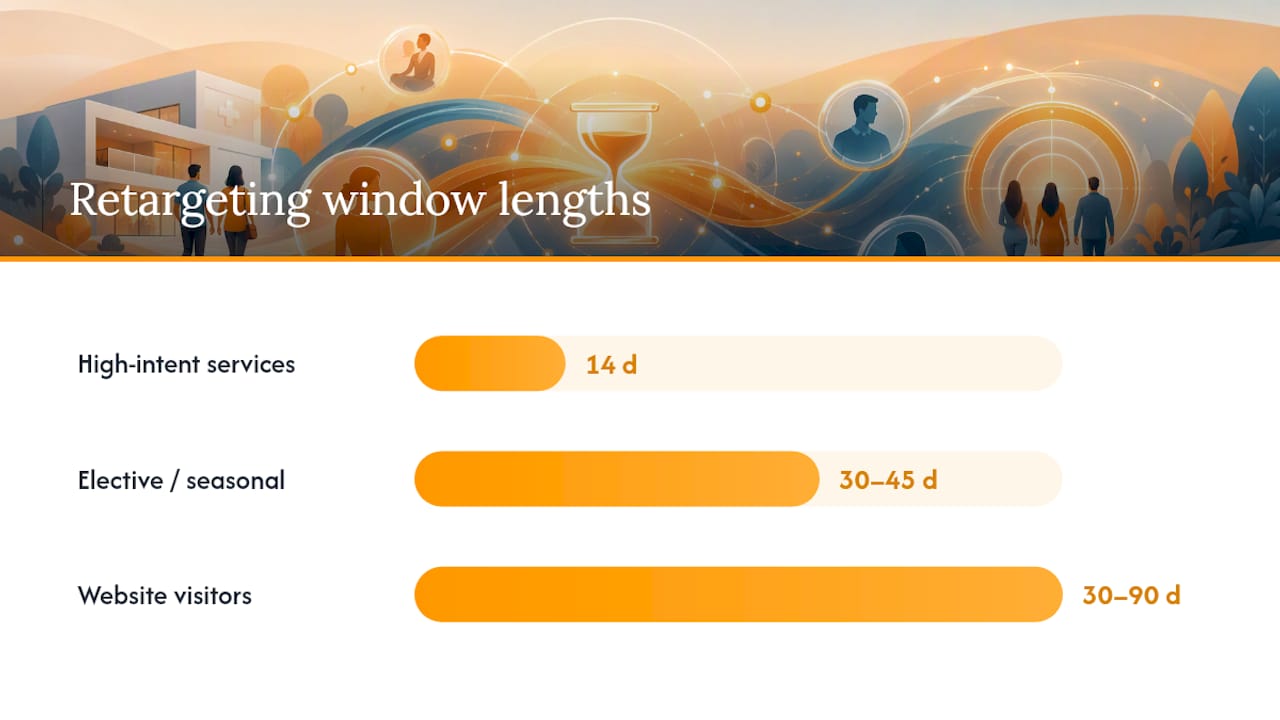
- Custom audiences from website visitors: Anyone who visited your services page in the last 30 to 90 days is a strong retargeting pool, built entirely from consented site behavior rather than clinical data.
- Anonymized patient lists: If you upload an email list for a custom audience, it must be properly hashed and built only from patients who consented to marketing contact. Academic reviews of digital health advertising stress that rigorous anonymization and consent handling reduce both privacy risk and account-flagging risk.
- Special Ad Audiences over lookalikes: Because traditional lookalike modeling is restricted for Special Ad Category campaigns, Meta substitutes a broader Special Ad Audience option. Expect less precision than a standard lookalike, and plan creative variety to compensate.
- Exclude current patients: Layer in a suppression audience of existing patients so your acquisition budget doesn’t waste impressions on people already on your schedule.
Pro Tip: Set your retargeting window at 14 days for high-intent services like urgent care or same-week bookings, and extend it to 30 to 45 days for elective or seasonal services where patients take longer to decide.
Special Ad Audiences function similarly to lookalikes but pull from a wider, less precisely modeled pool, according to Meta’s own healthcare advertiser guidance. That means your creative needs to work harder across a more varied audience instead of relying on razor-sharp targeting to do the filtering for you.
Creative and Copy That Convert Without Crossing the Line
The clinics that get this right treat every ad like a first appointment: informative, warm, and light on pressure. The ones that get flagged treat every ad like a hard sell, and Meta’s review system notices the difference fast.
Format matters more than most clinics assume. Short educational videos under 30 seconds, clinician introduction clips, quick facility tours, and carousel ads walking through service categories consistently outperform static image ads for trust-building. Specialist healthcare marketing coverage backs this up directly: video, clinician intros, and facility tours tend to drive higher engagement because patients are choosing a person and a place, not just a service.
Copy should sound like a knowledgeable neighbor, not a pharmaceutical commercial. “Learn about our new physical therapy program” clears review far more reliably than “Eliminate your chronic pain forever.” Words like learn, schedule, explore your options, and ask a question keep the tone educational instead of promissory.
Your landing page carries just as much compliance weight as the ad itself, and it’s where most clinics lose bookings they already paid for:
- Match the message exactly. If the ad promises information on a new dermatology service, the landing page headline should say the same thing in the same words, not redirect to a generic homepage.
- Show your privacy policy visibly, especially near any intake form, since patients scanning quickly for trust signals often check for this before typing anything.
- Keep the call to action singular and clear. One button, one action, whether that’s “Schedule a Consultation” or “Ask a Question,” not three competing options.
- Shorten the intake form to essentials only. Name, phone, preferred contact time, and general service interest are enough for a first touch. Do not ask for symptoms, diagnoses, or insurance details in a field that feeds your ad pixel.
Pro Tip: Test your landing page on a mid-range Android phone before launch. Healthcare click-through skews heavily mobile, and a form that requires pinch-zooming to complete will quietly kill your conversion rate no matter how good the ad creative is.
Consumer expectations for tailored experiences keep climbing, and Statista’s research on personalization expectations shows why message match matters so much. Patients expect the page to feel like it was built for their exact question, which is a real tension against the anonymized, privacy-first data handling healthcare advertising requires. The resolution is narrow message match paired with broad, non-identifying targeting signals, not personalization built on sensitive data.
Setting Up Pixel, Conversions API, and Consent Without Exposing Patient Data
Tracking is where good clinic campaigns quietly become HIPAA liabilities. The technical setup itself isn’t complicated, but the discipline required to keep protected health information out of it is where most in-house teams slip.
Install the Meta Pixel on your website and map only generic events: PageView, Lead, CompleteRegistration, and Contact. Never pass a URL parameter or event value that includes a condition, appointment type, or patient name. A form submission event should fire as a simple “Lead,” not “Lead: Diabetes Consultation Booked.”
- Install Pixel and CAPI together, not Pixel alone. Conversions API sends server-side event data, which is more resilient to browser tracking restrictions and iOS privacy changes than client-side pixel data alone.
- Route CAPI through a server-side integration using your CRM or a tag-management setup rather than sending raw form fields directly.
- Capture consent explicitly through a cookie banner and a marketing-contact checkbox before any custom audience upload, and log that consent somewhere auditable.
- Never upload a patient list without documented consent covering marketing use specifically, not just treatment communication.
Attribution windows for healthcare conversions tend to run longer than retail because booking decisions rarely happen on the first ad view. A useful starting benchmark set:
| Metric | Recommended setting | Why it fits clinics |
|---|---|---|
| Click attribution window | 7 days | Captures most booking decisions after initial ad engagement |
| View attribution window | 1 day | Limits over-crediting passive video views |
| Retargeting lookback | 30 to 45 days | Matches typical elective-care decision timelines |
| Reporting cadence | Weekly during test, biweekly once stable | Healthcare sample sizes need more data before conclusions hold |
Your key performance indicators should center on cost per lead, lead-to-appointment rate, and cost per booked appointment, in that order. Cost per lead tells you if the funnel top is efficient. Lead-to-appointment rate tells you if your intake process and staff follow-up are doing their job.
What Should a Clinic Budget for Facebook Ads, and How Fast Does It Scale?
Clinic marketers consistently ask the same first question: how much does this actually cost? The honest answer depends on specialty, but the ranges are predictable enough to plan around.
A single-location general practice can test meaningfully on $500 to $1,000 per month, enough to run a small awareness campaign and a modest retargeting slice. Specialty clinics, particularly dermatology, dental implants, or fertility, tend to need $1,500 to $3,000 monthly because the competitive bidding for those audiences pushes CPM higher. Multi-location groups should budget per location rather than pooling, since Meta’s delivery system optimizes each campaign against its own local audience pool.
- Cost per thousand impressions (CPM) in healthcare frequently runs higher than retail or general consumer categories, partly because the Special Ad Category removes precise targeting that would otherwise concentrate spend efficiently.
- Cost per lead varies enormously by specialty, from routine primary-care leads at the lower end to elective cosmetic or fertility leads at the higher end.
- Expect a learning phase of three to four weeks before drawing conclusions. Meta’s algorithm needs a meaningful volume of conversion events, typically in the range of fifty per week per ad set, before it optimizes delivery reliably.
To find a sane target cost per acquisition, work backward from patient value rather than guessing at an arbitrary lead cost. A clinic averaging $800 in first-year patient revenue, for instance, can reasonably target a CPA in the $120 to $160 range and still turn a profit once staff time and overhead are factored in.
Launch Checklist: Deploying a Compliant Clinic Campaign Step by Step
Print this, tape it to the wall, and check items off before you touch the “Publish” button.
- Confirm Special Ad Category tagging on every relevant campaign inside Meta Ads Manager.
- Audit ad creative against the forbidden list: no before/after imagery, no guaranteed outcomes, no condition-implying copy.
- Verify landing page message match, visible privacy policy, and a single clear call to action.
- Shorten intake forms to non-clinical fields only, and confirm no PHI flows into tracked form fields.
- Install Meta Pixel and map events (PageView, Lead, CompleteRegistration, Contact) with generic values.
- Layer in Conversions API through a server-side integration for redundancy against browser tracking loss.
- Set up consent capture (cookie banner, marketing checkbox) before uploading any custom audience.
- Build initial audiences: geo-radius, broad demographics, and a suppression list of current patients.
- Launch awareness video first, running at least two weeks before introducing conversion campaigns.
- Layer retargeting to warm viewers, then introduce lead-form or website conversion ads.
- Review weekly for the first month, watching cost per lead and creative fatigue signals.
- Refresh creative every three to four weeks, and reallocate budget toward whichever objective is producing the lowest cost per booked appointment.
Why This Guide Is Grounded in Real Clinic Campaign Work
An agency with extensive experience managing marketing campaigns across healthcare, retail, legal, and entertainment clients means the compliance patterns in this guide reflect actual account reviews, not theoretical policy reading. Working across sectors with wildly different regulatory exposure sharpens the instinct for what a platform will actually flag versus what merely sounds risky. Contributor Derek’s work on clinic and dental ad playbooks has repeatedly surfaced the same lesson: message match and clean event mapping fix more underperforming campaigns than clever targeting ever does. Case-study patterns from dental and healthcare clients consistently point back to the same fixes, tightening the intake form, correcting pixel events, and slowing down the ask, rather than any single creative breakthrough.
The Part Most Clinic Marketers Get Wrong
Most clinics treat Meta’s Special Ad Category restrictions as an obstacle to route around instead of a design constraint to build inside. That mindset produces exactly the creative that gets flagged: vague interest targeting disguised as health targeting, urgency language dressed up as patient education, before-and-after posts captioned as “results may vary.”
The conventional advice to “just run a lead form campaign and see what happens” skips the two things that actually determine whether a clinic campaign works: an audience warmed by genuine awareness content, and a landing page that matches the ad’s promise word for word. Skip either one and the lead form will fill up with unqualified clicks that never convert to booked appointments.
If you take one thing from this guide, prioritize the funnel sequence over the targeting cleverness. A mediocre audience with a proper awareness to retargeting to conversion structure beats a perfectly tuned lookalike audience pointed straight at a hard sell. Compliance isn’t the tax you pay for running healthcare ads. It’s the discipline that happens to produce the better campaign anyway.
— Derek
Get a Compliant Meta Ad Program Built for Your Clinic
Theartistevolution replaces the guesswork clinics face when trying to interpret Meta’s Special Ad Category rules alone. Instead of piecing together policy documents and hoping your account survives review, you get a team that has already built Pixel and Conversions API setups, compliant creative libraries, and message-matched landing pages for healthcare clients across multiple specialties.
A clinic audit through Theartistevolution starts with a policy check on your existing ads or account history, flags any creative or targeting issues likely to trigger rejection, and delivers a prioritized test plan built around your budget and specialty. From there, full campaign strategy and ongoing management covers everything from audience building to weekly optimization, and if paid media is your immediate priority, the pay-per-click management team can take Meta ad execution off your plate entirely. If your booking flow needs work before ad spend goes live, website design services can fix message match and intake forms first. Reach out for a clinic ad audit and get a specific plan for your specialty and location before your next campaign launch.
This article is general information, not a substitute for advice from a qualified doctor. Consult a qualified healthcare professional about your own circumstances before acting on anything here.
Sources
- Truth in advertising | Federal Trade Commission
- Healthcare Advertising – Meta for Business
- Article on digital health advertising and privacy (PMC)
- Statista: consumer expectations for personalization
- Facebook Ads for Healthcare: Compliant Meta Campaigns | Sweet Media
FAQ
Is $10 a Day Enough for Facebook Ads for a Clinic?
A $10 daily budget can sustain a small awareness campaign, but it won’t generate enough conversion volume for Meta’s algorithm to optimize a lead campaign effectively. Most single-location practices need closer to $500 to $1,000 monthly to run a real awareness-to-conversion funnel with enough data to judge performance.
How Do I Advertise a Medical Clinic on Facebook?
Start with an awareness campaign, tagged as a Special Ad Category, using educational video content rather than a direct sales pitch. Layer in retargeting to warm viewers, then introduce a conversion campaign with a message-matched landing page and a short, non-clinical intake form.
How Much Do Facebook Ads Cost per 1,000 Views?
Healthcare CPM tends to run higher than general consumer categories because Special Ad Category restrictions remove precise targeting options that would otherwise make delivery more efficient. Exact CPM varies by specialty and season, so treat your first month as a benchmarking period rather than expecting a fixed number.
What Is Facebook’s Ad Policy for Healthcare Products?
Meta classifies most health-related advertising under its Special Ad Category framework, which restricts detailed targeting and bans creative elements like before-and-after imagery, guaranteed outcomes, and language implying a viewer’s health condition. Meta also will not sign Business Associate Agreements, so no protected health information should ever flow into pixel or event data.
Can an Agency Help Manage Facebook Ads for Clinics?
Yes, some agencies build and manage compliant Meta campaigns for healthcare clients, handling everything from Special Ad Category setup to Pixel and Conversions API integration. Pricing for campaign management is available directly through Theartistevolution’s services page.