
CPG influencer marketing means partnering with creators whose audiences trust them, so shoppers notice your product, try it and choose it again at the shelf. It works best when you plan for retail reality: many creators, clear disclosure and measurement built around brand lift and store data rather than one-click sales. This guide walks through how to do that, from creator selection to budgets to reporting.
TL;DR
- CPG campaigns usually aim at awareness, preference and trial, so they use larger creator pools at lower investment per creator than direct-to-consumer campaigns.
- Choose creators for audience fit, engagement and content quality, not follower count alone. Micro and mid-tier creators often carry the most credibility.
- Plan measurement before launch: brand lift surveys, retail scan data and share of voice replace the last-click tracking DTC brands rely on.
- Every paid or gifted post needs a clear, hard-to-miss disclosure under FTC rules. Build it into the brief.
- Treat the campaign as a system: brief, creators, content, paid amplification, retail connection, reporting.
Table of Contents
- What CPG influencer marketing is, and how it differs from DTC
- Choosing creators whose audiences fit your product
- Platforms and formats that work for packaged goods
- Planning a campaign from brief to launch
- What CPG influencer marketing costs
- Disclosure and FTC compliance
- Measuring results when you sell through retail
- Our perspective
- How we can help
- FAQ
- Sources
What CPG influencer marketing is, and how it differs from DTC
At its core, CPG influencer marketing uses creators’ trust and rapport with their audiences to drive awareness, interest and consumer action for packaged products. A snack, a skincare line or a sparkling beverage gets introduced by someone the viewer already follows.
The difference from direct-to-consumer lies in where the sale happens. According to InfluencerFee, CPG campaigns typically target awareness, brand preference and trial, with larger creator pools at lower individual investment. DTC campaigns focus on measurable conversion with fewer creators at higher individual investment.
That shapes everything downstream:
- Goal: build familiarity and a reason to pick your product up at the shelf, not only a click.
- Scale: many voices, many occasions (breakfast, game day, back to school), many communities.
- Proof: lift in awareness and purchase intent, plus movement in retail data.
Choosing creators whose audiences fit your product
Creator selection decides most of the outcome. Sprout Social’s guidance points to the same short list: niche relevance, audience demographics, engagement rate over follower count, content quality and brand safety.
Why micro and mid-tier creators matter for CPG
LTK’s CPG guide describes micro-influencers (1,000 to 100,000 followers) as highly effective in their niche, and notes that a creator with 10,000 or fewer followers can show higher engagement and stronger conversion influence than a creator with over a million.
PepsiCo’s approach shows the same logic at enterprise scale. Its FLVR program partnered with 169 creators, using micro and mid-tier creators across genres to reach dedicated fan communities. The case study argues that genuine creator rapport and multiple dedicated communities can create more impact than selecting by audience size alone.
A simple screening checklist
- Audience match: does the creator’s audience reflect the shopper you want, by age, region and household type?
- Category fit: have they covered products like yours, and does your product fit naturally in their routine?
- Engagement quality: read the comments. Are people asking questions and sharing their own use?
- Content craft: can the creator shoot something that looks native to the platform?
- Brand safety: review recent posts and the tone of the community.
- Retail relevance: does the audience shop at the retailers that stock you?
For food and beverage, recipe creators are the backbone, according to InfluencerFee: they build original recipes around specific ingredients and post step-by-step content across YouTube, Instagram, TikTok and Pinterest. The same source notes that grocery haul creators on TikTok reach audiences with very high retail food purchase intent.
Platforms and formats that work for packaged goods
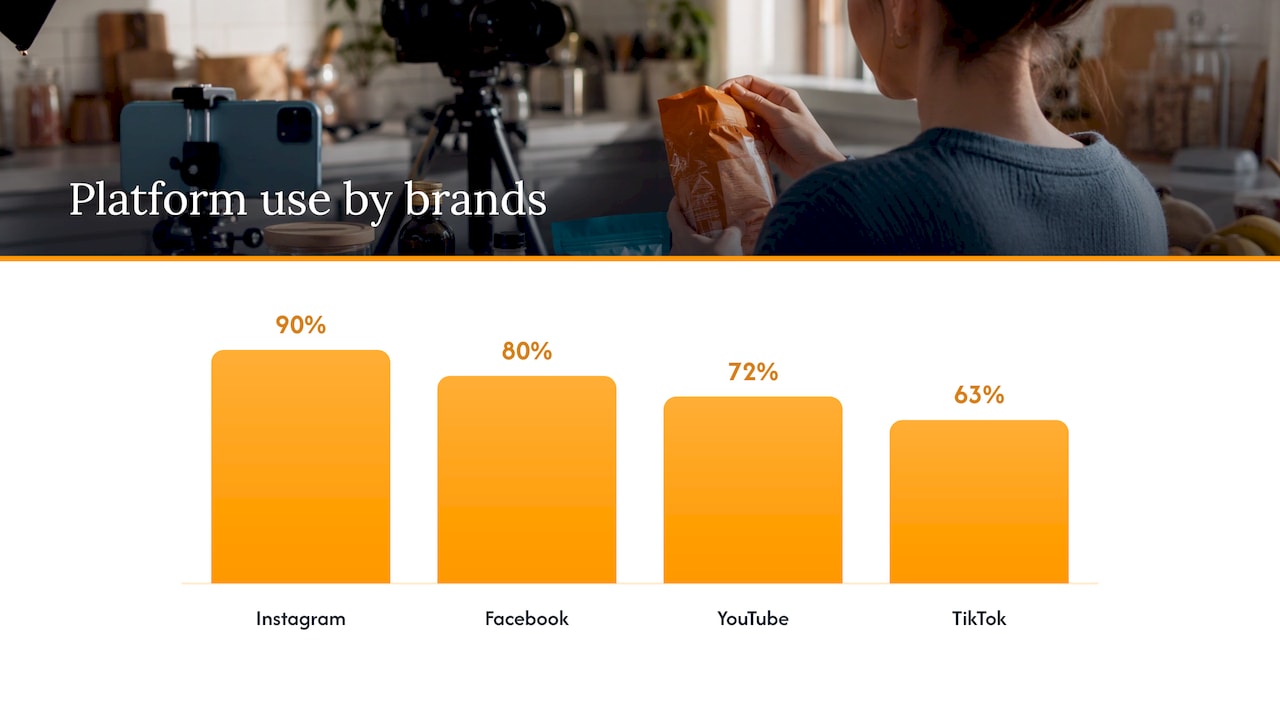
Digiday’s first-quarter 2026 survey found that 96% of brands and agencies partner with creators for social content. The most-used platforms were Instagram (90%), Facebook (80%), YouTube (72%) and TikTok (63%). Digiday’s analysis adds that Instagram tends to be more consistent for performance, while TikTok offers greater reach potential and a higher engagement ceiling.
A practical way to assign roles:
| Platform | Best use for CPG | Typical content |
|---|---|---|
| Steady performance, product discovery, Reels and Stories | Reels, carousels, shoppable posts | |
| TikTok | Reach and cultural moments, trial-driving trends | Short videos, recipe clips, hauls |
| YouTube | Depth and longevity | Long-form videos, Shorts |
| Planning-minded shoppers, especially food and home | Recipe and idea pins |
On format, Digiday’s 2026 index found that the most common content types in sponsored and gifted posts were product demonstrations and style shots. It also observed that single-product demos can look overtly promotional, while a get-ready-with-me style format showing several brands may feel less ad-like. For a packaged good, that suggests placing your product inside a routine, a recipe or a occasion instead of presenting it alone.
PepsiCo’s FLVR program shows another option: creators making long-form YouTube videos and YouTube Shorts around a brand platform. If your product suits visual, snackable storytelling, short-form video is a natural fit. We have written about why short video earns attention in our look at TikTok for restaurant marketing, and much of it applies to food and beverage brands.
Planning a campaign from brief to launch
A repeatable process keeps a many-creator program from turning into chaos. This is the sequence we use as a working frame.
1. Set one primary objective
Choose awareness, trial or repeat purchase as the lead goal. A launch needs reach and trial. A mature product needs occasions and loyalty. Everything else is secondary.
2. Define the shopper and the occasion
Write one paragraph on who buys, when they use the product and where they buy it. Creators need a concrete moment to build content around.
3. Write a brief that leaves room for the creator
A strong brief includes:
- the single message you want remembered;
- two or three must-show product moments;
- required disclosure language and placement;
- claims you can and cannot make about the product;
- usage rights and the posting window;
- the retailers where the product is sold.
Keep the rest open. Audiences respond to a creator’s own voice, and over-scripted posts read as ads.
4. Build the creator roster in tiers
Mix a handful of mid-tier creators for reach with a larger group of micro creators for credibility in specific communities. Assign each a role: launch announcement, recipe, review, haul or routine.
5. Plan amplification
Plan from the start to run the best-performing posts as paid media with the creator’s permission, and to reuse content on your own channels, retailer pages and email. Creator content is a library of assets, not a single post. Our piece on how user-generated content turned local buzz into retail impact shows how that reuse connects to store-level results.
6. Connect to the shelf
A great post that sends a shopper to an out-of-stock or poorly presented listing wastes the investment. Align campaign timing with distribution, promotions and your digital shelf. See our guide to making a CPG digital shelf buyable for what to fix before launch.
7. Launch, monitor and adjust
Watch the first week closely. Look for which creators, formats and hooks earn engagement, then shift budget and amplification toward them.
For more on working with creators day to day, our article on tips for successful influencer partnerships covers the relationship side.
What CPG influencer marketing costs
Creator rates depend on platform, tier, engagement, production quality and usage rights. Published ranges are guides, not quotes, and they move over time.
Opener reports micro-creator rates of $200 to $600 for an Instagram Reel, $250 to $750 for a TikTok video and $200 to $500 for a YouTube Short. Its hybrid example runs $400 to $700 per creator, or $10,000 to $17,500 for 25 creators.
For food specifically, Hypefy’s 2026 playbook lists typical per-post ranges by tier:
| Creator tier | Followers | Typical range per post |
|---|---|---|
| Nano | 1K to 10K | $50 to $250 |
| Micro | 10K to 100K | $180 to $2,500 |
| Macro | 100K to 1M | $1,800 to $22,000 |
These figures come from Hypefy’s 2026 Food Influencer Marketing Playbook.
When you build a budget, count more than creator fees:
- product seeding and shipping;
- paid amplification of top posts;
- usage rights for reuse in ads and retailer pages;
- measurement, such as brand lift studies;
- management time or agency support.
A useful rule: decide the share of budget for testing, the share for scaling winners and the share for measurement before you contract anyone.
Disclosure and FTC compliance
For U.S. campaigns, disclosure is part of the creative, not an afterthought. The FTC’s position is that material connections, such as payment or free product, should be clearly and conspicuously disclosed unless clear from context. In a warning letter, the agency said disclosures should be hard to miss and understandable, and that a video disclosure should appear in the video itself. If an endorsement is both visual and audible, the disclosure should be too.
The same letter says that putting #ad only in a later caption line can be inadequate because TikTok and Instagram descriptions are truncated, and viewers should not have to click or search for it.
On wording, a National Franchise Association legal paper summarizing the FTC’s 2023 guidance treats terms like “sp,” “spon,” “collab” or a standalone “thanks” as poor disclosure choices. Clear terms such as “Ad,” “Sponsored” or “Sponsored by [brand]” are safer when prominently placed. The same paper notes that the FTC’s Consumer Reviews and Testimonials Rule took effect in October 2024 and that brands and influencers share compliance responsibility.
In practice:
- put the required wording and placement in every brief;
- review drafts before posting, not after;
- keep records of creator agreements and approvals;
- train your team on the rules.
For a fuller walkthrough, see our FTC endorsement guidelines guide for marketers. For legal questions about a specific campaign, consult an advertising attorney.
Measuring results when you sell through retail
CPG brands sell through retailers, so they cannot tie a sale to a single creator post the way a DTC brand with a storefront can. InfluencerFee notes that CPG teams instead rely on brand lift surveys, Nielsen panel data, retail scan data and social share of voice.
What good measurement looks like
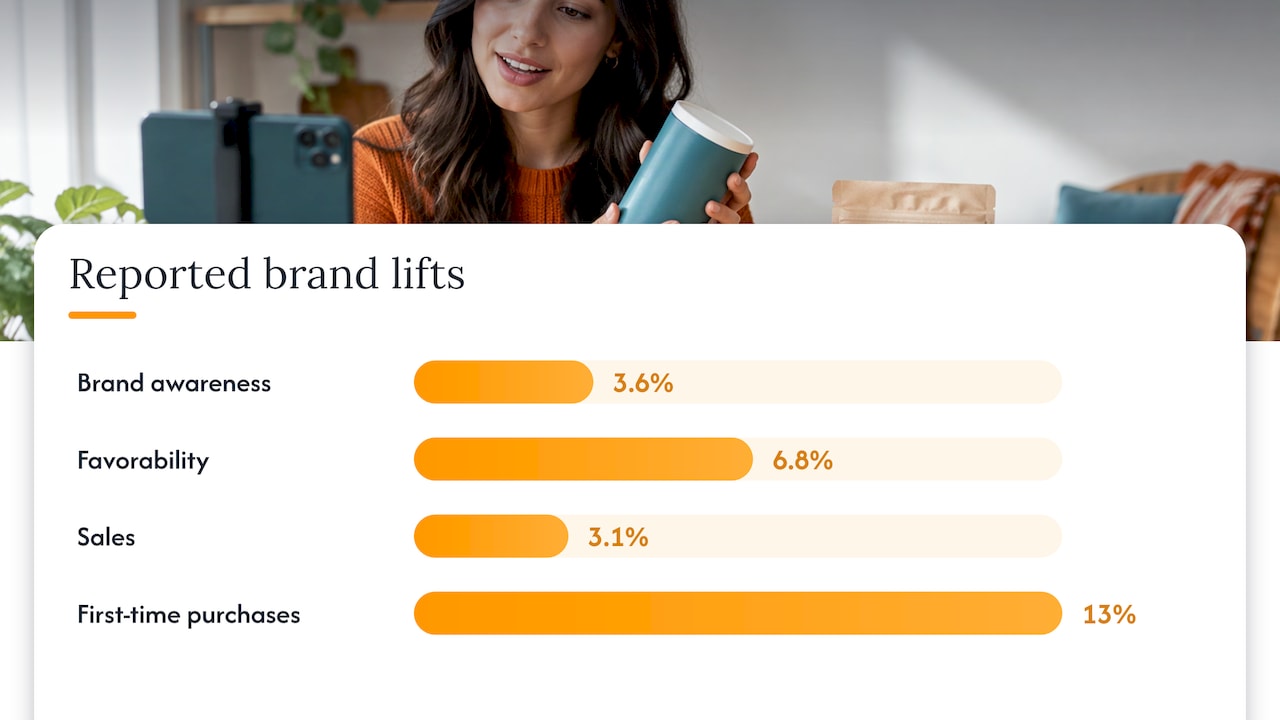
DiGiorno’s TikTok campaign is a useful example. AdExchanger reported that it increased brand awareness 3.6%, favorability 6.8% and sales 3.1%, with first-time purchases up 13%. It tracked views, comments, shares, creator-page followers and duets, and added post-campaign surveys for awareness and favorability. Its 22% full-view rate was 17% above the CPG benchmark, and engagement was 55% above.
PepsiCo’s case study reports that a Smosh campaign generated 90,000 conversions at a 1.85% conversion rate, with CPM 51% more efficient than the industry benchmark. It also reports that FLVR gained more than half a million subscribers and lifted ad recall by 12% and purchase intent by 3% for brands including Ruffles and Pearl Milling Company.
These are results from specific brands, not promises for every campaign. They show which metrics matter.
A measurement stack for CPG
| Layer | What it tells you | Examples |
|---|---|---|
| Engagement | Is the content resonating? | Views, full-view rate, comments, shares, saves |
| Brand lift | Did perception change? | Awareness, favorability, purchase intent surveys |
| Retail impact | Did shelf movement follow? | Scan data, panel data, promotion lift |
| Share of voice | Are you gaining conversation? | Brand mentions versus category |
For deeper guidance, read our practical guide to brand lift measurement and our campaign analytics framework, which covers one KPI, daily attribution and monthly marketing mix modeling.
Our perspective
Most CPG influencer programs stall for the same reason: they are run as a series of posts instead of one connected campaign. A creator video goes live, a few likes come in, and nobody links it to the shelf, the paid plan or the next quarter’s goals.
We approach it as an extension of your team. Strategy sets the objective and the shopper. Creative and content production turn creator posts into assets you can use across channels. Digital advertising amplifies what works. Reporting and optimization keep the budget moving toward the best performers.
That is the idea behind our in-house, multidisciplinary team and our marketing playbook system, built over more than 18 years of working with startups and household brands. Influencers are one engine of engagement. They deliver most when the brand, the website, the search presence and the retail experience are ready for the attention they create.
If you are launching a product or reviving a category position, start with the system, then choose the creators.
Derek
How we can help
If you are planning CPG creator work, we build and manage the whole campaign: strategy, brand development, content, paid media and ongoing reporting. Our retail activation work for CPG connects online campaigns to in-store results, and our brand engagement case study shows how we approach campaigns built around unique ideas.

To scope a program, talk with our team about strategy and campaign management. We can start from your objective, your retail footprint and your budget.
FAQ
How many influencers does a CPG brand need?
There is no fixed number. CPG programs typically work with larger creator pools at lower investment per creator than DTC, so a launch often involves a roster across tiers. PepsiCo’s FLVR program worked with 169 creators, but a smaller brand can start with a focused group and expand as it learns which creators and formats perform.
Are micro-influencers better than big creators for CPG?
They are often a strong fit. LTK’s guide notes that creators with smaller audiences can show higher engagement and stronger conversion influence in their niche. Many brands combine a few mid-tier or macro creators for reach with many micro creators for credibility.
How do you measure influencer ROI if you sell in stores?
Use a layered approach: engagement metrics from the platforms, brand lift surveys for awareness and favorability, and retail scan or panel data for sales movement. Set the measurement plan before launch so you have a baseline to compare against.
Do influencers have to disclose gifted products?
The FTC says material connections should be clearly and conspicuously disclosed, and free product can be one. Disclosures should be easy to notice and appear in the video itself for video content. Include the requirement in every brief and review posts before they go live.
Sources
- CPG Influencer Marketing: Proven Strategies & Tips (Tastewise)
- CPG Influencer Marketing (InfluencerFee)
- Influencer Marketing for CPG Food Brands (InfluencerFee)
- How to Find Influencers for Your Brand (Sprout Social)
- The Ultimate Guide to Influencer Marketing for CPG Brands (LTK)
- PepsiCo’s content creator marketing strategy (Think with Google)
- Digiday+ Research: A brand guide to social media campaigns
- DiGiorno Targets Gen Z With TikTok Songs About Its Pizza (AdExchanger)
- Micro-Influencers for CPG Product Launches (Opener)
- Food Influencer Marketing: The 2026 Playbook (Hypefy)
- FTC Warning Letter to Stephanie Grasso
- Franchise Advertising and the Use of Influencers in Social Media (National Franchise Association)