
A high-converting B2B case study leads with a quantified outcome, then proves it with context, a client quote, and clear measurement. The headline states the win, a snapshot box surfaces the top metrics with baseline and timeframe, and the body confirms the story with sourced evidence. Everything after that headline exists to remove doubt, not to introduce it.
TL;DR:
- Use a clear, outcome-focused headline with measurable results and a specific timeframe, such as reducing onboarding time by 40% in 90 days.
- Select customers whose results and profiles align with your target buyer segments and ensure approval is secured within a two-week window.
- Gather verified metrics from CRM or dashboards before the interview, and ask scene-based questions to elicit detailed, quotable responses.
- Structure the case study around a single key outcome, supported by a brief challenge, solution, and results section, ending with a genuine customer quote.
- Publish as an SEO-friendly web page, promote through targeted channels, and include supporting visuals and formats to maximize reach and conversion.
Table of Contents
- What Makes Case Study Writing B2B Actually Work
- How Do You Pick the Right Customer for a Case Study?
- How Do You Gather Evidence and Get Fast Sign-Off?
- What Should You Ask in a Case Study Interview?
- What Is the Best Structure for a B2B Case Study?
- How Do You Write a Case Study People Actually Read?
- Which Metrics Should You Feature, and How Do You Source Them?
- What Format Should Your Case Study Take?
- Where Should You Publish and Distribute a Case Study?
- How Does an Agency Actually Produce a Case Study Like This?
- What Actually Breaks a B2B Case Study Project
- Sources
What Makes Case Study Writing B2B Actually Work
Readers decide whether a case study is worth their time within the first five seconds, according to The Simons Group’s approach to B2B case studies. That means the headline metric, not the client’s logo or the agency’s tagline, carries the weight.
Case study writing b2b done right follows a simple sequence: pick a customer whose result maps to a real buyer segment, gather verifiable numbers before you ever schedule an interview, structure the narrative around challenge and resolution, and publish it somewhere it can actually get found. Skip any one of those steps and the piece turns into a glossy but forgettable testimonial.
Here’s the checklist version, so you can start today instead of planning for next quarter.
- Outcome-first headline. Name the result and the timeframe in one line: “[Client] cut onboarding time 40% in 90 days” beats “A Success Story.”
- Snapshot with baseline and timeframe. Readers need the “before” number next to the “after” number, plus how long it took to get there.
- One verified, attributable quote. A named person, a real title, and language that sounds like a human said it out loud.
- Buyer-segment match. Choose a customer whose industry, size, and problem mirror the prospects you’re actually trying to close.
- A two-week approval window. Set the sign-off deadline with the customer up front, and attach sourcing notes for every metric so legal or marketing review doesn’t stall on “where did this number come from?”
Miss the approval step and you’ll join the majority of marketing teams who let a finished draft die in someone’s inbox. That single bottleneck, more than writing quality, is why most case study pipelines run dry.
How Do You Pick the Right Customer for a Case Study?
Not every happy customer deserves a case study. The ones worth the investment share two traits: their outcome is measurable, and their profile matches a segment you’re actively selling into.
Start by pulling a list of accounts with strong renewal rates, expansion revenue, or a documented before/after in your CRM. Cross-reference that list against your current sales priorities. A logo that impresses your team internally is worthless if it doesn’t resemble the accounts your sales reps are chasing this quarter.
- Match the customer to a buyer segment, not to whichever account manager is most available for a call.
- Commit to one claim per case study. If you try to prove that a client saved money, moved faster, and improved retention all in one piece, you’ll end up proving none of it convincingly. Pick the single most persuasive outcome and build the whole narrative around it.
- Prepare an anonymized fallback. If the client won’t allow public naming, structure the story around industry, company size, and the metric itself. “A mid-market healthcare provider reduced patient intake time by 35%” still lands, even without a logo attached.
- Confirm access before you commit resources. A great candidate who won’t return your calls for three weeks isn’t a great candidate. Availability is part of the selection criteria, not an afterthought.
One overlooked filter: ask which customers already talk about you unprompted, in reviews, on LinkedIn, or in referral conversations. Those customers tend to give you the most usable material because they’ve already rehearsed the story in their own words.
How Do You Gather Evidence and Get Fast Sign-Off?
The customer agreement and final sign-off stages are where most case study projects stall, according to StoryVoice’s breakdown of the B2B case study process. Build your workflow around removing friction at exactly those two points.
- Pull baseline metrics before the interview. Grab CRM reports, dashboard screenshots, or ticket volume history so you’re not asking the customer to reconstruct numbers from memory.
- Make the ask small and specific. Tell the customer exactly how much time the interview will take, what you’ll need from them afterward, and when the piece will publish.
- Set a visible approval window. Two weeks is a reasonable default. State it in the very first outreach email, not buried in a follow-up.
- Send a sign-off checklist alongside the draft. Cover the direct quote, the source of every metric cited, and explicit permission to use the company name and logo.
- Route the checklist to the right person immediately. Many delays happen because the marketing contact has to loop in legal or a VP after the fact. Ask who needs to approve it before you finish the draft, not after.
A tool like the marketing dashboard metrics your team already tracks can double as the sourcing document you attach to the sign-off packet.
Pro Tip: Send the customer a nearly finished draft, not a blank interview request. People approve things fast when there’s almost nothing left to write, and they stall indefinitely on open-ended asks.
What Should You Ask in a Case Study Interview?
Interview technique determines whether you end up with usable quotes or a transcript full of vague praise. Record and transcribe every call, and talk to both the champion who pushed for the purchase and an implementer who lived with the product day to day, since Ektie’s guide to closing-focused case studies notes the champion typically delivers the most quotable material.
Scene-based questions outperform generic ones every time. Instead of “What did you like about working with us?”, ask:
- “Walk me through the week before you signed. What was breaking?”
- “Describe the moment you realized this was actually working.”
- “What did your team stop having to do once the new process was in place?”
- “If a peer asked you whether this was worth it, what would you tell them first?”
These questions pull out specifics: a missed deadline, a frustrated team member, a number someone finally didn’t have to chase down manually. That’s the material that makes a case study feel like a real story instead of a marketing mad lib.
Numbers need the same scene-setting treatment. If a customer says, “We cut response time significantly,” follow up immediately: “What was the response time before, and what is it now? Where does that number come from, a support ticket system or manual tracking?” Confirming the source during the call saves you a follow-up email later and gives legal review something concrete to check against.
Pro Tip: Ask every interviewee the same closing question: “Is there a number you can share that would surprise people?” It surfaces metrics they wouldn’t have volunteered otherwise.
What Is the Best Structure for a B2B Case Study?
Top SaaS companies converge on nearly the same template for a reason: headline, snapshot, challenge, solution, results, quote, according to Proofmap’s analysis of case study frameworks. Here’s the section-by-section breakdown with word budgets that keep the piece skimmable without losing substance.
- Headline (one line). Formula: “[Client] achieved [result] in [timeframe].” Lead with the number, always.
- Snapshot (50–80 words). Company name, industry, size, and the two or three headline stats a skimming executive needs before they decide to keep reading.
- Challenge (150–250 words). The root cause of the problem, what it cost the business, and what the customer tried before finding you.
- Solution (200–300 words). The decision that got made, how rollout actually happened, and the implementation details that make the story credible rather than generic.
- Results (100–200 words). The headline metric restated with its baseline and timeframe, plus two or three supporting metrics that reinforce it.
- Quote. One verbatim line from the customer that confirms the result and adds the emotional weight a spreadsheet can’t.
That structure isn’t accidental. It mirrors how a skeptical buyer actually reads: skim the top for proof, dig into the middle only if the proof looks credible, and end on a human voice that removes the last bit of doubt.
How Do You Write a Case Study People Actually Read?
Canonical web case studies run roughly 600 to 1,200 words, per The Simons Group’s benchmarks, and Proofmap’s analysis puts the average closer to 965 words. That range gives you enough room to tell a real story without testing a busy buyer’s patience.
Write the top third assuming the reader will never scroll past it. Put your best stat and your best quote where a skimmer can catch them in five seconds. Business audiences retain narrative structure far better than a list of features, which is part of why storytelling research from Harvard Business Review consistently shows scene-driven writing outperforming abstract claims.
- Choose the single metric your target buyer cares most about, and make it the headline. Don’t bury a strong number under three weaker ones.
- Cut vendor-speak entirely. “Leveraged a robust platform” tells the reader nothing; “cut manual data entry from six hours a week to forty minutes” tells them everything.
- Center the customer’s experience, not your product’s feature list. The product is the mechanism. The customer is the story.
- Write short paragraphs and use subheadings so a reader can scan the piece in under a minute and still walk away with the key point.
Which Metrics Should You Feature, and How Do You Source Them?
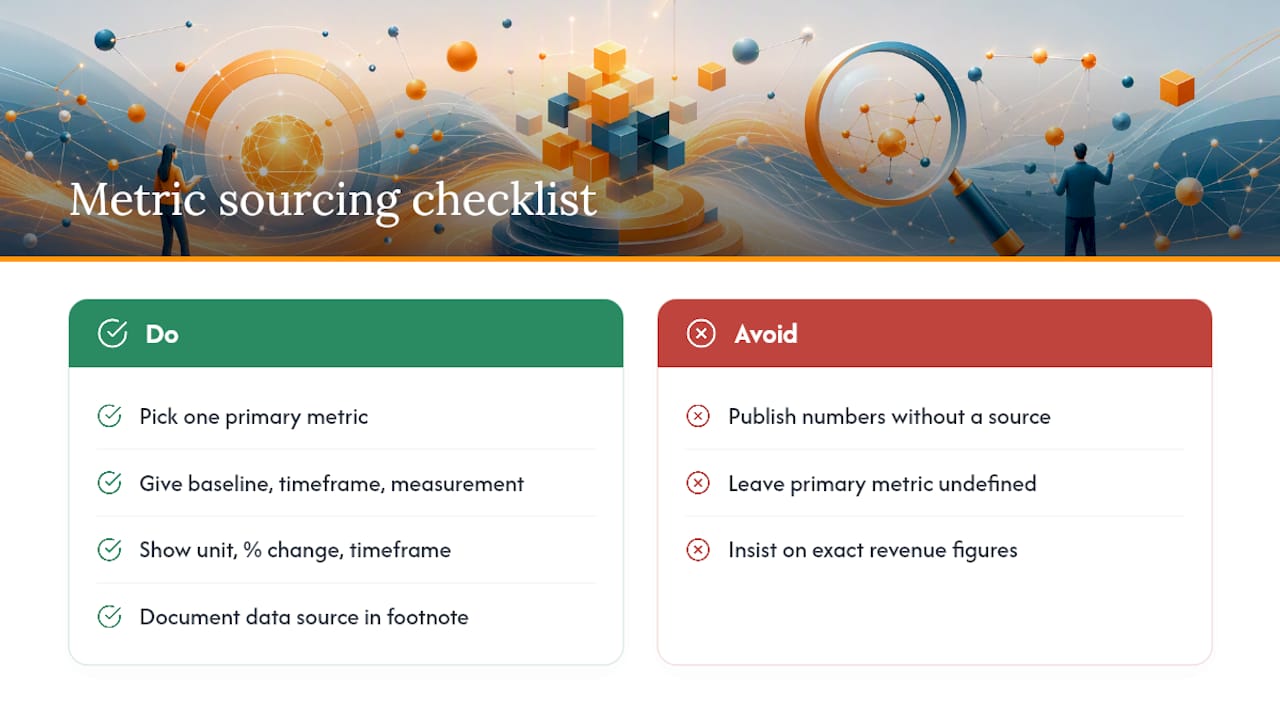
Pick one primary metric and give it a baseline, a timeframe, and a stated measurement method. Everything else in the case study supports that single number.
The primary metric rule: State what changed, from what starting point, over what period, measured how. “Response time dropped 60%” means little without knowing it went from 48 hours to 19 hours over a 90-day rollout, tracked through the client’s help desk software.
Supporting metrics add texture once the primary claim is solid. Show the unit of measurement, the percentage change, and the timeframe for each one, the same way you’d want to see it if you were the one deciding whether to trust a stranger’s marketing copy. A tool like the ROI measurement frameworks your team uses internally can double as the sourcing standard you apply to every client metric before it goes into print.
Some customers won’t share exact revenue or cost figures, especially in regulated industries. When that happens, ask for ranges or alternative metrics, hours saved per week, meetings booked per month, tickets closed per day, since Ektie’s guidance on handling guarded numbers confirms these substitutes still carry persuasive weight. Document the data source in a footnote regardless of which version you use. A number without a source reads as marketing invention, even when it’s true.
What Format Should Your Case Study Take?
One story, multiple containers. The canonical web page handles SEO and organic discovery. A one-pager gives sales reps something to attach to an email without asking a prospect to click through. A 60 to 180 second video works for social feeds and live demos where nobody wants to read paragraphs.
Visual elements carry more weight than most teams assume. A snapshot box with the headline stats, a simple chart with labeled axes, and a clean before/after comparison do more persuasive work than another paragraph of description.
Build your export checklist once and reuse it for every case study:
- PDF one-pager formatted for email attachments and printed leave-behinds
- A short LinkedIn post that pulls the headline stat and tags the client if they’ve agreed to it
- A 30 to 60 second audio or video clip pulled from the original interview for outreach sequences
- A two-sentence summary sales reps can paste directly into a proposal
Formats like the LinkedIn content strategy your team already runs give you a ready distribution channel for the social cut the moment the full piece goes live.
Where Should You Publish and Distribute a Case Study?
Publish the case study as an indexable web page, not a locked PDF, according to StoryVoice’s process recommendations. A PDF can’t rank, can’t be linked internally, and can’t be tracked the same way a page can. Add basic schema and metadata, then link to the case study from the product or solution pages it supports.
Distribution matters as much as the writing, and it’s the step most teams treat as optional. Build it into the same sprint as publication rather than leaving it for “later.”
- Add the case study to a targeted email sequence aimed at the buyer segment it matches.
- Equip sales reps with a one-line summary and the link, ready to paste into an active deal thread.
- Post the headline stat on LinkedIn with a link back to the full page.
- Include the case study directly in proposals for prospects who resemble the featured client.
Once it’s live, track page views, average time on page, CTA conversion rate, and pipeline the piece influenced. A case study with strong traffic but no CTA clicks usually means the offer at the bottom doesn’t match what the reader just read.
Pro Tip: Treat distribution as a launch, not an afterthought. A case study with zero promotion behaves exactly like a case study that was never written.
How Does an Agency Actually Produce a Case Study Like This?
An agency builds case studies around the same results-first discipline outlined above, starting every project with the headline metric and a snapshot box before a single paragraph of narrative gets written. That structure comes directly from [brand_signal] and appears across published work like brand story development projects, where the outcome leads and the story fills in why it matters.
An internal process runs on a short, repeatable checklist:
- Interview the champion and at least one implementer, recorded and transcribed.
- Verify every metric against a CRM report, dashboard export, or client-provided source document.
- Draft the story around one claim, using the headline, snapshot, challenge, solution, results, quote structure.
- Sign-off with a two-week window and a checklist covering quotes, metric sourcing, and logo permission.
- Publish as an indexable web page with supporting one-pager and social assets.
- Distribute through email, sales enablement, and LinkedIn within the same week the page goes live.
Examples like LinkedIn lead generation for expanding agency show that framework applied to a real account.
What Actually Breaks a B2B Case Study Project
Approval delay kills more case studies than bad writing ever does. Bring the customer a draft that’s already 90% finished instead of an open-ended interview request, and sign-off timelines shrink dramatically.
Guarded numbers cause the second-biggest slowdown. Ask for ranges instead of exact figures when a customer hesitates, and always cite where the number came from. Legal reviewers approve sourced ranges far faster than they approve unsourced exact percentages, because a documented source gives them something concrete to sign off on.
The last mistake is publishing to a PDF and calling the project done. A case study is a web asset first. Bundle distribution, email, sales enablement, social, into the same sprint as publication, or the story sits unread no matter how strong the underlying result actually is.
— Derek
If your team is sitting on strong customer results but no system for turning them into case studies that close deals, Theartistevolution’s brand development work builds that exact pipeline, from interview through distribution.
Sources
- Proven approaches for B2B case studies (The Simons Group)
- How to Write a Case Study: Framework, Steps, and Templates (Proofmap)
- How to Write a B2B Case Study: The Complete Process (StoryVoice)
- How to Write a B2B Case Study That Closes Deals (Ektie)