
AI media buying works best when software handles the bidding and a person owns the objective, the budget guardrails and the measurement. Machine learning is already good at the repetitive work: adjusting bids, shifting budget and spotting problems. It is much weaker at knowing what your business actually needs. At The Artist Evolution, we pair strategy and campaign management with the tools, so the automation chases the right goal.
This guide is for owners and marketing leads at healthcare practices, dental offices, law firms, consulting firms, retail brands and CPG companies. You don’t need a data science background. You need to know what the technology does, where it fails and how to test it.
TL;DR
- AI media buying uses machine learning and automation to plan, purchase and optimize ad placements across digital channels, evaluating hundreds of inputs in real time (EMARKETER).
- It optimizes toward whatever goal you give it. Broken conversion tracking or a click-only goal means it gets very good at the wrong outcome.
- Industry leaders consistently expect humans to set objectives, approve material actions and stay accountable.
- Test AI campaigns against a control, set the success rule before launch and scale only what wins.
- If you use patient or customer data for targeting, privacy rules such as California’s apply to automated decision-making.
Table of Contents
- What AI media buying actually is
- How the technology works under the hood
- What AI can take off your plate
- Where humans still make the decisions
- The risks to plan for
- How to test AI media buying before you scale it
- Privacy rules to keep in view
- Our perspective
- Putting it to work with The Artist Evolution
- FAQ
- Sources
What AI media buying actually is
Media buying is the work of purchasing ad space and placements: which channels, which audiences, how much to bid and when. Traditionally a buyer made those calls by hand and adjusted weekly or monthly.
AI-powered media buying uses machine learning and automation to plan, purchase and optimize placements across digital channels, with systems weighing hundreds of campaign inputs in real time (EMARKETER). Machine learning here means models that learn patterns from past results, such as which audiences convert, and use them to predict the value of the next ad impression.
You already use it if you run search or social ads. Automated bidding, broad-audience targeting and automated campaign types are all machine learning in practice. “AI for media buying” is the next step: software that also plans the mix, builds creative variations and recommends or takes actions across accounts.
How the technology works under the hood
Most digital ad space is sold in real-time auctions that close in milliseconds. According to the IAB Tech Lab’s AI in Advertising Primer, machine learning adjusts bids in those auctions by analyzing signals such as household demographics, browsing habits and engagement history to predict how valuable an impression is. Machine-learned segmentation also uncovers behavioral groups that are more likely to buy.
The same primer notes that machine learning is used in measurement, including deciding whether an ad view counts as a billable impression and screening for fraud. It also says that after Apple’s App Tracking Transparency and the decline of third-party cookies, ad systems invested heavily in probabilistic attribution, which estimates which ads drove a result when direct tracking is not available.
The IAB State of Data 2025 study maps AI use across the campaign lifecycle:
| Stage | What AI does |
|---|---|
| Planning | Simulates scenarios to suggest media mix and budget pacing, builds audience personas from CRM and site data, forecasts inventory |
| Activation | Optimizes cross-channel bids and targeting, detects anomalies, blocks ad fraud, automates A/B tests |
| Analysis | Multi-touch attribution, incremental lift, marketing mix models |
For a local dental group or a regional law firm, this mostly shows up as automated bidding and audience expansion inside the big ad platforms. For a CPG or retail brand, it also shows up in budget allocation across channels.
What AI can take off your plate
The CIMM October 2026 report describes systems that can turn briefs into plans, create and adapt assets, build audiences, configure campaigns, reconcile measurement data, diagnose delivery problems and recommend optimizations. Within defined limits, they can also execute approved actions.
The practical gains for a busy team:
- Speed. A Dentsu executive quoted by TV News Check says work that took days can now happen in hours, including audience discovery, scenario planning, forecasting and report generation.
- Coverage. Software can watch every campaign, every hour, and flag a budget that is running away or an ad that stopped delivering.
- Testing volume. Creative and audience variations that used to take weeks to set up can be launched and compared quickly.
Those gains are real. They are also the easy part. The hard part is deciding what the system should aim for and whether you can trust the numbers it reports.
Where humans still make the decisions
The same CIMM report says human work shifts toward defining objectives, approving material actions, exercising judgment, managing exceptions and retaining accountability. It does not disappear.
The INMA’s 2026 report, AI and Advertising: What You Need to Know, found that no advertising or revenue leader interviewed would let an AI agent buy or sell a meaningful budget without conditions. The conditions that kept coming up were:
- Explainability and an audit trail, so you can see why a decision was made.
- Human accountability at the level of objectives, not every transaction.
- Spend caps with anomaly detection.
- Trusted counterparties.
That is a sound template for any business. You do not need to approve every bid. You do need to decide the goal, cap the spend, and review what the system did.
The EMARKETER FAQ quotes AdLib’s CEO saying that handing everything to AI and telling it to go puts the burden on the brand and the advertiser to make it work. The TV News Check piece is just as direct: a Dentsu executive says human oversight and governance are required, and that a person must review any AI-built plan.
The risks to plan for
The point of knowing the risks is to set the system up well, not to avoid it. EMARKETER reports the barriers U.S. ad professionals cite most:
- 62% cite setup complexity.
- 62% cite data security concerns.
- 61% cite insufficient understanding of AI.
- 60% cite transparency worries.
The same page, citing the IAB, says 70% of marketers have encountered at least one AI-related advertising incident, such as hallucinated or off-brand content, and 40% had to pause or pull ads because of it. Only 6% believe current safeguards are sufficient, and 14% say no one in their organization owns AI governance. The IAB released its first AI Transparency and Disclosure Framework in January 2026.
For regulated or reputation-sensitive businesses, those numbers matter. A health system, dental practice or law firm cannot afford an ad that overpromises or sounds off-brand. Someone needs to own review and approval.
The wrong-goal problem
This is the most common failure and the least dramatic. The EMARKETER FAQ, summarizing Vertoz’s November 2026 warning, explains that AI optimizes toward whatever objective it is given. If conversion tracking is broken, or the goal is clicks, the system will find cheap clicks that never become patients, clients or orders. Over-favoring one winning creative can also wear out an audience.
CIMM adds a subtler point: cost, impressions, completions and short-term conversions are easy to feed into automated systems. Context, attention, incrementality and long-term brand effects are harder to represent, and a signal being machine-readable does not make it valid. A clean-looking dashboard is not proof the system is learning the right lesson.
How to test AI media buying before you scale it
This is the routine we recommend, and it works at any budget size.
Step 1: Fix the goal and the tracking first
Choose one primary outcome: booked appointments, qualified consultation requests, store sales, repeat orders. Then confirm the conversion is tracked accurately, including phone calls and form fills if those are your real leads. Our campaign analytics framework lays out one KPI with daily attribution and monthly marketing mix modeling, so the number the AI chases is the number the business cares about.
This is the step where most AI rollouts go wrong, and it is where a managed approach pays off. We handle tracking setup and reporting as part of campaign management, so the system starts from a goal that is wired correctly.
Step 2: Keep a control
Google’s CMO guide advises testing AI-powered campaigns against equivalent manual campaigns: give the AI the objective, let it optimize, then move budget toward the best performers. Keep your existing approach running alongside, so you have something to compare against.
Step 3: Write the decision rule in advance
Before launch, record the hypothesis, the primary conversion measure, the evaluation window and the threshold that means “scale” or “stop.” BigFin’s guidance on reviewing paid advertising with AI recommends changing one major variable at a time and not rewriting the success rule after seeing early numbers. That discipline keeps a lucky first week from becoming a bad budget decision.
Step 4: Check for real lift
Platform-reported conversions can include people who would have bought anyway. Incrementality testing compares exposed and unexposed groups to see what the ads truly added. For broader budget decisions across channels, marketing mix modeling shows how each channel contributes over time.
Step 5: Scale in stages, with caps
Move budget gradually, set daily and weekly spend caps, and turn on anomaly alerts. Our 90-day runbook for media spend optimization walks through that rhythm for performance teams. If you run Google’s automated campaign type, the 30/60/90 Performance Max strategy shows how to steer it with signals and exclusions rather than leaving it unattended.
Privacy rules to keep in view
AI targeting runs on personal data, and the rules are tightening. California’s CCPA regulations define automated decisionmaking technology to include software derived from machine learning or AI that executes or substantially facilitates decisions. According to the California Privacy Protection Agency’s modified regulation text (May 2025), businesses using it must give a pre-use notice with an opt-out link, and keep the collection, use and retention of personal information reasonably necessary and proportionate. The text also defines behavioral advertising as targeting based on a consumer’s activity across businesses and websites.
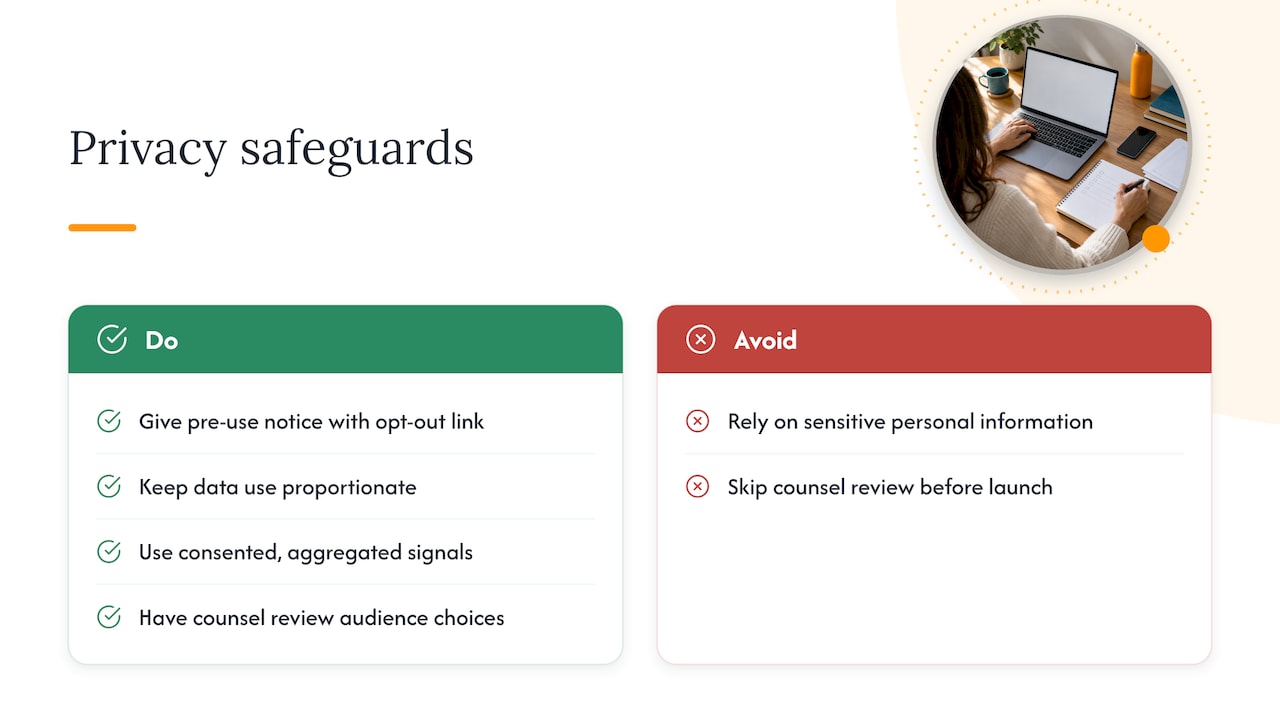
The practical takeaway: build targeting on consented, privacy-compliant and aggregated signals, and avoid relying on sensitive personal information. Healthcare and legal advertisers in particular should have their compliance counsel or privacy officer review audience and data choices before launch.
Our perspective
We have spent 18 years building campaigns, and the lesson holds with every new tool: automation multiplies whatever strategy it is given. A good strategy gets faster and cheaper to execute. A vague one gets expensive faster.
That is why we start with brand, offer and measurement before we touch bidding. A healthcare practice and a CPG brand need different goals, different creative and different definitions of a win. The platform cannot decide that for you.
Our multidisciplinary in-house team connects strategy to execution: paid search and social, SEO, creative and the reporting that ties them together. We act as an extension of your team, so the person tuning the AI also understands your brand and your market.
The businesses that win with AI media buying will be the ones with clean data, clear objectives and a team that reviews what the machine does. We build that foundation, then let the technology do what it does best.
Derek
Putting it to work with The Artist Evolution
If you want AI-assisted buying without the setup burden, start with the channels where it already runs best. Our pay-per-click management team manages search and social campaigns end to end, with ongoing reporting and optimization. Our marketing tools give you the technology layer for campaign management.
We work with startups through household brands, across healthcare, dental, legal, consulting, retail and CPG. Talk to us about your campaigns and we will map a goal, a measurement plan and a test you can judge on results.
FAQ
Can AI run my media buying on its own?
AI can handle a large share of execution, such as bidding, budget shifts and anomaly spotting. Industry leaders interviewed by the INMA were unwilling to give an AI agent a meaningful budget without conditions, including audit trails, spend caps and human accountability for objectives. The strongest setup is automation inside guardrails you define.
What is the difference between machine learning and AI in media buying?
Machine learning is the core technique: models that learn from past results to predict outcomes like the value of an impression. AI is the broader label, now including systems that plan, create assets and recommend or take actions. In daily practice, both show up as automated bidding, audience modeling and optimization inside ad platforms.
How do I know if AI is improving my results?
Run it against a control, such as your existing campaigns, and set the success measure and evaluation window before launch. Then check lift with an incrementality test so you know the ads added business rather than claiming credit for sales that would have happened anyway.
Is AI media buying suitable for a small practice or firm?
Yes. The automation built into search and social platforms works at modest budgets, provided your conversion tracking is accurate and your goal is a real business outcome like booked appointments or qualified inquiries. Our Google Ads management service is built for that kind of campaign.
Sources
- FAQ on AI media buying: Platform tools, agency strategy (EMARKETER)
- AI in Advertising Primer (IAB Tech Lab)
- IAB State of Data 2025
- AI and the Transformation of Advanced TV and Video (CIMM)
- AI and Advertising: What You Need to Know (INMA)
- AI Is Reshaping Media Planning & Buying (TV News Check)
- Put Google AI to work for your business (Think with Google)
- How to Use AI to Review Paid Advertising (BigFin)
- Modified Text of Proposed Regulations (California Privacy Protection Agency)