
A franchise marketing strategy works when one brand speaks with one voice everywhere and every location still sounds like it belongs to its neighborhood. The franchisor sets the brand, the claims and the national campaigns. Each location turns that into local search visibility, reviews, community presence and measurable leads. The hard part is the system between the two: who owns what, how the budget is split, and which numbers decide whether a tactic stays or goes.
This guide is for owners and marketing leaders in healthcare, dental, legal, consulting, retail and consumer packaged goods (CPG) who run, or are building, a multi-location network. It gives you the structure, the budget logic, the local tactics and the scorecard. It also shows where a full-service partner takes work off your team.
TL;DR
- Split the work clearly: the franchisor owns brand, approved creative and national campaigns; each location owns local execution, community ties and customer service.
- Fund national awareness and local demand together. National builds recognition; local search, reviews and community presence drive visits and calls.
- Lock the core brand elements, then give locations templates with editable fields for local details.
- Measure by location and by stage: cost per lead, conversion, same-unit sales growth and review volume, not impressions alone.
- We build and manage this system end to end: brand development, SEO, pay-per-click, website design and reporting under one roof.
Table of Contents
- What a franchise marketing strategy actually has to do
- Who owns what: franchisor and franchisee roles
- Protect the brand while localizing it
- Set the budget: how franchise marketing is funded
- Choose channels by what each one does
- Local franchise marketing: tactics that bring customers in
- Measure what matters
- A 90-day plan to put the strategy in motion
- Why a full-service partner fits franchise networks
- Our perspective
- FAQ
- Sources
What a franchise marketing strategy actually has to do
A single-location business markets to one town. A franchise network markets to dozens or hundreds of towns under one name. That creates two jobs that pull against each other.
The first is consistency. A patient who sees your dental brand in one city should recognize it in the next. The second is relevance. A neighborhood cares about its own streets, events, competitors and hours.
Guidance for franchise operators describes the same split: the franchisor sets brand strategy, standards and approved assets, and franchisees execute locally within those guardrails, with national campaigns building awareness while local marketing drives foot traffic, leads and loyalty. A strategy that only does the first job produces polished ads nobody acts on. A strategy that only does the second produces a patchwork of logos and offers.
The strategy has five parts: roles, brand controls, budget, channels, and measurement. The sections below take them in order.
Who owns what: franchisor and franchisee roles
Most friction in franchise networks comes from unclear ownership. Write the split down before you buy a single ad.
The franchisor typically owns:
- Brand positioning, logo, color, fonts and voice
- Approved creative and the claims and disclosures that go in it
- National and regional campaigns
- Shared technology: website platform, CRM, listings and review tools
- Training and system-level reporting
Each location typically owns:
- Local execution of approved campaigns
- Community relationships: schools, chambers, clinics, businesses, events
- Accurate location details, hours and staff information
- Customer service and responses to reviews
- Feedback on what is and is not working in its market
Some real networks run it this way. One franchise-industry article describes a brand that plans and executes marketing centrally while franchise partners handle grassroots community marketing and the customer experience. The same article notes that consolidated media buying gives a system consistent KPIs across locations.
Shared duties deserve their own line in the playbook: campaign calendars, adapting content for each market, escalating problems and the monthly review where you decide to scale or retire a tactic. If nobody owns the review, weak tactics run for a year.
Regulated categories need tighter guardrails
Healthcare, dental and legal networks carry extra weight here. Patient-facing and client-facing claims, testimonials and offers should be approved at the franchisor level and delivered to locations as ready-to-use assets. Locations then personalize the parts that are safe to personalize: the team, the address, the community involvement. Confirm the rules for your category and each state with your own counsel or compliance lead before launching.
Protect the brand while localizing it
Brand management in a franchise is mostly a design problem: decide what never changes, and make the rest easy to change correctly.
Two practical rules cover most of it. Both come from advice on balancing brand consistency and local relevance:
- Lock the core elements. Logos, color palettes, fonts and design styles are fixed. Locations do not edit them.
- Template everything else. Provide branded templates with editable sections for local details, automate core campaigns at the corporate level with flexible fields, and segment campaigns by location, persona or behavior.
In practice, that means a location manager can add a neighborhood photo, a local event or a team introduction to an email or landing page without opening a design tool or risking an off-brand result.
The brand foundation matters more than most networks admit. If positioning, story and visual identity are vague at the franchisor level, every location fills the gap differently. That is why brand development comes before campaign work for new networks and for networks preparing to expand. Our brand development work builds that foundation, and our franchise expansion case study shows the kind of project it supports.
Set the budget: how franchise marketing is funded
Most networks fund marketing in two layers: a system-wide fund that the franchisor manages for brand campaigns, and local spend that each location controls. One industry whitepaper reports that most franchisors collect around 2% of gross monthly revenue from each location for brand marketing and local advertising. Your franchise agreement sets your own number, so use that figure as context, not a target.
What matters more is how the money is divided inside the fund. A simple planning frame:
| Budget line | What it covers | Planning question |
|---|---|---|
| Working media | Paid search, paid social, display, local ads | Is spend weighted toward the markets with the most opportunity? |
| Creative and production | Ads, video, templates, photography | Can locations reuse assets instead of commissioning their own? |
| Marketing technology | CRM, listings, review and reporting tools | Does one platform show every location in one view? |
| Research and measurement | Audience research, dashboards, testing | Do you know which tactics produce booked appointments or sales? |
| Administration | Fund management and reporting | Is it capped and reported to franchisees? |
Transparency pays for itself. Franchisees who can see what the fund bought are far more likely to participate in campaigns and keep local budgets in line with the system plan.
Also plan for pressure at the unit level. A planning guide for franchise marketers reports that nearly 9 in 10 franchisees face inflation-driven financial strain, which makes reusable, efficient local assets more valuable than custom work at each site.
Choose channels by what each one does
Do not pick channels by habit. Pick them by the job. Mixed systems often keep a meaningful share of spend in traditional media, and digital channels add the targeting and tracking that traditional media cannot.
- National and regional brand media. Builds recognition so that local ads convert faster.
- Local search (SEO and Google Business Profile). Captures people already looking for “near me” services. For dentists, clinics and law firms, this is often the highest-intent channel you have.
- Pay-per-click. Puts a location in front of searchers right now, with geographic targeting by radius or ZIP code.
- Email and text. Retains and reactivates customers. Segment by location and behavior so a message from the brand feels local.
- Social and creator content. Shows real people and places. Local voices carry more trust than a corporate feed.
- Reviews and reputation. Feed both search ranking and the decision to book.
- Community and events. Sponsorships, partnerships and local events that a national campaign cannot copy.
One retail example from our own work shows how local excitement can become store-level impact: how user-generated content turned local buzz into real retail impact. To launch consistently across many channels at once, see our guide on launching your brand across multiple channels.
Local franchise marketing: tactics that bring customers in
Local marketing is where a network wins or loses individual locations. These tactics apply across healthcare, dental, legal, retail and CPG footprints.
Own your local search presence
Guidance for franchise merchants recommends investing in local SEO for “near me” searches, building and answering reviews, and updating your Google Business Profile regularly. Treat each location’s profile as its own storefront: correct hours, services, photos, posts and a steady flow of reviews. Each location also needs its own page on the main website, with unique copy rather than a swapped city name. Our walkthrough on local SEO for brick-and-mortar businesses covers the fundamentals, and our SEO services apply them across a network.
Run geo-targeted paid campaigns
Set up paid search and paid social around each location’s trade area. Use the same approved creative with local landing pages and local call tracking. Our pay-per-click management is built for this kind of structure, where budget needs to follow the opportunity in each market.
Build community ties
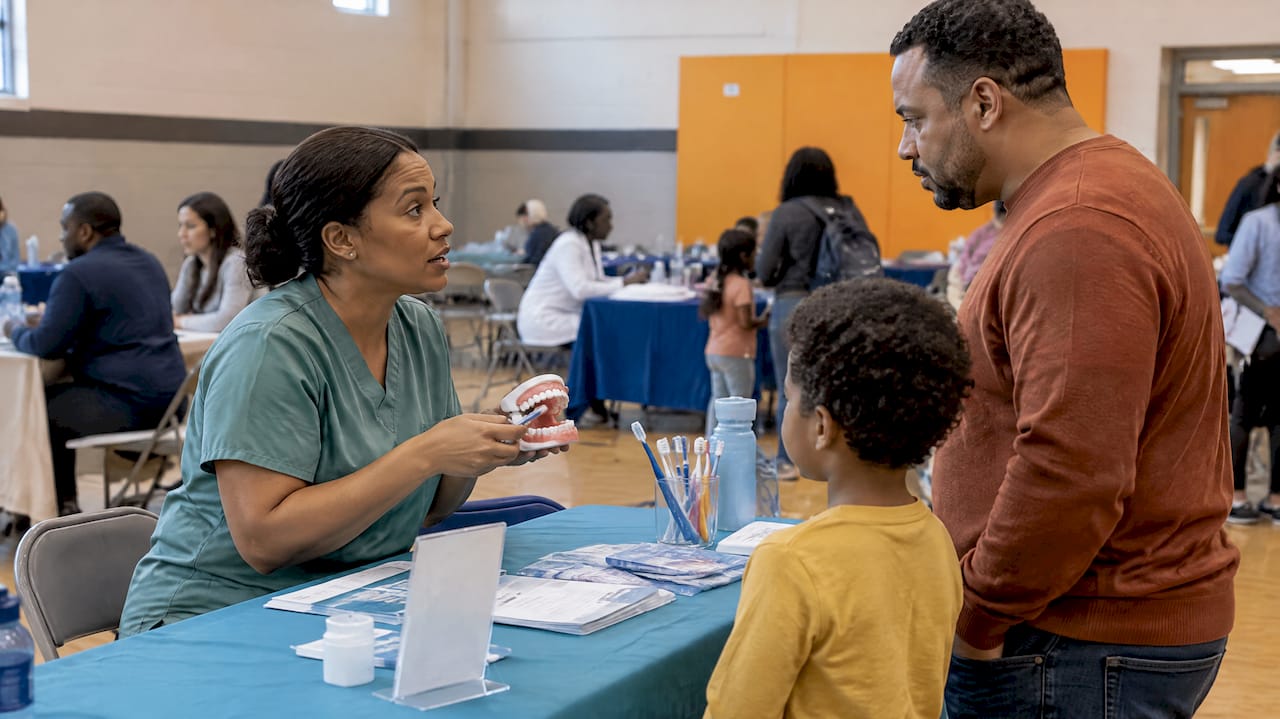
Paid ads are one part of local marketing. A franchise marketing writer recommends hosting events, sponsoring local sports teams and partnering with chambers of commerce, business associations and nonprofits, then mapping those partners and keeping a monthly calendar of touchpoints in the trade area. The same piece argues that earned media coverage adds credibility advertising cannot buy and supports both search visibility and appearances in AI-generated answers.
For a dental or medical location, that might be a school screening day or a health fair. For a law firm location, a local business association seminar. For retail and CPG, a store event tied to a product launch.
Use direct mail and offers with a trackable hook
Direct mailers tied to local events, with QR codes and exclusive offers, give you attribution that is hard to get offline. Give each location its own code or tracking number so results stay separable.
Make video do more work
The same planning guide that reports franchisee strain also cites vertical video ads with up to 58% greater reach than horizontal. Vertical is the default format on the platforms where local audiences scroll, so shoot and edit for it first.
Measure what matters
A franchise scorecard has to work at three levels: the system, the region and the single location. Pull the same metrics for every unit so you can compare like with like and find your best and weakest markets.
Marketing metrics
- Leads and booked appointments or orders by location
- Cost per lead, always read next to conversion rate
- Review count, average rating and response time
- Local search visibility and Google Business Profile actions (calls, direction requests, website clicks)
- Email and text engagement by segment
Business metrics
- Revenue per location
- Same-unit sales growth, which compares units that have been open for at least 13 months, so new openings do not hide stagnation in mature ones
- Marketing spend as a share of revenue per location
A franchise consultancy’s KPI guide makes the cost-per-lead point well: a $400 lead can be a bargain or a waste depending on how many leads become customers. The same logic applies to patients, clients and shoppers. Cost per lead means little until you know what share converts.
Set a review rhythm. Weekly checks catch broken tracking and budget pacing. A monthly review compares locations and decides which tactics to scale or retire. A quarterly review updates the plan and the budget split. Connect your CRM to your ad and call data so a lead can be followed from first click to booked visit; our CRM implementation roadmap explains how to roll that out in phases.
A 90-day plan to put the strategy in motion
- Days 1 to 30: foundation. Audit brand assets, location listings, websites and current spend. Write the franchisor and franchisee responsibility split. Choose the metrics and set up tracking.
- Days 31 to 60: build. Finalize templates, location pages and Google Business Profiles. Launch core campaigns with geo-targeting in a first group of markets.
- Days 61 to 90: learn and expand. Compare locations, move budget to what works, add community and event tactics, and roll the playbook to remaining markets.
If you want a structured starting point, a marketing assessment and a marketing plan cover the first of those steps.
Why a full-service partner fits franchise networks
A franchise network needs brand work, websites, search, paid media, creative and reporting to move together. When those sit with different vendors, each location ends up with a different version of the brand and nobody sees the full picture.
The Artist Evolution is a full-service marketing agency with more than 18 years in business and a multidisciplinary in-house team. We work with clients from startups to household brands across healthcare, legal, retail and other sectors, and we function as an extension of your team, bridging strategy and execution.

For a franchise network, that means one partner can build the brand foundation, design the website, run local SEO and pay-per-click, supply the marketing tools and report on results. If you are ready to scope it, start at theartistevolution.com and tell us about your network.
Our perspective
Franchise marketing fails most often at the handoff. The national team builds something strong, and the location never gets the version it can actually use.
We design for that handoff first. We start with the brand, because a clear story and identity make every later decision easier. Then we build the pieces locations rely on: pages, listings, campaigns and templates that work in each market without anyone starting from scratch.
Our 18 years in business and in-house team let us handle strategy and execution together, so the plan you approve is the plan that runs. Healthcare, dental and legal networks in particular benefit from one consistent system that makes visibility and patient or client engagement measurable by location.
Our approach is built on measurable results. We report by location, show you what each market is producing and use that to shift budget toward what works.
Derek
FAQ
How do you market a franchise business?
Combine national brand campaigns with local tactics for each location. Local work includes search optimization, a maintained Google Business Profile, geo-targeted ads, reviews and community partnerships. Keep the brand elements fixed and let locations edit templates for local details.
How should franchisors and franchisees split marketing responsibilities?
The franchisor owns brand standards, approved creative, national campaigns, shared technology and system reporting. The franchisee owns local execution, community relationships, accurate location information and customer service. Both share campaign planning and the monthly review of what to scale or stop.
How do you generate leads for a franchise location?
Start with the highest-intent channels: local search and paid search aimed at the location’s trade area. Add email, social content and community events. Give each location its own tracking number and landing page so you can see which source produced each lead.
How much should a franchise spend on marketing?
Your franchise agreement sets the required contribution, and one industry whitepaper reports that most franchisors collect around 2% of gross monthly revenue for brand and local advertising. Local spend on top of that depends on your market and growth goals. Track marketing spend as a share of revenue per location.
How do you measure franchise marketing performance?
Track leads, cost per lead, conversion, reviews and local search actions by location, then tie them to revenue and same-unit sales growth. Review them weekly for pacing, monthly for comparisons and quarterly for budget changes.
Sources
- Local franchise marketing: strategy and software, Birdeye
- How to Balance Brand Consistency and Local Relevance, Constant Contact
- Local Digital Marketing: Creating an exceptional customer journey, Franchising.com
- Guide to Franchise Marketing, Uber Eats
- Local Marketing Strategies for Small Business Owners, Franchise Wire
- 2025 Planning Guide for Franchise Marketers, Tiger Pistol
- Why the Creator Economy is the Next Big Win for Franchise Marketing in 2025, Franki
- Key Performance Indicators Every Franchisor Should Monitor, Accurate Franchising