
Creative fatigue analysis means tracking each ad on its own, comparing it with its own history, and watching three things together: how often people see it, how many of them respond, and what each result costs. When those move the wrong way at the same time, the ad is worn out and needs a replacement. Looking at frequency alone, or at a campaign average, hides the problem until budget is already wasted. This guide shows a clinic, law firm, consultancy, retailer or consumer brand how to run that analysis, what to do with the answer, and where an agency saves the most time.
TL;DR
- Creative fatigue is what happens when the same people see the same ad elements again and again and stop responding. Meta’s analytics team ties it to falling conversion rates and rising cost per action.
- Analyze by individual ad, not by campaign. Compare each ad with its own first weeks, because account averages blend young and old ads.
- One metric proves nothing. Fatigue is likely when frequency rises, click-through rate falls and cost per result climbs together.
- Set retirement triggers before launch, and keep new creative in production so a replacement is always ready.
- We build the testing, reporting and refresh routine as part of campaign management, so fatigue is caught by a system rather than a hunch.
Table of Contents
- What creative fatigue is, and what it is not
- Why it matters for the businesses we work with
- The warning signs to watch
- How to run a creative fatigue analysis, step by step
- A worked example
- How to prevent fatigue before it starts
- How often should you refresh?
- Why an analysis is only as good as the system behind it
- Perspective
- Put a fatigue routine behind your campaigns
- FAQ
- Sources
What creative fatigue is, and what it is not
Creative fatigue is the drop in response that follows repeated exposure to the same creative. Meta defines creative as the visual elements of an ad, and its analysts note that the effect extends across different ads that reuse the same images, footage or layouts. Swapping the headline on the same photo does not reset the clock for the person who has seen that photo ten times.
Two neighboring terms are often mixed up:
- Ad fatigue is usually the audience-level outcome: click-through rate and return on ad spend sliding because people have seen too much.
- Audience saturation means you have reached most of the people a small audience contains. New creative helps here too, but a larger or different audience may be the real fix.
The distinction matters because it tells you where to look. If one ad decays while another to the same audience holds steady, the creative is the problem. If everything decays at once, check audience size and budget first.
Why it matters for the businesses we work with
The same mechanism hits very different advertisers.
- Healthcare and dental practices advertise to a local, finite pool of patients. The same appointment-reminder ad reaches the same few thousand people repeatedly, so fatigue arrives fast.
- Law firms often run narrow, high-cost campaigns. When a worn-out ad pushes cost per lead up, each wasted click is expensive.
- Consulting firms and new businesses run small budgets with a few ads. One tired ad can be the whole campaign.
- Retail and CPG brands run many ads across many placements, which makes it hard to see which one is decaying without ad-level reporting.
A survey of US marketing professionals reported by EMARKETER shows how common the gap is. Limited asset updates were the top reason creative underperformed in programmatic advertising, at 54.3%. Another 51.8% said they do not produce enough versions for different audiences, contexts or formats, and only 17.1% always correlate creative with performance. The same survey found 71.3% say evaluating or improving creative effectiveness has become more important.
The warning signs to watch
Amazon Ads lists the typical symptoms: declining engagement, rising frequency, lower click-through rates, reduced conversion rates, higher cost per click, fewer impressions as platforms downrank stale ads, and increased ad blindness. In practice you can group them into three signals.
- Exposure: frequency, meaning the average number of times each person has seen the ad, and the share of impressions going to people who have already seen it.
- Response: click-through rate, or for video, how many viewers stay past the first seconds.
- Cost: cost per click, cost per thousand impressions and cost per lead or sale.
Exposure rising while response falls and cost climbs is the pattern to act on. A drop in conversion rate alone can point to something else, such as a landing page problem, a pricing change or a broken form. Click-through rate usually moves first, which is why it is the early indicator most teams watch.
How to run a creative fatigue analysis, step by step
Here is the routine, with the place each step usually goes wrong and what we handle in our own process.
Step 1: Break results out by individual ad
Pull performance by creative, not by campaign or ad set. Search Engine Land advises analyzing by creative ID for exactly this reason: a campaign total can look healthy while its best ad is dying and a newer one props up the average.
Where it goes wrong: platform default views group results by campaign, and teams never open the ad-level breakdown. When we manage campaigns, ad-level reporting is part of the ongoing reporting and optimization we deliver, so each asset has its own line.
Step 2: Set each ad’s own baseline
Compare every ad with its own early performance and your own history, not an industry number. Search Engine Land recommends benchmarking against your own historical data and factoring in seasonality and placement. A dental implant ad in January, when people act on new-year resolutions, behaves differently from the same ad in August.
Where it goes wrong: copying a generic benchmark from an article. A click-through rate that is poor for a retailer may be excellent for a law firm. Your baseline is the only fair yardstick.
Step 3: Track the trend, not the single day
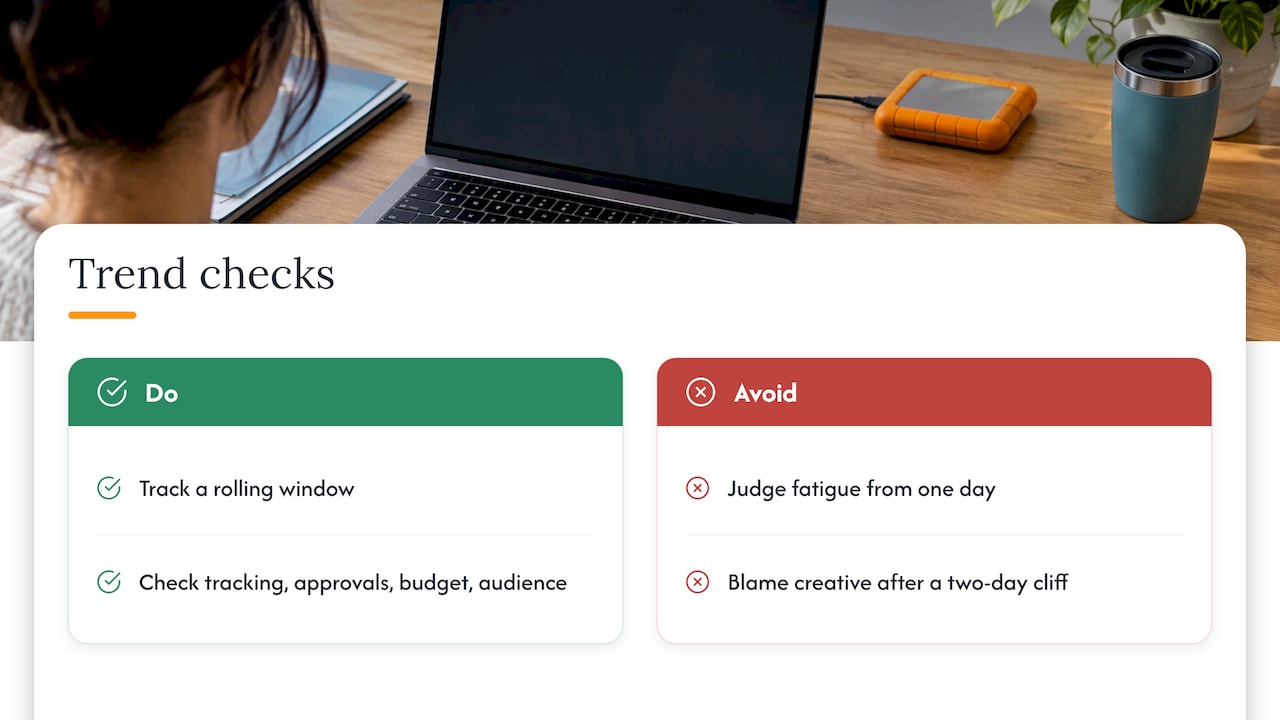
Daily numbers are noisy. Look at a rolling window of several days and ask whether the direction is consistent. A single bad Tuesday is not fatigue. A week of falling click-through rate with rising frequency is.
Search Engine Land also gives a useful lifecycle reference: a high-performing ad typically sees engagement drop about 20% to 30% week over week near the end of its natural run, and a faster decline points to a deeper problem than creative age. If an ad falls off a cliff in two days, check tracking, approvals, budget and audience before blaming the creative.
Step 4: Read the three signals together
Use a simple decision table.
| What you see | Likely cause | Next move |
|---|---|---|
| Frequency up, click-through down, cost up | Creative fatigue | Launch fresh creative |
| Frequency high on a small audience | Audience too small for the budget | Widen targeting or lower spend |
| Click-through steady, conversions down | Landing page, offer or tracking | Fix the page or the offer |
| Everything down at once across ads | Seasonality, competition or budget change | Review market factors first |
Search Engine Land notes that when frequency exceeds 3 for prospecting or 5 for retargeting, the audience may be too small for the budget. That is a sign to review reach, not only the artwork. If you retarget past visitors, our guide to retargeting frequency caps explains how to test limits based on intent.
Step 5: Decide with triggers, not feelings
Write down the retirement rules before an ad goes live. D2C Times reports that winning creative should carry predefined retirement triggers, such as a frequency threshold, a cost ceiling or a click-through floor, set before launch. That removes the temptation to leave a once-great ad running because it used to work.
A fixed calendar alone is a blunt tool: it retires strong ads as readily as weak ones. Triggers drawn from your own history let a winner run and a loser stop.
Step 6: Replace, and change the right things
When the verdict is fatigue, refresh. Search Engine Land recommends launching new versions under new ad IDs so the system re-enters learning, and avoiding drastic budget, bid or targeting edits at the same time, since frequent changes reset learning and slow recovery. Change one lever at a time so you know what worked.
A worked example
This is an illustration with made-up numbers, not a client result.
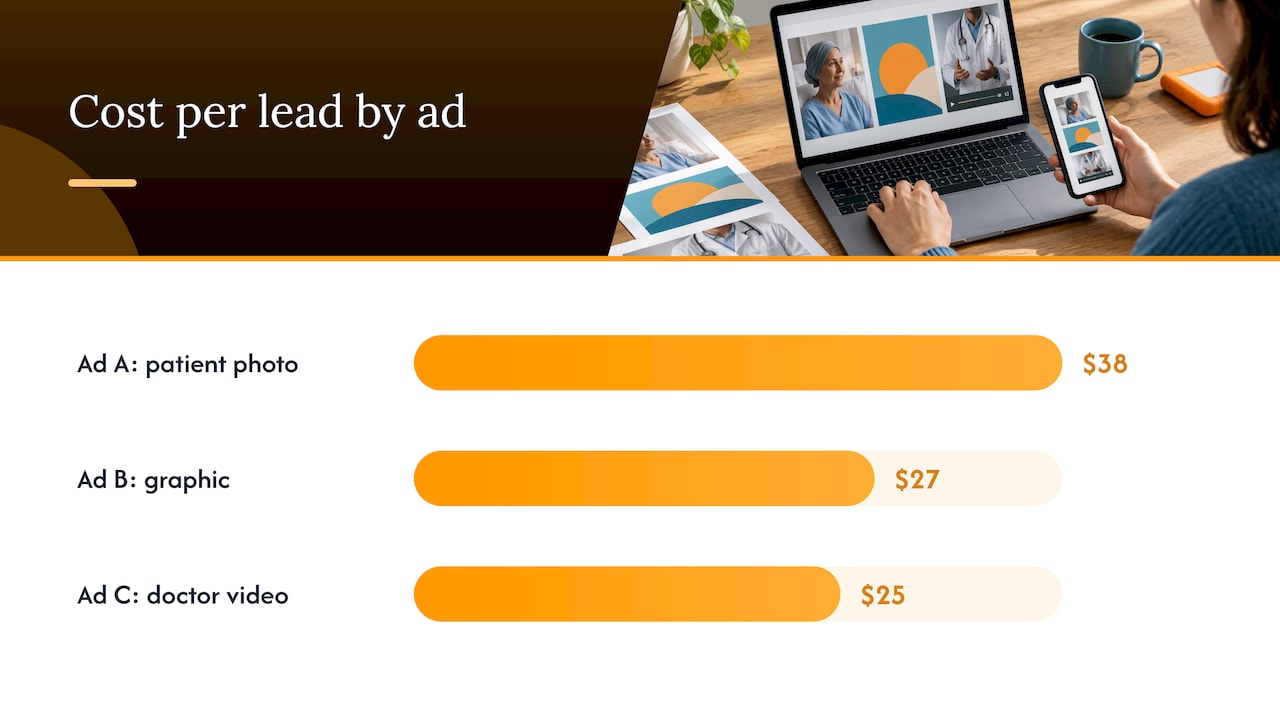
A dental practice runs three ads for a whitening promotion to a 25-mile radius. After two weeks, the campaign-level click-through rate looks flat. Ad-level reporting tells a different story:
| Ad | Week 1 CTR | Week 3 CTR | Frequency | Cost per lead |
|---|---|---|---|---|
| A: smiling patient photo | 1.8% | 1.1% | 4.2 | $38 |
| B: before-and-after style graphic | 1.4% | 1.4% | 1.9 | $27 |
| C: short doctor video | 1.2% | 1.3% | 1.6 | $25 |
Ad A has lost roughly 39% of its click-through rate, its frequency is the highest, and its cost per lead is the worst of the three. Ads B and C are healthy. The campaign average hid all of it. The fix is to retire Ad A, move its budget toward B and C, and brief two new concepts so the next fatigue point does not arrive with no replacement ready.
The lesson is not the numbers. It is that the decision was only possible because results were split by ad and compared with each ad’s own start.
How to prevent fatigue before it starts
Analysis tells you when an ad is tired. Prevention keeps you from running out of fresh options.
- Build several distinct angles. D2C Times reports that a common testing mistake is running five variations of the same concept and calling it a test. Real testing sets different angles against each other, such as education versus social proof, or a patient story versus a doctor explanation, with enough budget to reach a clear result. Our post on ad creative testing covers how to structure that.
- Mix formats. Static images, short video and carousels age at different speeds. Our guide to brand video types shows the formats and workflows that keep a video library full.
- Segment audiences. Amazon Ads recommends audience segmentation, frequency caps, dynamic creative and channel diversification alongside creative rotation. A message written for new patients should not be shown to existing ones.
- Keep production running. EMARKETER’s survey found the problems compound: without measurement you cannot see what needs refreshing, without multiple versions you cannot test, and without production budget you cannot make the variations. A steady pipeline solves all three.
- Mind the rules of your industry. Healthcare and legal advertisers have platform and professional restrictions on what an ad can say. New creative should be checked before it goes live, and our guide to compliant Facebook ads for clinics walks through it.
How often should you refresh?
There is no universal number. Evergreen campaigns that run for months need a regular review, and promotional campaigns need creative that matches the offer and the season. The better rule has two parts: refresh when your leading indicators cross the lines you set from your own history, and review any asset once it passes a maximum age you choose. Cadence then comes from data, with the calendar as a safety net.
For a small local budget, expect fatigue sooner, because the audience is small and the same people see the ad repeatedly. For a national retail or CPG campaign with a large audience, an ad can run longer, but more placements mean more assets to monitor.
Why an analysis is only as good as the system behind it
Most of the failures above are process failures. Nobody opened the ad-level report. Nobody wrote down a retirement trigger. Nobody had the next creative ready when the old one faded. Making the analysis a recurring routine, with reporting, a testing plan and a production calendar attached to it, is what turns a diagnosis into steady performance.
If your budget is flowing through several platforms, our 90-day runbook for media spend optimization shows how to connect creative decisions to spend decisions.
Perspective
Fatigue is rarely a surprise in hindsight. The ad was telling you for a week or two: frequency up, clicks down, cost creeping. The businesses that stay ahead are not the ones with better instincts, they are the ones who look at the right report on a schedule.
In our 18 years, we have found the most useful habit is to treat creative as a pipeline rather than a project. Strategy, design, copy, video and media buying sit in one in-house team, so when the numbers show an ad fading, the person reading the report can brief the person making the replacement the same day. No handoff between vendors, no weeks lost.
That is also why we pair creative with reporting and optimization. An ad that is retired at the right moment, replaced with a distinct new angle and measured against its own baseline will almost always do more for a clinic, a firm or a brand than a bigger budget pushed behind the same tired image.
Derek
Put a fatigue routine behind your campaigns
Our team builds and manages campaigns for startups through household brands, including ongoing reporting and optimization, creative asset production and content creation. For paid media, our pay-per-click management service is where ad-level analysis, testing and creative refreshes come together. If you are not sure where your current campaigns stand, a marketing assessment is a good first step, and you can reach us through the Artist Evolution site to talk through your goals.
What you get is a routine, not a one-off audit: ad-level reporting, clear triggers, and new creative ready before the old creative runs out.
FAQ
What is creative fatigue?
Creative fatigue is the decline in response that occurs when people see the same ad visuals repeatedly. Meta describes it as the effect of repeated exposure to the same creative, with conversion rates falling and cost per action rising as exposures build. It is fixed by adding genuinely new creative.
How do I know if my ad is fatigued or just underperforming?
Compare the ad with its own first weeks. If it started strong and frequency is now rising while click-through rate falls and cost per result climbs, it is fatigue. If it never performed, the issue is the offer, the audience or the concept, not age.
How do I avoid creative fatigue?
Run several distinct concepts, mix formats, segment your audiences and keep new creative in production. Set retirement triggers before launch so you replace ads on evidence. Launch replacements as new ads rather than editing a live one, so the platform treats them as new.
Is $10 a day enough for Facebook ads?
It can run an ad, but a small budget means slow learning and a small reached audience, so the same people may see your ad often. With a limited budget, test fewer, clearly different concepts and watch frequency closely. Our team can help you plan spend against your goals.
Sources
- Creative Fatigue: How advertisers can improve performance by managing repeated exposures (Analytics at Meta)
- Your ads are dying: How to spot and stop creative fatigue (Search Engine Land)
- FAQ: Marketers grapple with ad creative strategies in programmatic advertising (EMARKETER)
- What is Ad Fatigue? How to Diagnose, Prevent, and Cure It (Amazon Ads)