
B2B content syndication means distributing content you already own, such as an ebook, research report, case study or webinar, through third-party sites, networks and platforms so that new, relevant buyers see it. Done well, it extends the reach of your best assets and brings in contacts you would not have reached on your own. Done carelessly, it produces a spreadsheet of names that sales never wants to call. This guide shows how to do it well, from choosing partners to following up and measuring.
TL;DR
- Syndication works best when you start with a defined buyer profile and one strong asset, not with a vendor’s list of “available leads.”
- Treat a download as a sign of interest in a topic, not as a sales-ready lead. Route follow-up by what the person actually asked for.
- Protect your search rankings: ask partners to noindex syndicated copies and link back to your original.
- In the US, commercial email, including B2B email, falls under CAN-SPAM, and you remain responsible for what partners send on your behalf.
- Measure pipeline and revenue influenced, not cost per lead alone.
Table of Contents
- What B2B content syndication is and how it works
- Single-touch vs. multi-touch programs
- Build your syndication strategy in four decisions
- How to vet a syndication partner
- Protect your search rankings
- Lead quality, consent and compliance in the US
- Follow up on what the reader actually asked for
- Measure what matters
- A 90-day starter plan
- Our perspective
- Put your content to work with a full-service team
- FAQ
- Sources
What B2B content syndication is and how it works
There are two broad models, and they behave very differently.
Organic (earned) syndication. A publisher or industry site republishes or excerpts your article, usually with a credit and a link to the original. Nobody pays per lead. The goal is reach, authority and backlinks. According to Semrush’s overview of content syndication, syndication can expand reach, build brand awareness and authority, and generate backlinks.
Paid (lead-generation) syndication. You supply a gated asset. A partner promotes it to its audience or database through email, newsletters, content hubs and on-site placements. Interested readers fill out a form, and you receive their contact details, usually priced per lead. This is what most people mean when they search for content syndication programs.
The typical flow of a paid program looks like this:
- You choose an asset and define the audience: industry, company size, job function, seniority, geography.
- The partner promotes the asset to matching contacts.
- A reader requests the asset and submits a form, often with consent language for sharing their details with you.
- You receive the lead, which may be validated against your criteria.
- Your team follows up and nurtures the contact.
Write once, publish often is the appeal. The catch is that the buyer’s relationship is with the partner’s brand first and yours second. Your follow-up has to earn the trust that the placement borrowed.
Single-touch vs. multi-touch programs
A single-touch program delivers a lead after one interaction: the person sees the offer, downloads the asset, and the contact is passed to you. It is fast, simple and usually cheaper per lead. It also tells you the least about intent, because one click is a thin signal.
A multi-touch program exposes the same person to your content more than once, for example several assets in a sequence, or a download followed by a second engagement, before the lead is delivered. Fewer contacts come through, each with more evidence of interest, and the cost per lead is typically higher.
| Factor | Single-touch | Multi-touch |
|---|---|---|
| Volume | Higher | Lower |
| Cost per lead | Usually lower | Usually higher |
| Intent signal | One download | Repeated engagement |
| Best for | Top-of-funnel awareness, list building | Longer sales cycles, high-value accounts |
| Follow-up | Educational nurture | Consultative outreach sooner |
A simple rule: if your deals are large and your buying committees are small and well defined, pay for fewer, better-qualified contacts. If you need to build a nurture audience from scratch, single-touch can be a sensible starting point, as long as you do not expect it to produce meetings by itself.
Build your syndication strategy in four decisions
1. Define the audience before the channel
Write a one-paragraph buyer profile: the industries you serve, the company size you win, the titles that sign, and the titles that influence. Then add exclusions. Students, competitors, existing customers and companies outside your service area waste budget if they are not filtered out.
Healthcare, legal, dental and consulting firms often have narrow audiences. A partner with a big database is not useful if only a small slice matches. Ask for a count of contacts that fit your criteria, not the total database size.
2. Set one goal per program
Pick the primary job of this campaign:
- Awareness: reach and engagement among a target account list.
- Lead generation: a number of contacts that meet your criteria at an acceptable cost.
- Pipeline: meetings and opportunities sourced or influenced.
Mixing goals makes results impossible to judge. A program built for awareness should not be graded on closed revenue in 30 days.
3. Choose content that earns the exchange
The best-performing syndicated assets solve a specific problem for a specific role. Original research, practical templates, benchmarks and case studies tend to outperform generic overviews, because the reader gets something concrete in return for their details. Title the asset around the reader’s problem, not your product.
You rarely need to create something new. One strong report can become a short guide, a checklist, a webinar and several articles. Our content repurposing strategy walks through turning one asset into 8 to 12 derivatives. Case studies are a particularly good syndication asset, and our guide to writing B2B case studies shows how to get one signed off quickly.
4. Pick channels that match how your buyers research
Syndication is not only paid lead-generation networks. Your options include:
- Industry publications and association sites that republish expert articles.
- Professional networks and publishing platforms where you can repost long-form pieces with a link to the original.
- Paid placements on content hubs and email newsletters run by third parties.
- Social advertising that promotes the same gated asset. For B2B, LinkedIn is often the benchmark for precise job-title targeting. See our LinkedIn Ads playbook for B2B marketers and our LinkedIn Ads strategy for 30-day funnels for how that compares and combines with syndication.
One useful test: run the same asset through a syndication partner and through a direct paid social campaign, then compare lead-to-opportunity rates, not just cost per lead.
How to vet a syndication partner
Before you sign, ask every provider the same questions. Write down the answers so you can compare them later.
- Where does the audience come from? Opt-in newsletter subscribers, on-site readers, a purchased list? How recent is the opt-in?
- How is a lead defined and validated? Is each contact checked against your criteria before delivery? Is there a human review?
- What is the replacement policy? If a lead has a fake email, wrong title or a company outside your target, what happens?
- What consent language does the reader see? Does it name you as the recipient?
- Can you see where your asset is promoted? Transparency about placements and creative matters.
- What reporting do you get? Lead-level data, including source, date, form answers and the specific asset requested.
- How do they handle SEO? More on this below.
Be cautious about promises of guaranteed volume at very low cost. Cheap leads usually come from broad targeting and thin intent.
Protect your search rankings
Gated assets hosted on a partner’s form generally do not create a crawlable duplicate of your page. The SEO risk is greater with editorial republishing, where a full copy of your article lives on another site.
The risk is real: syndicated versions can show up in search results in place of your original, and that can confuse search engines about which page to show, as Semrush’s syndication guide notes. A high-authority partner can outrank you for your own article.
Google’s guidance is direct. In a June 2023 SEO office hours session, Google said that if you do not want syndicated versions to appear in Search, they should include a noindex robots meta tag, and that rel=canonical is a signal rather than a guarantee.
A practical checklist for republished articles:
- Ask the partner to add a noindex tag to the syndicated copy.
- Require a visible credit and a link back to the original page.
- Publish on your own site first and let it get indexed before the copy goes live elsewhere.
- Add a rel=canonical pointing to your original as a backup signal, knowing it may be ignored.
- Set a calendar reminder to search for key phrases from the article and confirm your page ranks as expected.
If you keep your own content healthy, your original has the best chance of winning. Our content refresh strategy explains how to lift pages that are already published, and our SEO agency services cover the technical work around it.
Lead quality, consent and compliance in the US
Syndication puts your name on outreach that you did not write and may not see. That makes compliance part of the program design, not a legal afterthought. The details below are general information; confirm your specific situation with counsel.
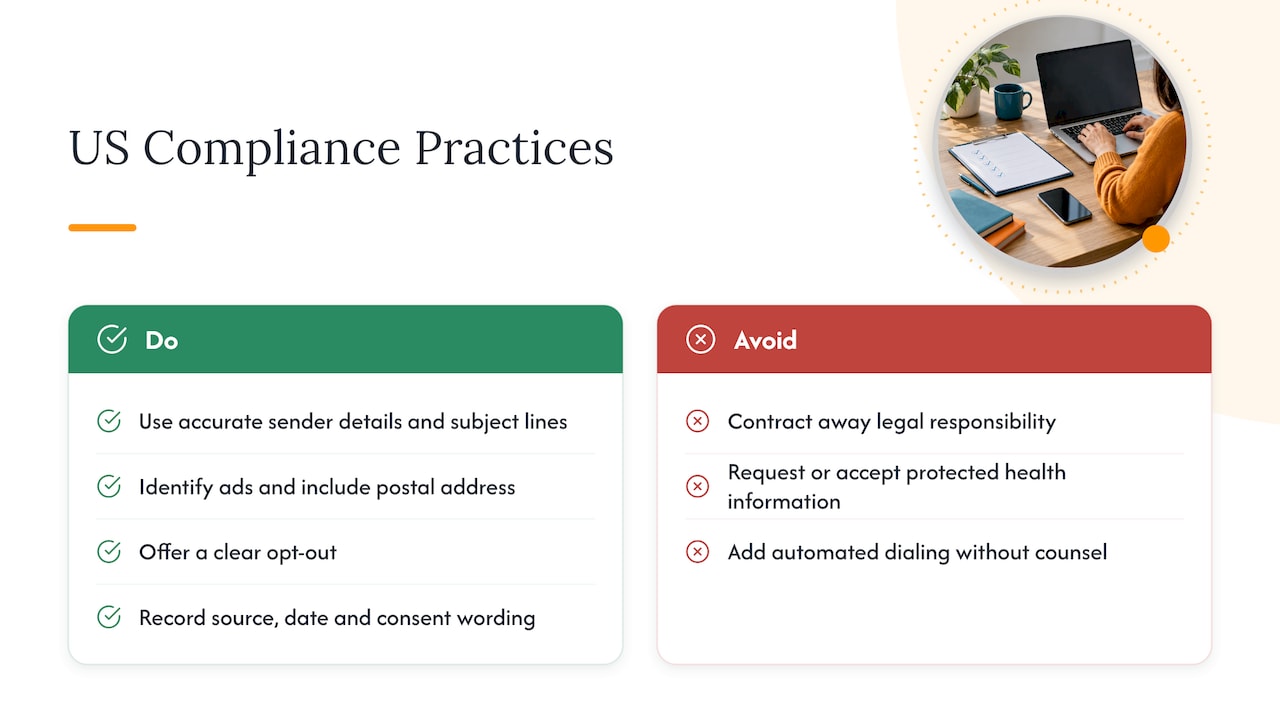
Email. The FTC’s CAN-SPAM compliance guide states that the law covers commercial email, including B2B email. Messages must carry accurate sender information and subject lines, be clearly identified as ads, include a valid physical postal address, and give recipients a clear way to opt out. The same guide makes clear that you cannot contract away your legal responsibility and must monitor what others do on your behalf. If a partner emails your offer, you need to know how they handle opt-outs.
Consent language. Review the form copy. The reader should understand who will receive their details. Make sure your follow-up matches what they agreed to.
Phone outreach. If your team calls leads, check the rules on calling, especially for mobile numbers and automated dialing, and scrub against the National Do Not Call Registry where it applies. Ask counsel before you add any automated dialing to a syndication follow-up process.
Regulated industries. Healthcare and legal marketers face extra rules about what they can say and what they can collect. Do not request or accept protected health information through a syndication form.
Data hygiene. Keep a record of the source, date and consent wording for every lead, and honor opt-outs across your systems.
Follow up on what the reader actually asked for
The fastest way to waste a syndication budget is to hand every download to sales as a hot lead. A person who downloaded a general guide has shown interest in a topic. A person who asked for a demo has shown interest in you. They need different responses.
A workable routing model:
| Reader action | What it signals | Response |
|---|---|---|
| Downloads a broad guide | Topic interest | Welcome email with related content, enroll in nurture |
| Downloads a second or more specific asset | Growing interest | Targeted nurture, light sales awareness |
| Matches your ideal profile and engages with pricing or case study content | Evaluation | Personal outreach from a rep |
| Requests a demo or consultation | Buying intent | Same-day response after a quick fit check |
Some practical rules:
- Respond quickly, but with the right message. Reference the asset they downloaded. Do not pretend they asked for a sales call.
- Check fit first. A 60-second review against your buyer profile saves reps from chasing contacts outside your market.
- Send a useful next step. A related case study, a short checklist or an invitation to a webinar usually outperforms a generic meeting request.
- Give nurture time. B2B decisions involve several people and often take months.
Measure what matters
Cost per lead is easy to measure and easy to misread. A program with a low cost per lead and no pipeline is more expensive than one with a higher cost and real opportunities. Track the full path:
- Delivery metrics: leads delivered, percent matching your criteria, percent rejected or replaced.
- Engagement metrics: email open and click rates on nurture, return visits to your site, additional content consumed.
- Sales metrics: meetings booked, opportunities created, pipeline value, closed revenue.
- Efficiency metrics: cost per qualified lead, cost per opportunity, return on spend.
Tag every syndicated lead with a source and campaign field in your CRM so you can trace it through to revenue. Review results at 30, 60 and 90 days, and compare programs by asset, audience and partner.
When results are weak, diagnose in this order: audience definition, then asset relevance, then form friction, then follow-up speed and message, and only then the partner. Many programs fail because of the follow-up, not the leads.
One caution on benchmarks: conversion rates from syndicated leads vary widely by industry, asset and audience. Build your own baseline from the first two or three programs instead of trusting a figure from a vendor’s report.
A 90-day starter plan
- Weeks 1 to 2: Write the buyer profile and exclusions. Choose one asset with a clear promise. Set one goal.
- Weeks 3 to 4: Shortlist partners, ask the vetting questions, review consent language and SEO terms. Set up CRM source tracking and the follow-up routing table.
- Weeks 5 to 8: Launch a limited test with a capped budget. Review the first leads by hand. Reject poor fits and document why.
- Weeks 9 to 12: Adjust targeting, test a second asset or a multi-touch version, and compare against a direct paid social campaign. Decide where to scale.
Our perspective
Most syndication programs fail in the handoff, not in the distribution. The placement gets the download. What happens in the next 48 hours decides whether it becomes pipeline.
We build programs backwards from the buyer. First the profile and the offer, then the asset, then the channel, then the follow-up and reporting. When strategy and execution sit in the same team, the lead that arrives is already expected, tagged and routed.
We also like syndication as one channel in a mix. The same asset that earns downloads through a partner can run on LinkedIn, feed an SEO content plan and become a case study. That is how a single investment keeps working, and how reporting shows what actually moved revenue.
Derek
Put your content to work with a full-service team
Syndication is easiest when the surrounding pieces are in place: a clear message, strong assets, a site that converts, and reporting you trust. The Artist Evolution has spent more than 18 years helping companies from startups to household brands build and manage campaigns, including brand development, SEO, pay-per-click management and marketing technology.
If you want to see how that works in B2B lead generation, read our case study on LinkedIn lead generation for an expanding agency. If you are not sure where to begin, a marketing assessment shows which channels and assets deserve budget first, and a marketing plan turns that into a sequence you can execute.

Ready to turn your best content into qualified conversations? Talk to our team about building a syndication and demand program that your sales team will actually use.
FAQ
Is content syndication the same as guest posting?
No. Guest posting means writing an original piece for another site. Syndication republishes or distributes content you already have, whether as an editorial copy or as a promoted gated asset. Both can build reach, but syndication is about getting more value from existing content.
Does content syndication hurt SEO?
It can if a full copy of your article outranks the original or confuses which page should rank. Ask partners to add a noindex tag to syndicated copies, link back to your original and publish on your own site first. Gated asset promotion usually does not create a crawlable duplicate.
How do I know if a syndication lead is any good?
Check it against your buyer profile: industry, company size, title and geography. Then look at behavior after the download, such as repeat visits, additional content and replies to follow-up. A contact that fits and engages is worth a sales conversation. A contact that only downloaded once belongs in nurture.
Do B2B emails have to follow CAN-SPAM?
Yes. The FTC states that CAN-SPAM applies to commercial email, including B2B email, and that you cannot hand off your responsibility to a partner. Accurate sender details, a physical postal address and a working opt-out are required.
What should I syndicate first?
Start with one asset that already performs well on your own site, such as a research report, a practical checklist or a strong case study. Choose something that answers a specific problem for one role in your target audience.
Sources
- What Is Content Syndication? The Basics + How to Do It, Semrush
- June 2023 Google SEO Office Hours Transcript, Google Search Central
- CAN-SPAM Act: A Compliance Guide for Business, Federal Trade Commission