
For most businesses, the right explainer video length is 60 to 90 seconds. That is enough time to name a problem, show your solution and ask for one next step. The best runtime for your video can move up or down from there, depending on where it will play, who is watching and how much explaining the product needs. This guide gives you the starting range, the adjustments that matter, a word-count formula for scripting, and a simple way to test what works for your audience.
TL;DR
- Start at 60 to 90 seconds for a homepage or product-page explainer, then trim until every second earns its place.
- Go shorter (15 to 30 seconds) for social feeds and paid placements, and longer (2 to 3 minutes) for complex products and late-stage buyers.
- Script at roughly 130 to 150 spoken words per minute, so a 90-second video needs about 200 words.
- Shorter videos hold a higher share of viewers, but length alone does not decide results. Clarity does.
- Publish two versions, watch retention and click-through, and let your own data set the final runtime.
Table of Contents
- Why 60 to 90 seconds is the usual starting point
- Explainer video length by goal and placement
- How funnel stage changes the right length
- Topic complexity: simple ideas, short videos
- Industry matters too
- What the retention data actually says
- Script to the clock: how many words fit
- A simple structure for 60 and 90 seconds
- Our perspective: length is a result, not a target
- When a longer explainer is the right call
- When shorter wins
- How to test your ideal length
- Common length mistakes to avoid
- Make the video part of a campaign
- Work with us on your explainer
- FAQ
- Sources
Why 60 to 90 seconds is the usual starting point
Most published guidance converges on the same window. A 60-second explainer has room for a hook, the problem, your solution and a call to action. Stretch to 90 seconds and you can add a short proof point or a second feature without rushing.
The pull toward shorter runtimes is real. HubSpot’s marketing data shows that 83% of marketers suggest keeping video under 60 seconds, and 71% of them report that shorter videos deliver a higher return on investment. Wistia’s State of Video data points the same way: videos under one minute average a 52% engagement rate, which it defines as the average share of the video viewers actually watch.
But those figures describe averages across every kind of video. An explainer has a narrower job than a brand teaser or a webinar. Its job is to make one idea click. Vidyard’s analytics guidance gives explainers a rule of thumb of more than 60 seconds, because explaining takes a little more room than attention-grabbing does.
So treat 60 to 90 seconds as the default, not the rule. The real rule is simple: use the shortest runtime that makes the idea clear.
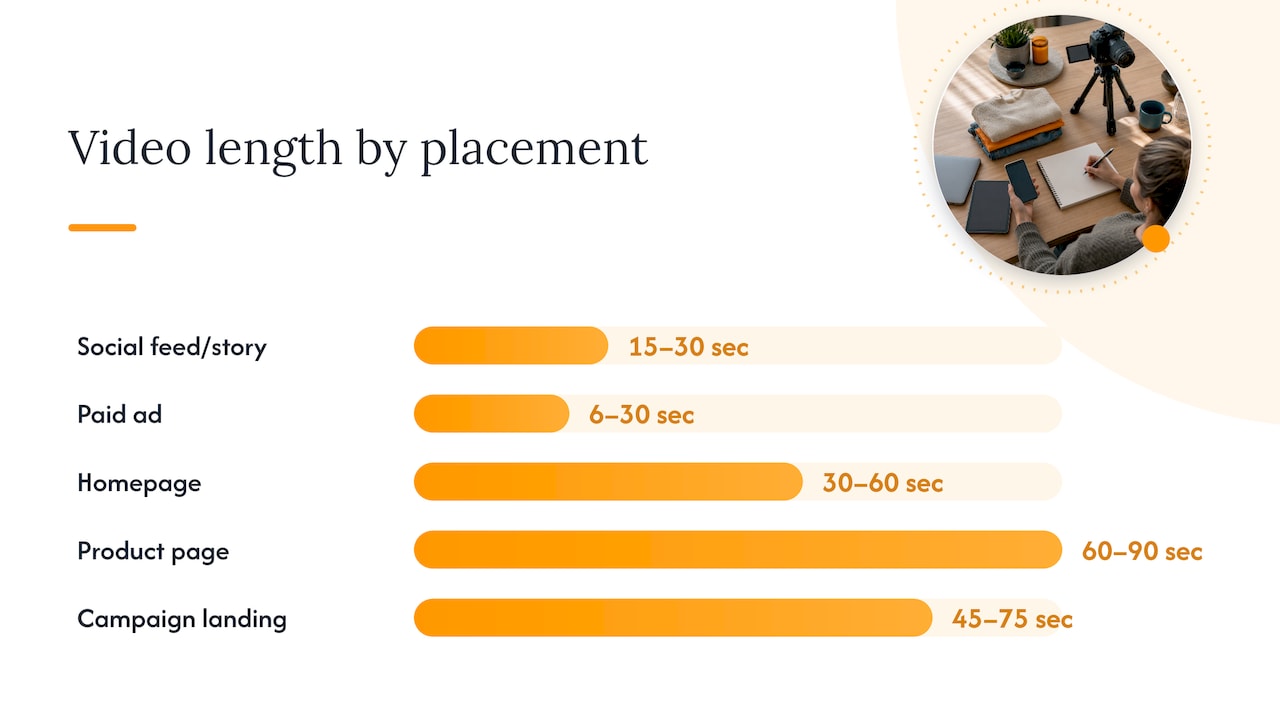
Explainer video length by goal and placement
Where the video lives changes how long it should be more than any other factor. A viewer scrolling a feed gives you a second or two. A visitor who landed on your product page on purpose will sit through more.
Here is the working range we use as a planning baseline. These are rules of thumb, not laws, and they overlap on purpose.
| Placement | Typical length | What the video should do |
|---|---|---|
| Social feed or story | 15 to 30 seconds | Hook fast, deliver one point, drive a click |
| Paid ad (pre-roll, in-feed) | 6 to 30 seconds | Land the offer before the skip button appears |
| Homepage | 30 to 60 seconds | Say what you do and who it is for |
| Product or service page | 60 to 90 seconds | Show how it works and why it is different |
| Landing page for a campaign | 45 to 75 seconds | Support one offer and one action |
| Sales or outreach email | 30 to 60 seconds | Earn a reply, not a full education |
| Software or process demo | 1 to 3 minutes | Walk through the key steps |
| Onboarding or help content | 2 to 5 minutes | Teach a task from start to finish |
Wistia’s 2026 data supports the broad logic behind this table: videos under one minute suit awareness and social, while 1 to 5 minute videos are optimal for educating or explaining. If you plan to cut one master video into several placements, shoot or animate the long version first, then build the 15 and 30-second edits from its strongest moments.
For a deeper look at the formats behind these placements, see our guide to brand video types and workflows.
How funnel stage changes the right length
A cold viewer has not asked for your pitch. A late-stage buyer has, and is looking for reasons to say yes. That difference should show up in your runtime.
- Awareness (cold audience): 15 to 30 seconds. Open on the problem, not your logo. The goal is a click or a follow, not full understanding.
- Consideration (comparing options): 60 to 90 seconds. This is the classic explainer. Show how your approach works and what changes for the customer.
- Decision (ready to choose): 2 to 2.5 minutes, sometimes longer. These viewers want specifics: process, proof, what happens after they sign.
Vidyard’s guidance describes the same pattern: shorter videos tend to work higher in the funnel, while longer videos can work later, when viewers are more invested. Practically, that means one company often needs three explainers, not one. A 20-second social cut, a 75-second homepage video and a 2-minute walkthrough for the sales team can all come from the same story.
Topic complexity: simple ideas, short videos
A product with one clear benefit fits in 30 to 60 seconds. A product with several moving parts, such as a multi-step service, a software platform or a regulated procedure, may need 90 seconds or more before it stops feeling rushed.
Ask three questions before you lock a runtime:
- Can a stranger state the single main idea after one viewing?
- How many steps, features or terms must they understand to get it?
- What would they need to see to trust it?
If the answers are “yes, two, and one proof point,” you are at 60 seconds. If they are “maybe, six, and a customer story,” plan for two minutes, or split it into a series of shorter videos that each carry one idea.
B2B and B2C often differ
Business buyers tend to tolerate more detail because the purchase is bigger and involves more people. A consumer deciding on a quick purchase tends to want less. If your explainer sells to other businesses, lean toward the upper end of the 60 to 90 second range, and add a longer companion cut for the evaluation stage. A consumer-facing product can usually live closer to 45 to 75 seconds.
Industry matters too
Some sectors earn attention in different ways. Wistia’s 2026 industry data shows that finance, insurance and health brands benefit most from long-form content of 30 minutes or more to build trust, while retail and food and beverage perform best with videos under three minutes.
That does not mean a dental practice needs a 30-minute explainer. It means the explainer is the front door, not the whole house. A healthcare provider might run a 60-second video on the service page to explain a procedure in plain language, then offer a longer educational video for patients who want depth before booking. A retail or CPG brand can keep the whole story short and visual, because shoppers decide quickly.
For legal and consulting firms, where trust carries the sale, a 90-second explainer on the practice page plus a 2 to 3 minute walkthrough of how an engagement works is a common and effective pairing.
What the retention data actually says
The engagement numbers are worth reading carefully, because they are easy to misuse.
Shorter videos show higher engagement rates, meaning a larger share of each video gets watched. Longer videos often produce more total watch time, which matters for reach on platforms like YouTube. Wistia’s report notes that shorter videos have higher engagement, but performance varies by industry, which suggests viewer intent matters more than the format itself. And for lead generation specifically, Wistia reports that videos between five and 30 minutes are most effective for converting or nurturing leads, at an average 9% click-through rate.
Put together, the lesson is not “shorter always wins.” It is that each length does a different job:
- Short videos win on completion and reach.
- Mid-length videos win on explaining.
- Long videos win on depth and trust with people who already want it.
Vidyard describes a 60% whole-video completion rate as a broad success benchmark. That is a useful target for an explainer, but only if the video is meant to be watched to the end. If your call to action sits at 20 seconds and viewers click then, a lower completion rate may be fine.
Also remember that useful or entertaining content can hold attention beyond short-form norms. A 3-minute video that never wastes a second will outperform a 60-second video that wanders.
Script to the clock: how many words fit
The fastest way to control length is to control the script. Spoken English runs at about 130 to 150 words per minute for a clear, paced voiceover. HubSpot puts the general range of 120 to 160 words per minute for an average speaker.
Using about 140 words per minute as a planning number:
| Runtime | Approximate script length |
|---|---|
| 30 seconds | 65 to 75 words |
| 60 seconds | 130 to 150 words |
| 90 seconds | 200 to 220 words |
| 2 minutes | 270 to 300 words |
| 3 minutes | 400 to 450 words |
Three tips make the math work in practice:
- Leave breathing room. Animation and on-screen text need pauses. If your visuals carry a point, cut the narration for it.
- Read it aloud with a timer. Silent reading is always faster than the finished voiceover.
- Cut to the lower end. A script that hits 130 words for a 60-second slot is safer than one stuffed to 160.
Some strong explainers use no dialogue at all, relying on motion graphics, music and text. In that case, time the video by the number of distinct beats, usually one new visual idea every 4 to 6 seconds.
A simple structure for 60 and 90 seconds
A clean structure keeps length honest. Here is the arc we build most explainers around.
- Hook (0 to 5 seconds): Name the problem your viewer feels, in their words.
- Problem (5 to 20 seconds): Make it specific and costly. Show what it looks like in daily life.
- Solution (20 to 45 seconds): Introduce your product or service and how it works, in no more than three steps.
- Proof (45 to 70 seconds, for the 90-second cut): One result, one customer scenario or one clear differentiator.
- Call to action (final 5 to 10 seconds): One action. Not three.
The 60-second version drops the proof beat or folds it into the solution. The 90-second version keeps it. Either way, work backward from the call to action: if a moment does not move the viewer toward it, cut it.
That one-idea rule applies to every kind of story. Even storytelling for nonprofit campaigns depends on a single clear narrative thread that people can repeat, and the same discipline keeps a commercial explainer short.
Our perspective: length is a result, not a target
After 18 years of building campaigns for startups and household brands, we rarely start a video project by asking how long it should be. We start with the job the video has to do, the person who will watch it and the action that should follow. The runtime falls out of those answers.
Here is what that looks like in practice:
- We write the single sentence the viewer should be able to repeat, then build only what supports it.
- We plan a family of cuts from one production, so a 90-second master also yields 30 and 15-second versions for paid and social use.
- We treat the video as one part of a campaign, which means it connects to the landing page, the ad targeting and the reporting from day one.
- We read the retention curve after launch and adjust. The first version is a hypothesis.
The common mistake we see is cramming. A company has six services and six messages, and tries to fit them into 60 seconds. The result is a video nobody remembers. Either choose one message or make several videos.
The opposite mistake is padding. If a 75-second idea is stretched to two minutes to feel more substantial, viewers leave at the point where the idea was already delivered.
Our view is simple: respect the viewer’s time, and they will give you more of it.
— Derek
When a longer explainer is the right call
Sometimes two to three minutes, or more, is correct. Longer runtimes make sense when:
- The product is complex, regulated or involves several steps the buyer must understand to trust it.
- The viewer is late in the funnel and actively comparing options.
- The video is for onboarding, training or a walkthrough, where completeness matters more than speed.
- The industry relies on trust, such as healthcare, legal or financial services.
When you go long, protect attention with structure. Break the video into clear chapters, put the most important point in the first 15 seconds, and consider adding timestamps or chapter markers where the player supports them. Keep a short version alongside it, so a casual visitor is not forced into the long one.
When shorter wins
Cut your explainer to 30 seconds or less when:
- It will play in a social feed, where the first two seconds decide everything.
- It is a paid ad, where the skip button is a hard deadline.
- The product is simple, familiar or low-cost.
- You are driving a click to a page that will do the longer explaining.
In these cases, one benefit and one action is the whole script. Captions help too, since many people watch with sound off.
How to test your ideal length
Industry averages get you to a first draft. Your own audience tells you the final answer. A basic test looks like this:
- Make two versions. For example, a 60-second and a 90-second cut with the same hook and call to action.
- Place them in the same context. Same page, same audience, similar traffic, run over the same period.
- Track the right metrics. Vidyard’s analytics tools report average percentage watched, average watch time, retention at specific moments and call-to-action engagement, which is the set you need.
- Find the drop-off. If viewers leave at 25 seconds in both versions, the problem is the content at that moment, not the length.
- Judge by the goal. A video meant to generate leads should be judged on clicks and form fills, not on completion alone.
- Keep the winner and iterate. Trim the weakest section, republish and compare again.
Sample size matters. A page with a few dozen visits will not give a reliable answer, so test on your highest-traffic placement or extend the test period.
Common length mistakes to avoid
- Starting with the company, not the problem. Ten seconds of logo and history costs you a third of a short video.
- Packing in every feature. Pick the three that matter to this audience.
- Ignoring the platform. A homepage video reused as an ad rarely works. Re-cut it.
- Setting runtime by competitors. What others publish does not tell you what your audience needs.
- Skipping the call to action. A video without a next step is entertainment, not marketing.
- Never measuring. A video you do not analyze cannot improve.
Make the video part of a campaign
Length decisions work best when the video is planned alongside the rest of your marketing. A great 75-second explainer on a page nobody visits does little. That is why we build video as part of a full campaign: strategy first, then production, distribution, paid media and reporting.
If you are weighing formats, our animated video and live-action video services cover both approaches. For budgeting, our breakdown of video production costs shows where spend goes, and the benefits of a brand explanation video explain why the format keeps earning its place. For the bigger picture, read why video marketing is the future of digital advertising.
Work with us on your explainer
If you want an explainer sized correctly for your audience, platform and goals, we can help. We start with a review of where you are today, then plan the video, the cuts and the campaign that carries it. See how we manage campaign strategy and ongoing management, or start with a marketing assessment to find where video fits.
Tell us what you need the video to do, and we will tell you how long it should run.
FAQ
Is 3 minutes too long for an explainer video?
Not always. Three minutes works for complex products, late-stage buyers and onboarding content, where viewers want detail. For a homepage or social placement it is usually too long, so offer a 60 to 90 second cut there and keep the longer version for people who ask for more.
How many words should an explainer video script have?
Plan on about 130 to 150 spoken words per minute. That makes a 60-second video roughly 130 to 150 words and a 90-second video roughly 200 to 220 words. Read the script aloud against a timer, because the finished voiceover is almost always slower than silent reading.
Should I make one explainer or several versions?
Several, if you can. A 15 to 30 second cut for social and ads, a 60 to 90 second video for your website and a longer walkthrough for sales conversations serve different viewers. They can all come from one story and one production.
What is a good completion rate for an explainer video?
Vidyard cites a 60% whole-video completion rate as a broad success benchmark. Treat it as a reference point, not a rule. If your call to action appears early and drives clicks, a lower completion rate can still mean the video is working.
Sources
- Wistia: How to choose the right marketing video length
- Wistia: State of Video Report, video marketing statistics
- HubSpot: How much does an explainer video cost
- HubSpot: How to create an engaging 5-minute presentation
- Vidyard: The video analytics metrics you need to track
- Vidyard: Analyze video performance with the Insights dashboard
- Storytelling for nonprofit public campaigns