
This page gives you a copy-ready digital marketing RFP with scoring rubric, a weighted scoring rubric, and a realistic timeline from draft to award. You’ll find the eight sections every proposal should include, thirty prioritized questions for agencies, and clear rules for when a formal RFP is worth running at all. The whole structure is modular, so you can pull sections in or out based on project size and budget.
TL;DR:
- Formal RFPs are justified mainly for complex, multi-channel projects with substantial annual marketing budgets or procurement rules requiring documentation.
- Requesting detailed team bios, verifiable case studies, and signed legal certifications helps ensure transparent, comparable proposals.
- Fixing evaluation weights on strategy, team, and proven performance before proposal submission helps keep scoring aligned with project priorities.
- The full RFP process typically takes nine to fifteen weeks, with shorter timelines recommended for smaller budgets under $50,000 to $100,000.
- For lower-spend projects, a referral or brief to trusted agencies often outweighs the effort and cost of a formal RFP.
Table of Contents
- What a marketing RFP is and when to use one
- Essential sections to include in your RFP
- Sample questions to ask marketing agencies
- How to evaluate proposals with a weighted rubric
- Timeline and process rules from draft to award
- Proposal format and required attachments
- Copy-ready template skeleton and customization tips
- Practitioner guidance on when to skip the formal RFP
- A few rules of thumb worth following
- Get help drafting or running your marketing RFP
- FAQ
- Sources
What a marketing RFP is and when to use one
A request for proposal (RFP) is a formal document that asks agencies to respond with a specific plan, team, and price for a defined scope of work. It differs from a request for information (RFI), which gathers general capability data, and a request for quote (RFQ), which is used when the deliverable is standardized and price is the deciding factor. An RFP works best when you need comparable, auditable proposals from multiple vendors before a contract decision.
Running a full RFP makes sense under a few conditions:
- The project has complex, multi-channel scope that’s hard to describe in a short brief.
- Annual marketing spend is substantial enough that a formal comparison process pays for itself.
- Procurement or compliance rules require documented, auditable vendor selection.
When none of those apply, a referral or a short brief to two or three trusted agencies usually gets you a faster, cheaper decision. A proper RFP process should produce comparable proposals, a documented evaluation trail, and a selection you can defend to finance or leadership, according to the complete RFP process guide from Brandmovers.
Essential sections to include in your RFP
A marketing RFP works best as a specification document built around measurable outcomes, not a loose conversation starter, according to TrinityP3’s agency RFP guidance. Treat the document as modular: deactivate any section that doesn’t apply to your project so evaluators aren’t scoring filler.
Here’s the eight sections skeleton to copy into your document:
- Cover and contacts: RFP title, issue date, submission channel, and a single named contact.
- Company background: a short description of your business, market, and current marketing setup.
- Objectives and KPIs: the measurable goals and success metrics this engagement needs to hit.
- Scope of work: channels, deliverables, and explicit exclusions so nothing gets assumed.
- Budget and timeline: fee envelope or range, who handles media spend, and key milestone dates.
- Proposal requirements: file structure, page limits, and required attachments.
- Evaluation criteria: weights, pass/fail gates, and the scoring scale you’ll use.
- Legal and submission checklist: NDA, IP terms, data handling, and a final submission checklist.
Pro Tip: Lock your evaluation weights before you send the RFP, not after proposals arrive. Scoring criteria decided in advance keeps the process focused on priorities instead of first impressions.
Sample questions to ask marketing agencies
Thirty focused questions, grouped by what they reveal, give you enough signal to compare agencies fairly without burying them in busywork.
- What’s your initial read on our biggest marketing gap?
- What would you test first, and why?
- How will you define success in the first 90 days?
- Which KPIs will you report against, and how often?
- Who is the named lead on our account?
- How many hours per week will senior staff dedicate to us?
- Who else on the team touches this account day to day?
- Can you share a case study with specific before-and-after metrics?
- Can we speak directly with a current client reference?
- What’s your average client tenure?
- What’s your fee model: retainer, project, or performance-based?
- What assumptions does your quote depend on?
- Do you mark up media spend, and if so, by how much?
- Is your rate card available on request?
- What’s included versus billed as an extra?
- What reporting cadence do you commit to?
- What tools do you use for tracking and attribution?
- What’s your standard response time for urgent requests?
- What happens if a campaign underperforms against target?
- How do you handle creative revisions and scope changes?
- What’s your onboarding process in the first 30 days?
- How do you structure testing and optimization cycles?
- What data do you own versus what do we own?
- How do you export our data if we part ways?
- What security certifications do you hold?
- How do you handle conflicts of interest with competitors?
- What insurance coverage do you carry?
- How do you staff for seasonal spikes in workload?
- What’s your escalation process when something goes wrong?
- Why should we pick you over an agency with a similar offer?
How to evaluate proposals with a weighted rubric
Fixing your weights and scoring scale before proposals land is standard procurement practice, and it’s one of the clearest ways to keep scoring grounded in priorities rather than polish, according to the Sourcing Industry Group’s RFP template. Publishing those weights with the RFP itself also improves the quality of what agencies send back, since they know exactly what you’re judging.
A workable starting rubric:
- Strategy and approach: 30%. Does the thinking match your actual problem?
- Team and resourcing: 25%. Named leads, real hours, not just logos on a slide.
- Performance proof: 20%. Verified case studies and references over promises.
- Price: 15%. Total cost against the proposed scope, not just the headline number.
- Technical and compliance: 10%. Certifications, insurance, data handling.
Score each criterion on a written 1 to 5 scale with definitions for each number, which removes most of the subjectivity that creeps into panel scoring. Pair that with pass/fail gates for non-negotiables: security certifications, active insurance, and no undisclosed conflicts of interest. A proposal that fails a gate is out regardless of its score elsewhere.
Timeline and process rules from draft to award
A full marketing agency selection typically runs 9 to 15 weeks from drafting to signed contract, with simpler projects moving faster and platform-heavy procurements taking longer due to technical and legal review, per Brandmovers’ RFP process guide. A workable schedule looks like this:
- Drafting: 2 weeks to write and internally approve the RFP.
- Q&A window: 1 to 2 weeks for agencies to ask clarifying questions.
- Response window: 3 to 4 weeks for agencies to build proposals.
- Evaluation: 1 to 2 weeks for scoring and internal debate.
- Finalist stage: 2 to 3 weeks for presentations, reference checks, and negotiation.
Keep the process fair by routing every question through a single point of contact, publishing all Q&A to every bidder at once, and sending identical briefing materials to each agency. For finalists, require a standard presentation template, completed reference checks, and a clearly scoped demonstration so you’re comparing like for like.
Proposal format and required attachments
Comparable proposals depend on a fixed submission format. Ask for the technical response as a PDF and the cost proposal as a separate spreadsheet, since separating cost from narrative prevents pricing from getting buried in creative language, a practice reflected in public-sector marketing services RFP examples. Set a page limit, usually 10 to 15 pages for the narrative, and require consistent file naming.
Required attachments worth standardizing:
- Team bios for every named lead, not just account directors.
- One to three case studies with specific, verifiable metrics.
- Signed certifications covering insurance and security where relevant.
- A completed cost workbook in your fixed template, not a freeform quote.
On the legal side, require a signed NDA, a clear statement of who owns IP produced under the contract, the format and timeline for data export if the relationship ends, and a compliance declaration covering data handling.
Copy-ready template skeleton and customization tips
Paste these placeholders directly into your document and fill in the brackets with your own specifics:
- Cover: “[Company name] Marketing RFP, issued [date], responses due [date] to [contact].”
- Background: “We are a [industry] business serving [market] with [current setup] in place.”
- Objectives: “We need to improve [metric] from [baseline] to [target] by [date].”
- Scope: “This engagement covers [channels/deliverables] and excludes [exclusions].”
Pro Tip: Build your scoring workbook as a simple spreadsheet with one tab per criterion and automatic weighted totals, so the math updates itself as each evaluator enters scores.
Toggle out sections that don’t apply: a brand refresh RFP rarely needs a media pass-through clause, while a paid media search can skip most creative brief sections. Keep the master file in Google Docs for easy collaborative editing, then export to DOCX for formal distribution.
Practitioner guidance on when to skip the formal RFP
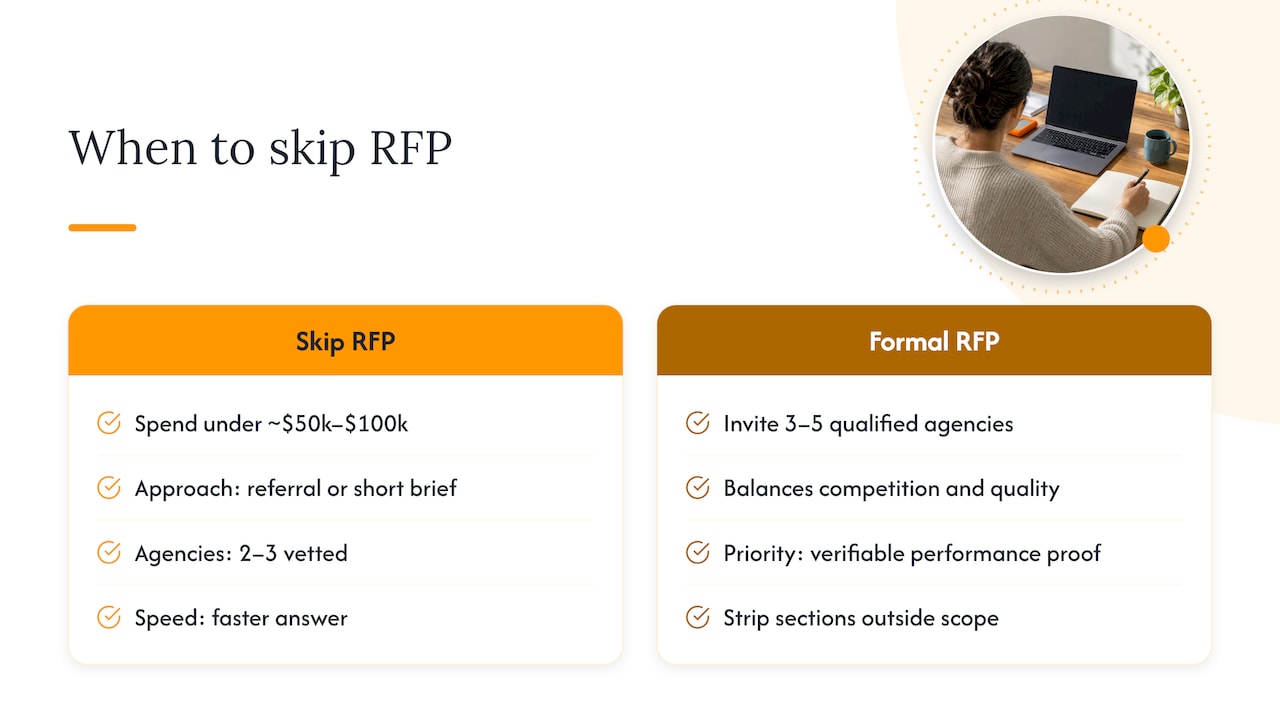
A full RFP is often more process than the project needs when annual marketing spend sits under roughly $50,000 to $100,000, since a referral or a short brief to two or three vetted agencies usually gets a faster answer, per SocialRails’ agency RFP guide. When you do run a formal process, invite three to five qualified agencies, a range that balances real competition against proposal quality, according to the National Marketing Awards RFP guide. Weight verifiable performance proof above polished presentation, and strip any section that doesn’t apply to your scope.
A few rules of thumb worth following
Three shortcuts save real time. First, if you can’t name the metric an agency is supposed to move, you’re not ready to send the RFP yet. Second, a proposal that leans on brand names instead of named leads and specific hours is telling you something. Third, watch for a missing data export clause, vague success metrics, or no named account team: each is a red flag worth asking about before you sign anything.
— Derek
Get help drafting or running your marketing RFP
Writing a defensible RFP and scoring it fairly takes time most marketing teams don’t have free. Our Marketing Assessment gives you an outside read on your current setup before you even draft questions, which sharpens the objectives section and keeps your scope realistic.

- We help translate your goals into the KPIs and success metrics your RFP’s objectives section needs.
- We can scope a marketing plan that doubles as the benchmark against which agency proposals get measured.
- We have extensive experience responding to agency RFPs across retail, healthcare, legal, and consulting.
If you’d rather skip the RFP process and talk directly about strategy and campaign management, reach out and we’ll walk through what a working partnership would look like for your scope and budget.
FAQ
What is a marketing RFP template?
A marketing RFP template is a structured document with fixed sections, covering background, objectives, scope, budget, proposal requirements, and evaluation criteria, that agencies fill out so their responses can be compared side by side. A good template also ships with a scoring rubric so evaluators judge every proposal against the same standard.
How many agencies should I invite to respond?
A shortlist of a few qualified agencies balances real competition against proposal quality, according to the National Marketing Awards guide. Invite fewer for resource-heavy creative pitches and more when bidders can respond quickly, such as technical or commodity selections.
How long does a marketing RFP process take?
A full selection process commonly runs 9 to 15 weeks from drafting the RFP to signing a contract, per Brandmovers’ RFP guide. Simpler projects move faster, while platform or technical procurements take longer due to legal and security review.
Is a formal RFP always necessary?
No. For many mid-market projects, a formal RFP is more process than needed when annual marketing spend is under roughly $50,000 to $100,000, and a referral or short brief to two or three vetted agencies is often more efficient, according to SocialRails. Formal RFPs earn their cost when scope is complex or procurement rules require a documented evaluation.
What should the scoring rubric weigh most heavily?
Strategy and approach typically carry the most weight, often around 30%, followed by team quality and performance proof. Weighting documented performance results meaningfully, in the 25 to 35% range, helps favor verified outcomes over polished but unproven pitches, a point echoed in Social Animal’s agency RFP scoring guidance.
Sources
- Marketing agency RFP template — TrinityP3
- Template: Marketing Services RFP — Sourcing Industry Group (SIG)
- Marketing agency RFP guide — SocialRails
- What Is the RFP Process? A Complete Guide for Marketers — Brandmovers