
Expect to pay from low to moderate amounts for short social clips, a mid-range budget for corporate or explainer videos, and significantly more for high-end commercial work. The number that moves your budget the most isn’t the video style, it’s scope: how many finished assets you need, how many shoot days those assets require, and how many rounds of revisions you’ve built into the plan. Use these bands to size your brief before you request quotes, or run your numbers through a line-item cost calculator for a tailored figure.
TL;DR:
- Most video projects’ costs are driven by scope, including the number of assets, shoot days, and revision rounds, rather than just video style or length.
- Production expenses are split into roughly 10–25% for pre-production, 40–55% for shooting, and 25–35% for post-production, with rates varying by market and labor type.
- Per-minute quotes can be misleading because costs depend on complexity, talent, and deliverables, with typical ranges from $1,000 to over $10,000 per finished minute.
- Producing multiple assets in a single shoot reduces costs significantly, especially when scripts, storyboards, and talent are locked beforehand.
- Using detailed, itemized budgeting tools and proactively planning for all deliverables helps prevent unexpected costs and keeps the project aligned with the initial estimate.
Table of Contents
- What does video production cost by project type?
- Where does the money actually go during production?
- How should you interpret a per-minute video quote?
- Freelancer, agency, or in-house: who should produce your video?
- What drives costs up, and what do quotes usually leave out?
- How can you lower video production costs without cutting quality?
- Which budgeting tools help you build an accurate estimate?
- How much do video production costs vary by region?
- What payment terms should you expect, and how do you budget for them?
- What most buyers get wrong about video budgets
- How The Artist Evolution helps you budget and deliver video with fewer surprises
- Sources
- FAQ
What does video production cost by project type?
Every video type has its own economics, and the label matters less than what the budget actually buys. A “corporate video” at $4,000 looks nothing like one at $18,000, even though both fit the category.
Short-form and social content sits at the low end because it typically involves one shooting day, sometimes even a self-shoot setup, and produces a single cutdown for a single platform. Testimonial and interview videos cost a bit more, since they require a crew, lighting, and an interview subject, but the edit stays relatively light.
Corporate and explainer videos shot as live action climb quickly once you add scripting, branded graphics, and a run time of one to three minutes. According to benchmark data from 2026, corporate and brand films commonly run from $5,000 to $20,000 or more depending on scope, while social and short-form pieces stay closer to $800 to $3,000. Animated explainers land in a comparable range to their live-action counterparts, though the exact number depends heavily on animation style: simple motion graphics cost far less than character animation with custom illustration.
Commercial and brand film work sits at the top of the scale because it usually spans multiple shoot days, involves paid talent, and demands heavier post-production, including color grading and custom motion graphics.
- Short-form or social: typically one shoot day or a self-shoot, one platform cutdown.
- Testimonial or interview: single-camera setup with a straightforward edit.
- Corporate or explainer, live action: scripted, branded, one to three minutes.
- Animated explainer: price varies with animation complexity and style.
- Commercial or brand film: multi-day production, talent fees, and heavy post work.
Quantity changes everything. A single 60-second explainer might land near the bottom of its range, but ask for three vertical cutdowns, a square version, and a set of thumbnail stills, and the same shoot can push toward the top of the band or beyond it. Businesses that budget by asset count, not just by “one video,” end up with fewer surprises when the invoice arrives.
Where does the money actually go during production?
Every video project breaks down into three phases, and each one claims a predictable share of the total budget. Knowing these percentages lets you compare vendor quotes and spot what’s missing before you sign anything.
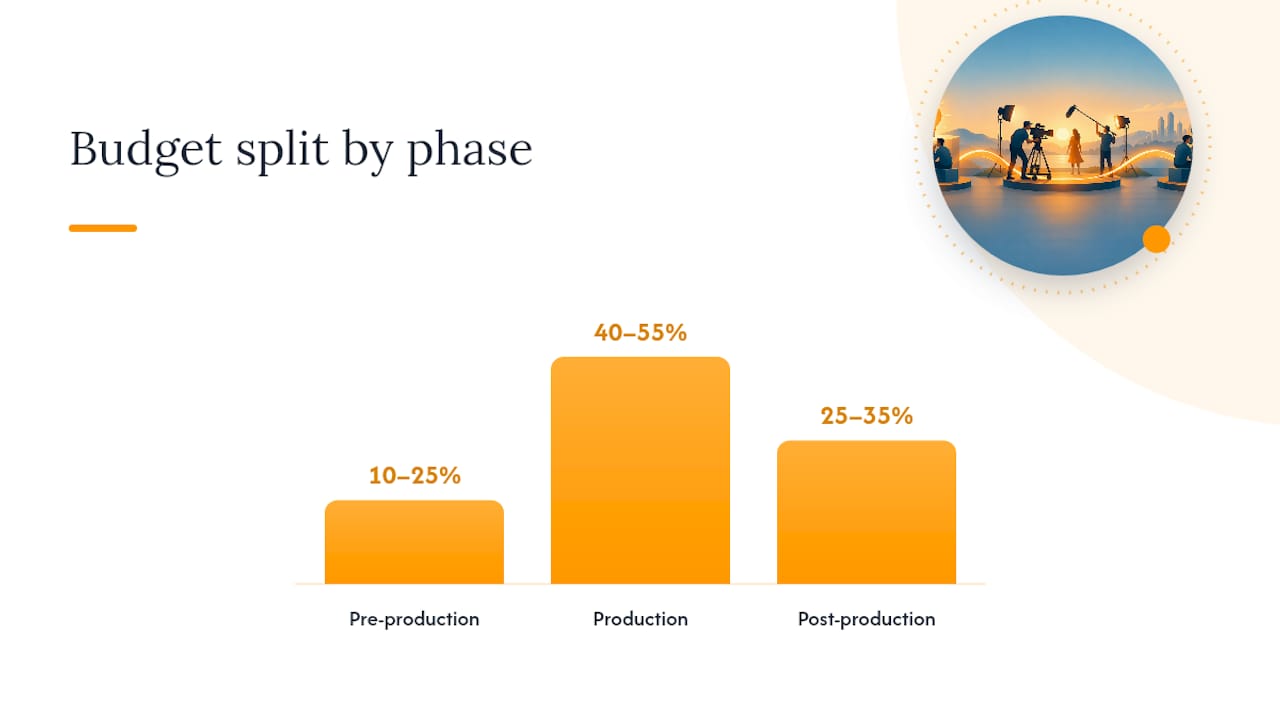
Pre-production typically runs a moderate share of the total budget, covering scripting, storyboards, casting calls, and scheduling logistics, and skipping it can lead to budget overruns through reshoots and confused direction on set.
Production claims the largest share, covering crew day rates, equipment rental, location fees, and catering. Post-production takes up the remaining portion, covering editing hours, color grading, sound design, and motion graphics work. These splits hold up across most project types, according to current industry cost guides.
- Pre-production (10% to 25%): scripting, storyboards, casting, and scheduling.
- Production (40% to 55%): crew day rates, gear rental, locations, and catering.
- Post-production (25% to 35%): editing, grading, sound design, and motion graphics.
- Deliverables: each additional format (vertical cuts, thumbnails, custom encoding) adds its own line item.
Rate cards vary by market, but common day and hourly rates put camera operators at $500 to $1,200 per day, directors at $1,000 to $3,000 per day, and editing time at $75 to $150 per hour. When a quote skips straight from a lump sum to a delivery date with no stage breakdown, ask for the itemized version. It’s the fastest way to see where your dollars are actually landing.
How should you interpret a per-minute video quote?
Per-minute pricing sounds simple, but it flattens projects that have almost nothing in common. A one-minute animated explainer with custom illustration can cost more than a five-minute raw interview, because the price follows complexity and deliverable count, not run time. Industry guidance from 2026 points out that per-minute figures compress very different production styles into a single number, often hiding fixed setup costs that don’t scale down just because the video is short.
That said, rough per-finished-minute bands are useful for a first pass: expect anywhere from $1,000 to $10,000 or more per finished minute, depending on animation complexity, talent, and post work. Three worked examples show how this plays out:
- A one-minute social explainer with a half-day shoot, light animation, and a same-day turnaround edit often lands between $2,000 and $6,000 total.
- A two-minute corporate video with a full shoot day, scripted interviews, and branded graphics typically runs $6,000 to $15,000.
- A five-minute brand film spanning two shoot days, professional talent, and layered post-production can reach $20,000 to $40,000 or more.
The takeaway: brief vendors in shoot days, deliverable counts, and revision rounds rather than run time alone. A per-minute number is a starting point for comparison, not a budget.
Freelancer, agency, or in-house: who should produce your video?
The right model depends less on your industry and more on your volume, complexity, and how many people need to sign off before a video goes live.
Freelancers offer the lowest day rates, typically $600 to $1,200 per day, and work well for single-camera shoots, testimonials, or projects with a tight budget and a clear, simple brief. What you give up is bench depth: one person handling shooting, editing, and revisions has less capacity to absorb a rush request or a reshoot.
Agencies carry higher minimums, often starting around $5,000 per project, but that figure typically includes account management, strategic input, and a full slate of deliverables rather than a single file. For businesses running recurring campaigns or juggling multiple stakeholders, that added structure often pays for itself in fewer miscommunications.
In-house production carries salary overhead year-round, which only makes financial sense once your video volume is high and continuous. A single marketer handling video alongside other duties rarely produces agency-grade output at agency speed.
- Freelancer: best for single-camera shoots and tight budgets, $600 to $1,200 per day.
- Agency: best for multi-stakeholder projects needing strategy and full deliverables, $5,000 and up per project.
- In-house: best for high, continuous volume where the salary overhead is justified by output.
Pro Tip: Match the model to your approval chain, not just your budget: three rounds of internal sign-off eat more time and money with a solo freelancer than with a team built to handle revisions.
What drives costs up, and what do quotes usually leave out?
The number on a proposal rarely matches the final invoice, and the gap almost always comes from items nobody mentioned up front.
Music licensing is a frequent surprise, especially when a client falls in love with a track during the rough cut and discovers the license costs more than the edit. Extra revision rounds beyond what’s scoped in the contract, talent usage fees for extended run times, permits for public locations, insurance for certain shoot types, and travel or lodging for out-of-town crews often appear as add-ons rather than included costs. Cost guides covering 2026 production budgets list all of these as common items that push final spend above the original estimate.
Rush fees deserve their own line of attention.
Usage and licensing scope matters just as much as the shoot itself. A video licensed for organic social use costs less than one cleared for paid digital advertising, and a broadcast or multi-country license costs more than either. Locking down where and how long a video will run, before production starts, prevents a second negotiation after the fact.
- Music licensing: often discovered late, after the edit is already locked to a track.
- Extra revisions: rounds beyond what’s written into the scope of work.
- Talent usage and licensing: fees scale with run time, medium, and geography.
- Permits, insurance, and travel: location-dependent costs that rarely appear in a first estimate.
How can you lower video production costs without cutting quality?
The most effective lever is producing more from every shoot day, not producing less overall.
Batching multiple videos into a single production sprint spreads your fixed setup costs, lighting, crew travel, and location fees, across many finished assets instead of one. According to industry data on sprint-based production, capturing a full asset library in one sprint can lower per-asset cost by up to roughly 60% compared with producing videos one at a time.
Locking scripts and storyboards before the camera rolls prevents the single most common cause of budget overruns: revisions triggered by a direction that was never approved in writing. Using employee talent for testimonials or internal culture content also keeps costs down while often reading as more authentic than a paid actor, reserving your talent budget for the handful of spots where professional delivery actually changes outcomes.
- Batch shoots into a production sprint to spread setup costs across many finished assets at once.
- Lock scripts and storyboards before production so revisions happen on paper, not on the timeline.
- Use employee or customer talent for authenticity-driven content, and save paid talent for high-stakes campaigns.
- Prioritize deliverables built for reuse across multiple channels instead of one-off assets.
Pro Tip: Before you book a shoot day, list every asset you could plausibly need in the next six months. Adding a vertical cut or a thumbnail set during the original sprint costs a fraction of commissioning them later.
Which budgeting tools help you build an accurate estimate?
An itemized estimate beats a gut-feel number every time, and a handful of public tools make that process straightforward even for teams without a production background.
BidKit offers an 80-plus line-item calculator covering seven production categories, with sliders for profit margin, rush fees, and state tax rates, which makes it useful for building a proposal that clients can actually audit. Ubifire’s estimator breaks costs into similar line items for project-level budgeting, and both tools work well as a first pass before a formal quote.
The workflow that produces the fewest surprises: run an internal line-item estimate covering every stage and deliverable, refine the creative brief against that number, then convert it into a client-facing proposal with clear contract terms. Locking scope and revision limits into the agreement itself, the same principle covered in guidance on marketing agency contract clauses, prevents the disputes that inflate final invoices. The Artist Evolution applies this same itemized approach across its production and campaign case studies, treating video as one line item within a broader, measurable marketing plan rather than an isolated expense.
- BidKit: 80-plus line items with profit, rush fee, and tax sliders for detailed estimates.
- Ubifire: a straightforward online estimator for project-level cost breakdowns.
- Internal estimate first, client proposal second: the sequence that keeps scope and price aligned.
How much do video production costs vary by region?
Location changes the math more than most buyers expect, largely because crew day rates and studio or location fees follow local cost of living. A camera operator or editor in a major metro market typically charges more per day than the same role in a smaller city, simply because overhead, from studio rental to insurance, runs higher in dense markets.
Union versus non-union crews add another layer of variation. Productions that require union labor, common on larger commercial shoots, carry higher day rates and more rigid scheduling rules than non-union crews hired for smaller corporate projects. Remote and rural locations can cut crew rates but often add travel and lodging costs that offset the savings, particularly for multi-day shoots.
Working with a remote or freelance crew based outside a high-cost market, then handling post-production digitally, is one practical way businesses narrow this gap without sacrificing the quality of the final cut. It’s also why two companies budgeting for what looks like the identical corporate video, same length, same style, can end up with quotes thousands of dollars apart once local labor and facility costs are factored in.
The safest planning approach is to price your project against your own market’s typical rates rather than a single national average, and to ask any vendor whether their quote reflects local crew, remote crew, or a hybrid of both.
What payment terms should you expect, and how do you budget for them?
Most production companies and freelancers structure payment around milestones rather than a single invoice at the end. A common pattern is a deposit due at signing, typically to cover pre-production costs and secure the shoot date, followed by a second payment tied to delivery of the rough cut, and a final balance due on delivery of finished files.
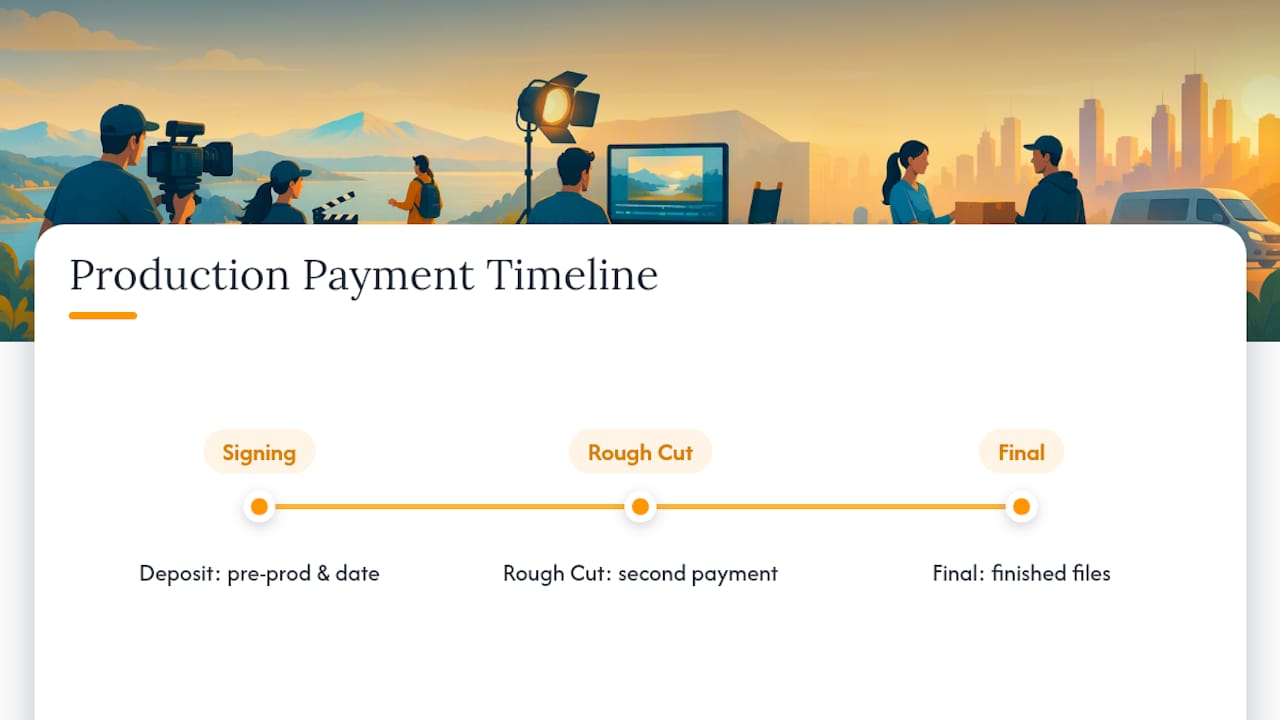
Budgeting for video works best when you treat the deposit as a planning trigger, not just a payment. Once a deposit is paid, script and storyboard changes become far more expensive to accommodate, since crew and equipment are already booked against a locked schedule. Building in a contingency of roughly 10% to 15% above your itemized estimate covers the hidden costs covered earlier, music licensing, an extra revision round, or a permit you didn’t anticipate, without forcing a renegotiation mid-project.
For businesses running recurring video needs, negotiating a retainer or subscription arrangement instead of paying per project can meaningfully lower the per-video rate once volume passes a modest threshold. Industry benchmarks from 2026 suggest that teams producing more than roughly six videos a year typically see lower per-video costs under a subscription or program model compared with one-off project pricing, since setup and account management costs get spread across the whole year rather than repeated on every single shoot.
What most buyers get wrong about video budgets
The biggest mistake I see isn’t overspending, it’s under-scoping. Businesses write a brief for one video and then discover mid-project they actually needed four cutdowns, a vertical version, and a set of thumbnails, none of which were priced in from the start.
Three rules fix most of this before it happens: brief tightly enough that a vendor can quote deliverables and shoot days instead of just a topic, plan every asset you’ll need across channels before the camera rolls, and set aside real budget for distribution, since a video with no promotion plan behind it rarely earns back its production cost.
The other recurring error is treating revisions and licensing as afterthoughts rather than line items. Bring in an agency partner once your video needs touch multiple channels or stakeholders; keep production internal or freelance when the brief stays simple and the approval chain is short.
— Derek
How The Artist Evolution helps you budget and deliver video with fewer surprises
Getting a realistic number is only half the job. Turning that number into a finished video that actually performs across your channels is where most in-house budgets run into trouble, and it’s where a full-service partner earns its keep.

The Artist Evolution builds video into a broader campaign plan rather than treating it as a one-off purchase, which means the deliverables you need for social, web, and paid advertising get planned and priced together instead of being tacked on after the fact. Our team handles the production sprint, the deliverable bundling, and the distribution strategy that makes a video budget actually convert.
- Live-action production for corporate, testimonial, and commercial video needs, scoped against your actual goals.
- Animated video for explainer content where custom illustration or motion graphics fit the message better than live action.
- Campaign management that plans video deliverables alongside the paid and organic channels that will carry them.
- Detailed scopes of work that lock revision rounds and licensing terms up front, so your invoice matches your estimate.
If you’re scoping a video project and want a clear, written plan before you commit budget, start with a conversation about strategy and management and we’ll help you turn your brief into a number you can actually plan around.
Sources
- BidKit — Free Video Production Cost Calculator & Estimator
- Video Production Cost Estimator / Calculator Tool
- Video Production Cost Estimator (US) | Shootsta
- Video Production Cost: What You’ll Actually Pay in 2026
- How Much Does Corporate Video Production Cost in 2026? | INDIRAP
FAQ
What does the 80/20 rule mean in video editing?
In editing, the 80/20 rule generally refers to spending roughly 80% of your planning effort on story and structure before you touch the timeline, then letting the remaining 20% cover technical polish like color and sound. Definitions vary across editors, but the core idea stays consistent: get the story right first, since fixing a weak edit later costs more time than getting the cut right from the start.
How much should a 2 minute video cost?
A two-minute corporate video with a full shoot day, scripted interviews, and branded graphics typically runs between $6,000 and $15,000. Simpler two-minute social content shot in a single session can cost significantly less, often falling within the $800 to $3,000 short-form range depending on production complexity.
How much for a videographer for 2 hours?
Most videographers price by half-day or full-day rates rather than a strict hourly rate, with freelance day rates commonly falling between $600 and $1,200. For a short two-hour session, expect to pay a portion of that day rate, since setup, travel, and gear transport take time regardless of how long the actual filming lasts.
How much should I charge for a 4 minute video?
Pricing a four-minute video depends on shoot days and complexity rather than run time alone: a straightforward corporate piece might fall in the $4,000 to $20,000 corporate and explainer range, while a heavier production with multiple locations or talent can push past $20,000. Build your quote around deliverables, revision rounds, and shoot days rather than a flat per-minute rate.