
Run a prioritized content refresh program before writing another new post: audit existing pages, rank them by opportunity, make substantive updates, then measure results. This approach typically produces ranking and traffic gains within 14 to 60 days, faster than most net-new content earns comparable authority. Marketing agencies build these programs around pages that already carry search equity because that equity compounds when you reinvest in it.
TL;DR:
- Content refreshes typically yield measurable ranking and traffic improvements within 14 to 60 days, with larger word-count changes driving stronger results.
- Refreshing a page is most effective when the topic and format still match search intent but factual data or examples are outdated, avoiding costly full re-structures.
- Prioritization should focus on pages with high impressions, ranking between 8 and 20, and some traffic decline, while avoiding recent, low-impression or unrelated content.
- Key edits include adding a direct answer early, updating data and examples, fixing technical issues, and strengthening internal links to amplify authority.
- Measuring success requires tracking impressions, clicks, position, and engagement at 14, 30, and 60 days to confirm the refresh’s impact and identify when a relaunch is needed.
Table of Contents
- What Is a Content Refresh Strategy vs. a Relaunch?
- Why Refreshes Outperform New Content for SEO and AI Visibility
- How to Audit and Prioritize Pages for a Refresh
- The Highest-Impact Edits to Make During a Refresh
- How to Measure Whether a Refresh Actually Worked
- Building a Rolling Content Refresh Calendar
- What the Research Says About Refresh Programs and Trust Signals
- Common Refresh Mistakes Executives Should Watch For
- How Theartistevolution Runs Your Content Refresh Program
- Sources
- FAQ
What Is a Content Refresh Strategy vs. a Relaunch?
A content refresh means editing an existing page to make it more accurate, complete, and useful without changing its core purpose or URL. A relaunch goes further: it restructures the page’s angle, rewrites most of the copy, and sometimes changes the URL or merges it with another asset entirely.
The distinction matters because the two require different levels of effort and produce different types of results. A refresh on a “best project management software” post might mean updating pricing, adding two new tools, and rewriting an outdated screenshot. A relaunch of that same post might mean scrapping the listicle format for a comparison guide with an embedded tool, because the underlying search intent shifted and a refresh can’t fix that.
Here’s how to decide which one a page needs:
- Refresh when the topic and format still match what searchers want, but facts, examples, or data are stale.
- Relaunch when the ranking page’s format no longer matches intent (a blog post ranking against interactive tools, for example) or the page has fallen out of the index entirely.
- Refresh when the page still holds a top 20 position and gets some impressions in Google Search Console.
- Relaunch when a competitor has published a structurally different, more useful format that is now outranking you.
- Prune instead of either when the page has near-zero search demand and no internal link value.
Effort and impact scale differently for each path. A refresh usually takes a writer two to six hours and can lift a page within two weeks, based on multi-source case studies compiling refresh outcomes across HubSpot, Backlinko, and Ahrefs. A relaunch takes longer, sometimes a full sprint with design and development involved, but the payoff tends to be larger. An SEO improvement case study after a national relaunch shows how a full rebuild of an existing property, rather than a fresh domain, converted dormant authority into new ranking positions. The lesson holds across most industries: don’t rebuild what only needs updating, and don’t patch what needs rebuilding.
Why Refreshes Outperform New Content for SEO and AI Visibility
Refreshing an established page works because Google and generative AI systems both reward the same thing: evidence that a page is current, complete, and trustworthy relative to what else is ranking. A brand-new URL starts at zero. An existing page that already ranks on page one or two only needs a nudge to jump several positions, and that nudge often comes faster than building authority from scratch.
By the numbers: Case studies analyzing refreshed content found traffic gains between 106% and 260% after substantive updates, with improvements frequently appearing faster than for comparable new posts. Separately, an analysis of 103,000 content updates found that pages with more than 10% word-count change saw materially higher pageview growth than pages with cosmetic edits alone, and extreme rewrites averaged the largest gains of any update category.
Google can re-crawl and re-evaluate an updated page within days, and ranking improvements have shown up in as little as 14 days when the update meaningfully improves the page relative to competitors. That’s a much shorter runway than the months new content typically needs to earn trust signals.
Generative AI search adds another layer worth planning around. Google’s own guidance is direct: optimizing for AI features on Search is still SEO, built on unique, helpful content, solid indexability, and clear answers, not a special file or schema. That means a refresh aimed at AI visibility should focus on fundamentals rather than gimmicks.
Before spending time chasing AI citations, confirm a page is even eligible:
- The page is indexed and returns a 200 status with no crawl errors.
- It answers a specific question in the first 100 words rather than burying the answer under throat clearing.
- Claims are backed by named sources, data, or examples an AI system can quote with confidence.
- Headings map to real subtopics, not vague marketing labels.
- The page loads cleanly on mobile and passes Core Web Vitals.
Google’s own documentation on snippet eligibility notes that fixing indexing and eligibility gaps is often the cheapest lever available before any content rewrite happens. Check that box first. It costs nothing and unblocks everything else.
How to Audit and Prioritize Pages for a Refresh
A reproducible audit starts with two data sources: Google Search Console and GA4. Pull impressions, clicks, average position, and click-through rate for every indexed URL over the trailing 12 months, then filter for pages that once performed better than they do now or that sit just outside page one.
Look specifically for pages with high impressions but low CTR (a sign the title or meta description underdelivers), pages ranking in positions 8 through 20 (close enough to page one to move with a moderate push), and pages that have lost more than 20% of organic traffic year over year. Cross-reference that list against GA4 engagement metrics like average engagement time and conversion events, so you don’t waste effort refreshing a page that ranks fine but never converts.
Once you have that list, sort candidates into a simple three-tier matrix:
| Priority | Criteria | Recommended action |
|---|---|---|
| High | Drives revenue or conversions; ranks positions 4–20; high impressions | Full rewrite or relaunch |
| Medium | Meaningful traffic but few conversions; ranks positions 10–20 | Substantial refresh |
| Low | Minimal traffic; ranks position 20+; no clear intent match | Minor update or prune |
This three-tier structure mirrors what Raptive’s analysis of 103,000 content updates treats as a practical baseline, and it keeps a team from spreading limited editorial hours across pages unlikely to move.
A few filtering rules make the list more actionable. Exclude pages under six months old. They haven’t had time to earn or lose ranking yet. Exclude pages with fewer than 10 monthly impressions unless they support a high-value conversion path. And flag any page where a direct competitor recently published a more thorough version, since that’s often the clearest signal a relaunch, not a light refresh, is the right call.
Pro Tip: Export your Search Console query data by page before filtering by position. Sorting by page first, then by query, reveals keyword cannibalization you’d otherwise miss when scanning position averages alone.
A guide on navigating Google’s algorithm changes walks through the technical diagnostics worth running alongside this audit, particularly for pages that dropped suddenly rather than gradually.
The Highest-Impact Edits to Make During a Refresh
Once a page is flagged for a refresh, the order of operations matters. Some edits move rankings quickly. Others protect the page from breaking during the update. Work through them in this sequence:
- Add a direct answer in the first 100 words. Both traditional featured snippets and AI answer engines pull from the opening of a page, so lead with the conclusion before the explanation.
- Expand thin sections with genuine new information, not padding. A section that answers a subtopic in two sentences when competitors answer it in five paragraphs is losing that keyword’s long-tail traffic.
- Update every statistic, price, and date reference. Stale numbers are one of the fastest ways to lose reader trust and, increasingly, AI citation eligibility.
- Add a new example, case study, or original data point. Substantive changes, not cosmetic ones, are what correlate with traffic growth in large-scale refresh studies.
- Rebuild the heading structure around real subtopics rather than generic labels, since clear H2/H3 hierarchy helps both crawlers and AI summarization tools parse the page correctly.
- Fix every broken or outdated external link, and replace any link pointing to a source that has since been superseded by better data.
- Refresh images and screenshots that show old interfaces, outdated branding, or discontinued products.
- Update
dateModifiedin structured data only when the changes are substantive. Changing the date without changing the content is a signal Google has learned to discount. - Verify indexing and snippet eligibility after publishing, using Search Console’s URL Inspection tool to confirm the updated version was crawled.
Internal linking deserves its own line item because it’s the most underused lever in most refresh programs. Add three to five new internal links pointing into the refreshed page from related, higher-traffic content, and add three to five outbound internal links from the refreshed page to newer, relevant posts. Internal linking amplifies refresh impact substantially because it redistributes authority and signals to Google that the page is part of an active topic cluster, not an orphaned artifact. Theartistevolution’s content calendar playbook includes a template for mapping these internal links across a content cluster before a refresh sprint begins.
Republishing safely means changing the visible “updated on” date to reflect the real edit, but never changing the URL or canonical tag unless you’re doing a full relaunch. Preserve every backlink pointing to the original URL by keeping that URL intact. If a redirect becomes unavoidable, use a 301 and monitor the destination page’s rankings for 30 days afterward to confirm the link equity transferred cleanly.
How to Measure Whether a Refresh Actually Worked
Track five metrics after every refresh: impressions, clicks, click-through rate, average position, and assisted conversions. Pair those with GA4 engagement metrics like average engagement time per session and scroll depth, since a page can gain clicks without gaining readers who actually stay and convert.
Timelines matter more than most teams expect. At 14 days, check whether Google has re-crawled the page and whether average position has moved at all, even slightly. At 30 days, expect early signals: modest CTR improvement if you rewrote the title and meta description, and possibly a position jump if the update was substantial. At 60 days, you should see the full effect. If nothing has moved by then, treat the update as underperforming and diagnose why rather than waiting longer.
By the numbers: Refresh case studies point to a two-week floor and a two-month ceiling for most substantive updates to show their full effect, which is why update impact studies recommend measuring at both windows rather than picking one.
When a refresh underperforms, run through this troubleshooting checklist before concluding the strategy failed:
- Shallow update: Did the edit actually add depth, or just change a date and a sentence or two? Cosmetic edits rarely move rankings.
- Wrong keyword demand: Has search volume for the target query dropped industry-wide, independent of your page’s quality?
- Increased competition: Did a competitor publish a more thorough or better-structured page in the same window?
- Indexing issues: Did Search Console confirm the updated version was actually crawled and indexed, not just saved as a draft?
- Cannibalization: Is another page on your own site competing for the same query and diluting the signal?
Most refresh failures trace back to the first item on that list. A shallow update dressed up as a substantive one rarely fools either the algorithm or the reader.
Building a Rolling Content Refresh Calendar
A one-time refresh sprint fixes a backlog. A governance calendar prevents the backlog from returning. Cadence should vary by content type, because different formats decay at different rates.
News and trend content needs monthly review, since relevance has a short shelf life. How-to guides and evergreen educational content hold up longer and typically need review every six months. Statistics-heavy posts and data-driven content need at least an annual pass, since a single outdated figure can undermine an entire page’s credibility. These intervals track closely with industry scheduling guidance compiled from multiple SEO audits, which recommends reviewing high-change technical and SEO fields every three to six months regardless of content type.
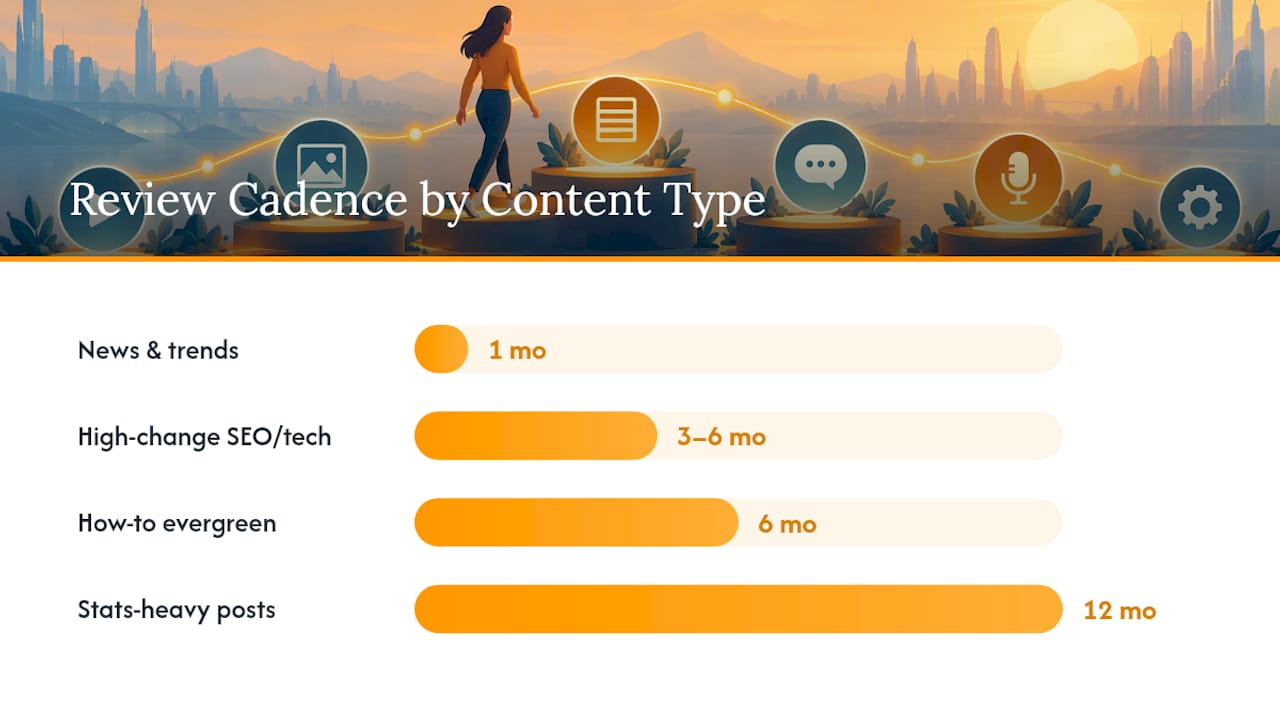
Translate those cadences into weekly throughput targets rather than letting them sit as abstract goals. A content team managing 200 published pages, for example, might target eight to ten substantive refreshes per month to cycle through evergreen content on a six-month schedule, plus a lighter monthly pass on any news or trend pages in the archive.
Governance needs clear ownership to function. A workable structure looks like this:
- A content lead maintains the master refresh calendar and priority list.
- Writers receive edit briefs specifying exactly what changed (new stats, new examples, restructured headings) rather than a vague “update this page” instruction.
- An SEO reviewer checks internal links, structured data, and indexing before publishing.
- A final QA pass confirms the visible date, canonical tag, and redirects are correct.
Generic project management tools, a shared editorial calendar, and rank-tracking software can run this workflow without requiring anything specialized. What matters more than the tool stack is the handoff discipline: no page goes live until the SEO reviewer and the content lead both sign off.
What the Research Says About Refresh Programs and Trust Signals
Multiple independent studies point in the same direction. Case-study data compiled across HubSpot, Backlinko, and Ahrefs shows substantive content updates driving traffic gains well above 100% in a meaningful share of tracked cases. Separately, a large-scale analysis of 103,000 refreshes found that word-count changes exceeding 10% correlated with materially stronger pageview growth than smaller edits, with the most dramatic rewrites producing the largest average gains, according to Raptive’s refresh analysis.
A rolling refresh program compounds results over time. Frequent, substantive updates across many pages sustain domain-wide freshness signals and help a site avoid the gradual decay that hits static content libraries, rather than relying on one large relaunch to carry the whole site.
Some case work reflects the same pattern at the campaign level. A national relaunch case study documents how reinvesting in an existing property, rather than starting a new one, converted latent authority into measurable ranking movement.
For any page flagged as a priority candidate, three edits consistently produce the most reliable early signal:
- Rewrite the opening paragraph to answer the core query in the first sentence.
- Add or update one data point with a linked, credible source.
- Add three internal links from related, higher-authority pages on the site.
Run those three first, measure at 14 and 30 days, and let the results tell you whether the page earns a deeper investment.
Common Refresh Mistakes Executives Should Watch For
The biggest mistake I see is teams changing a publish date without changing anything that matters. A new “updated” stamp with no new substance is easy for both readers and Google to detect, and it can do more harm than doing nothing at all.
The second mistake is skipping the link audit. Broken outbound links and missed internal-linking opportunities quietly cap a refresh’s upside, even when the writing itself is excellent.
The third is refreshing without a measurement plan. If you don’t check Search Console at 14 and 30 days, you can’t tell a working strategy from a wasted sprint.
Know when to stop refreshing and start over. If a page has been refreshed twice with no movement, the format or intent match is likely wrong, and no third edit will fix that. That’s a relaunch decision, not a refresh decision.
For resource allocation, use this checklist: fund refreshes for pages with existing rank and revenue signal first, fund relaunches only where the format itself is the problem, and never authorize a refresh without a 30-day measurement checkpoint already scheduled.
— Derek
How Theartistevolution Runs Your Content Refresh Program
Some marketing agencies replace guesswork with a data-first process. Instead of a general agency retainer that treats every page the same, clients get an audit that ranks existing content by real opportunity before a single word gets rewritten.

That process draws on the agency’s broader Search Engine Optimization services, which handle everything from the Search Console audit through the prioritization matrix to the actual editing and republishing sequence described above. For pages that need more than a refresh, the team’s website design work can execute a full relaunch without losing the backlink equity the original URL built over years. Marketing leaders juggling both SEO and paid channels also lean on Theartistevolution’s strategy and management services to keep the refresh calendar coordinated with campaign timing rather than running in isolation.
If your team has a backlog of underperforming pages and no clear system for triaging them, request a content audit from Theartistevolution’s strategy and management team and get a prioritized list back before your next editorial sprint.
Sources
- We analyzed 103,000 content refreshes. Here’s what was most associated with Google traffic growth — Raptive / Stacc summary
- We analyzed 103,000 content refreshes. Here’s what was most associated with Google traffic growth — Raptive
- How to Fix Content Quality Issues: Post-HCU Guide 2026
FAQ
What Are the 5 Pillars of Content Strategy?
Most frameworks name planning, creation, distribution, governance, and measurement as the five recurring pillars. A content refresh strategy sits inside governance and measurement, since it depends on ongoing audits and performance tracking rather than one-time production.
What Is a Content Refresh?
A content refresh is a substantive update to an existing published page, such as expanding thin sections, updating data, and improving structure, done without changing the page’s core purpose or URL. Studies tracking 103,000 refreshes found the pages with the biggest word-count changes saw the strongest pageview growth.
Is SEO Dead Now That AI Search Exists?
No. Google’s own guidance states that optimizing for AI features on Search is still SEO, built on unique, helpful content and solid technical fundamentals rather than any separate AI-specific tactic. Indexability and clear, direct answers matter more now, not less.
What Are the 7 Steps in Creating a Content Strategy?
Common versions include audience research, goal setting, content audit, keyword and topic mapping, creation and editing workflow, distribution planning, and measurement with iteration. A content refresh strategy specifically operationalizes the audit and measurement steps on an ongoing, rather than one-time, basis.
How Long Does It Take to See Results From a Content Refresh?
Early ranking movement can appear within 14 days for substantive updates, with the fuller effect typically visible by 60 days. Cosmetic edits, like changing a date without adding new substance, rarely produce measurable movement in either window.