
The CPG digital shelf is every touchpoint where a shopper evaluates and buys your product online: search results, product detail pages, ratings, and price, across retailer sites, marketplaces, and your own DTC store. The single highest-leverage move is making the SKU buyable first: correct availability, a compliant product detail page, and accurate price, before spending a dollar on retail media. Standards bodies like GS1 govern the UPC/GTIN data that underpins this whole system, and NielsenIQ’s research on the digital shelf backs the sequencing.
TL;DR:
- Ensuring SKUs are in stock and meet retailer-specific image, content, and structured data requirements is essential before investing in paid media or search optimization.
- Fixing high-revenue, out-of-stock SKUs and optimizing their search rank should be prioritized over creating new listings or focusing solely on visibility metrics.
- Regular SKU-level audits, dynamic price and availability monitoring, and a focus on ratings and reviews are key to improving conversion and trust.
- Implementing toolsets like digital asset management systems, automated monitoring platforms, and AI-assisted content creation enhances scalability and efficiency.
- Cross-functional ownership with clear KPIs such as stock availability, share of shelf and search, and conversion rate is necessary for effective digital shelf management.
Table of Contents
- What Is the CPG Digital Shelf, and Why Does It Decide Sales?
- The Six Elements That Actually Move the Needle
- A SKU-Level Checklist You Can Run This Quarter
- Who Owns the Digital Shelf, and What Should They Track?
- The Tools That Make This Manageable at Scale
- How an Agency Actually Runs a Digital Shelf Program
- What the Industry Gets Wrong About Digital Shelf Strategy
- Get Your Digital Shelf Audited by Theartistevolution
- Sources
- FAQ
What Is the CPG Digital Shelf, and Why Does It Decide Sales?
Think of the digital shelf as the retailer aisle that never closes. Every listing, image, and star rating on Amazon, Walmart.com, Target.com, Instacart, or your own site functions the way a physical shelf tag, package, and in-store display used to. A shopper cannot pick up your product, read the back label, or ask a store associate a question, so the product detail page has to do all that work.
That substitution effect is why content quality carries so much weight. NielsenIQ’s research confirms that images, detailed product information, and reviews act as the shopper’s stand-in for physical inspection, and weak content on any of those elements directly suppresses conversion. Search placement compounds the effect: NielsenIQ’s Future of the Digital Shelf research found that 80% of products shoppers actually put in their basket appear in the top 10 search results for their category.
That single figure should reorder your priorities. It means:
- Ranking on page two of a retailer’s search results is close to invisible, regardless of how good your packaging photography is.
- Retailer search functions like its own SEO discipline, distinct from Google, with its own ranking signals tied to sales velocity and content completeness.
- Fixing a broken listing that already ranks well often beats building a new listing from scratch.
The Six Elements That Actually Move the Needle
Every digital shelf program breaks down into the same six levers. Get these right, in this order, and everything downstream (including paid media) performs better.
Availability comes first, always. An out-of-stock SKU cannot convert no matter how strong the content is. Set daily or near-real-time OOS alerts on your top revenue SKUs at each retailer, and treat any stockout on a top-20 item as an urgent fix, not a queue item.
Imagery and video carry more conversion weight than most brand teams assume. Each retailer publishes its own image specs (Amazon’s minimum pixel dimensions differ from Walmart’s), and a hero image plus a five- to seven-image carousel with at least one lifestyle shot and one video consistently outperforms a bare product-on-white listing.
PDP content needs to match retailer requirements exactly, not approximately. Titles, bullet points, backend attributes, and structured data (schema markup for the web, retailer-specific attribute fields for marketplaces) all feed the search algorithm. Keyword placement in the title and first two bullets matters more than density anywhere else on the page.
- Availability: OOS monitoring and rapid-response alerting
- Imagery: hero shot, carousel, video, retailer-specific specs
- PDP content: title, bullets, attributes, structured data
- Price and promotions: buy box eligibility and cross-channel accuracy
- Search: share of search and keyword placement by category
- Ratings and reviews: volume, recency, and response time
Price and promotions determine buy box eligibility on marketplaces and, increasingly, in-store parity too. Retailers are moving fast on electronic shelf labels, with Walmart planning digital price tags in every U.S. store by the end of 2026, which means a promo that is live online but stale on a physical tag (or vice versa) creates the exact trust gap the digital shelf is supposed to solve. Ratings and reviews close the loop: volume and response speed to negative reviews both feed the trust signal that recovers a shopper who almost bounced.
Retail media belongs last, not first. NielsenIQ’s own research on the omnichannel digital shelf is blunt about this: media creates traffic, but traffic hitting a broken or out-of-stock listing just burns budget faster.
A SKU-Level Checklist You Can Run This Quarter
Running this workflow SKU by SKU, rather than trying to fix an entire catalog simultaneously, is what makes digital shelf work tractable for a lean brand team.
- Build a UPC/GTIN-normalized product master. Every pack size, flavor, and variant needs its own clean identifier before you can compare performance across retailers without false readings.
- Map each SKU against retailer-specific specs. Image dimensions, required attributes, and category placement rules differ by retailer, so document what each one demands.
- Prioritize which SKUs and retailers to fix first. Rank by revenue contribution and current gap severity; a top-10 SKU that is out of stock outranks a long-tail item with a mediocre title.
- Audit the live listing on both desktop and mobile. Titles, bullets, attributes, imagery, and structured data often render differently on mobile, and mobile is where most shoppers actually browse.
- Verify price, promotion, availability, and fulfillment status. Catch mismatches between what the PDP promises and what happens at checkout.
- Grow ratings and reviews through retailer-compliant programs. Volume and response time both matter more than chasing a perfect star average.
- Activate paid retail media only once the listing is buyable. This is the step brands skip under sales pressure, and it is the one that wastes the most budget when skipped.
- Run controlled A/B or incrementality tests before scaling spend. Confirm that a content or media change caused the sales lift rather than seasonality or a competitor’s stockout.
- Review SKU performance weekly and iterate. A practical audit cadence pairs weekly checks on top SKUs with a deeper monthly audit across your full prioritized retailer list.
Pro Tip: Set a same-day remediation rule for any critical issue on a top-20 SKU: out of stock, price mismatch, or lost buy box. Waiting for the weekly review to catch these costs real revenue.
Who Owns the Digital Shelf, and What Should They Track?
Digital shelf performance breaks down fast when it sits with one team. Marketing owns content and brand voice, e-commerce owns the retailer relationships and platform mechanics, supply chain owns availability, commercial planning owns pricing and promotion calendars, and insights owns the measurement layer that ties it all together. Consumer Goods Technology’s research on organizational best practice makes the case directly: digital commerce needs cross-functional ownership, a focused KPI set, and a test-and-learn culture, not a single owner working in isolation.
The KPI list stays short on purpose:
- Availability and OOS rate by SKU and retailer
- Digital share of shelf and share of search by category
- Conversion rate at the PDP level
- TACoS or incrementality on any paid media spend
One measurement guardrail matters more than any dashboard feature: separate organic visibility from paid visibility in every report, because folding paid placements into an “overall visibility” number hides whether the content itself is working. That top-10 search finding from earlier, where 80% of in-basket products rank there, is an organic signal worth tracking on its own line. Cadence should run weekly for SKU-level checks, monthly for experiment reviews, and quarterly for the strategic reset that reallocates budget across retailers.
The Tools That Make This Manageable at Scale
Trying to run this checklist across hundreds of SKUs and a dozen retailers by hand does not scale past a handful of items. Four tool categories cover the gap.
A digital asset management (DAM) system centralizes retailer-ready creative so every team pulls the current, compliant image and claim set instead of an outdated file from a shared drive. Digital shelf monitoring platforms track SKU and UPC-level status across retailers, flagging OOS, price violations, and content drift automatically rather than through manual spot checks. Analytics platforms connect content and availability changes directly to sales, and the more advanced ones prioritize fixes by estimated revenue impact instead of just surfacing a KPI that moved. Generative AI now speeds up PDP copy and image-variant creation considerably, but it needs a human review step, because unsupervised AI content can drift from approved claims or miss a retailer’s exact spec requirements.
- DAM: centralized, retailer-compliant creative
- Monitoring platforms: SKU/UPC tracking and violation alerts
- Analytics: revenue-ranked action lists tied to sales
- Generative AI: faster content drafts with mandatory human review
How an Agency Actually Runs a Digital Shelf Program
A structured engagement starts with the same UPC/GTIN normalization step covered above, because no agency can prioritize fixes across a catalog without clean SKU identity first. From there, the work typically follows a pilot audit: identify the highest-revenue SKUs with the worst listing gaps, fix content and availability issues, and only then layer in paid retail media, an approach Theartistevolution structures around a 90-day incrementality testing window so a brand can see whether the lift is real before scaling spend.
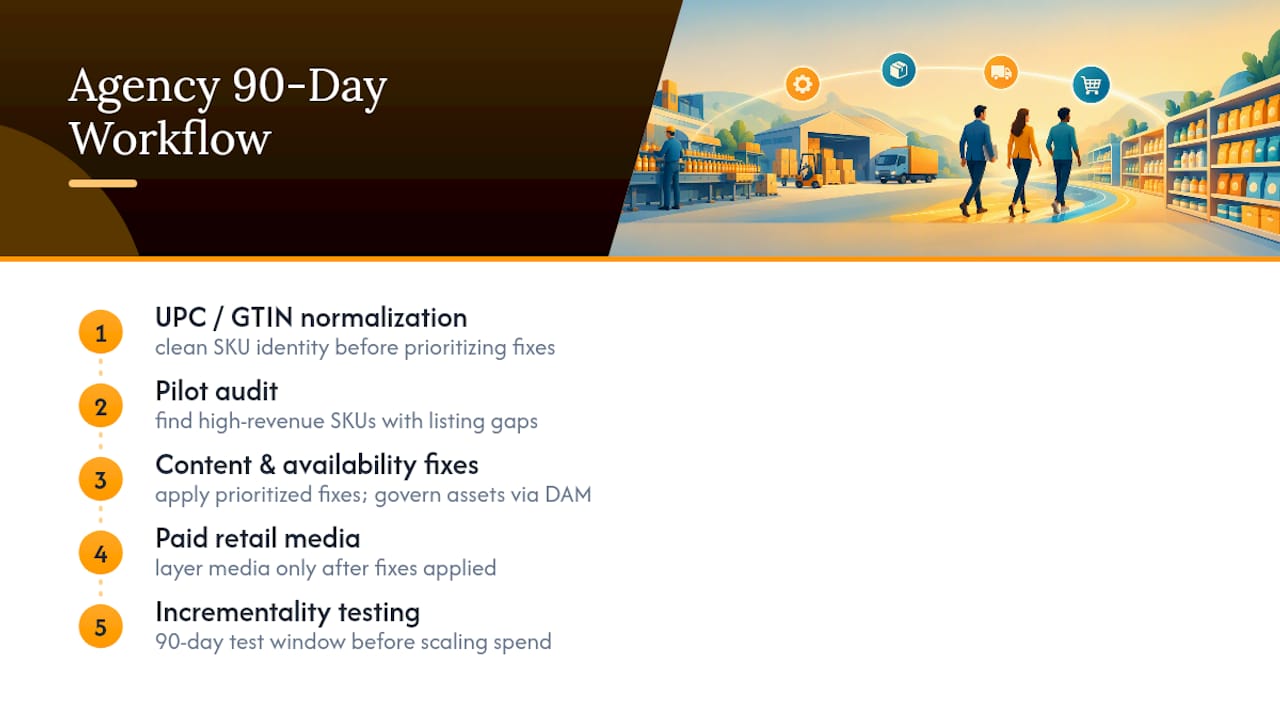
Assets get governed through a DAM so retailer specs and approved claims stay consistent across a catalog rather than drifting listing by listing. If you are evaluating agency partners for this work, ask what baseline deliverables come in the first 30 days: a SKU audit, a retailer-spec gap list, and a prioritized fix roadmap should all be on that list before any media spend gets discussed.
What the Industry Gets Wrong About Digital Shelf Strategy
Most digital shelf advice treats visibility as the goal. It isn’t. Visibility without buyability is a wasted impression, and the conventional wisdom, chase share of search first, gets the sequence backward for most CPG brands.
Here is the judgment this research actually supports: fix the SKU master data and buyability before touching search or media spend. A UPC/GTIN-normalized product record sounds like back-office housekeeping, but it is the precondition for every reliable metric that follows. Without it, share-of-shelf numbers compare a 12-ounce variant against a 16-ounce one and produce a false read.
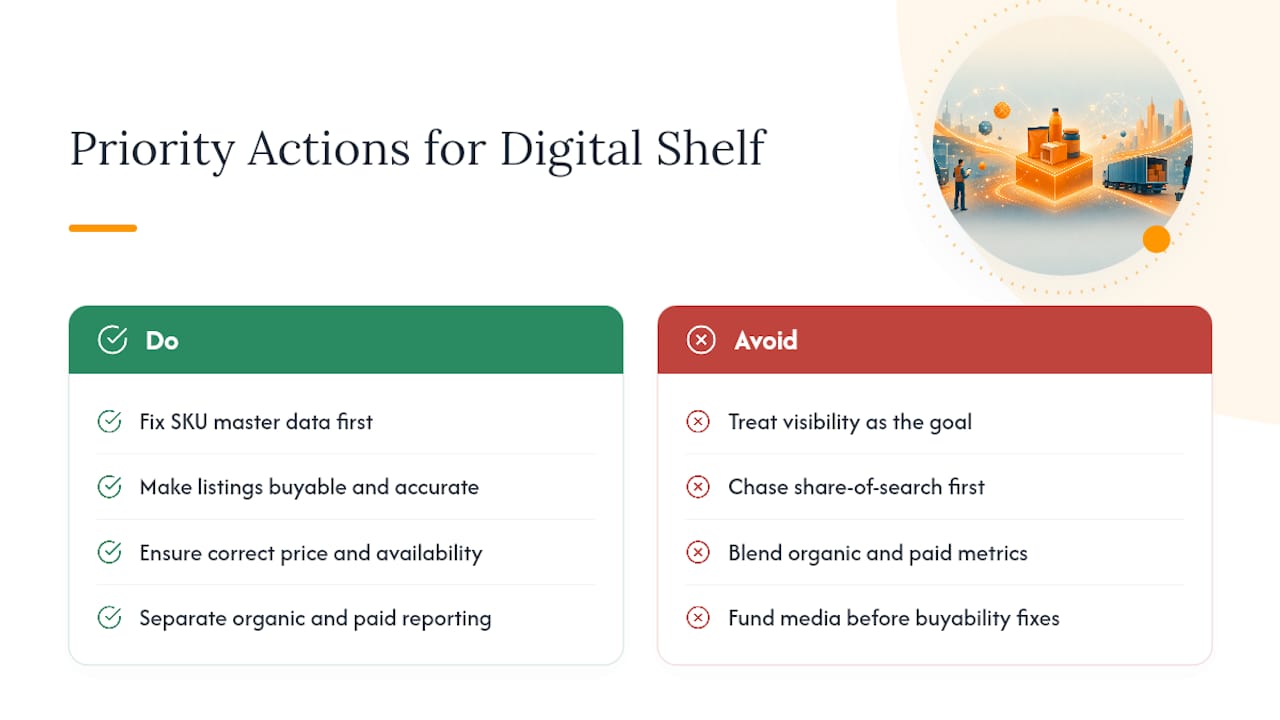
The bigger gap I see in how brands measure success is conflating traffic with revenue. A campaign that lifts impressions 40% and sales 2% is not a win, it is a signal the content or availability failed to convert the demand media already bought. Brands that separate organic and paid performance in reporting catch this early. Brands that report a single blended visibility number do not, and they keep funding the wrong lever.
Prioritize the boring fix first: clean data, buyable listings, accurate price. Everything else on the digital shelf compounds from there.
— Derek
Get Your Digital Shelf Audited by Theartistevolution
Theartistevolution gives CPG brand teams the operational depth of an in-house digital shelf function without the headcount, running SKU-level fixes and media activation as one coordinated program instead of separate vendor handoffs. Our Strategy & Management team starts with the same audit-first approach covered above: SKU master cleanup, retailer-spec gap analysis, and a prioritized fix roadmap before any paid spend gets touched.

From there, our Pay-Per-Click Management Agency work handles retail media and Amazon Ads activation once listings are buyable, and our retail activation capabilities cover both the online and in-store side of the equation, which matters as electronic shelf labels spread across major retailers. A typical engagement runs an initial audit, a prioritized 90-day roadmap, and pilot tests with incremental measurement built in from day one. If your catalog has SKUs stuck on page two of retailer search or losing the buy box on price mismatches, consider requesting a marketing assessment to get a prioritized fix list before your next media budget cycle starts.
Sources
NielsenIQ’s digital shelf overview and its Future of the Digital Shelf research anchor the search and conversion figures in this guide. Consumer Goods Technology’s piece on organizational best practices covers the cross-functional model in more depth, and CNBC’s reporting on Walmart’s digital price tag rollout tracks the in-store shift affecting price parity.
- What is the digital shelf? – NielsenIQ
- 4 ways CPG brands can win on the digital shelf — Consumer Goods Technology
- Walmart digital price tags will be in every U.S. store by end of 2026 – CNBC
FAQ
What Is the Digital Shelf?
The digital shelf is every online touchpoint where shoppers discover and evaluate a product before buying: search results, the product detail page, price, and reviews across retailer sites and marketplaces. NielsenIQ frames it as the digital equivalent of the physical store shelf, where content and reviews replace hands-on inspection.
How Much Do Digital Shelf Labels Cost?
Electronic shelf label pricing varies by retailer and hasn’t been published in specific per-store or per-tag figures. What’s confirmed is the scale of rollout: Walmart plans to have digital price tags in every U.S. store by the end of 2026.
Why Is Walmart Switching to Digital Shelf Labels?
Digital shelf labels let Walmart update in-store pricing instantly and keep it aligned with online prices and promotions, closing the gap between what a shopper sees on the app and on the physical shelf. That parity issue is exactly what CPG brands need to watch as electronic labels expand across more retailers.
What Are the Biggest CPG Digital Shelf Trends Right Now?
The clearest trend is retailers pushing electronic shelf labels to sync in-store and online pricing in real time, alongside brands adopting generative AI to scale PDP content faster. Neither trend changes the fundamentals: NielsenIQ’s research still shows that a buyable, well-ranked listing converts better than a heavily promoted one, and Theartistevolution builds every retail media plan around confirming that buyability first.
Why Does Retailer Search Ranking Matter So Much?
Because most purchases come from a narrow band of results: NielsenIQ found that 80% of in-basket products rank in the top 10 search results for their category. A SKU ranking below that threshold gets a fraction of the exposure, no matter how strong its content is.