
Dental practice branding has one job: turn a stranger’s search or a drive-by glance at your sign into a booked appointment, fast. It is the sum of your name, visual identity, website, in-office experience, and reputation, and it only works if every one of those pieces pushes the same prospective patient toward calling, clicking, or walking in. The pillars that make that happen include a distinct name and visual system, conversion-ready website funnels, active reputation management, outcome-driven content, and an in-clinic experience that matches what your digital brand promises.
TL;DR:
- A strong dental brand requires a memorable name, consistent visual identity, and a website that answers patient questions within 90 seconds.
- Practice branding should clearly differentiate your practice based on actual strengths, pricing transparency, and community positioning.
- Using outcome stories, patient testimonials, and a matching physical office environment builds trust and reinforces brand consistency.
- Developing a brand-focused patient retention system includes personalized communication, loyalty touches, and membership plans to encourage repeat visits.
- Working with a specialized dental branding agency ensures cohesive messaging and measurable improvements in traffic, inquiries, and bookings.
Table of Contents
- Building a Dental Practice Branding System: Name and Visual Identity
- What Should a Dental Website Do in the First 90 Seconds?
- How Do You Turn Reviews and Front-Desk Calls Into Booked Patients?
- Why Outcome Stories Outperform Procedure Descriptions
- Does Your Waiting Room Match Your Website’s Promise?
- A 90-Day Plan to Launch Your Dental Practice Branding
- What Does Working With a Dental Branding Agency Look Like?
- Competitive Analysis and Market Positioning for Dental Practices
- Defining Brand Values and Mission for a Dental Practice
- Staff Branding and Culture Alignment
- Community Engagement and Local Partnerships
- Digital Marketing Beyond Social Media: SEO and PPC for Dental Practices
- Patient Retention Strategies Linked to Branding
- Why Brand-First Investment Beats Ad-Only Tactics
- How Theartistevolution Helps Dental Practices Build a Brand That Converts
- Sources
- FAQ
Building a Dental Practice Branding System: Name and Visual Identity
Your practice name and visual identity are the first filter patients use to decide whether you look credible, and they need to work as hard as your clinical skills do. The American Dental Association advises that a practice name should be memorable, easy to search, and consistent with the values you actually deliver, since mismatched branding erodes patient trust faster than almost anything else you control, according to ADA guidance on naming and branding. A name loaded with generic dental jargon rarely stands out in local search results, while a name tied to a neighborhood, a founder, or a clear promise tends to stick.
Your logo and color palette should commit to one lane: premium and modern, warm and family-focused, or clinical and wellness-driven. Trying to be all three reads as none of them.
- Pick a directional style and apply it everywhere, from your sign to your Instagram grid.
- Avoid dental clichés like generic tooth icons and stock blue-and-white palettes that blend into every competitor nearby.
- Build a short brand guideline document covering logo use, fonts, and color codes so every vendor and staff member works from the same playbook.
- Create a physical “branding passport” that extends those rules into paint, signage, and uniforms so the office matches the website.
Pro Tip: Test your logo and name idea on someone outside dentistry before you commit. If they can’t repeat it back to you after five seconds, it’s too complicated for a patient scrolling past ten other search results.
What Should a Dental Website Do in the First 90 Seconds?
A new patient lands on your homepage with three questions: how long will this take, how much will it cost, and will it hurt. If your site does not answer those within seconds, they bounce to the next practice in the search results. Sites that update content regularly and build SEO into their structure see measurably better patient acquisition, according to the 2023 ProSites State of Dental Marketing report.
Structure your homepage and key landing pages around three separate conversion paths:
- New-patient path: hero section with a clear call-to-action, visible phone number, and an online scheduler above the fold.
- Uninsured-patient path: a dedicated membership plan page with simple pricing tiers and an enrollment form, not a buried PDF.
- Emergency path: a same-day availability promise and a click-to-call button, since panicked patients do not read paragraphs.
Beyond those three funnels, a few operational details separate sites that convert from sites that just look nice:
- A phone number visible on every page, not just the contact page.
- A chat widget or callback request for patients who won’t call during work hours.
- Fee ranges or transparent enrollment steps instead of “contact us for pricing,” which structuring content for quick answers helps both patients and AI search tools surface directly, per marketing guidance for the AI search era.
How Do You Turn Reviews and Front-Desk Calls Into Booked Patients?
Reviews and phone calls are where branding either pays off or falls apart. A steady flow of fresh reviews, displayed prominently on your homepage and Google Business Profile, does more to reassure a nervous new patient than any amount of ad spend.
- Ask every satisfied patient for a review at checkout, through a text link, not a generic email blast three days later.
- Display your three or four strongest testimonials on the homepage and the membership plan page specifically.
- Give front-desk staff a short script that mentions your membership plan whenever a caller says they lack insurance.
Front-desk staff are consistently the highest-converting channel for membership enrollment, and a simple script paired with a one-page sign-up form meaningfully lifts sign-up rates, according to Dentplicity’s guidance on marketing in-house membership plans. Track three numbers monthly: review volume, call-to-booked-appointment rate, and membership enrollment rate.
Pro Tip: Role-play the membership pitch with your team once a month. A script that sounds natural out loud converts far better than one that reads well on paper.
Why Outcome Stories Outperform Procedure Descriptions
Patients don’t care how a crown is milled. They care whether it will look natural and stop hurting. Marketing that shows real patient outcomes builds trust more effectively than clinical explanations of the procedure itself, notes cosmetic dentist Minal Sampat in Incisal Edge.
- Swap “we perform same-day crowns” for a before-and-after story about a patient who smiled at their own wedding photos again.
- Use short-form video for testimonials and quick procedure walkthroughs. Thirty seconds of a real patient beats a paragraph of clinical detail.
- Publish an FAQ page with direct answers on cost ranges, pain levels, and appointment length, since AI search tools increasingly pull those answers straight into results, per FAQ content strategy research from Novasapien Labs.
- Repurpose every FAQ answer into a 15 to 30 second video and a social caption. One good answer becomes three assets.
Does Your Waiting Room Match Your Website’s Promise?
A polished website followed by a dated, cluttered waiting room breaks trust immediately. Brand consistency across physical and digital touchpoints reduces the anxiety patients already feel walking into a dental office, and it reinforces that you are exactly who your marketing said you’d be.
- Lock your paint colors, signage fonts, and reception materials into the same branding passport you built for your logo.
- Photograph your actual space and staff for the website. Stock photos of generic offices undercut credibility the moment a patient walks in and notices the mismatch.
- Send patients home with a branded folder or card, not a loose stack of insurance forms.
- Train staff to greet patients using the same warm, direct tone your website copy uses. A mismatch between friendly online copy and a rushed front desk erases the brand instantly.
A 90-Day Plan to Launch Your Dental Practice Branding
Branding work stalls when it has no deadline. Breaking it into three phases gives you visible wins early and keeps the bigger visual overhaul from eating the whole quarter.
- Days 1 to 14: Rewrite your homepage hero to answer cost, time, and pain questions immediately. Make your phone number and scheduler visible on every page. Publish a basic FAQ page with fee ranges.
- Weeks 3 to 6: Write and rehearse front-desk membership scripts. Set up a review-request workflow triggered at checkout. Build a dedicated membership landing page. Film two or three short patient-outcome videos.
- Weeks 7 to 12: Finalize your logo, palette, and brand guidelines document. Update signage and printed materials to match. Build a content calendar mixing outcome stories, FAQs, and short video for the next quarter.
Many practices are increasing their web and social output right now, and the ones updating consistently and investing in SEO see stronger patient acquisition than those posting sporadically. Track call-to-book rate, review volume, and membership sign-ups weekly during all three phases so you catch a stalled funnel before it costs you a month of new patients.
What Does Working With a Dental Branding Agency Look Like?
Agencies that specialize in dental branding tend to follow a similar arc: discovery, strategy, execution, and reporting. Discovery maps your current name recognition, competitors, and website performance. Strategy sets the visual direction and messaging framework. Execution builds the site, content, and campaigns. Reporting ties every deliverable back to booked appointments, not just impressions.
Theartistevolution’s dental work shows what that looks like in practice, including a case study on how strategic website and content work increased traffic for a dental office and translated that visibility into new-patient inquiries.
When evaluating any agency partner, watch for a few signals:
- They ask about your membership plan and front-desk workflow, not just your logo.
- They show real case studies with traffic or booking numbers, not vague “brand awareness” claims.
- They have specific dental experience, since general retail branding tactics rarely translate to patient acquisition.
- Red flag: an agency that pitches a full rebrand before auditing your current website funnel and reviews.
Competitive Analysis and Market Positioning for Dental Practices
Most dental practices lose the positioning battle before they ever open a landing page, because they never actually looked at what the practice down the street promises. A real competitive audit means visiting three to five competitor websites in your service area and noting their stated differentiators, price transparency, and review counts.
You are almost always positioning against one of three archetypes: the high-volume budget practice, the premium cosmetic-focused practice, or the family-first general practice. Pick the lane that matches your actual clinical strengths and staffing, then make sure your name, visual identity, and messaging all point at that same lane. A practice that markets itself as premium cosmetic dentistry while running a walk-in, high-volume schedule confuses patients and tanks conversion.
Look specifically at what competitors are not saying. If none of the practices within five miles publish fee ranges or membership pricing, publishing yours becomes an immediate differentiator. If every competitor’s site buries their emergency care option, putting yours front and center on the homepage captures the patients searching in a panic at 9 p.m.
Positioning also means being honest about where you cannot compete. A single-doctor practice cannot out-market a ten-location group on ad spend, but it can win on personalized care messaging, same-doctor continuity, and a faster callback promise. Map your three closest competitors against price, speed, and specialty focus, then build your brand messaging around whichever gap you can genuinely fill.
Defining Brand Values and Mission for a Dental Practice
A mission statement that says “providing quality dental care to our community” describes every dental practice in the country, which means it describes none of them. Your values and mission need to be specific enough that a patient could tell your practice apart from a competitor’s just by reading them.
Start by naming the actual behavior you want patients to experience, not a vague adjective. “We call every patient the day after a procedure to check on them” is a value. “Compassionate care” is not, because it makes no promise you can be held to.
Your mission should answer one question clearly: who do you serve best, and what do you do differently for them? A practice built around anxious patients might commit to sedation options and a no-judgment policy on delayed care. A practice built around busy families might commit to same-day appointments for multiple kids at once. Either mission gives your front desk and your marketing copy a consistent standard to write toward.
Once you have real values, put them somewhere patients actually see them: on the About page, in staff bios, and in the language your team uses at checkout. A mission statement locked in a binder in the back office does nothing for your brand. A brand messaging framework that turns those values into specific phrases for your website and scripts gets far more mileage out of the same idea.
Staff Branding and Culture Alignment
Your brand lives or dies at the front desk before it ever reaches the treatment chair. A patient who reads warm, reassuring copy on your website and then gets a rushed, transactional check-in call experiences a direct contradiction, and they notice it even if they can’t name what felt off.
Staff branding starts with hiring for the tone you’ve already committed to in your marketing. If your brand promises a calm, low-pressure experience, your hiring interviews should test for that temperament directly, not just clinical competence. Skills can be trained. Tone is much harder to install after the fact.
Give every team member, from hygienists to the scheduling coordinator, a short reference of your brand voice: is it warm and casual, or polished and efficient? Should staff use first names with patients or more formal address? These details sound small until a patient experiences three different tones across three different appointments and starts to wonder which one is real.
Culture alignment also means letting staff see the brand strategy, not just the visual output. A hygienist who understands that the practice positions itself around anxious-patient care will naturally adjust their chairside manner, without being handed a script. Include staff in reviewing new website copy or a rebrand before launch. Their pushback often catches gaps between what marketing wrote and what actually happens in the exam room.
Community Engagement and Local Partnerships
Dental practices compete almost entirely on a local level, which makes community visibility one of the most underused branding tools available. Sponsoring a youth sports team, partnering with a local school for dental health days, or setting up a booth at a neighborhood farmers market puts your name in front of exactly the patients your practice serves, without competing against national ad budgets.

Local partnerships work best when they tie back to something your practice actually does well. A pediatric-friendly practice sponsoring a kids’ health fair reinforces the same positioning your website already claims. A cosmetic-focused practice partnering with a local bridal expo does the same thing for a different audience.
These partnerships also generate content your marketing team can use for months: photos from the event, a social post thanking the partner organization, and a natural reason to mention your practice name in local news coverage or community newsletters. That kind of coverage carries more local trust than a paid ad, because it comes wrapped in a community context rather than a sales pitch.
Consider formal cross-promotion with adjacent local businesses too, like an orthodontist referring general dentistry patients back to your practice, or a pediatrician’s office keeping your brochures in their waiting room. These relationships take time to build but tend to produce steady, low-cost referral streams that outlast any single ad campaign.
Digital Marketing Beyond Social Media: SEO and PPC for Dental Practices
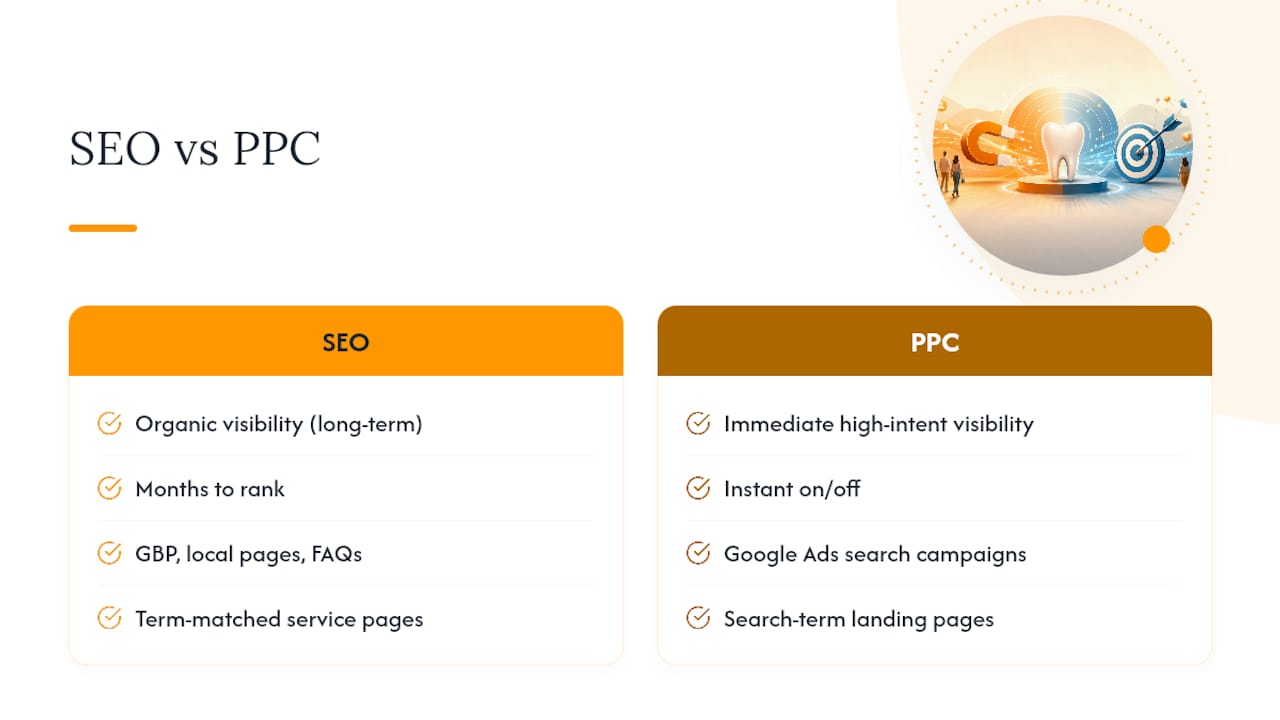
Social media builds familiarity, but search engine optimization and pay-per-click advertising are what capture the patient actively looking for a dentist right now. Both channels only work if they point traffic toward a website that’s already built to convert, which is why branding and digital marketing strategy have to move together rather than in sequence.
SEO for dental practices means optimizing your Google Business Profile, building location-specific service pages, and publishing the kind of FAQ and fee-range content that AI-era search tools increasingly surface directly in results, per research on marketing for the AI search era. A practice ranking for “emergency dentist near me” without a same-day booking option on that landing page is wasting the click it worked to earn.
PPC campaigns, particularly on Google Ads, let you target high-intent searches like “dental implants cost” or “same day crown” with immediate visibility while your organic SEO builds over months. The mistake most practices make is running ads that drive to a generic homepage instead of a landing page matched to the exact search term, which quietly inflates cost per booked patient. A dedicated Google Ads playbook for dentists outlines how to align ad copy, landing pages, and follow-up calls so paid traffic converts at a rate that justifies the spend.
Neither channel replaces the other. SEO builds compounding, long-term visibility. PPC delivers immediate volume you can turn on or off. Practices that treat them as one coordinated system, feeding the same brand messaging and conversion paths, get more booked patients per dollar than those running either channel in isolation.
Patient Retention Strategies Linked to Branding
Acquiring a new patient costs far more than keeping one you already have, which makes retention one of the highest-leverage branding investments available, even though it rarely gets the marketing budget attention that new-patient campaigns do.
Retention starts with the same consistency principle that governs every other branding decision: a patient who felt reassured by your website and greeted warmly at checkin needs that same experience at every recall visit, not just the first one. Automated recall reminders that use your actual brand voice, rather than a generic system-generated text, reinforce the relationship instead of feeling like an obligation.
Membership plans double as a retention tool, not just an acquisition one. A patient enrolled in a membership plan has already committed to returning for their next cleaning, and the predictable, affordable-care positioning that works for enrollment also gives staff a natural reason to check in between visits, per Dentplicity’s guidance on membership plan marketing.
Loyalty also builds through small, branded touches: a birthday text, a post-procedure follow-up call, or a printed care card that matches your visual identity rather than a generic insurance form. None of these cost much, but they compound. A patient who feels genuinely remembered rarely shops around for a new dentist, and they tend to refer family members without being asked.
Why Brand-First Investment Beats Ad-Only Tactics
Ad spend rents attention. Branding earns it, and that difference compounds over years, not weeks. A practice with a clear name, consistent visual identity, and a website built to answer patient questions immediately spends less per new patient every quarter, because word of mouth and organic search start doing work that ads used to carry alone.
DIY branding works for the fundamentals: your FAQ page, your review workflow, your front-desk scripts. Bring in strategic help once you’re rebuilding visual identity, messaging, or a full website funnel, where mistakes are expensive to unwind.
— Derek
How Theartistevolution Helps Dental Practices Build a Brand That Converts
An agency alternative to piecing together a dental brand from a freelance logo designer, a separate web developer, and a part-time social media hire is one team handling identity, website, and campaign execution together, so messaging never contradicts itself across channels.
Practices we’ve worked with have seen what coordinated branding does to real numbers, including a documented increase in website traffic and conversions for a dental office. A typical engagement starts with a marketing assessment of your current site, reviews, and competitive position, then moves into brand development for your name, logo, and messaging, followed by website design built around the quick-conversion funnels covered above. From there, ongoing campaign management keeps your SEO, PPC, and content working as one system instead of three disconnected efforts. If you want a second opinion on where your current branding is leaking patients, request a marketing assessment and we’ll walk you through what an aligned brand could do for your booking rate.
Sources
This article draws on the ADA’s guidance on practice names and branding, Dentplicity’s membership plan marketing research, the ProSites State of Dental Marketing report, and industry commentary on marketing for the AI search era. For general guidance on building trust with an online audience, see this overview of online trust-building strategies.
- Your Brand and the Name of Your Practice — ADA
- How to Market In-House Dental Membership Plans in 2026 — Dentplicity
- 2468: Marketing Wisdom For The AI Search Era In Dentistry — Snipd episode notes
FAQ
What Is the 3 7 27 Rule of Branding?
The rule suggests it takes roughly 3 seconds to form a first impression, 7 seconds to decide whether to stay engaged, and enough trust to take action, like calling or booking. For a dental website, that means your hero section and phone number need to answer cost, timing, and pain questions within that narrow window or the visitor leaves for a competitor.
What Is the 50-40-30 Rule in Dentistry?
This isn’t a standardized industry framework, and definitions vary depending on the source using it. Rather than rely on an unverified ratio, focus on the metrics that actually predict growth for your practice: your call-to-book rate, review volume, and membership enrollment rate.
Can a Dentist Make $500,000?
Dentist income varies widely by ownership status, location, specialty, and how well the practice converts its marketing into booked patients, so no single figure applies universally. Strong branding and conversion systems, like clear website funnels and effective front-desk scripts, tend to correlate with higher patient volume and revenue, though specific income figures depend on factors this article does not cover in detail.
What Is the 2 2 2 Rule in Dentistry?
Like this phrase, it doesn’t correspond to a single widely recognized dental branding or clinical standard, so treat any specific claim about it with caution. If you’ve encountered it referring to a scheduling or recall cadence, confirm the source before applying it to your practice.
How Long Does a Dental Rebrand Take?
A focused rebrand covering name evaluation, visual identity, and a new website can fit into a 90 day plan. The 90 day plan outlined above breaks that timeline into immediate fixes, front desk and content work, and a final visual refresh so you see booking improvements before the full rebrand is finished.
Does Theartistevolution Work Specifically With Dental Practices?
Yes, Theartistevolution has direct experience with dental clients, including documented work on increasing website traffic for a dental office. Current pricing for brand development, website design, and campaign management services is available directly on the Theartistevolution website.