
A retail media strategy prioritizes incrementality and SKU-level economics: pick networks that match your audience and give you real measurement access, then test before you scale. The core metric is incremental sales, not platform-reported ROAS. Start with a full spend audit, rank networks by data fidelity and category fit, set tiered SKU budgets, and run geo holdouts before committing serious dollars.
TL;DR:
- Measuring incrementality through geo holdouts and clean-room analyses is essential to avoid the misleading results from platform-reported ROAS.
- Retail media budgets should be tied to margin-adjusted target ROAS calculated at the SKU level, not based on last year’s averages or platform metrics.
- Prioritizing formats based on funnel stage—such as sponsored search for bottom-funnel conversions and off-site CTV for awareness—is crucial for effective campaign performance.
- Building a connected retail media program requires an audit of current spend, setting clear incremental goals, and establishing standardized measurement and testing procedures.
- Assigning one owner to the retail media P&L and integrating measurement access requirements into vendor SLAs can prevent fragmentation and improve overall program effectiveness.
Table of Contents
- What Is a Retail Media Strategy, and How Does the Ecosystem Work?
- Why Does Retail Media Deserve a Bigger Share of the Marketing Budget?
- Which Retail Media Ad Formats Should You Prioritize?
- How Do You Build a Retail Media Program From Scratch?
- How Should You Measure Retail Media Incrementality?
- What Should You Ask an RMN Before You Sign?
- How Do You Optimize Campaigns Without Eroding Margin?
- What Goes Wrong Most Often in Retail Media Programs?
- What Does a Retail Media Audit Actually Uncover?
- The Measurement Gap Nobody Wants to Talk About
- Build and Measure Your Retail Media Program the Right Way
- Sources
- FAQ
What Is a Retail Media Strategy, and How Does the Ecosystem Work?
Retail media covers any paid placement running on or connected to a retailer’s digital properties, from a sponsored product on a search results page to a display banner on the retailer’s app. The category splits into three practical buckets: retail media networks (RMNs) owned directly by retailers like Amazon, Walmart Connect, and Target Roundel; commerce media intermediaries that aggregate inventory across smaller retailers or add off-site distribution; and hybrid platforms that blend both.
On-site inventory sits inside the retailer’s own digital footprint, search results, category pages, product detail pages, and it typically ties directly to purchase intent and shopper first-party data. Off-site inventory extends that same audience data into open web, social, or connected TV placements outside the retailer’s app. In-store retail media, digital shelf displays, audio, and connected screens, adds a physical layer that most networks measure differently, often through sales lift rather than clicks. Amazon Advertising’s case examples show how blending these layers into one campaign can lift purchase rates beyond what any single format delivers alone.
Why Does Retail Media Deserve a Bigger Share of the Marketing Budget?
Retail media has moved from a nice-to-have line item to a primary growth channel because it solves a problem third-party targeting can no longer solve cleanly: connecting an ad impression to an actual purchase. First-party shopper data and closed-loop measurement let brands see sales lift directly, something cookie-based display never reliably offered, according to eMarketer’s analysis of retail media network budget allocation.
US retail media ad spend was very large in 2025 and is forecast to grow further in 2026, according to eMarketer. That’s a growth rate most other channels can’t touch.
That scale isn’t just about lower-funnel conversion. Retail media now covers the full funnel: off-site video and CTV build awareness among category shoppers, on-site display drives consideration during the browsing session, and sponsored search closes the sale at the exact moment of intent. Few other channels let a brand manage the whole customer journey inside a single measurement environment.
Which Retail Media Ad Formats Should You Prioritize?
Format choice should follow funnel stage, not habit. Sponsored search and sponsored products dominate lower-funnel spend because they intercept a shopper who has already typed a query, and they typically carry the tightest, most defensible ROAS. On-site display works mid-funnel, catching browsers who haven’t searched yet but are in a buying mindset. Off-site DSP and CTV extend reach into audiences the retailer knows but hasn’t yet converted, and they demand a different measurement lens since clicks rarely happen on connected TV.
- Sponsored search/products: highest intent, KPI is typically ROAS and share of search; budget should scale fastest here for hero SKUs.
- On-site display: mid-funnel consideration; KPI blends click-through with new-to-brand rate.
- Off-site display/CTV: awareness and reach; KPI shifts to brand lift and incremental sales rather than direct-response metrics.
- In-store digital and audio: influences path-to-purchase; measured mostly through sales lift studies, not clicks.
Off-site is worth watching closely. eMarketer notes it’s the fastest-growing segment of retail media, but it requires creative built for sound-off, non-clickable environments, a discipline most sponsored-search teams haven’t had to build before.
How Do You Build a Retail Media Program From Scratch?
Building a program that survives budget scrutiny takes a sequence, not a scramble. Skipping steps here is how brands end up with five disconnected RMN relationships and no way to compare them.
- Audit current spend and distribution. Pull every dollar currently flowing to retail media, by network, by SKU, and reconcile it against actual retailer sales data. Most brands find spend concentrated on two or three retailers with no clear rationale for the split.
- Set goals tied to incremental outcomes. Replace vague “drive sales” goals with a margin-adjusted ROAS target and an incremental sales percentage you expect each network to deliver.
- Score networks on a prioritization matrix. Weigh category fit, audience scale, data fidelity, measurement access, and whether the platform offers self-serve controls versus managed-service-only.
- Tier SKUs and split budget accordingly. Hero SKUs (established sellers) typically get 50 to 60% of budget, growth SKUs get 25 to 30%, and long-tail or new launches get the remainder for discovery.
- Reserve 10 to 15% of budget for testing. Run a 90-day learning plan on new networks or formats before folding them into always-on budget.
Pro Tip: Never let a network’s account manager set your test budget for you. Set the 10 to 15% test allocation before the sales call, and treat any pressure to skip testing as a signal that the network doesn’t want its incrementality checked.
How Should You Measure Retail Media Incrementality?
Vendor dashboards are the biggest trap in retail media. Every network calculates attribution differently, and the Advertising Research Foundation’s study of 16 major RMNs found that reporting dashboards routinely mask disparate underlying measurement systems, making cross-network ROAS comparisons close to meaningless without standardization.
Start by fixing your attribution window across every network you buy. A common industry standard is 7-day click and 0-day view, applied consistently regardless of what a platform defaults to. That one change alone makes cross-network comparison possible for the first time in most programs.
From there, layer in real incrementality testing:
- Geo holdouts and matched markets: hold out comparable regions from spend and measure the sales delta, the closest thing retail media has to a randomized controlled trial.
- Passive experimentation: when a network won’t allow a formal holdout, NielsenIQ recommends tracking natural distribution or pricing shifts as a pragmatic proxy for lift.
- Clean-room analysis: an emerging method for matching retailer and brand data at the individual or household level without exposing raw personal data.
For cross-channel validation, Ipsos MMA argues that marketing mix modeling is the right tool because it evaluates retail media against every other marketing variable simultaneously, rather than trusting a platform’s self-reported attribution. Use MMM quarterly for the big-picture read; use geo tests and structured incrementality testing for tactical, network-by-network decisions. Digiday’s 2026 marketer survey found sales remains the top success metric across nearly every major RMN, which is exactly why the metric needs a rigorous, standardized definition before anyone reports it up the chain.
What Should You Ask an RMN Before You Sign?
Procurement conversations with retail media networks tend to focus on rate cards and minimums. That’s backwards. The questions that actually protect your budget are about data and testing rights.
- Can you provide raw log-level data, or only aggregated dashboard summaries?
- Will you support a formal geo holdout or matched-market test, and on what timeline?
- Is clean-room matching available, and which data fields does it expose?
- Does off-site inventory integrate with major DSPs and CTV platforms, or is it walled off?
- What do the minimum spend commitments, creative specs, invoicing cadence, and SLA for reporting delays?
Any network that hesitates on the measurement-access questions is telling you something about how confident it is in its own numbers.
How Do You Optimize Campaigns Without Eroding Margin?
Efficient campaign management starts with a target ROAS grounded in actual gross margin, not a round number pulled from last year’s plan. The formula: Target ROAS = 1 ÷ (Gross Margin % × Target Ad-to-Sales Ratio). Run this calculation per SKU tier, not as one blended average across the catalog.
- Set bidding rules by format. Sponsored search bids should adjust daily based on search-term performance; DSP and display budgets move weekly based on frequency caps and reach efficiency.
- Run a negative keyword review biweekly. Pull search-term reports and cut terms driving clicks with zero conversion before they drain hero-SKU budget.
- Refresh off-site and CTV creative every four to six weeks. Video and connected TV placements fatigue faster than static search ads, and stale creative quietly erodes view-through rates.
Pro Tip: *Calculate target ROAS at the SKU level before the campaign launches, not after the first reporting cycle.
What Goes Wrong Most Often in Retail Media Programs?
Fragmentation is the quiet killer of most retail media programs. Five networks, five dashboards, five different attribution logics, and no one owns the consolidated view. That’s how a brand ends up reporting “strong ROAS” across every network while total incremental sales barely move.
Trusting platform-reported attribution without question compounds the problem. Every RMN has an incentive to report generous numbers, and the ARF’s research confirms the underlying methodologies vary too much for face-value comparison. Clean-room environments help here, provided they’re used with clear data-governance rules around what gets matched and retained.

The fix is structural: assign one owner to a consolidated retail media P&L, run quarterly reviews against the same standardized KPIs across every network, and write measurement-access requirements directly into vendor SLAs before signing, not after a disappointing quarter.
What Does a Retail Media Audit Actually Uncover?
Retail media audits for CPG and retail clients tend to surface the same three gaps: spend that doesn’t reconcile against retailer-reported sales, SKU-level economics no one had calculated before, and no clean checklist for what data access a network actually offers.
One CPG client’s online-to-in-store retail activation paired sponsored search with in-store digital placements and measured lift across both channels rather than treating them as separate budgets. A related campaign built around user-generated content turned local social buzz into measurable store-level sales impact, proof that creative strategy and retail media measurement have to work together, not in separate lanes.
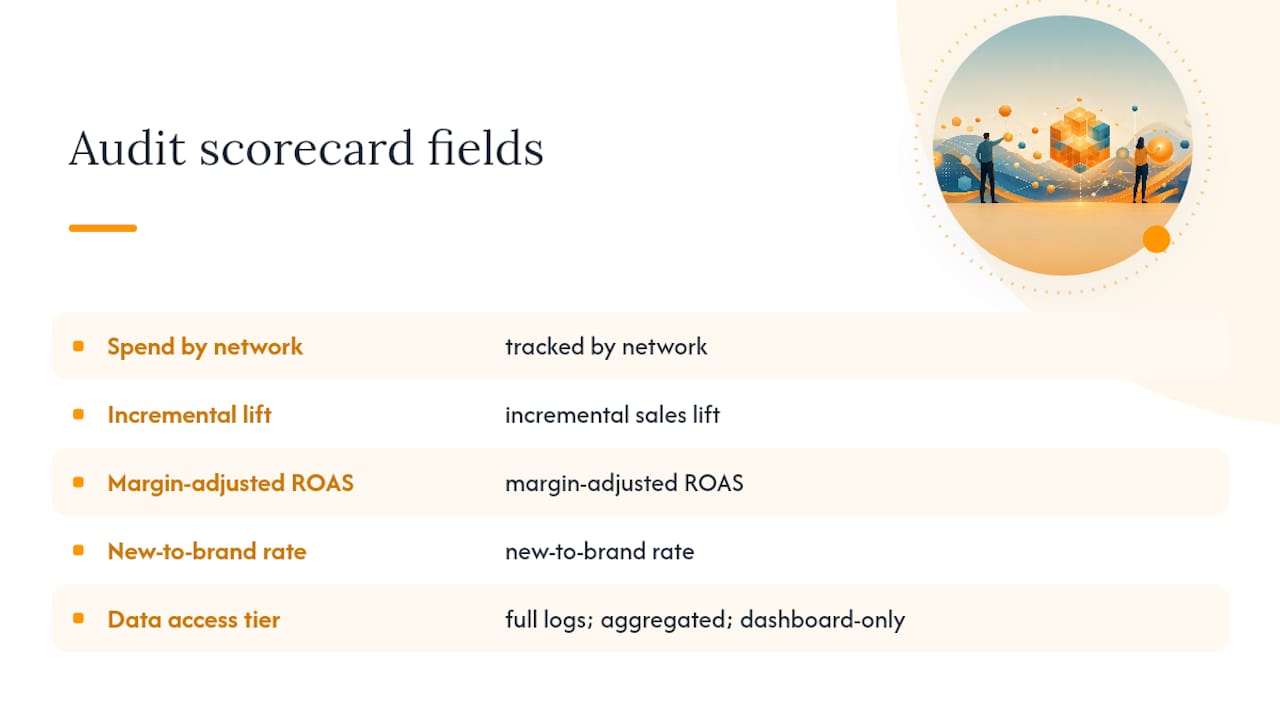
A usable scorecard tracks: spend by network, incremental sales lift, margin-adjusted ROAS, new-to-brand rate, and data access tier (full logs, aggregated, or dashboard-only).
The Measurement Gap Nobody Wants to Talk About
Most retail media programs are optimizing against numbers that were never designed to be compared against each other. That’s not a minor technical footnote, it’s the central reason so many brands can point to “strong ROAS” across five networks while total incremental revenue barely budges year over year.
The fix isn’t complicated, but it’s uncomfortable. It means telling a network you like that its dashboard number doesn’t count until a geo holdout or clean-room match backs it up. It means killing budget on a channel with beautiful attribution numbers if marketing mix modeling shows no real lift. Most teams resist this because platform numbers are easy and incrementality tests take real time and organizational will.
My priority for any brand building or rebuilding a retail media program: put incrementality testing at the center of the budget conversation before the media plan, not after. Start with a spend audit this quarter. Run one geo holdout on your largest network before the next budget cycle. Give one person ownership of the consolidated retail media P&L. Everything else, formats, creative, bidding, works better once those three things are in place.
— Derek
Build and Measure Your Retail Media Program the Right Way
Most brands don’t need another network relationship. They need someone who can audit what’s already running, fix the measurement gaps, and set up a testing cadence that actually holds vendors accountable. That’s a common gap in retail and CPG brands: lacking an in-house team that treats retail media as one connected system instead of five disconnected dashboards.

An engagement typically starts with a marketing assessment covering spend reconciliation, SKU-level margin economics, and a full data-access checklist across your current networks. From there, campaign management handles the day-to-day optimization, bidding, negative keywords, creative refresh, while incrementality testing validates what’s actually driving sales. If your retail media budget has grown faster than your ability to prove it’s working, start a strategy conversation with Theartistevolution and get a clear read on where your program stands today.
Sources
The measurement guidance in this article draws on Digiday’s 2026 retail media marketer survey, eMarketer’s retail media budget allocation FAQ, Ipsos MMA’s measurement methodology, the ARF’s study of RMN dashboard transparency, and NielsenIQ’s incrementality research. For a broader look at performance measurement frameworks, see Baby Love Growth’s analysis of measuring SEO performance.
- FAQ on retail media networks: How marketers should allocate budgets, 2026
- What Is Retail Media Network Measurement? | Ipsos MMA
- What marketers need to know about retail media measurement
- Retail media incrementality measurement | NielsenIQ
FAQ
What Are the 5 P’s in Retail?
The 5 P’s, product, price, place, promotion, and people, are the classic retail marketing framework. In a retail media context, promotion and place map most directly onto ad placement and format choice, while product and price feed the SKU-level economics that determine which items deserve ad budget.
What Is the 3-3-3 Rule for Marketing?
Definitions vary by source, but a common version suggests testing three channels, over three months, with three creative variations before scaling budget. Applied to retail media, that maps well to the 90-day test-and-learn window recommended before committing a new network to always-on spend.
What Is an Example of a Retail Media Strategy?
A brand running sponsored search on hero SKUs, on-site display for mid-tier growth products, and an off-site CTV campaign for a new launch, all measured against a standardized 7-day click attribution window and validated with a quarterly geo holdout test, is a working example of a full-funnel retail media strategy.
What Are Examples of Retail Media?
Sponsored product listings on a retailer’s search results page, display banners on a retailer’s app or website, connected TV ads run through a retailer’s off-site DSP, and digital screens or audio ads inside physical stores are all forms of retail media.
How Much Does Retail Media Management Cost?
Costs vary by scope, network mix, and campaign complexity. Theartistevolution’s campaign management and marketing assessment pricing is available on request through a direct consultation.