
Ad creative testing is a structured experiment that isolates one creative variable and measures it against a pre-declared decision metric. Before you write a single headline or storyboard a single hook, decide the one variable you’re changing and the one metric you’ll use to call a winner. Everything else in this guide, from questionnaire design to platform budgets, exists to protect that decision from noise.
TL;DR:
- Monadic testing is preferred for accurate results, but sequential monadic can halve sample needs at the cost of order bias, while comparative cells are mainly for final selection.
- Using about 200 completes per cell and a 10% soft launch helps ensure reliable data, with thresholds set in advance to decide when to kill or scale variants.
- Platform ad-set budget optimization should be avoided during testing in favor of equal budgets per variant to prevent early signal bias, with at least $50 to $100 daily per ad set.
- Quantitative metrics need to be supported by qualitative feedback; diverse open-end responses can reveal confusion or misinterpretation that numbers alone miss.
- Short-term creative wins do not necessarily indicate long-term brand impact; separate brand lift studies are essential to measure future perception changes.
Table of Contents
- What Is Ad Creative Testing, and When Do You Need It?
- Monadic, Sequential Monadic, or Comparative Cells: Which Design Fits?
- How Do You Design a Defensible Creative Test?
- How Do You Set Up a Creative Test on Meta or Google?
- How Do You Read Results and Decide What to Kill or Scale?
- What Pitfalls Sink Most Creative Tests?
- Designing Creatives Built to Survive the Testing Process
- How Do You Handle Bias in Creative Testing?
- Do Creative Test Wins Predict Long-Term Brand Impact?
- Why Qualitative Feedback Still Matters in a Quantitative Test
- How Does an Agency Turn a Creative Test Into a Repeatable Playbook?
- Let Theartistevolution Run Your Creative Testing Program
- Sources
What Is Ad Creative Testing, and When Do You Need It?
Creative testing measures how people perceive and respond to a specific creative element, such as a hook, a visual style, or a value proposition, before or during a live campaign. It’s distinct from A/B testing, which usually compares whole campaigns or landing experiences for behavioral outcomes like clicks and purchases. Creative testing tells you why an ad might work; in-market A/B testing confirms whether it actually did, using survey-based methods that measure perception and intent alongside behavioral A/B data.
Brand lift studies sit one level up, measuring awareness and favorability shifts across an entire campaign rather than a single asset.
Match your method to your question:
- New concept, unproven audience reaction: survey-based creative testing before spending media dollars.
- Two finished ads, need a performance verdict: in-platform A/B testing.
- Campaign-wide awareness or perception shift: brand lift measurement.
Monadic, Sequential Monadic, or Comparative Cells: Which Design Fits?
Your exposure design decides how much sample you need and how clean your data will be. Three approaches dominate practitioner use:
- Monadic exposure. Each respondent sees exactly one concept. Scores stay independent, with no contamination from comparing concepts against each other, which makes monadic testing the recommended default whenever your sample budget allows it.
- Sequential monadic. Respondents see multiple concepts in sequence, rating each one. It stretches your sample further, but order effects creep in, the second concept a person sees is judged against the first, so cap sequential monadic at three concepts per respondent.
- Comparative cells. Respondents see two or more concepts side by side and pick a winner. Treat this as a tiebreaker between finalists, not a primary research method. It answers “which do you prefer” without telling you why either one works.
Pro Tip: If you’re deciding between monadic and sequential monadic purely on cost, run the math first: sequential monadic can cut your total sample need by roughly half, but only if you’re willing to accept some order bias in the second and third exposures.
How Do You Design a Defensible Creative Test?
A reliable creative test follows a fixed sequence, not an improvised list of questions. The canonical block order runs ten stops: screener, pre-exposure baseline, exposure, unaided recall, aided takeaway, diagnostics, post-exposure purchase intent, open end, and demographics, bookended by a soft launch check. Show the creative full screen, and use a forced timer when you need to control minimum exposure length.
Scale construction matters more than most teams assume:
- Label every scale point; an unlabeled 1 to 5 slider invites inconsistent interpretation across respondents.
- Keep the same scale format across every wave of testing so scores stay comparable over time.
- Report Top 2 Box (the share choosing the top two favorable responses) as your headline metric, a standard practice in creative testing reporting, but always show the mean and full distribution alongside it. Top 2 Box alone can hide a bimodal result where half your audience loves a concept and half hates it.
Sample sizing: Plan in cells, not total respondents. A working target is roughly 200 completes per cell to read differences between concepts with any confidence. To calculate how many starts you need, divide your target completes by your screener’s incidence rate. If only 40% of traffic qualifies past the screener, you need 500 starts to land 200 completes.
Before fielding your full sample, soft launch roughly 10% of the total and check for speeders, failed trap items, unrealistic exposure times, and question-order contamination. Document your removal rules in advance so nobody can retroactively justify cutting an inconvenient respondent. A partner resource on building effective surveys for actionable insights covers additional quality-control tactics worth layering on top.
How Do You Set Up a Creative Test on Meta or Google?
Survey results tell you what people say they’ll respond to. Platform tests tell you what they actually do with real money on the line. The setup choices you make determine whether that data is trustworthy.
For Meta specifically, ABO (ad-set budget optimization) usually beats CBO for testing because it forces equal budget across every variant. CBO shifts spend toward whichever ad shows early signal, which can starve a genuinely strong concept before it has enough impressions to prove itself. Save CBO for the scaling phase, after you already know which creative wins.
Budgeting and structure:
- Give each variant enough daily budget to clear the platform’s learning phase, generally $50 to $100 per day per ad set for many mid-market hook tests.
- Test three to six variants at once; three is the floor to avoid a coin flip, six is the practical ceiling before spend gets split too thin.
- Run tests for at least 4 to 7 days to clear weekday-weekend swings and the algorithm’s own learning curve.
- Once a survey-based winner emerges, validate it with a live incrementality test before committing full budget. For search-specific creative, the setup logic shifts; a Google Ads management approach handles headline and description testing differently than social placements do.
How Do You Read Results and Decide What to Kill or Scale?
Read every metric in funnel order, not whichever number looks best first. Hook rate (attention in the first three seconds) comes first, followed by hold rate, then click-through rate, then cost per acquisition or return on ad spend. A weak CPA with a strong hook rate points to a landing page or offer problem, not a creative problem. Changing the hook or format tends to move upper-funnel numbers more than tweaking the call-to-action ever will.
Before calling any winner, check your sample size. Wait for at least 50 conversions per variant before trusting a conversion-based metric; anything below that threshold is too noisy to act on with confidence.
- Kill a variant when its CTR sits 50% or more below the leading variant, or its CPA runs double the leader’s, or it has spent a full daily budget with zero conversions.
- Scale the winner by shifting it into a CBO campaign structure once you’ve confirmed the result, letting the algorithm allocate spend freely now that you know which creative earns it.
- Monitor for drift. A winning ad’s performance decays over 2 to 4 weeks as audiences see it repeatedly; refresh creative before CPA creeps back up past your kill threshold.
Pro Tip: Write your kill and scale thresholds down before you launch the test, not after you see the first day of data. It’s remarkably easy to rationalize keeping a favorite creative alive when the rule isn’t already on paper.
What Pitfalls Sink Most Creative Tests?
Most failed tests share the same handful of mistakes, and nearly all of them are avoidable with a little discipline up front.
- Changing more than one variable at a time. If you swap the headline and the image together, you’ll never know which one moved the needle.
- Skipping the pre-declared hypothesis. Write it before you build creative: “If we change X, then Y will improve, because Z.” Pre-declare your decision metric and kill/scale rule at the same time.
- Running too many variants for your budget. Cap variant count at 4 to 6 for mid-size budgets; more than that just splits spend too thin to read anything.
- Overloading the questionnaire. Every extra question increases dropoff. Prioritize diagnostics that explain why over adding another concept “while we’re at it.”
- Skipping the soft launch. Field cleaning rules exist for a reason; write them down and apply them consistently, not just when a result looks inconvenient.
A marketing assessment can help you scope sample sizes and question banks before you commit budget to a full field.
Designing Creatives Built to Survive the Testing Process
A creative that tests well and a creative that merely looks good in a deck are not the same thing. Build for testability from the first sketch, not as an afterthought once the concept is locked.
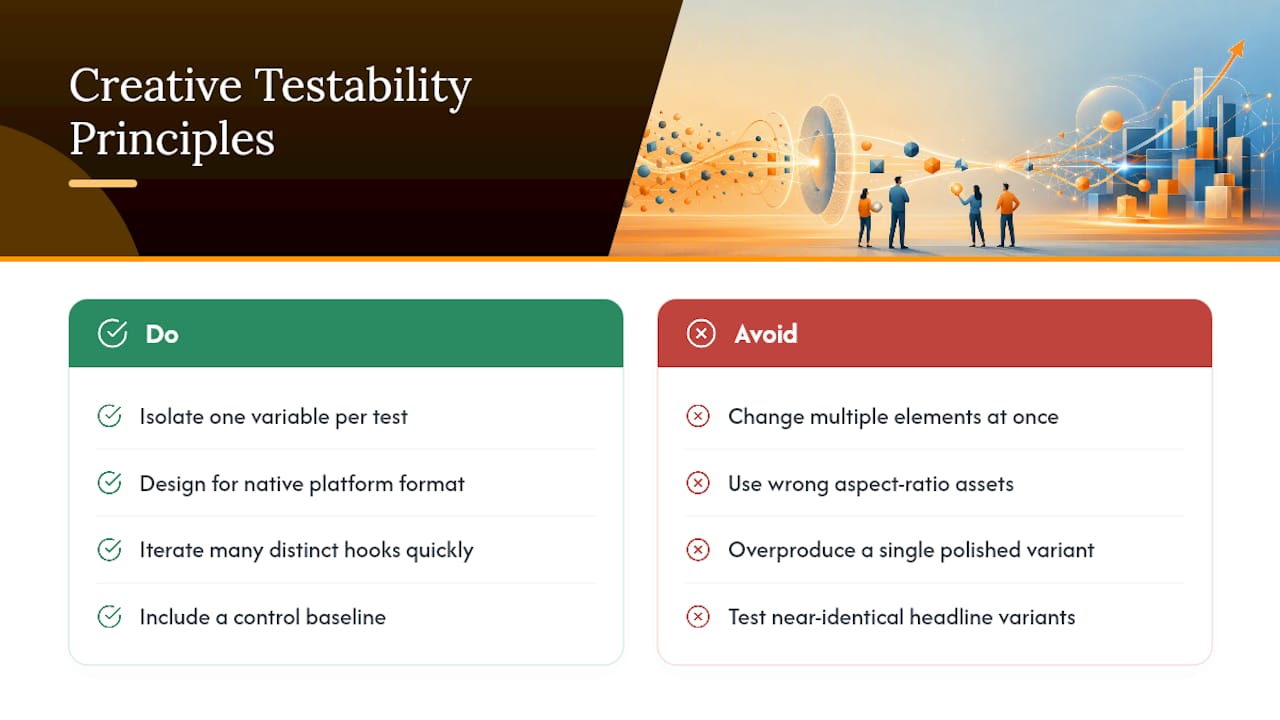
Isolate the variable you actually care about. If your hypothesis is about hook strength, hold the offer, the color palette, and the CTA constant across every variant. Muddy variants that change three things at once produce results nobody can act on, no matter how clean your sample math is.
Design for the platform’s native format before you design for the brief. A static image built for a 4:5 Instagram feed placement and dropped into a 9:16 Reels slot will crop awkwardly and skew your hook rate for reasons that have nothing to do with the creative idea itself.
Keep production light enough to iterate fast. Testing rewards volume and speed over polish; a rough version of five different hooks tells you more than one beautifully finished ad. Save the production budget for the concept that already proved itself in testing.
Build in a control. Always include your current best-performing ad, or a plain “control” variant with no creative flourish, as a baseline. Without one, you’re comparing new ideas against each other with no anchor to tell you whether any of them actually beat what’s already running.
Finally, write distinct hooks, not variations on the same sentence. Testing five headlines that all open the same way tells you almost nothing about what actually drives attention. Hook tests deliver the strongest signal for static social ads precisely because the first few words or frames decide whether someone stops scrolling, so make your variants genuinely different at that moment.
How Do You Handle Bias in Creative Testing?
Bias creeps into creative testing in ways that are easy to miss and expensive to ignore. The most common is order bias in sequential monadic designs, where the second or third concept a respondent sees gets judged relative to the first rather than on its own merits. Capping sequential exposure at three concepts limits the damage, but monadic exposure remains the cleaner choice whenever sample budget allows it.
Screener bias shows up when your qualifying questions skew the sample toward people who are unusually engaged with a category, producing intent scores that look better than what a general audience would give. Keep screener criteria as close as possible to your actual target customer profile, not an idealized enthusiast version of them.
Novelty bias inflates scores for anything unfamiliar simply because it’s new and attention-grabbing in a survey context, a bump that often fades once the same creative runs in-market for a few weeks. This is exactly why survey intent scores and live platform performance sometimes disagree, and why validating survey winners with an actual incrementality test matters before committing full budget.
Platform algorithms introduce their own bias. CBO budget allocation favors whichever variant shows early signal, which can look like a creative bias problem when it’s actually a budget-allocation artifact. Running tests in ABO structure removes that confound before you ever look at a number.
Finally, watch for confirmation bias on your own team. A pre-declared hypothesis and decision rule, written down before the data comes in, is the single best defense against reading results the way you hoped they’d turn out.
Do Creative Test Wins Predict Long-Term Brand Impact?
A creative that wins a short-term test and a creative that builds long-term brand equity are answering two different questions, and conflating them causes real strategic mistakes. Hook rate, CTR, and CPA measure whether an ad grabs attention and drives an immediate action. None of those metrics tell you whether the ad is building the kind of recognition and preference that compounds over months or years.
This gap matters most for direct-response-style creative that wins every short-term test by leaning on urgency, discount framing, or attention-grabbing shock value. Those tactics reliably win hook rate and CTR comparisons, but they can flatten brand perception or even damage it if overused, since audiences start associating the brand with pressure tactics rather than a distinct point of view.
The safest read of any creative test result treats it as a tactical answer to a tactical question: which version of this specific ad, for this specific goal, performs better right now. For a read on whether a campaign is shifting how people feel about the brand overall, run a dedicated brand lift study alongside your performance testing rather than assuming a strong CTR is a proxy for brand health.
Practically, that means treating creative testing wins as inputs to a portfolio, not a single verdict. A winning performance ad still deserves scrutiny for tone, message consistency, and whether it aligns with brand positioning before it gets scaled into a campaign’s dominant creative.
Why Qualitative Feedback Still Matters in a Quantitative Test
Numbers tell you what happened. They rarely tell you why, and that gap is where creative testing goes wrong most often. A concept that scores well on Top 2 Box but draws confused open-end responses is a warning sign that the score is measuring something other than genuine enthusiasm, maybe curiosity, maybe unfamiliarity, but not the intent you’re hoping to bank on.
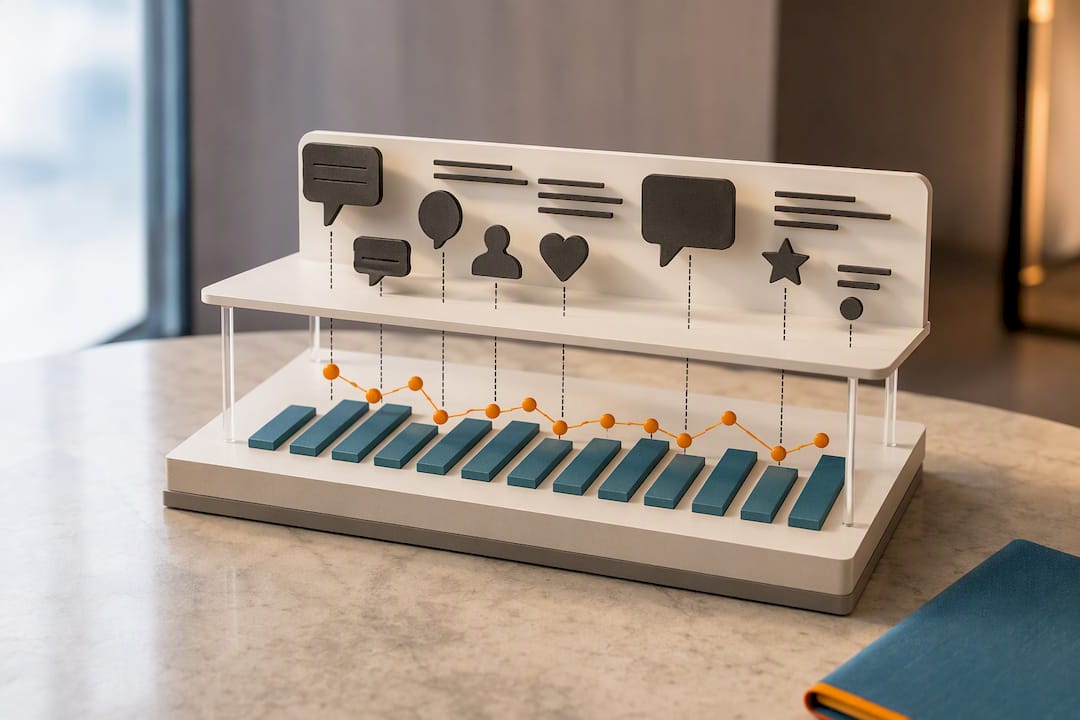
The open-end block at the end of your questionnaire exists for exactly this reason. Read every response, not just the ones that confirm what the quantitative data already suggested. Look specifically for language respondents use unprompted; if three separate people describe the same visual as “confusing” without being asked a diagnostic question about clarity, that’s a stronger signal than a single diagnostic rating buried in the middle of the survey.
Diagnostics questions, the block that asks respondents to rate specific attributes like clarity, relevance, or distinctiveness, bridge the gap between raw scores and actionable direction. A concept with strong purchase intent but weak “this feels relevant to me” scores tells a very different story than one strong across every diagnostic dimension, even if their Top 2 Box numbers land in the same range.
Treat qualitative signal as a diagnostic layer over quantitative results, never a replacement for them. A handful of vivid open-end quotes shouldn’t override a clean 200-completes-per-cell result. But when the two disagree, when the numbers say “winner” and the comments say “confusing,” that disagreement is worth investigating before you commit media budget to scale.
How Does an Agency Turn a Creative Test Into a Repeatable Playbook?
An agency runs creative testing as a four-step loop: form a hypothesis tied to a specific business goal, field the test using the survey-to-platform bridge outlined above, read results in strict funnel order, then convert the winning pattern into a reusable creative brief. Experienced agencies with many years managing campaigns across retail, healthcare, legal, and entertainment clients often build playbooks that turn a single test’s findings into templates for subsequent creative briefs, so wins compound instead of getting reinvented from scratch every quarter.
— Derek
Let Theartistevolution Run Your Creative Testing Program
The alternative to guessing which ad concept will work is to work with a team experienced in running the full creative testing loop across multiple industries, rather than building your own survey instrument, screener quotas, and platform test structure from scratch.
If you’re comfortable managing sample math and platform budgets yourself, the framework above gives you everything you need to run a defensible test in house. But if you’d rather hand off the sample sizing, questionnaire design, and platform execution to a team that already has the playbooks, campaign strategy and ongoing management covers the full loop from hypothesis through scaled rollout. Start with a marketing assessment to scope your testing calendar and get a clear read on the sample sizes and quotas your next test actually needs.
Sources
- Creative Testing Survey: Questionnaire Design Guide
- What is creative testing? A 2026 framework for Meta static ads | Adrio Blog