
AI SEO strategies are the specialized methods digital marketers use to make content discoverable, extractable, and citable by AI-powered search engines, going well beyond traditional ranking signals. The industry term for this discipline is Generative Engine Optimization (GEO), and it sits alongside classic SEO as a parallel, equally critical practice. AI Overviews are triggered by 48% of search queries in 2026, which means nearly half of all searches now route through an AI layer before a user ever clicks a link. Theartistevolution has worked with brands across retail, healthcare, legal, and entertainment to navigate exactly this shift, building content systems that perform in both traditional and AI-driven search environments.
What is Generative Engine Optimization (GEO) and why does it matter?
Generative Engine Optimization is the practice of structuring content so AI systems can extract, synthesize, and cite it in generated answers. Where traditional SEO targets ranking positions on a results page, GEO targets citation inclusion inside an AI-generated response. The two disciplines complement each other, but they require different tactics.
The core of GEO readiness rests on what practitioners call the “Citation Trinity”: clarity, attribution, and corroboration. Clarity means your answer is direct and positioned at the top of a section. Attribution means you cite named sources and statistics inside your content. Corroboration means your claims are confirmed by multiple independent, authoritative sources across the web.
GEO techniques yield a 30%–40% uplift in AI citation visibility when structural improvements focus on content extractability and source authority. That is not a marginal gain. It represents the difference between being cited in an AI answer and being invisible to it.
Key attributes that improve GEO readiness include:
- Answer-first structure: Place the direct answer within the first 40–60 words of every section.
- Named entity density: Include specific statistics, standards, and organizations rather than vague claims.
- Semantic HTML: Use proper heading tags, lists, and paragraph structure so AI parsers read content correctly.
- Source attribution: Cite external data points inside your content to signal corroboration.
- Freshness signals: Update content regularly so AI systems treat it as current and reliable.
Pro Tip: Rewrite the first 40 words of each H2 section to deliver a direct, complete answer. Practitioners report citation share gains of over 40% within 30 days of making this single structural change.
How do AI SEO strategies enhance visibility in AI-powered search engines?
AI search visibility is defined by five signals: citation frequency, presence rate, mention order, explanation depth, and authority signaling. These replace the classic metrics of ranking position and click-through rate as the primary indicators of search performance.

Citation frequency measures how often your brand or content appears in AI-generated answers across multiple queries. Presence rate tracks the percentage of relevant queries where your content is included in the AI’s source pool. Mention order matters because AI systems tend to reference the most authoritative source first, which carries more weight with readers. Brand mention rates above 70% indicate strong AI presence, and that threshold is the benchmark serious marketers should target.
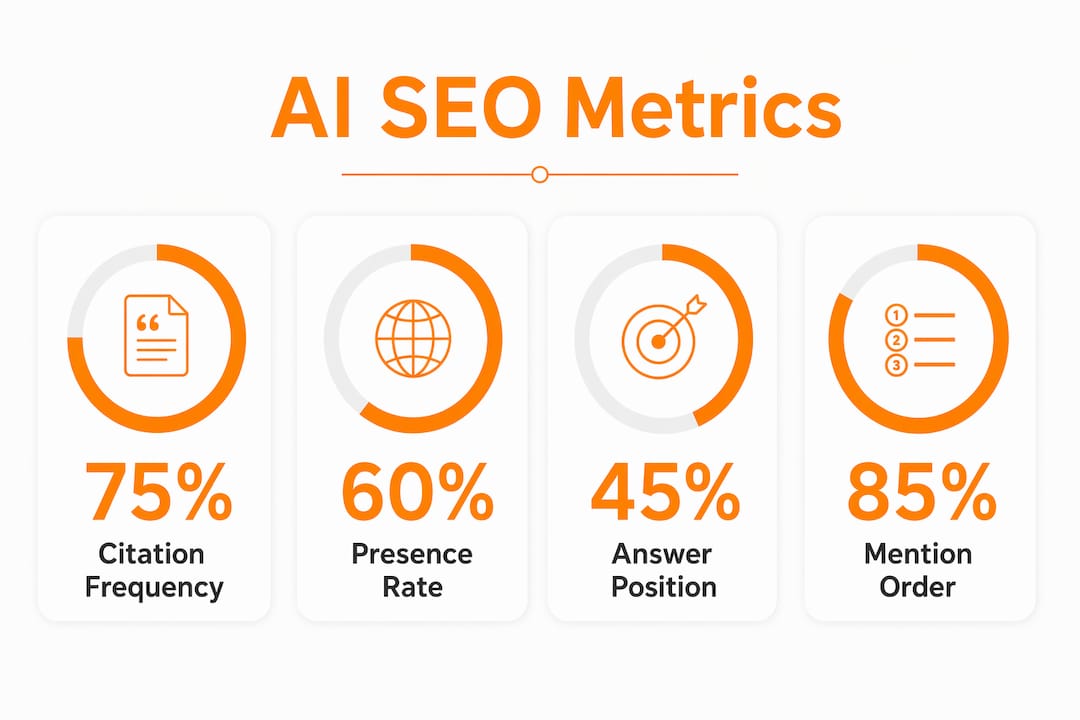
Structured data accelerates AI extractability in measurable ways. Pages with FAQPage schema see 4.3 times more featured snippet inclusions, and featured snippets feed directly into AI answer generation. HowTo schema produces similar results for process-based content. Both formats give AI models pre-parsed, labeled content they can pull without guessing at structure.
Multimodal content also plays a direct role. Images and video improve organic traffic by 116% on AI Overview pages. AI systems increasingly factor in content format diversity as a quality signal, rewarding pages that combine text, visuals, and structured data.
The distinction between traditional ranking and AI citation performance is real and growing. A page can rank on page one of Google and still receive zero AI citations if its content is buried in dense paragraphs, lacks structured data, or blocks AI crawlers. Optimizing only for traditional blue links risks losing half your search visibility to AI Overviews, voice results, and agentic search surfaces. Both disciplines must run in parallel.
What practical tactics can businesses implement for AI SEO?
The most effective starting point is rewriting key sections to lead with direct answers. AI models process content in 200–500 token chunks, so answers buried three paragraphs into a section rarely get cited. The fix is mechanical: move the answer to the first sentence, keep it under 60 words, then expand with evidence below.
Here is a practical implementation checklist:
- Write answer-first passages: Open every major section with a 40–60 word direct answer to the implied question.
- Add named statistics: Integrate source-attributed data points inside your content, not just in footnotes.
- Deploy FAQPage JSON-LD schema: Mark up every FAQ section with structured data so AI parsers can extract Q&A pairs cleanly.
- Configure robots.txt for AI bots: Explicitly allow GPTBot and ClaudeBot in your robots.txt file. Blocking them by default makes your content invisible to AI indexing.
- Create an llms.txt file: This emerging standard signals to large language models which pages carry authoritative content.
- Build external corroboration: Earn mentions on Wikipedia, LinkedIn, industry forums, and authoritative publications to satisfy the Citation Trinity’s corroboration requirement.
- Update content on a regular cadence: AI systems weight recency. Stale content loses citation share over time.
The following table summarizes the core tactics and their primary impact:
| Tactic | Primary Impact |
|---|---|
| Answer-first section rewrites | Increases AI extractability and citation frequency |
| FAQPage JSON-LD schema | Boosts featured snippet and AI Q&A inclusion |
| GPTBot / ClaudeBot access in robots.txt | Enables AI crawler indexing of your content |
| Named statistics with attribution | Satisfies corroboration signals for AI trust |
| Multimodal content (images, video) | Expands eligibility for AI Overview inclusion |
| External entity mentions | Builds citation consensus across authoritative domains |
Pro Tip: Check your robots.txt file today for any wildcard “Disallow: /” rules that may be blocking AI crawlers. Many SEO teams overlook AI-specific crawling requirements, and a single misconfigured line can erase all your GEO work.
For a broader foundation, the SEO best practices checklist for agencies from BabyLove Growth covers both traditional and AI-aligned tactics in a structured format worth bookmarking.
How to measure and monitor AI SEO success effectively
Traditional rank trackers do not capture AI search performance. A page can drop from position three to position eight on Google and simultaneously gain significant AI citation share. Measuring only one dimension gives you an incomplete picture of your actual visibility.
The five metrics that define AI SEO performance are:
- Presence rate: The percentage of relevant queries where your content appears in the AI’s source pool.
- Citation share: How often your brand is cited relative to competitors across a defined query set.
- Answer position: Whether your content is cited first, second, or later in an AI-generated response.
- Sentiment: Whether AI systems describe your brand positively, neutrally, or negatively in generated answers.
- Cited domains: Which external sites are corroborating your claims and contributing to your citation authority.
AI visibility metrics differ across engines. ChatGPT, Perplexity, and Google AI Overviews each apply different citation logic. Blending scores across platforms masks where you are winning and where you are losing. Track each engine separately and compare trends over time.
Specialized platforms now combine AI visibility tracking with diagnostic audits and structural fixes, including JSON-LD schema generation and robots.txt configuration for AI bots, into a single workflow. These tools close the measurement-to-fix gap that manual audits leave open. Given that AI responses are non-deterministic, meaning the same query can return different citations on different runs, a weekly measurement cadence across at least 20–30 representative queries gives you statistically reliable trend data.
The commercial case for this investment is strong. AI citation share converts at 4.4 times the rate of traditional organic search visits. That conversion premium makes AI SEO one of the highest-return activities in a digital marketer’s current toolkit. You can also explore AI SEO advantages for professionals to understand how agencies are structuring these measurement programs for clients at scale.
Key Takeaways
AI SEO strategies require a parallel GEO discipline focused on content extractability, structured data, AI crawler access, and multi-engine citation tracking to achieve measurable visibility gains.
| Point | Details |
|---|---|
| GEO drives citation uplift | Structural improvements to content extractability yield a 30%–40% increase in AI citation visibility. |
| Answer-first writing is mandatory | Direct answers in the first 40–60 words of a section are far more likely to be cited by AI models. |
| Technical access enables indexing | Explicitly allowing GPTBot and ClaudeBot in robots.txt is required for AI crawler visibility. |
| FAQPage schema multiplies inclusion | Pages with FAQPage schema receive 4.3 times more featured snippet inclusions, feeding AI answer extraction. |
| Multi-engine tracking is non-negotiable | ChatGPT, Perplexity, and Google AI Overviews cite differently, so separate tracking per engine is required. |
Why most marketers are still optimizing for a search engine that no longer exists
I have watched digital marketing teams spend months perfecting title tags and meta descriptions while their AI citation share sits at zero. The uncomfortable truth is that the search engine most marketers are optimizing for, the one that returns ten blue links, now handles less than half of all search interactions. The other half routes through AI layers that do not care about your title tag at all.
The biggest pitfall I see is not a lack of effort. It is misallocated effort. Teams do excellent traditional SEO work, then unknowingly block GPTBot in their robots.txt and wonder why they never appear in AI Overviews. The technical fix takes ten minutes. The awareness gap is what costs brands months of lost visibility.
The second pitfall is incomplete answer-first rewrites. Marketers add a one-sentence summary at the top of a section and call it done. Real GEO requires that the first 40–60 words fully answer the question, with no setup, no context-setting, and no throat-clearing. That discipline is harder than it sounds, and most content fails the test on the first pass.
My prediction is that AI agents will become the dominant discovery surface for commerce within three years. When a user asks an AI agent to recommend a marketing agency, find a healthcare provider, or compare legal services, the agent cites sources it trusts. Building that trust now, through corroboration, structured data, and consistent citation presence across ChatGPT, Perplexity, and Google AI Overviews, is the single most future-proof investment a brand can make in its AI-driven marketing strategy today.
— Derek
How Theartistevolution builds AI search visibility for your brand
Theartistevolution has spent over 18 years building marketing systems that produce measurable results, and AI SEO is now central to every campaign we build. We integrate GEO principles, structured data implementation, and multi-engine citation tracking into our full-service programs for clients in retail, healthcare, legal, and entertainment.

Whether you need a complete brand story development that positions your content for AI citation, or a full SEO agency partnership that covers both traditional and AI-driven search, Theartistevolution builds the infrastructure your brand needs to be cited, not just ranked. Contact us to discuss a tailored program for your business.
FAQ
What are AI SEO strategies?
AI SEO strategies are methods used to make content discoverable and citable by AI-powered search engines, including Google AI Overviews, ChatGPT, and Perplexity. They combine traditional SEO foundations with Generative Engine Optimization techniques focused on content extractability and structured data.
What is Generative Engine Optimization (GEO)?
GEO is the discipline of structuring content so AI systems can extract and cite it in generated answers. It focuses on answer-first writing, named entity density, FAQPage schema, and external corroboration rather than classic ranking signals.
How do I optimize content for AI Overviews?
Place a direct, complete answer within the first 40–60 words of each section, implement FAQPage JSON-LD schema, and allow AI crawlers like GPTBot in your robots.txt file. Pages using FAQPage schema see 4.3 times more featured snippet inclusions, which directly feeds AI Overview extraction.
How do I measure AI search visibility?
Track five metrics separately per engine: presence rate, citation share, answer position, sentiment, and cited domains. ChatGPT, Perplexity, and Google AI Overviews apply different citation logic, so blended scores mislead optimization decisions.
Why does AI citation matter commercially?
AI citation share converts at 4.4 times the rate of traditional organic search visits. That conversion premium makes improving AI citation one of the highest-return activities in a digital marketer’s current program.
Recommended
- Navigating SEO in 2023: Google’s Latest Algorithms and Best Practices – The Artist Evolution
- Unveiling Local SEO Secrets: A Blueprint for Boosting Visibility for Brick-and-Mortar Businesses – The Artist Evolution
- SEO Improvement After National Relaunch – The Artist Evolution
- Search Engine Optimization Agency – The Artist Evolution