
A multi-channel brand strategy is the practice of building a unified brand presence across several platforms simultaneously, including owned storefronts, marketplaces, social media, email, and PR. When you launch brand across multiple channels with a deliberate sequence and consistent messaging, you generate compounding visibility that no single platform can deliver alone. The channels that matter most in 2026 include Shopify, Amazon, TikTok Shop, Walmart, eBay, Instagram, LinkedIn, and email. Each demands a tailored approach, but all must speak with one recognizable voice. This playbook covers the operational foundation, launch sequencing, content strategy, and post-launch optimization you need to execute a brand launch that actually converts.
What foundational steps are essential before launching across multiple channels?
The foundation of any effective brand launch is a master product catalog built before a single channel goes live. Every product needs a standardized title, description, image set, and pricing structure that can be adapted to each platform’s specific format requirements. Without this, you will spend weeks correcting inconsistencies after launch instead of driving sales.
Build a consistent SKU system
An effective SKU system uses a structured code that captures brand, category, product, and variant in a single string. For example, a code like “TAE-APR-HOODIE-BLK-L” maps cleanly to platform-specific identifiers such as Amazon’s ASIN or Walmart’s Item ID. This structure prevents the SKU mismatches that cause inventory errors and order failures across channels.

Set up your technology stack
Your technology stack is the operational backbone of your multi-channel launch. The core components are:
- Storefront: Shopify as your owned channel and primary data source
- Order Management System (OMS): A tool like Linnworks, Skubana, or Extensiv for real-time inventory sync across all platforms
- Payment processing: Stripe or Shopify Payments for owned channels; marketplace-native processors for Amazon and Walmart
- Analytics: Google Analytics 4 plus platform-native dashboards to track channel-specific performance
Pro Tip: Set up your OMS before activating any marketplace. A central nervous system for orders and inventory prevents overselling and protects your seller ratings from day one.
The table below shows the key operational elements and their function in a multi-channel setup:
| Operational element | Function |
|---|---|
| Master product catalog | Standardizes product data for platform-specific adaptation |
| SKU mapping system | Links internal codes to each platform’s unique identifiers |
| OMS with real-time sync | Prevents overselling and routes orders accurately |
| Multi-location inventory | Supports FBA, 3PL, and direct fulfillment simultaneously |
| Analytics dashboard | Tracks contribution margin and channel ROI from launch day |
The most common mistake brands make is skipping the OMS setup and managing inventory manually in spreadsheets. That approach collapses under the volume of even a modest launch. Get the technology right first, and every channel you add becomes easier to manage.
How to sequence your multi-channel brand launch for optimal impact
Launching all channels at once is the fastest path to operational chaos. Sequential channel rollout is the proven alternative. Each channel requires focused attention during setup, and some, like Walmart, require weeks of approval time before you can sell a single unit.
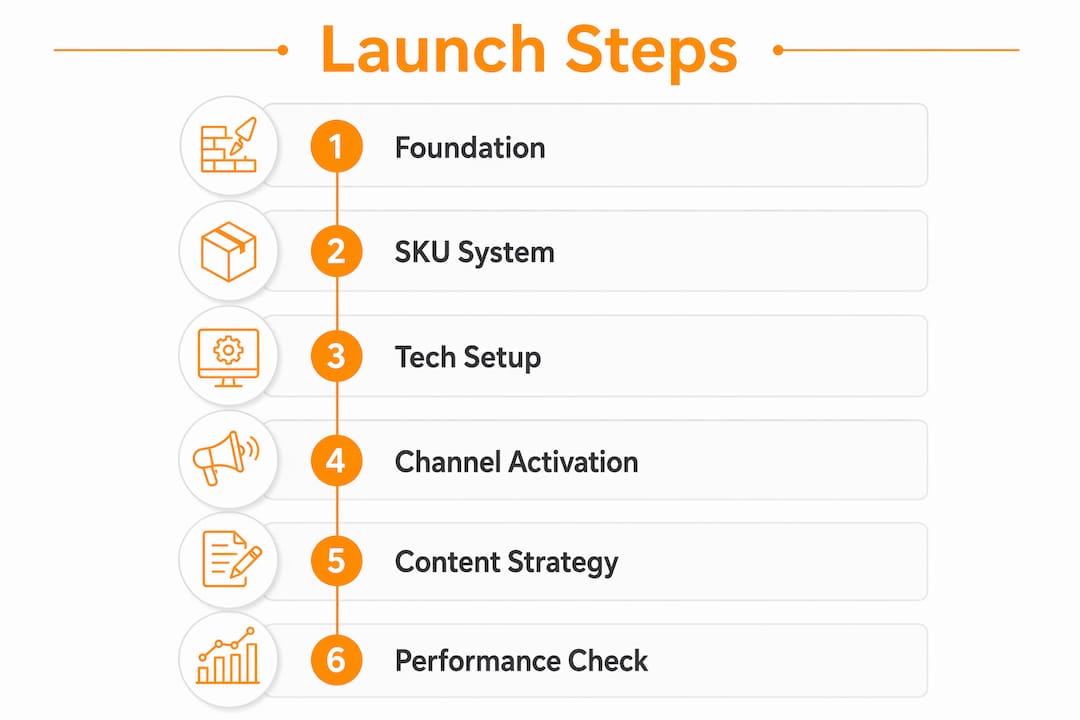
The recommended timeline for a five-channel launch runs 8 to 12 weeks, structured as follows:
- Weeks 1 to 2: Foundation. Complete your master catalog, SKU system, OMS configuration, and brand asset library. Register seller accounts on all target platforms so approval processes run in parallel.
- Weeks 3 to 4: Shopify launch. Your owned storefront goes live first. This gives you a controlled environment to test checkout flows, product pages, and email capture before marketplace traffic arrives.
- Weeks 5 to 6: Amazon activation. List your top SKUs, configure FBA shipments, and run initial Sponsored Products campaigns to generate early reviews and ranking signals.
- Weeks 7 to 8: TikTok Shop. Connect your product catalog, recruit two to three creators for affiliate content, and publish your first shoppable videos. TikTok rewards early content volume with organic reach.
- Weeks 9 to 10: Walmart and eBay. By this point your inventory data is clean, your listings are proven, and your OMS is handling real order volume. Adding these channels carries far less risk.
Pro Tip: Apply for Walmart Seller Center on day one of your foundation phase. Approval can take three to four weeks, and there is no way to accelerate it. Missing this step delays your entire sequence.
Starting with Shopify before marketplaces gives you a critical advantage: you own the customer data. Every email address captured on your storefront becomes a retargeting asset that improves your paid performance on Amazon and Meta. Marketplaces do not share customer contact information, so your owned channel is the only place you can build a first-party audience from the start.
A channel strategy framework with defined roles and budget allocations tied to commercial objectives prevents budget dilution across the sequence. Assign each channel a primary job: Shopify for retention and lifetime value, Amazon for new customer acquisition, TikTok Shop for awareness and impulse conversion, Walmart for high-intent shoppers, and eBay for clearance and secondary market reach.
What multi-channel marketing techniques ensure consistent brand messaging?
Cross-channel success depends on consistency, not uniformity. Your brand voice, values, and core promise stay fixed. The format, tone, and content type flex to match each platform’s native behavior. A LinkedIn article and a TikTok video can carry the same message with completely different execution.
The buyer journey framework maps channels to intent stages:
- Awareness: TikTok and Instagram Reels for short-form video; PR placements for earned reach
- Consideration: Blog posts, email newsletters, and YouTube for deeper product education
- Conversion: Paid search and shopping ads on Google, Amazon Sponsored Products, and retargeting on Meta
Pro Tip: Build your content calendar around one core asset per week, then repurpose it. A single product photo shoot produces your Shopify hero image, Amazon A+ content, Instagram carousel, TikTok background, and email header. One shoot, six assets, zero redundant effort.
Repurposing core content assets across channels improves efficiency and keeps your message coherent without requiring a separate creative team for every platform. The brands that struggle with consistency are the ones treating each channel as a standalone campaign rather than a branch of the same story.
The table below compares tone and format expectations across key channels:
| Channel | Tone | Best content format |
|---|---|---|
| TikTok Shop | Casual, energetic, authentic | Short-form video, creator collabs |
| Aspirational, visual | Reels, carousels, Stories | |
| Personal, direct | Segmented newsletters, product drops | |
| Amazon | Informational, benefit-driven | Bullet points, A+ content, video |
| Professional, thought leadership | Articles, case studies, data posts |
Automation tools like Later, Hootsuite, or Sprout Social handle scheduling across owned social channels so your team focuses on content quality rather than manual posting. Pair scheduling automation with a shared brand style guide that documents approved colors, fonts, tone guidelines, and messaging pillars. Every team member and external creator works from the same reference.
How to manage post-launch optimization and grow your brand momentum
The 90 days after launch determine whether your multi-channel presence scales or stalls. Successful brands execute a structured review cycle at 30, 60, and 90 days, evaluating SKU performance, audience quality, and creative effectiveness at each checkpoint.
- Day 30 review. Measure contribution margin by channel and SKU. Identify which products are generating profit versus which are driving traffic without conversion. Cut or reprice underperformers before they drain ad spend.
- Day 60 review. Evaluate audience data. Which channels are delivering repeat buyers versus one-time purchasers? Shift budget toward channels with higher lifetime value signals. Assess your content cadence: are you publishing one to two SEO pieces per month and three to five short-form videos per week as recommended?
- Day 90 review. Make your scaling decision. Double down on the two or three channels showing the strongest channel ROI. Pause or reduce investment in channels that have not hit contribution margin targets after two full review cycles.
Pro Tip: Track contribution margin, not just revenue. A channel generating $50,000 in revenue with $48,000 in costs is not a win. Contribution margin tells you which channels actually build the business.
Team coordination is the operational factor most brands underestimate. Marketing, operations, and customer support must share a single source of truth for inventory levels, promotional calendars, and customer feedback. A weekly cross-functional sync of 30 minutes prevents the miscommunications that cause stockouts during promotions or inconsistent customer service across channels.
A structured marketing plan with built-in performance check-ins after launch keeps your team aligned and your budget accountable to real results rather than vanity metrics.
Key takeaways
A successful multi-channel brand launch requires operational discipline, sequential channel activation, and a content strategy built on consistency without rigidity.
| Point | Details |
|---|---|
| Build the foundation first | Complete your SKU system, OMS, and master catalog before any channel goes live. |
| Sequence your channel launches | Follow an 8 to 12 week rollout starting with Shopify, then marketplaces, to reduce operational risk. |
| Consistency over uniformity | Keep your brand voice fixed while adapting format and tone to each platform’s native behavior. |
| Repurpose content assets | One photo shoot or video concept should produce assets for five or six channels simultaneously. |
| Review at 30, 60, and 90 days | Evaluate contribution margin and channel ROI at each checkpoint before scaling investment. |
What I have learned from running multi-channel brand launches
After working with brands across retail, healthcare, and entertainment, the single most consistent finding is this: the brands that struggle are not the ones with weak products. They are the ones that underestimate the operational complexity of going multi-channel and try to compensate with more marketing spend.
I have seen well-funded launches collapse because the OMS was not configured before Amazon went live. Inventory numbers drifted, orders were oversold, and seller ratings dropped in the first two weeks. Recovering from a damaged Amazon seller account takes months. The fix is not sophisticated. It is simply doing the operational work before the marketing work.
The other pattern I see consistently is brands treating every channel as if it needs a completely original content strategy. That burns teams out within 60 days. The brands with staying power build one strong content engine and distribute intelligently. A single brand story told well across five channels outperforms five separate stories told adequately.
My honest advice: resist the pressure to launch everywhere at once. The sequenced approach feels slower in week three. By week ten, you will have cleaner data, stronger listings, and a team that actually understands what is working. That is the position from which you scale.
— Derek
Ready to launch your brand with expert support?
Building a multi-channel presence is a significant operational and creative undertaking. Theartistevolution has spent 18 years helping brands from startups to household names execute launches that generate measurable results across every major platform.
Whether you need a complete brand development strategy that unifies your messaging architecture before launch, or ongoing campaign management to optimize channel performance after go-live, Theartistevolution brings the tools, experience, and cross-functional discipline to make your launch count. Connect with the team to build a launch plan built around your commercial objectives.
FAQ
What does it mean to launch a brand across multiple channels?
Launching a brand across multiple channels means activating your brand presence on several platforms simultaneously or in sequence, including owned storefronts like Shopify, marketplaces like Amazon and Walmart, social platforms like TikTok and Instagram, and email. The goal is to reach buyers wherever they shop and engage.
How long does a multi-channel brand launch take?
A five-channel ecommerce brand launch typically requires 8 to 12 weeks, starting with two weeks of foundational setup and sequentially activating Shopify, Amazon, TikTok Shop, Walmart, and eBay in focused two-week windows.
Why should I launch Shopify before Amazon or other marketplaces?
Shopify gives you full ownership of customer data, including email addresses, that marketplaces do not share. Launching your owned storefront first lets you build a first-party audience and test your product pages before marketplace traffic arrives.
How do I keep my brand consistent across so many platforms?
Brand consistency across channels comes from maintaining a fixed brand voice and core message while adapting format and tone to each platform’s native behavior. A shared brand style guide and a content repurposing system are the two most practical tools for maintaining coherence at scale.
What metrics should I track after a multi-channel launch?
Track contribution margin by channel and SKU at 30 and 60 days, then make your scaling decision at day 90. Supplement margin data with engagement rates, channel ROI, and repeat purchase rates to identify which channels are building long-term brand value versus short-term volume.